4G Mobile Proxies vs 5G Mobile Proxies: Does the Network Type Matter for Bots?
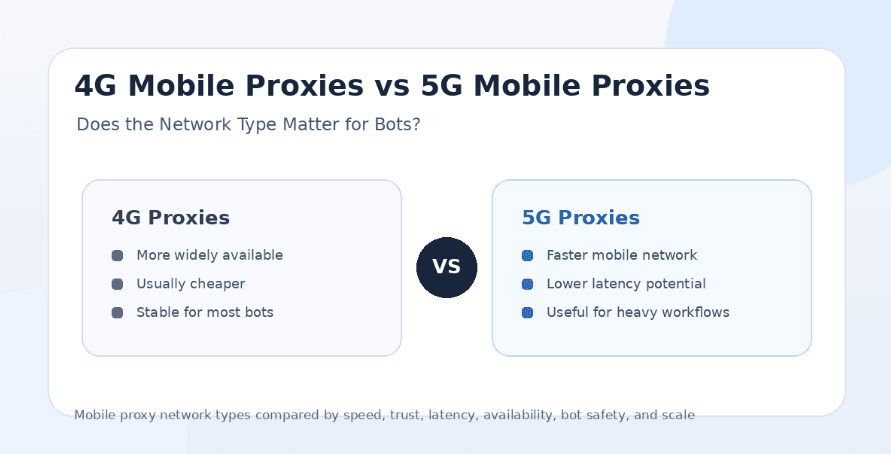
Mobile proxies are already one of the strongest proxy types for social media bots, phone farms, app testing, scraping, and multi-account automation. But once bot operators start comparing providers, another question comes up quickly: should they choose 4G mobile proxies or 5G mobile proxies?
At first, 5G sounds like the obvious winner. It is newer, faster, and usually marketed as the better network. But for bots, the answer is more nuanced. A 5G proxy can be faster and lower latency, but speed is not always the main thing that keeps accounts safe. For many social media workflows, IP trust, session stability, carrier quality, sticky sessions, device consistency, and realistic behavior matter more than whether the connection is 4G or 5G.
The short answer is that 5G can matter for speed-heavy workflows, but 4G is still more than enough for most bot operations. For Instagram, TikTok, LinkedIn, Reddit, Telegram, Snapchat, YouTube, and Threads automation, a clean 4G mobile proxy with stable sessions is usually better than a poorly managed 5G proxy that rotates too often or comes from an abused pool.
What Are 4G Mobile Proxies?
4G mobile proxies route traffic through mobile carrier networks using 4G or LTE connections. When a bot uses a 4G mobile proxy, the target platform sees traffic coming from a mobile network rather than a datacenter or home broadband connection.
This matters because many normal users access social apps through mobile networks. Instagram, TikTok, Snapchat, Threads, YouTube, Telegram, and other platforms expect to see mobile carrier traffic from real users. A 4G proxy can help make an account’s network environment look more natural than a datacenter proxy.
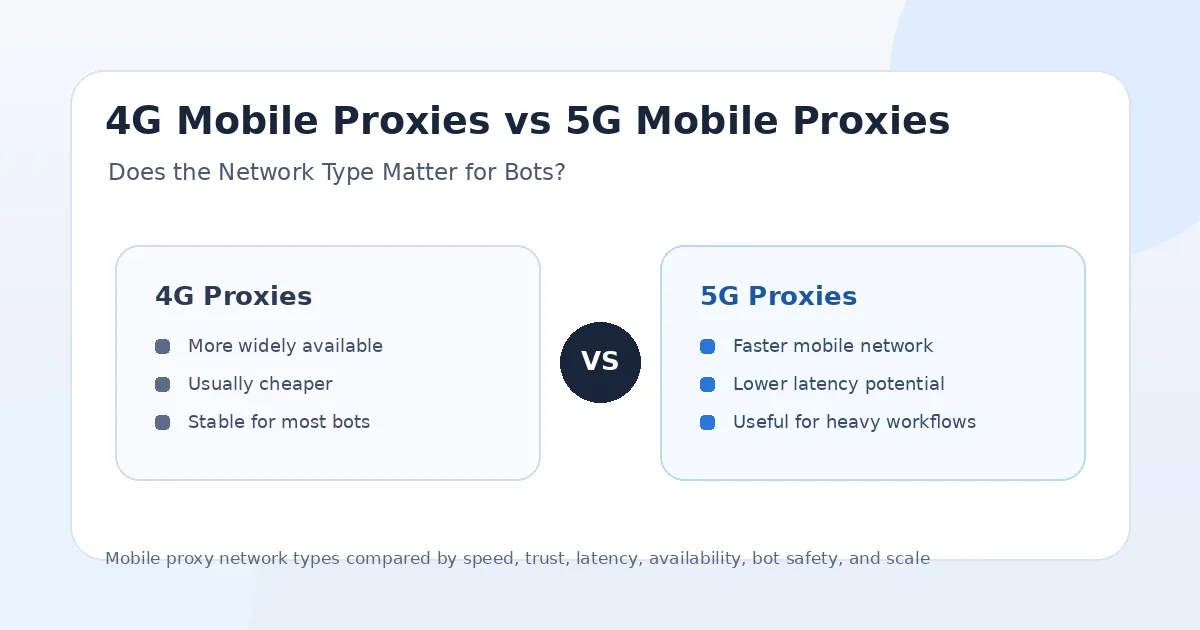
4G proxies are usually widely available, stable, and cheaper than 5G proxies. They are also mature, which means many proxy providers have larger 4G pools, better coverage, and more predictable performance. For most social media bots, 4G mobile proxies are still a strong and practical choice.
What Are 5G Mobile Proxies?
5G mobile proxies route traffic through mobile carrier networks using 5G connections where available. They are still mobile proxies, but they use newer network infrastructure that can offer higher speeds, lower latency, and better bandwidth under the right conditions.
For bot operators, 5G proxies may be useful when the workflow is heavy, media-based, or latency-sensitive. TikTok video workflows, YouTube app testing, Snapchat media tasks, app QA, ad verification, livestream checks, and high-bandwidth browsing can benefit from stronger mobile performance.
The important detail is that 5G is not automatically safer than 4G. A 5G proxy still needs clean IP reputation, stable sessions, good carrier routing, realistic location consistency, and proper account behavior. If those parts are weak, the 5G label alone will not protect the account.
4G vs 5G Mobile Proxies: The Main Difference
The main difference is performance, not trust. Both 4G and 5G mobile proxies come from mobile carrier networks, which gives them a stronger trust profile than datacenter proxies. The difference is that 5G can offer better speed, lower latency, and higher bandwidth when the provider’s setup and local coverage are strong.
For bots, this means 5G may feel smoother for video-heavy apps, faster page loads, quicker app response, and higher-volume browsing. But if the workflow is simple, such as liking posts, checking messages, posting comments, managing accounts, or sending moderate DMs, 4G is usually enough.
The more important question is not “4G or 5G?” The better question is whether the proxy is clean, stable, sticky, correctly located, and matched to the account’s normal behavior.
Does 5G Reduce Ban Risk?
5G does not directly reduce ban risk just because it is 5G. Platforms do not simply say, “This user is on 5G, so the account is safer.” They care more about IP reputation, device signals, account history, behavior patterns, location consistency, and whether the session looks normal.
A clean 4G proxy can be safer than a low-quality 5G proxy. If the 5G proxy rotates too often, comes from an abused pool, has unstable sessions, or mismatches the account’s location history, it can still create risk.
5G can indirectly help if it improves session quality. For example, smoother loading, fewer timeouts, and more natural app behavior can make automation less glitchy. But that is not the same as saying 5G itself makes bots safer.
Does 4G Still Work for Bots?
Yes, 4G still works well for most bot workflows. Many real users still access social platforms through 4G or LTE networks, so 4G mobile proxies remain believable and practical.
For Instagram bots, TikTok engagement, Telegram workflows, Reddit account activity, LinkedIn mobile automation, Snapchat app tasks, and YouTube browsing workflows, 4G is usually fast enough. Most bot actions do not require huge bandwidth. They require consistency, clean routing, realistic limits, and stable account behavior.
For many operators, 4G is the better value because it offers strong mobile trust without the higher price or lower availability sometimes associated with 5G proxy slots.
Speed and Latency
5G usually has the advantage in speed and latency when the network is truly 5G and the provider has good infrastructure. This can matter for media-heavy workflows, app testing, video playback, live interactions, and high-bandwidth browsing.
4G is still fast enough for most social automation. Following, liking, commenting, sending DMs, loading profiles, checking feeds, and managing accounts usually do not require 5G-level speeds. If the bot is moving slowly and naturally, 4G performance is rarely the bottleneck.
The danger is that some bot operators overvalue speed. Faster is not always safer. In social media automation, moving too fast can actually create more risk. A slower, stable 4G session can be better than a fast 5G connection used for aggressive actions.
Session Stability
Session stability is more important than raw network type. A stable 4G proxy with a sticky session is usually better for logged-in accounts than a 5G proxy that changes IPs often. Real users do not usually jump between many IP addresses during one short session.
For account-based automation, each account should have a consistent proxy environment. That means the same region, predictable carrier behavior, and sticky sessions long enough to complete natural workflows. If the proxy rotates in the middle of a login session, DM flow, or app task, it can create suspicious signals.
5G proxies can be stable if the provider manages them well. 4G proxies can also be unstable if the provider has poor routing or aggressive rotation. The network type matters less than the provider’s session control.
Carrier Reputation
Carrier reputation matters more than 4G vs 5G. Some mobile proxy providers use cleaner carrier pools, better SIM infrastructure, and more reliable routing. Others may overload devices, recycle IPs too aggressively, or sell shared access to too many users.
A clean carrier IP from a trusted provider is valuable whether it is 4G or 5G. A heavily abused mobile IP can create problems even if it is technically 5G. Bot operators should care about how the proxy is sourced, how often it rotates, how many users share the pool, and whether the provider offers sticky sessions.
This is especially important for social media accounts. If an IP pool has already been used for spam, fake engagement, scraping, or mass account creation, the network type will not fix that history.
Cost Difference
4G mobile proxies are usually cheaper and easier to find. Because 4G infrastructure is more mature and widely available, providers often have larger pools and more predictable pricing.
5G mobile proxies can cost more because the infrastructure is newer, availability may be lower in some regions, and providers may market them as premium slots. The higher price can make sense for heavy workflows, but it is not always necessary for normal social media automation.
Bot operators should match cost to account value. If the workflow is high-value, media-heavy, or latency-sensitive, 5G may be worth testing. If the workflow is moderate social automation, 4G often gives a better cost-to-safety balance.
Availability and Coverage
4G has broader coverage in many markets, which makes it easier to find stable proxy locations. This is useful when account geography matters. If an account history is tied to a specific city, region, or country, availability matters more than network generation.
5G coverage is expanding, but it may still be uneven depending on the country, carrier, city, and provider. A provider may advertise 5G proxies, but the real-world quality depends on where the proxy devices are located and how strong the local 5G network is.
For bot operators, the best proxy is the one that matches the account’s location and stays stable. A good 4G proxy in the right location is usually better than a 5G proxy in the wrong region.
4G vs 5G for Instagram Bots
For Instagram bots, 4G is usually enough. Instagram actions like follows, likes, comments, story views, profile visits, DMs, and feed browsing do not require 5G speeds. They require realistic pacing and a believable mobile environment.
5G may help when workflows involve frequent media uploads, Reels browsing, story-heavy tasks, or high-volume testing. But it does not automatically reduce Instagram ban risk.
For most Instagram operators, a clean 4G mobile proxy with sticky sessions is better value than paying extra for 5G. If you are running high-value accounts or media-heavy workflows, 5G can be tested, but it should not replace careful limits and account warm-up.
4G vs 5G for TikTok Bots
TikTok is more video-heavy than Instagram, so 5G can be more useful here. Faster loading, smoother playback, and lower latency can help TikTok workflows feel more natural, especially when watching videos, scrolling feeds, uploading content, or testing app behavior.
That said, 4G still works for TikTok automation if the connection is stable. Many real TikTok users browse on 4G networks, so 4G traffic is not inherently suspicious.
For TikTok, 5G is worth considering when video performance matters. For simple account actions, engagement, or moderate browsing, 4G can still be enough.
4G vs 5G for YouTube Bots
YouTube workflows can benefit from 5G when video playback quality, buffering, uploads, or app testing matter. A 5G proxy may provide smoother viewing and better performance for heavy media tasks.
However, watch-time automation is risky regardless of proxy type. A 5G proxy does not make fake watch time safe. If the behavior looks artificial, YouTube can still remove views, ignore watch time, or reduce trust.
For legitimate YouTube workflows like testing, account management, app navigation, comment handling, and cross-platform operations, 5G can improve performance. For most light tasks, 4G is still fine.
4G vs 5G for Snapchat Bots
Snapchat is camera-heavy and mobile-first, so real mobile behavior matters. 5G can help with media-heavy workflows, story activity, snap uploads, and app testing. Faster network performance may make sessions smoother.
4G still works for many Snapchat workflows, especially if the automation is light and controlled. The bigger risks usually come from spammy behavior, mass adding, repetitive snaps, or suspicious account patterns rather than the difference between 4G and 5G.
For Snapchat, 5G is useful for performance, but account safety still depends on realistic limits, clean devices, and stable sessions.
4G vs 5G for Telegram Bots
Telegram usually does not need 5G unless the workflow involves large media files, high-volume content, or heavy channel operations. Text messaging, group management, and moderate account workflows work fine on 4G.
For Telegram mass-message workflows, safety depends more on opt-in behavior, message pacing, account trust, and avoiding spam reports. A 5G proxy will not protect an account that blasts strangers with repetitive messages.
4G is usually enough for Telegram. 5G is only worth considering for media-heavy or high-bandwidth Telegram workflows.
4G vs 5G for App Testing
For app testing, 5G can be valuable because it helps test performance under modern mobile network conditions. QA teams may want to compare app behavior on 4G and 5G to understand loading, latency, media playback, and network handling.
4G is still important because many real users continue to use 4G networks. Testing only on 5G can hide performance issues that users on weaker or older networks may experience.
For Appilot users running real Android devices and emulators, both 4G and 5G proxy setups can be useful depending on the test. 5G is better for high-performance scenarios, while 4G is better for broad real-world coverage.
Where Appilot Fits
Appilot helps with the device and workflow layer, while 4G or 5G mobile proxies handle the network layer. The strongest setup is usually a real Android device or emulator controlled through Appilot, paired with a stable mobile proxy that matches the account’s region and use case.
For Instagram, TikTok, Snapchat, YouTube, Threads, Telegram, Reddit, LinkedIn, and other social apps, Appilot gives users a real-device automation environment without ADB or laptop dependency. That matters because proxy quality alone is not enough. The device behavior also needs to look believable.
For most bot operators, Appilot plus 4G mobile proxies is a strong default. Appilot plus 5G mobile proxies is better when speed, media loading, app testing, or high-bandwidth workflows matter.
When 4G Is the Better Choice
4G is the better choice when cost matters, availability matters, and the workflow is not bandwidth-heavy. For most social media bots, 4G provides enough speed and strong mobile trust.
It is also better when the provider has stronger 4G coverage than 5G coverage in the target region. A stable 4G proxy in the correct city or country is more useful than a weaker 5G proxy that does not match account history.
Bot operators should choose 4G for Instagram engagement, LinkedIn mobile workflows, Telegram messaging, Reddit app activity, moderate TikTok browsing, and general account management when performance is not the bottleneck.
When 5G Is the Better Choice
5G is the better choice when speed, latency, and bandwidth matter. This includes TikTok video-heavy workflows, YouTube playback testing, Snapchat media operations, high-volume app QA, video uploads, and workflows that involve frequent media loading.
5G can also be useful when the account environment needs to look like a modern high-performance mobile user in markets where 5G usage is common. This can be useful for certain app testing and ad verification workflows.
However, 5G should not be chosen only because it sounds safer. It is a performance upgrade first. Account safety still depends on proxy quality, session stability, device behavior, and automation limits.
Common Mistakes Bot Operators Make
One mistake is assuming 5G automatically means lower ban risk. It does not. A bad 5G proxy can be worse than a clean 4G proxy if the session is unstable or the pool is abused.
Another mistake is choosing speed over stability. Social media bots usually need realistic pacing, not maximum speed. A fast proxy used aggressively can create more risk than a slower proxy used carefully.
A third mistake is rotating too often. Logged-in accounts usually need stable proxy sessions. Frequent IP changes during normal account activity can look unnatural, whether the proxy is 4G or 5G.
Final Verdict
4G mobile proxies are still the best default for most bot operators. They are widely available, usually more affordable, stable enough for most social media workflows, and trusted because they come from real mobile carrier networks.
5G mobile proxies are better when the workflow needs speed, lower latency, high bandwidth, or smoother media performance. They make the most sense for TikTok, YouTube, Snapchat, app testing, video-heavy workflows, and high-performance mobile operations.
The network type matters, but not as much as many people think. A clean, stable, sticky 4G proxy is better than a poorly managed 5G proxy. For serious automation, pair the right proxy with a believable device environment, realistic limits, and strong account behavior. Appilot helps with that by letting users run bots on real Android devices and emulators remotely without ADB or laptop dependency. You can explore Appilot’s bot store and real-device workflows at appilot.app.
FAQs
Q1: Are 5G mobile proxies safer than 4G mobile proxies?
Not automatically. 5G can be faster, but safety depends more on IP reputation, sticky sessions, account behavior, and provider quality than network type.
Q2: Are 4G mobile proxies still good for bots?
Yes, 4G mobile proxies are still excellent for most social media bots. They are stable, widely available, and usually more cost-effective than 5G.
Q3: When should bot operators use 5G proxies?
Use 5G proxies for video-heavy workflows, app testing, TikTok, YouTube, Snapchat, and high-bandwidth tasks. For normal engagement bots, 4G is usually enough.
Q4: Do 5G proxies reduce Instagram bans?
5G proxies do not directly reduce Instagram bans. Clean mobile IPs, stable sessions, realistic limits, and real-device behavior matter more.
Q5: Does Appilot work with 4G and 5G proxies?
Yes, Appilot can support workflows using both 4G and 5G mobile proxies. The best choice depends on your platform, account value, speed needs, and risk level.