AdsPower Synchronizer Feature and Appilot Integration

AdsPower includes a Synchronizer feature that allows users to control multiple browser profiles at the same time. This feature is useful when performing identical actions across multiple accounts, such as logging in, navigating pages, or executing repetitive workflows.
While the Synchronizer is powerful for real-time multi-profile control, managing large-scale automation still requires structure, scheduling, and organization.
This is where Appilot becomes useful.
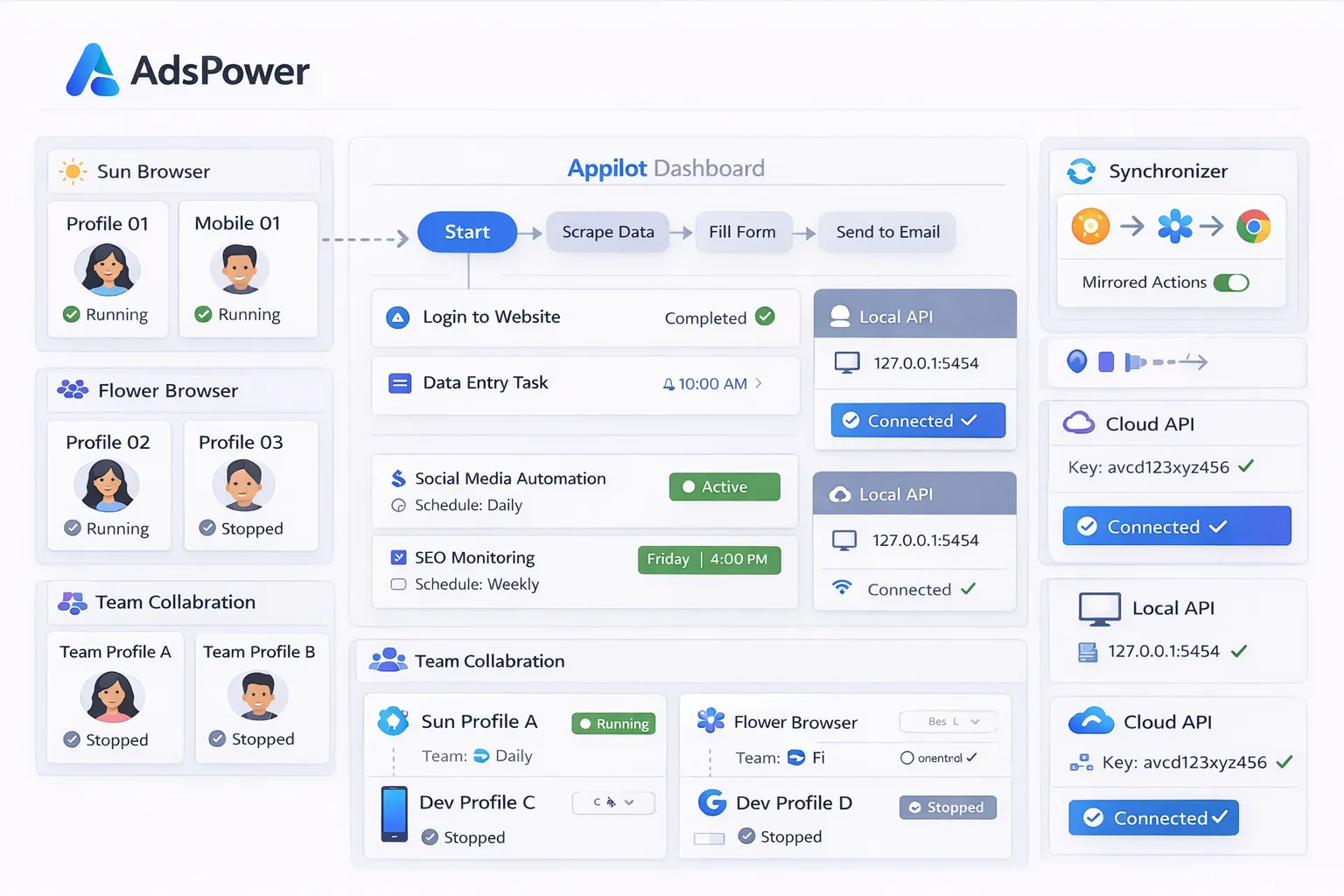
Appilot helps organize AdsPower Synchronizer workflows from one dashboard so you can assign schedules, manage profile groups, and monitor automation activity more efficiently.
What Is the AdsPower Synchronizer Feature
The AdsPower Synchronizer allows you to mirror actions across multiple browser profiles at the same time.
For example, if you click on a button in one browser profile, the same action can be repeated across other selected profiles.
This is useful for workflows where multiple accounts need to perform the same actions at once.
It can help save time when setting up accounts, performing repetitive navigation, or executing bulk actions across multiple profiles.
However, Synchronizer workflows are usually controlled manually in real time.
Once you scale beyond a small number of profiles, managing everything manually becomes difficult.
Why Combine Synchronizer with Appilot
The Synchronizer is useful for executing actions across multiple profiles at once, but it does not handle scheduling, workflow organization, or long-term automation.
For example, you may need certain workflows to run at different times of the day, across different profile groups, and under different conditions.
Without a scheduling system, you would still need to manually trigger Synchronizer sessions.
Appilot helps solve this problem.
It acts as the scheduling and workflow management layer above AdsPower, allowing you to organize profiles, assign workflows, and automate when tasks run.
This combination makes it easier to scale beyond manual control.
How Appilot Works with AdsPower Synchronizer
First, browser profiles are created or imported inside AdsPower. Each profile has its own fingerprint, cookies, proxy settings, session data, and account information.
You can use the Synchronizer feature to set up workflows, perform initial actions, or execute bulk tasks across multiple profiles.
Once workflows are defined, Appilot can be used to organize those profiles into groups and assign schedules.
For example, one profile group may use Synchronizer-based workflows for account setup, another may use it for content posting, and another may use it for repetitive navigation tasks.
Inside Appilot, you can create schedules, assign timing windows, and monitor workflow execution across different profile groups.
This allows you to move from manual Synchronizer control to structured and automated workflow management.
Common Synchronizer-Based Workflows
Different workflows can benefit from Synchronizer usage.
For example, initial account setup tasks can be performed across multiple profiles at the same time.
Bulk navigation tasks, such as visiting specific pages or performing similar actions across accounts, can also be handled using Synchronizer.
Content posting workflows may also use synchronized actions across multiple profiles.
Once these workflows are defined, Appilot can be used to schedule when they run and how they are applied across different profile groups.
This makes it easier to transition from manual control to automated workflows.
Benefits of Combining Synchronizer with Scheduling
One major benefit is time savings.
Instead of manually triggering Synchronizer sessions every time, Appilot can help organize and schedule workflows automatically.
Another major benefit is better organization.
You can group browser profiles by workflow type, account type, or campaign and assign different schedules to each group.
This helps reduce confusion and improves workflow control.
Another advantage is scalability.
Once workflows are defined, they can be applied across larger numbers of browser profiles without increasing manual effort.
Monitoring is also improved.
You can track workflow execution, identify failed tasks, and review profile activity from one dashboard.
Best Practices for Synchronizer Automation
One of the most important rules is to use Synchronizer carefully.
Running identical actions across too many profiles at the same time can create repetitive patterns.
It is better to combine Synchronizer workflows with staggered schedules and delays.
You should also organize profile groups clearly so it is easy to understand which profiles are running which workflows.
Using clear naming conventions helps avoid confusion.
It is also important to match proxy settings and fingerprints correctly for each profile.
Finally, test workflows on a small number of profiles before scaling across larger groups.
Common Mistakes to Avoid
One common mistake is relying only on manual Synchronizer sessions without any scheduling system.
Another mistake is running identical actions across too many profiles at the exact same time.
Some users also scale too quickly without testing workflows properly.
Using the same proxy across too many profiles is another common issue because it increases overlap and detection risks.
Poor organization is often the biggest problem. Without clear profile groups, schedules, and workflow assignments, automation becomes difficult to manage.
The best approach is to stay organized, combine Synchronizer with structured scheduling, and scale gradually.
Frequently Asked Questions
Q1: What does the AdsPower Synchronizer feature do?
It allows you to mirror actions across multiple browser profiles at the same time.
Q2: Can Appilot automate Synchronizer workflows?
Appilot can help organize and schedule workflows that are built using Synchronizer, making them easier to manage at scale.
Q3: Should Synchronizer be used for all workflows?
Not always. It is best for bulk actions and setup tasks, but other workflows may require separate scheduling.
Q4: Why should workflows be scheduled instead of manual?
Scheduling helps reduce manual work, improve organization, and avoid missed tasks.
Q5: What is the biggest mistake when using Synchronizer?
The biggest mistake is running identical actions across too many profiles at the same time without proper scheduling.
Conclusion
The AdsPower Synchronizer feature is powerful for controlling multiple browser profiles at once, especially for bulk actions and setup workflows.
However, managing large-scale automation requires more than real-time control.
Appilot helps bridge this gap by providing structured scheduling, workflow organization, and centralized monitoring.
The best approach is to combine Synchronizer for execution with Appilot for scheduling, allowing you to scale automation efficiently while maintaining control and organization.