How Agencies Manage 100+ Instagram Accounts: The Compliant and Scalable Way
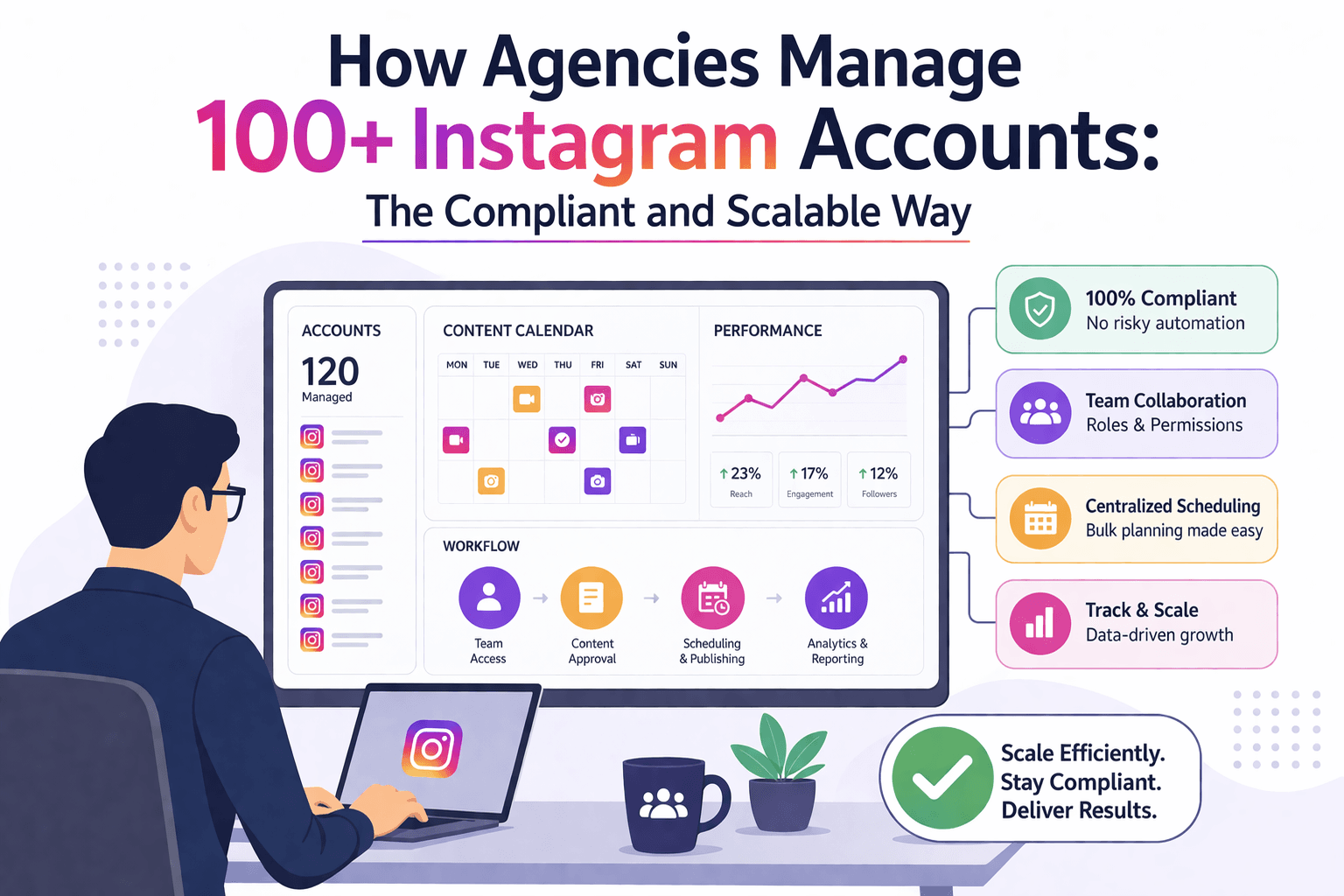
The real problem with managing 100 or more Instagram accounts is not posting itself. The real problem is operations. Once an agency moves beyond a small portfolio of accounts, missed posts, conflicting schedules, content mix-ups, inconsistent branding, overwhelming analytics, and team burnout start showing up at the same time.
Imagine running a large Instagram operation where content is approved in advance, publishing is organized, reporting is automated, permissions are controlled properly, and no one is logging into random accounts manually all day. That outcome is not only possible, it is exactly what strong agencies build when they stop chasing shortcuts and start building systems.
This guide shows you exactly how agencies manage 100+ Instagram accounts compliantly, what tools and structure they need, the workflow to follow, and how to scale without relying on risky automation.
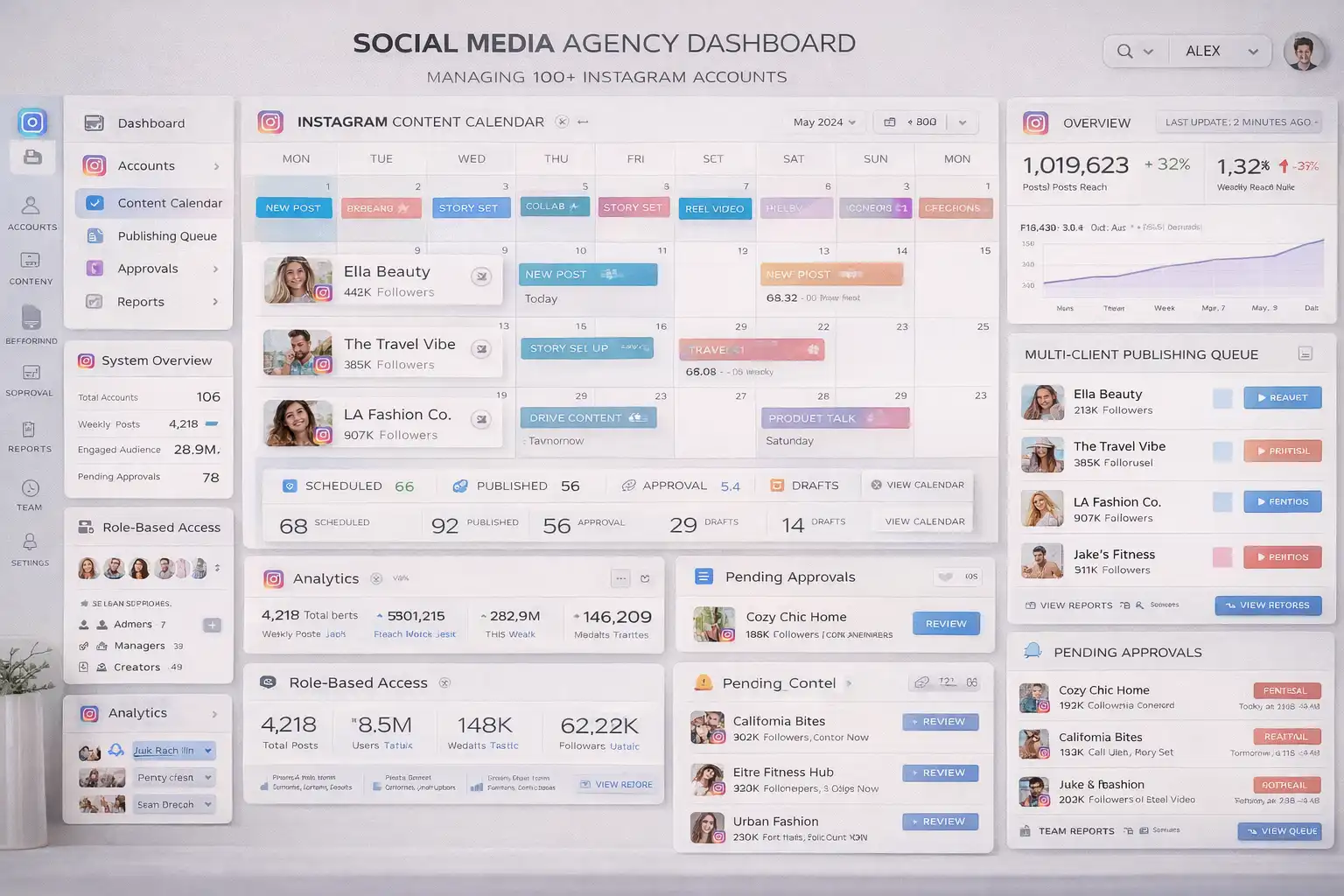
Why Managing 100+ Instagram Accounts Matters / The Opportunity
Managing Instagram at scale matters because agencies are no longer just posting content. They are coordinating brands, creators, niches, schedules, approvals, analytics, and client expectations across large account portfolios. Once the number of managed accounts grows, small inefficiencies become expensive operational problems.
Managing 100+ Instagram accounts compliantly is becoming essential because Instagram increasingly rewards authentic engagement, content quality, creator consistency, and platform-native behavior. Agencies that build strong systems gain a competitive advantage because they can stay organized, protect account health, and deliver reliable client performance without creating unnecessary platform risk.
At this scale, the opportunity is not just efficiency. It is retention, margin, and reputation. Agencies that can handle large account portfolios cleanly usually keep clients longer because their operations feel dependable instead of chaotic.
1. Who This Use Case is For
This approach works best for agencies managing multiple Instagram clients across different niches, especially those already feeling the strain of manual account handling, inconsistent approval workflows, and scattered reporting.
It is also highly valuable for internal social media teams that manage several brand pages, regional divisions, or product-line accounts and need stronger publishing structure without compromising security.
This model is equally useful for creator agencies, franchise marketing teams, and white-label social media operators because all of them need systems that separate content production, approvals, publishing, and analytics instead of mixing everything together.
2. What You'll Achieve
By implementing a compliant Instagram operations system, you will be able to centralize content planning, schedule posts across many accounts with less friction, reduce team workload, protect client account access, automate reporting, and improve overall posting consistency.
In practical terms, that means fewer missed posts, better client visibility, cleaner internal workflows, lower security risk, and more time spent improving content strategy instead of managing operational chaos.
3. What You'll Need
Before scaling Instagram operations successfully, you need the right publishing foundation, the right planning structure, and the right access model.
Technical Requirements
At a minimum, agencies need official or supported publishing tools such as Meta Business Suite, the Instagram Graph API for eligible accounts, and social media management platforms like Sprout Social, Later, Hootsuite, or Buffer. These tools support scheduled publishing, analytics access, comment moderation, multi-account management, and centralized team workflows much better than device-based workarounds.
You also need a central content system such as Notion, Airtable, ClickUp, Asana, Google Drive, or a DAM platform where every asset, caption version, scheduled date, approval status, and performance note can be tracked.
For agencies that also need mobile workflow visibility or Android-side operational review in broader content operations, Appilot can be relevant as a supporting tool because it works with real Android devices and mobile-first workflows. However, it should not replace official Instagram publishing infrastructure or be used for behavior simulation.
Skills and Knowledge
The team should understand content operations, account permissions, approval systems, reporting workflows, and how Instagram performance signals such as watch time, saves, shares, comments, and posting consistency affect outcomes.
Technical knowledge of APIs, dashboards, automation tools, and data reporting helps, but the most important capability is operational discipline. Agencies do not scale large Instagram portfolios through hacks. They scale through repeatable systems.
Time and Resource Investment
A basic multi-account operations setup can be built within days, but a strong agency-grade system usually takes longer because it needs role assignment, account segmentation, reporting standards, approval pipelines, and publishing rules.
The real cost is not just software. It is the work required to create structure. Once that structure exists, scaling becomes much easier and less stressful.
Appilot Integration Method #1 - The Complete Solution Approach
Implementing Large-Scale Instagram Operations with Official Tools and Workflow Systems
There are two very different ways agencies try to scale Instagram operations. The weak approach is relying on manual logins, scattered spreadsheets, repeated account switching, and risky shortcuts that eventually create errors and account risk. The stronger approach is combining workflow automation, official publishing infrastructure, and clear segmentation.
The DIY version of this system usually includes a planning tool, cloud asset storage, Meta Business Suite, one or more supported publishing platforms, reporting dashboards, and internal approval logic. This works well when the agency has clear processes and enough discipline to keep every moving part aligned.
An integrated operational support layer can also be useful in agencies that work across both browser and mobile-first workflows. This is where Appilot can fit in carefully and appropriately as a supporting workflow layer for Android-side operational visibility where that context genuinely matters. Because Appilot works with real Android devices and mobile-first workflows, it can help teams review mobile operational context, but it should remain separate from direct Instagram behavior automation.
The key principle is simple. Agencies should automate workflow, not behavior. That means automation belongs in planning, approvals, scheduling logic, analytics, and reporting rather than in trying to mimic account activity at scale.
Step-by-Step Implementation Guide
Agencies that manage 100+ Instagram accounts successfully usually break the system into a few operational layers and improve each one deliberately.
Step 1: Build a Central Content Pipeline
The first step is creating a centralized system where every post is tracked by client, format, caption version, hashtag set, scheduled date, approval status, and performance notes. This removes the need for teams to chase content across chats, folders, and email threads.
From an operational perspective, this content pipeline becomes the source of truth for the agency. It allows creators, managers, editors, and account leads to see exactly what is going live, for whom, and when. That clarity is what prevents content mix-ups and missed deadlines.
If an agency is asking how to manage 100+ Instagram accounts without chaos, this is the first answer. Build one place where the whole content operation lives.
Step 2: Use Role-Based Account Access
The next step is replacing password sharing with role-based access through Meta Business Manager or other official permission systems. Team members should be added with the correct roles, 2FA should be enforced, and client-level isolation should be maintained at all times.
This matters because login chaos is one of the fastest ways to create internal confusion and security incidents. Once too many people start sharing credentials, agencies lose accountability, clients lose confidence, and account risk increases.
The safest model is clear permissions, not shared logins.
const accountAccess = {
  client: "Client A",
  teamMember: "Content Manager",
  role: "Editor",
  twoFactorEnabled: true
};
function validateAccess(access) {
  return access.role && access.twoFactorEnabled;
}
console.log(validateAccess(accountAccess));
This simple logic reflects a broader operational principle. Access should be structured, intentional, and reviewable.
Step 3: Create a Scheduling Engine
At scale, agencies do not schedule content one account at a time in a reactive way. They batch schedule weekly, use time-zone-aware logic, segment accounts by niche, and avoid simultaneous identical posting across large groups of accounts.
Scheduling consistency is important because it supports publishing reliability, but it also helps agencies stay aligned with audience behavior and account positioning. Consistency does not mean every account should publish in the exact same pattern. It means every account should have a dependable and intentional cadence.
This is one of the clearest differences between structured operations and chaotic growth.
Step 4: Automate Analytics and Reporting
Large agencies cannot depend on manually checking every account. They need reporting systems that collect weekly performance data, track engagement rate, monitor follower growth, surface reach trends, and compare content formats across clients and niches.
When analytics are automated correctly, account managers stop spending hours pulling numbers into reports and start spending time interpreting what the results mean. That shift improves both team efficiency and client value.
Good reporting automation does not replace strategy. It gives strategy better data faster.
Step 5: Segment Accounts Properly
Agencies that manage large account portfolios successfully usually segment them by niche, region, audience type, funnel stage, or content format. This improves targeting and reduces unnecessary overlap in how accounts are managed.
Segmentation is important because scale without segmentation creates operational blur. Teams start treating all accounts the same, which usually leads to weaker strategy and repetitive publishing decisions.
When agencies scale structure instead of intensity, account quality improves along with operational clarity.
Appilot Integration Method #2 - Specific Feature Showcase
Handling Mobile-First Workflow Visibility Across Large Teams
One of the biggest challenges in agencies managing many accounts is not just content planning. It is making sure mobile-first operational context is visible when teams need it, especially when creators, reviewers, and account managers are working across different environments.
The traditional approach often becomes fragmented because some information lives in browser dashboards while other workflow realities only make sense from a mobile perspective. When that context is missing, teams make more mistakes around reviews, timing, and handoff quality.
Appilot can support this challenge where Android-side workflow visibility is relevant because it uses real Android devices and mobile-first workflows. In that supporting role, it can help teams bring more operational clarity into mobile review processes. The important boundary is that this should support workflow visibility, not replace official Instagram publishing systems or attempt behavior simulation.
Common Challenges and Solutions
Even agencies with decent systems usually run into a few recurring problems once the account count climbs.
Challenge 1: Content Mix-Ups Across Clients
This happens when assets, captions, and scheduling notes are not clearly tied to the correct client and account. As the number of accounts grows, even small labeling errors become expensive.
The solution is to enforce naming conventions, approval states, client tagging, and account-specific scheduling views inside the content pipeline. Every asset should already know where it belongs before publishing begins.
Challenge 2: Analytics Overload
Agencies often drown in data because they are collecting too much manually and reviewing it without structure. This usually leads to reporting fatigue and shallow insights.
The solution is to define a reporting framework first, then automate only the metrics that actually matter. Weekly performance reports, engagement trends, format comparison, and growth dashboards are far more useful than endless raw exports.
Challenge 3: Scaling Too Fast Without Validating Formats
Some agencies grow their account volume before confirming which content formats actually work for each niche. That leads to scale without effectiveness.
The solution is to validate format performance first, then expand. Workflow automation makes good systems more efficient, but it cannot rescue weak content strategy.
Appilot Integration Method #4 - Real-World Case Study
Case Study: A Multi-Team Agency Scales to 130 Instagram Accounts
An agency managing 130 Instagram accounts across 12 niches, 4 internal teams, and 8 content creators needed a system that would reduce operational stress without introducing platform risk. Their main requirements were clear: they needed centralized publishing, stronger approval structure, automated analytics, and better client visibility.
Their earlier approach was becoming too fragmented. Content moved through too many places, reporting took too much manual effort, and the team was spending more time coordinating than optimizing performance.
The improved model used a centralized content calendar, weekly batch scheduling, automated analytics reporting, and client performance dashboards. Official publishing tools handled the distribution layer, while the agency used structured workflows to separate content creation, approvals, scheduling, and reporting into cleaner stages. Where relevant for broader mobile-first operational visibility, Appilot could support Android-side workflow review, but it was not used as a substitute for official Instagram infrastructure.
After 90 days, the agency saw roughly three times better posting consistency, reduced internal workload, zero security incidents, and stronger client retention. The biggest success factor was not aggressive automation. It was operational clarity.
Scaling Instagram Account Management from 20 to 200 Accounts
Once an agency proves the model at 20 accounts, the next goal is not to automate more aggressively. It is to improve workflow clarity, content production capacity, approval pipelines, reporting automation, and analytics visibility.
From 20 to 200 Accounts
At this stage, operational discipline matters more than individual publishing speed. More accounts require stronger review systems, cleaner ownership, and more reliable publishing schedules. Without that structure, every new account adds friction instead of revenue.
The economics also become clearer at scale. Agencies that centralize reporting and standardize publishing operations reduce time waste significantly. That allows teams to support more accounts without linearly increasing burnout.
Automation and Optimization at Scale
The best parts to automate are reporting, scheduling logic, content status tracking, internal alerts, and dashboard generation. The parts that should remain manual are client strategy, creative direction, content quality review, and nuanced performance decisions.
Where mobile-first operational visibility matters at larger scale, Appilot can support Android-side workflow context, but official publishing and compliant infrastructure should remain the core of the system.
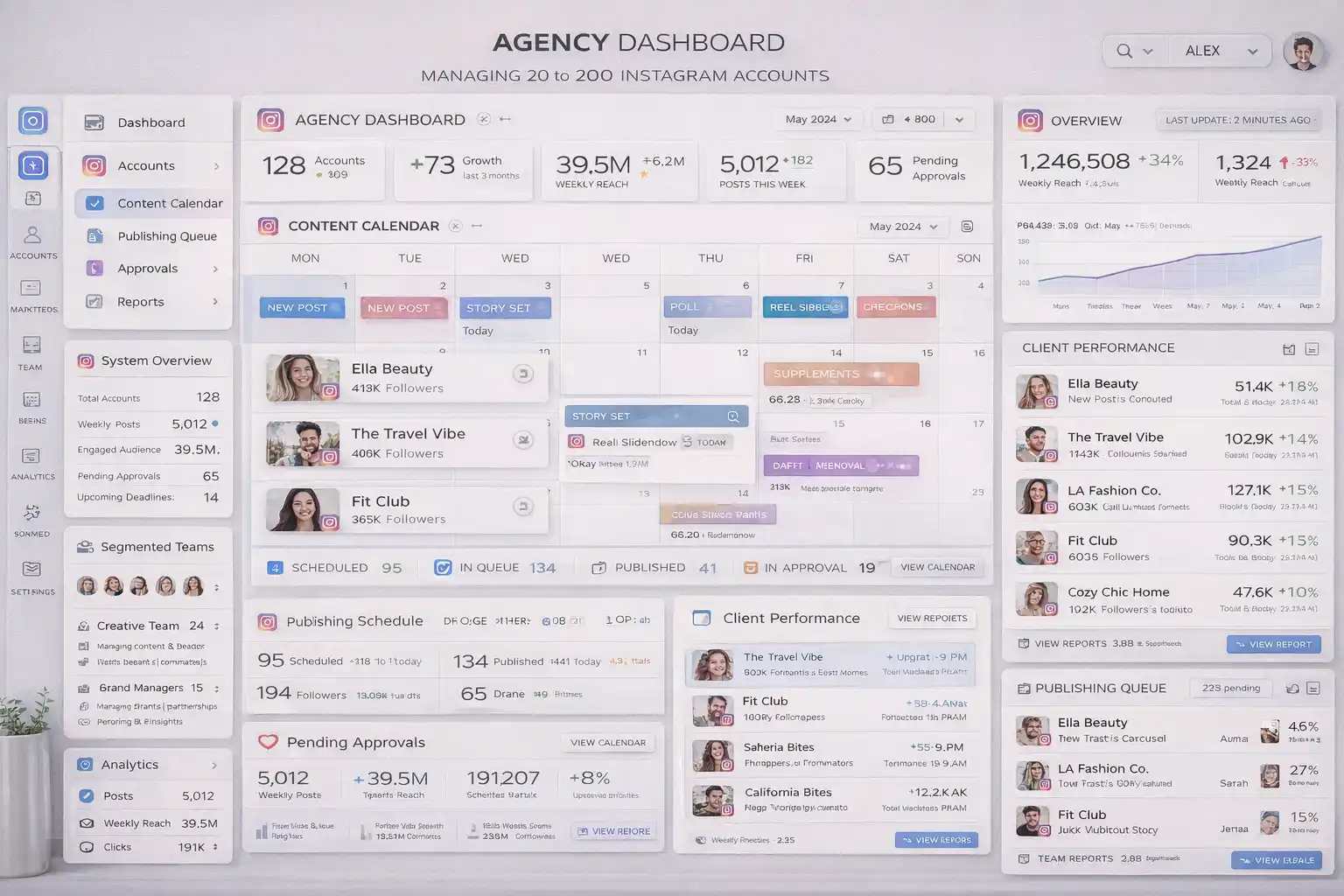
Best Practices and Pro Tips
Best Practice 1 - Separate Content Creation from Distribution
Agencies perform better when content production and publishing operations are treated as separate systems. The implementation is straightforward: creators focus on assets and messaging, while distribution workflows handle timing, approvals, and account delivery. The impact is less confusion and more reliable output.
Best Practice 2 - Standardize Reporting Before Scaling
Before adding more accounts, define what metrics clients should receive and how often they should receive them. This makes reporting automation much easier and prevents account managers from rebuilding the reporting format for every client. A common pitfall is trying to customize everything too early, which slows the whole operation down.
Best Practice 3 - Protect Account Security Relentlessly
Security discipline becomes more important as account count rises. Every account should have clear ownership, correct permission levels, strong 2FA enforcement, and minimal credential exposure. The advanced version of this is reviewing access regularly so inactive or unnecessary permissions do not remain in the system.
Tools and Resources
For official publishing and account operations, Meta Business Suite should be the starting point because it supports account roles, centralized publishing, inbox management, and built-in analytics. For agencies that qualify, the Instagram Graph API can support programmatic publishing, data ingestion, moderation workflows, and account insights. Social media management platforms such as Sprout Social, Later, Hootsuite, and Buffer can also support multi-account scheduling and reporting operations at scale.
For content planning and approvals, tools such as Notion, Airtable, ClickUp, Asana, Google Drive, and DAM systems are especially useful because they create structure before publishing begins.
For agencies that need Android-side operational review in broader mobile-first workflows, Appilot can support that visibility because it works with real Android devices and mobile-first systems, but again, it should remain a supporting workflow layer rather than a replacement for official Instagram publishing tools.
Key Takeaways
Managing 100+ Instagram accounts successfully depends on using official publishing tools, automating workflow rather than behavior, centralizing content management, protecting account security, and scaling through systems instead of shortcuts.
The biggest mistake is trying to outsmart Instagram’s detection systems. The smarter move is to align with how Instagram is designed to operate and build an agency workflow that makes consistency, security, and reporting easier every week.
A compliant large-scale Instagram operation is absolutely achievable. Start by centralizing content and access control, validate the publishing workflow, automate reporting, and then scale systematically. The agencies that last are the ones that scale structure, not risk.
Frequently Asked Questions
Q1: How do agencies manage 100+ Instagram accounts without chaos?
They do it by centralizing content planning, role-based access, official publishing tools, scheduling logic, and reporting dashboards. The real solution is operational structure, not device-level shortcuts.
Q2: Do agencies need unofficial automation to scale Instagram?
No. Long-term agencies usually avoid risky shortcuts because they create account risk and operational instability. Official tools and strong workflow systems scale much better.
Q3: What should agencies automate at scale?
They should automate content pipeline visibility, scheduling workflows, analytics reporting, client dashboards, and internal coordination. They should not automate behavior or simulate engagement.
Q4: Can Appilot replace official Instagram publishing tools?
No. Appilot can support Android-side operational visibility in broader mobile-first workflows where relevant, but official Instagram publishing infrastructure should remain the foundation.
Q5: What actually improves reach across many Instagram accounts?
Instagram rewards watch time, saves, shares, comments, content quality, and consistent posting. Operational automation helps teams stay consistent, but it cannot replace strong creative output.
Conclusion
The real challenge in managing 100+ Instagram accounts is not posting. It is building an operation that can stay organized, secure, and consistent under scale.
The strongest agencies do not grow by increasing risk. They grow by centralizing content, formalizing permissions, automating reporting, segmenting accounts intelligently, and using official publishing infrastructure the way it was designed to be used.
That is the real agency advantage. They scale systems, not shortcuts.