Appilot vs Combin: Instagram Audience Management Tools Compared
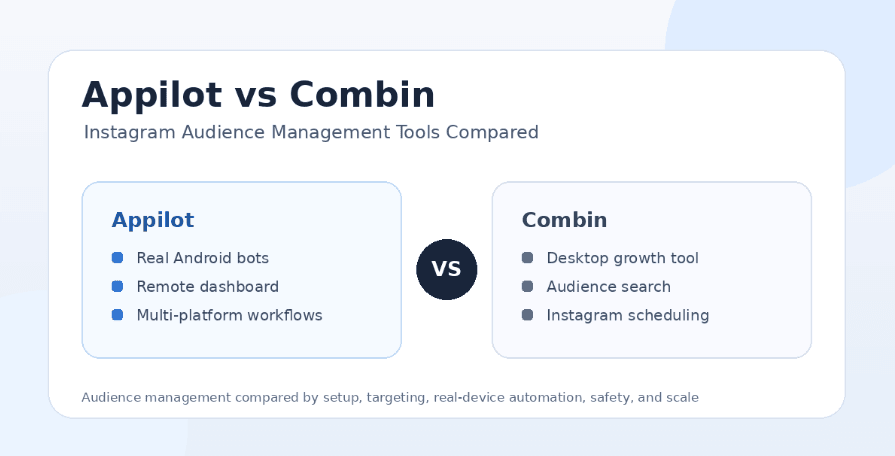
Instagram audience management used to be mostly about finding the right people, following relevant accounts, liking posts, leaving comments, and cleaning up inactive or irrelevant users. Tools like Combin became popular because they helped users search Instagram audiences, organize targeting, schedule content, and manage growth activity from a desktop environment.
But Instagram automation has changed. Users now care less about simple mass actions and more about account safety, device behavior, remote control, multi-account workflows, and whether the tool still fits modern platform rules. A desktop audience tool can still be useful for research and planning, but serious automation often needs a more realistic mobile environment.
That is where the Appilot vs Combin comparison matters. Combin is best understood as an Instagram audience management and desktop growth tool, while Appilot is a real-device automation platform that lets users run bots on Android phones and emulators through a web dashboard without ADB or a laptop. Both tools relate to Instagram automation, but they are built for very different workflows.
What Is Combin?
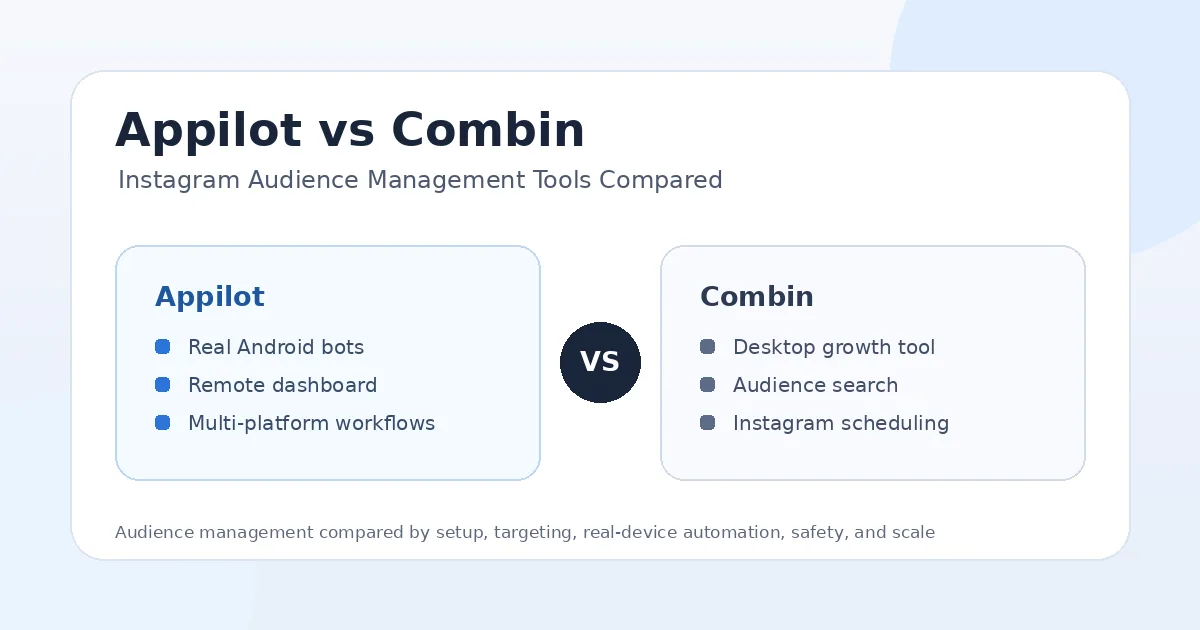
Combin is known as an Instagram marketing and audience management tool that helped users search accounts, find relevant posts, target audiences through hashtags and locations, analyze profiles, engage with users, and schedule Instagram content. It was often discussed in two parts: Combin Growth for Instagram audience discovery and engagement, and Combin Scheduler for planning posts and Stories.
Its main appeal was control over audience research. Users could search for potential followers, filter accounts, find competitors’ audiences, and manage engagement from a desktop-style interface. For social media managers who wanted a more organized way to discover and interact with Instagram users, Combin offered a useful workflow.
The important caveat is that Combin’s current availability appears unclear from public signals, with some recent third-party sources claiming it has shut down or changed direction. Users considering Combin should verify whether the official product is still available and supported before depending on it for new Instagram growth work.
What Is Appilot?
Appilot is a real-device automation platform that lets users run bots on Android phones and emulators remotely through a web dashboard. Instead of depending on desktop software, browser automation, API shortcuts, or a local laptop setup, Appilot is built around mobile environments where workflows can run directly inside Android app sessions.
The key advantage is that Appilot gives users control over real mobile automation. Users can run bots without ADB, without keeping a laptop connected, and without dealing with cables, drivers, or device pairing problems. This makes it useful for phone farm operators, agencies, growth teams, and users managing multiple social accounts.
Appilot also includes a bot store with ready-to-use automations for Instagram, TikTok, Twitter/X, LinkedIn, Discord, Reddit, Snapchat, YouTube, Threads, Telegram, Gmail, Chrome, and more. That makes it broader than a traditional Instagram audience management tool because it supports multi-platform automation from one dashboard.
Appilot vs Combin: The Main Difference
The biggest difference between Appilot and Combin is the automation environment. Combin is mainly associated with desktop-based Instagram audience discovery, targeting, engagement, and scheduling. Appilot is focused on running real mobile automation through Android devices and emulators.
This difference matters because audience management is only one part of Instagram automation. Finding relevant users, analyzing profiles, and organizing targets can help a growth strategy, but it does not solve the entire automation problem. Modern users also need safe execution, realistic device behavior, proxy support, multi-account management, and workflows that can continue without a local machine running all day.
Combin is more useful when the goal is Instagram research and audience organization. Appilot is more useful when the goal is real-device bot execution, remote control, and scalable automation across many platforms.
Audience Management vs Real-Device Automation
Combin’s strength is audience management. It gives users a structured way to search for people, posts, hashtags, locations, and competitor audiences. This kind of workflow is useful when you want to understand who to engage with and how to build a relevant Instagram audience.
Appilot’s strength is real-device automation. Instead of only helping users find or organize audience targets, Appilot gives users a way to run workflows on Android devices and emulators. This is important when the task involves app interaction, account workflows, posting actions, DMs, engagement, monitoring, or multi-platform automation.
The difference is simple. Combin helps with discovering and managing Instagram audiences. Appilot helps with executing mobile automation workflows. If you need research, Combin may be useful. If you need automation infrastructure, Appilot is the stronger fit.
Setup and Ease of Use
Combin’s desktop-style workflow can feel familiar to users who like managing Instagram activity from a computer. A social media manager can search audiences, review profiles, organize targeting, and schedule content from a local app-style interface. That can be convenient for users who prefer desktop management over mobile automation.
Appilot solves a different setup problem. Traditional Android automation often requires ADB, cables, drivers, laptop uptime, device troubleshooting, and local machine dependency. Appilot removes that friction by letting users control Android phones and emulators through a web dashboard.
If you only want to research Instagram audiences from a desktop tool, Combin may feel simpler. If you want to run real mobile bots without keeping a laptop connected, Appilot is more practical.
Safety and Account Risk
No Instagram automation or audience management tool is completely risk-free. Any system that automates follows, unfollows, likes, comments, DMs, scraping, or repeated engagement can create problems when used too aggressively. Instagram accounts can face restrictions if activity becomes unnatural, repetitive, or disconnected from normal behavior.
Combin-style tools can be useful for discovery and planning, but mass engagement actions from desktop environments should be used carefully. Even when the goal is real audience growth, high-volume activity can still look suspicious if it does not match the account’s normal behavior.
Appilot’s advantage is that workflows run on Android devices and emulators. Real-device behavior can create a stronger mobile automation environment than many desktop or API-style approaches, but it does not make automation completely safe. Users still need realistic limits, strong proxies, consistent account environments, and natural workflows.
The safest approach is to treat automation as support for a real strategy, not as a shortcut. Content quality, audience relevance, warm-up behavior, account trust, and reasonable action limits matter more than the tool name.
Platform Support
Combin is mainly associated with Instagram. That focus can be helpful if your only goal is Instagram audience management, audience discovery, content planning, and growth-related research. A narrow tool can feel easier when you do not need support for other apps.
Appilot supports Instagram, but it also supports many other social and mobile workflows. Users can run automations for TikTok, Twitter/X, LinkedIn, Discord, Reddit, Snapchat, YouTube, Threads, Telegram, Gmail, Chrome, and more from one dashboard.
This makes Appilot stronger for agencies and operators who manage more than one platform. If Instagram is just one part of your workflow, Appilot gives you much more room to scale.
Remote Control and Phone Farm Workflows
Remote control is one of Appilot’s biggest advantages. Users can manage Android phones and emulators from a browser dashboard, which means they do not need to sit beside devices, keep a laptop running, or maintain ADB connections throughout the day.
This is especially important for phone farm operators and multi-account teams. Local tools can become difficult to manage when workflows grow across many accounts and devices. A dashboard-based system gives users more visibility and flexibility.
Combin’s traditional value is audience management from a desktop environment, not remote Android device control. That can be enough for research-heavy users, but it is limiting for anyone building a serious automation operation.
Pricing and Value for Money
The value of Combin depends heavily on whether the product is currently available, supported, and aligned with your Instagram workflow. If a user needs desktop-based audience search, targeting, and scheduling, Combin’s older feature set may still sound useful. But if availability or support is uncertain, users should be careful before treating it as a long-term solution.
Appilot’s value is broader because it solves the execution side of automation. Users get real-device bots, remote control, no ADB setup, no laptop dependency, proxy support, and multi-platform workflows. That gives Appilot more long-term value for teams that need automation infrastructure rather than only audience research.
If you only need Instagram audience discovery, a research-focused tool may be enough. If you want real mobile automation that can run across many apps, Appilot is the better investment.
Where Combin Wins
Combin wins when the user needs structured Instagram audience research and desktop-style management. Its historical strength was helping users find relevant accounts, filter audiences, analyze profiles, and organize engagement around hashtags, locations, and competitors.
It may also appeal to users who prefer working from a desktop interface rather than managing mobile devices. For some social media managers, desktop-based audience discovery is easier than running device-level automation.
Combin’s Instagram focus can also be a strength for users who do not care about TikTok, Reddit, Discord, LinkedIn, Telegram, YouTube, or other platforms. If the job is only Instagram audience management, a dedicated Instagram tool can feel simpler.
Where Appilot Wins
Appilot wins when users need real automation execution instead of only audience management. Its biggest advantage is that workflows run on Android phones and emulators, which gives users a more realistic mobile environment for social media automation.
Appilot also wins on scalability. It supports many platforms from one dashboard, making it more useful for agencies, phone farm operators, and growth teams that manage multiple channels. Instead of buying one tool for Instagram and separate tools for every other platform, users can organize automation from one place.
The no-ADB and no-laptop setup is another major advantage. Many automation setups become unstable because devices disconnect, laptops sleep, drivers fail, or cables break. Appilot removes much of that friction by making the web dashboard the main control layer.
Appilot is also better for users who want ready-to-use bots without coding, while still having room for custom bot development when a workflow needs something specific.
Who Should Use Combin?
Combin is best for users who want Instagram audience research, targeting, and content planning from a desktop-style workflow, assuming the product is available and supported for their use case. It may fit social media managers who mostly care about finding relevant accounts, analyzing audiences, and organizing Instagram engagement.
It is less ideal for users who need real-device automation, phone farm control, multi-account operations, or workflows across many apps. If you are considering Combin today, verify its current availability before building your Instagram system around it.
Who Should Use Appilot?
Appilot is best for users who want real-device automation and direct control over mobile workflows. It fits phone farm operators, agencies, growth teams, and marketers who manage multiple accounts or need automation across several platforms.
It is also a better choice for users who are tired of desktop tools, ADB setup, disconnected devices, and laptop-based automation. If you want Instagram automation alongside TikTok, Reddit, Discord, LinkedIn, Telegram, YouTube, Snapchat, Threads, Gmail, Chrome, and other workflows, Appilot is the stronger option.
Final Verdict
If your main need is Instagram audience research, targeting, and desktop-style management, Combin may be worth reviewing, but only after confirming whether it is currently available and properly supported. Its older feature set was useful for discovering audiences, analyzing profiles, and managing Instagram engagement.
If you want real-device automation, remote Android control, no ADB, no laptop dependency, proxy support, multi-account workflows, and automation across many social platforms, Appilot is the better choice. It gives users more control over how automation actually runs and more flexibility as their workflow grows.
For Instagram audience research, Combin can make sense if it is still available for your needs. For serious automation, phone farm operations, agency workflows, and multi-platform social media bots, Appilot is the stronger long-term investment. You can explore Appilot’s bot store and real-device workflows at appilot.app.
FAQs
Q1: Is Appilot better than Combin for Instagram automation?
Appilot is better if you need real-device bots, remote control, proxies, and multi-account workflows. Combin is more focused on Instagram audience research and desktop management.
Q2: Is Combin still available?
Combin’s current availability appears unclear from public information, so users should verify support before choosing it. Appilot is better if you need an active real-device automation setup.
Q3: Does Appilot require ADB or a laptop?
No, Appilot does not require ADB or a laptop-based setup. Users can manage Android devices and emulators remotely through a web dashboard.
Q4: Which tool is better for audience management?
Combin may be useful for Instagram audience discovery and targeting if available. Appilot is better when audience work needs to connect with real mobile automation.
Q5: Which tool is worth the money?
Combin may be worth it for Instagram research if supported, while Appilot is worth more for scalable real-device automation. The better choice depends on your workflow.