Appilot vs FollowingLike: Feature-by-Feature Comparison for Multi-Account Growth
If you manage multiple social media accounts, the tool you choose matters more than most people realize. It is not only about whether a tool can follow, like, comment, post, or send messages. The bigger question is whether the automation environment fits the way social platforms work now.
FollowingLike has been known as a broad social media automation tool for users who want to manage accounts across several platforms from one place. Its official site describes it as a comprehensive social media marketing tool that supports platforms such as Pinterest, Reddit, and Quora, while also automating actions like post creation, liking, commenting, following, and direct messaging.
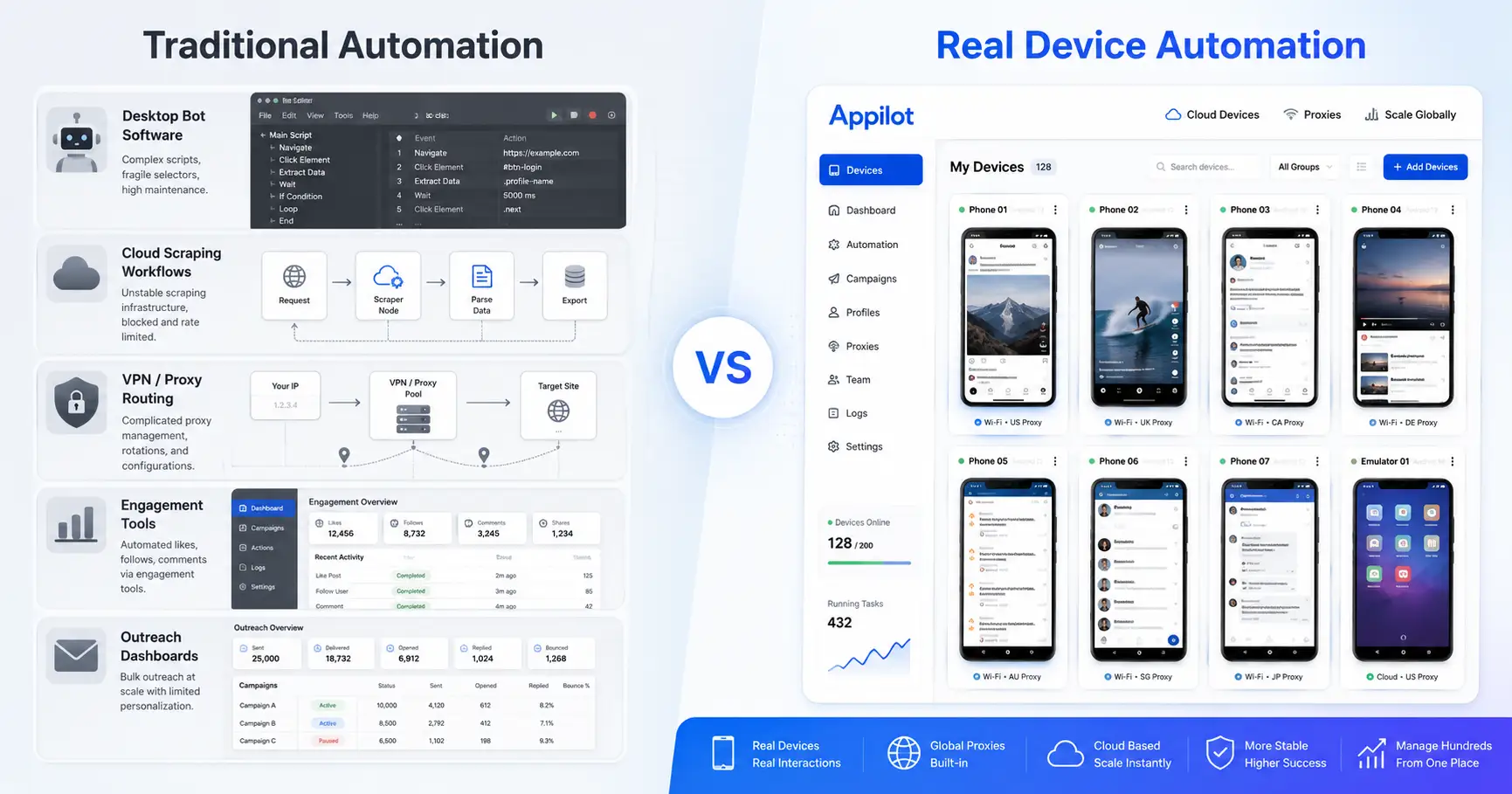
Appilot takes a different approach. Instead of focusing on desktop-style automation, Appilot runs bots on real Android devices and emulators through a remote web dashboard. That makes it more relevant for users who care about mobile-first behavior, no-ADB setup, no laptop dependency, and real-device workflows.
This comparison looks at Appilot vs FollowingLike from the perspective of multi-account growth. The goal is not to trash FollowingLike. It is to understand where each tool fits, what kind of user each one serves, and why real-device automation has become more important for modern social media operations.
What Is FollowingLike?
FollowingLike is a social media automation tool designed to help users manage and grow accounts across multiple platforms. Its website positions it as a tool for social network marketing and describes support for platforms including Instagram, Facebook, X, YouTube, Pinterest, Reddit, Tumblr, and Quora.
The tool focuses on automating repetitive social media actions. These can include creating posts, liking content, commenting, following accounts, sending direct messages, joining groups, adding friends, and managing social interactions from a central setup. Its features page also mentions functions such as automatically joining group chats and batch adding friends.
For users who want a traditional automation dashboard with broad platform coverage, FollowingLike can look attractive. It gives marketers and account operators a way to reduce repetitive manual work and manage multiple accounts with more structure.
The main limitation is that FollowingLike still feels closer to the older desktop-style automation category. That kind of workflow can be useful, but it may not be the best fit for users who want mobile-native behavior, real Android execution, and remote dashboard control without local machine dependency.
What Is Appilot?
Appilot is a social media automation platform that runs bots on real Android devices and emulators. Instead of relying on desktop scripts or browser-based workflows, Appilot lets automation happen inside mobile environments where many social apps naturally run.
This difference matters because platforms like Instagram, TikTok, Threads, Snapchat, Telegram, and YouTube are heavily mobile-first. A user scrolling, tapping, typing, waiting, and navigating inside the mobile app creates a different automation environment than a desktop-based bot performing similar actions from outside the mobile app layer.
Appilot is also designed to reduce technical setup problems. It does not require ADB, does not require users to keep a laptop connected, and does not depend on USB cables or local drivers. Users can manage bots, devices, accounts, and workflows from a web dashboard.
The platform also includes a bot store with ready-to-use automations for Instagram, TikTok, Twitter/X, LinkedIn, Discord, Reddit, Snapchat, YouTube, Threads, Telegram, Gmail, Chrome, and more.
For multi-account growth, Appilot’s main value is that it combines real-device automation with remote control, proxy support, and easier workflow management.
Appilot vs FollowingLike: The Core Difference
The biggest difference between Appilot and FollowingLike is the execution layer. FollowingLike is built around a more traditional social automation model, while Appilot is built around real Android automation.
FollowingLike focuses on managing social actions across multiple platforms from a centralized tool. That is useful for users who want broad automation coverage and campaign-style control. Its own material emphasizes multi-platform social marketing, engagement actions, posting, direct messaging, and social interaction management.
Appilot focuses on where the automation actually runs. Instead of treating social accounts mainly as dashboard objects, Appilot runs bots on Android devices and emulators, which makes the behavior closer to real mobile app usage.
That difference becomes important when users are managing many accounts. Platforms do not only look at what action was performed. They may also evaluate device patterns, login consistency, timing, app behavior, IP history, browser signals, and whether the activity looks natural.
No automation platform can guarantee complete safety. Bad proxies, aggressive limits, weak accounts, repetitive messages, and poor warmup can still create problems. But real-device automation gives users a stronger starting point than workflows that depend heavily on desktop-style execution.
Multi-Account Management
FollowingLike is built for users who want to manage multiple accounts and automate repetitive actions across social platforms. Its own blog describes it as a tool that allows users to manage social media accounts from one dashboard, including Reddit account management and automation for tasks such as growing community members and upvotes.
That makes FollowingLike useful for users who want a traditional multi-account control center. If the goal is to configure accounts, automate repeated tasks, and keep campaigns organized from one place, FollowingLike fits that older dashboard-driven model.
Appilot also supports multi-account workflows, but the workflow is more focused on device-based automation. Instead of only organizing accounts in a desktop-style control system, Appilot lets users connect automation to Android devices or emulators and manage the process remotely.
This is useful for agencies and phone farm operators because multi-account growth is not only about having many accounts in one panel. It is about making sure each account has a believable environment, proper proxy handling, realistic behavior, and stable execution.
For users who care about mobile-first account behavior, Appilot has the stronger structure.
Setup and Ease of Use
FollowingLike can be useful for users who are comfortable with traditional automation software. The tool is designed for people who want control over multiple social actions and are willing to configure workflows, accounts, proxies, and campaign behavior.
That setup can work well for experienced operators, but it may feel heavy for users who want something easier to manage remotely. Desktop-style automation often brings maintenance tasks with it, including software setup, machine uptime, local configuration, and troubleshooting when something stops working.
Appilot is designed to reduce that operational burden. Since it works through a web dashboard and runs bots on Android devices or emulators, users do not need to keep a laptop connected all day.
The no-ADB setup is also important. ADB can be powerful for developers, but for everyday automation it often creates friction. It can lead to cable dependency, driver issues, device disconnects, battery drain, and setup confusion.
Appilot avoids that workflow, which makes it easier for users who want automation without becoming device infrastructure managers.
Real-Device Automation vs Desktop-Style Bots
Real-device automation is Appilot’s biggest advantage in this comparison.
FollowingLike focuses on automating social media actions, but it belongs closer to the desktop-style automation category. That kind of tool can still be useful for certain workflows, especially if the user wants broad social management from one dashboard.
The issue is that many modern social platforms are mobile-first. Instagram, TikTok, Snapchat, Threads, Telegram, and YouTube are not just websites with mobile apps attached. Their most natural user behavior often happens inside the mobile app.
Appilot is built around that environment. Bots can interact with apps through Android devices and emulators, moving through the UI in ways that look closer to normal mobile sessions.
This does not mean Appilot removes all risk. It does mean the automation layer better matches the platforms where multi-account growth usually matters most.
For users who are serious about account quality and long-term operations, the execution environment matters as much as the feature list.
Platform Coverage
FollowingLike supports a wide set of platforms. Its pricing page mentions Instagram, Facebook, X, YouTube, Pinterest, Reddit, Tumblr, and Quora in relation to the software’s platform support.
That broad coverage is one of FollowingLike’s strongest points. It can appeal to users who want one tool for many older social marketing workflows, especially across platforms where posting, commenting, following, messaging, or group actions are part of the strategy.
Appilot also supports a wide platform set, including Instagram, TikTok, Twitter/X, LinkedIn, Discord, Reddit, Snapchat, YouTube, Threads, Telegram, Gmail, Chrome, and more.
The important distinction is that Appilot’s platform support is paired with Android device execution. This makes it especially relevant for mobile-heavy platforms like TikTok, Instagram, Threads, Snapchat, and Telegram.
If someone wants broad social automation coverage with a more traditional tool, FollowingLike may still be worth considering. If someone wants automation that better matches mobile app behavior, Appilot is the stronger fit.
Proxy Support and Account Separation
Proxy support matters for any serious multi-account growth setup. When several accounts share poor network patterns, platforms can link them more easily or treat the activity as suspicious.
FollowingLike is commonly used with proxies, and proxy providers market dedicated proxy setups for FollowingLike users. Proxy-Seller, for example, describes FollowingLike proxies as a way to support SMM promotion, multi-account activity, private proxy use, and social automation workflows.
Appilot also supports proxy-based workflows, including mobile and residential proxies. This is important because real-device automation still needs strong network separation. A real Android device workflow can become risky if many accounts run through weak or reused proxies.
The practical difference is that Appilot combines proxy support with Android device behavior and remote dashboard control. That gives operators a more complete environment for multi-account management.
Good proxies are not optional for serious automation. They are part of the foundation. Appilot’s advantage is that proxies fit into a more mobile-native automation system.
Remote Control and Laptop Dependency
FollowingLike gives users a centralized place to manage automation, but the workflow still feels closer to traditional desktop automation. That means users may need to think about machine uptime, software access, and local environment reliability.
Appilot is built for remote control from the start. Users can manage bots and devices through a web dashboard without keeping their personal laptop connected all day.
This matters more as the number of accounts grows. A single account can be managed manually. Ten accounts can be managed with basic tools. But fifty or one hundred accounts need a system that reduces manual maintenance.
For agencies, remote teams, and phone farm operators, Appilot’s web dashboard is a major advantage. It makes automation easier to monitor, adjust, and scale without tying the whole workflow to one machine.
Where FollowingLike Wins
FollowingLike wins when the user wants a broad, traditional social automation tool with many supported platforms and familiar campaign-style actions.
It can be useful for users who want to automate actions like posting, liking, commenting, following, direct messaging, group interactions, and multi-platform account management. Its official site and feature pages clearly position it around those types of workflows.
FollowingLike may also appeal to users who prefer a more classic automation setup and are comfortable managing proxies, account settings, and campaign behavior manually.
For users who mainly care about broad dashboard functionality and do not need real Android execution, FollowingLike can still look useful.
The trade-off is that this kind of workflow may feel less aligned with mobile-first platforms in 2025.
Where Appilot Wins
Appilot wins when the user wants real-device automation, remote control, and a workflow built for mobile-first social platforms.
Its biggest advantage is that bots run on Android devices and emulators instead of depending on desktop-style execution. This helps the automation environment better match how users actually interact with apps like Instagram, TikTok, Threads, Snapchat, Telegram, and YouTube.
Appilot also wins on setup simplicity. It does not require ADB, laptop dependency, USB cables, or driver troubleshooting. That makes it easier for non-technical users and more practical for large account operations.
The web dashboard is another advantage. Agencies and phone farm operators can manage bots remotely instead of relying on a single local machine.
The bot store also makes Appilot easier to start with. Users do not need to build every workflow manually, and teams with specific needs can still use custom bot development.
For modern multi-account growth, Appilot is the stronger choice if mobile behavior and operational simplicity matter.
Who Should Use FollowingLike?
FollowingLike is a better fit for users who want a traditional multi-platform social automation tool and are comfortable with campaign-style setup.
It may suit users who want broad platform coverage, manual configuration, and familiar automation actions such as following, liking, commenting, posting, and direct messaging.
It can also make sense for operators who already understand proxy setup and do not mind managing a more traditional automation environment.
But users who care about real mobile app behavior, no-ADB setup, and remote Android device automation may find FollowingLike less aligned with their needs.
Who Should Use Appilot?
Appilot is a better fit for phone farm operators, social media agencies, growth teams, and users managing multiple accounts across mobile-first platforms.
It is especially useful for people who want to run automation on real Android devices or emulators without dealing with ADB, cables, drivers, or laptop dependency.
Appilot also fits users who want ready-to-use bots from a bot store instead of building every automation workflow from scratch.
If the goal is to manage multi-account growth in a way that feels modern, mobile-native, and easier to operate remotely, Appilot is the better option.
Final Verdict
FollowingLike is a broad social media automation tool with multi-platform support and familiar campaign-style actions. It can make sense for users who want a traditional dashboard for social automation and are comfortable managing setup details themselves.
Appilot is the stronger choice for users who want real-device automation, no ADB, no laptop dependency, proxy support, remote dashboard control, and mobile-first workflows.
If your priority is classic multi-platform automation, FollowingLike may be worth reviewing. If your priority is multi-account growth on mobile-first platforms with a more modern execution layer, Appilot is the better fit.
You can explore Appilot’s bot store and try it at appilot.app.
FAQ
Q1: What is the biggest difference between Appilot and FollowingLike?
FollowingLike is closer to traditional desktop-style social automation, while Appilot runs bots on real Android devices and emulators. Appilot is stronger for mobile-first workflows.
Q2: Is Appilot a FollowingLike alternative?
Yes, Appilot is a FollowingLike alternative for users who want real-device automation, remote dashboard control, no ADB, and multi-account growth workflows.
Q3: Does FollowingLike support multiple platforms?
Yes, FollowingLike supports multiple platforms, including Instagram, Facebook, X, YouTube, Pinterest, Reddit, Tumblr, and Quora.
Q4: Does Appilot require ADB or a laptop?
No, Appilot works without ADB and does not require users to keep a laptop connected. Bots can be managed remotely through a web dashboard.
Q5: Who should use Appilot instead of FollowingLike?
Appilot is best for agencies, phone farm operators, and growth teams that want real Android automation across mobile-first social platforms.