Appilot vs Fuelgram: Instagram Engagement Automation Compared
Instagram engagement automation can mean very different things depending on the tool. For some platforms, it means boosting likes and comments on new posts. For others, it means running full automation workflows inside the Instagram app, including actions that look closer to how a real user would interact with the platform.
That difference is what makes the comparison between Appilot and Fuelgram important.
Fuelgram has been known more as an Instagram engagement exchange or engagement group platform than a traditional bot. Older reviews describe it as a service where users exchange likes, comments, and views to improve Instagram performance, rather than a tool that automates follows, unfollows, spam comments, or direct bot actions.
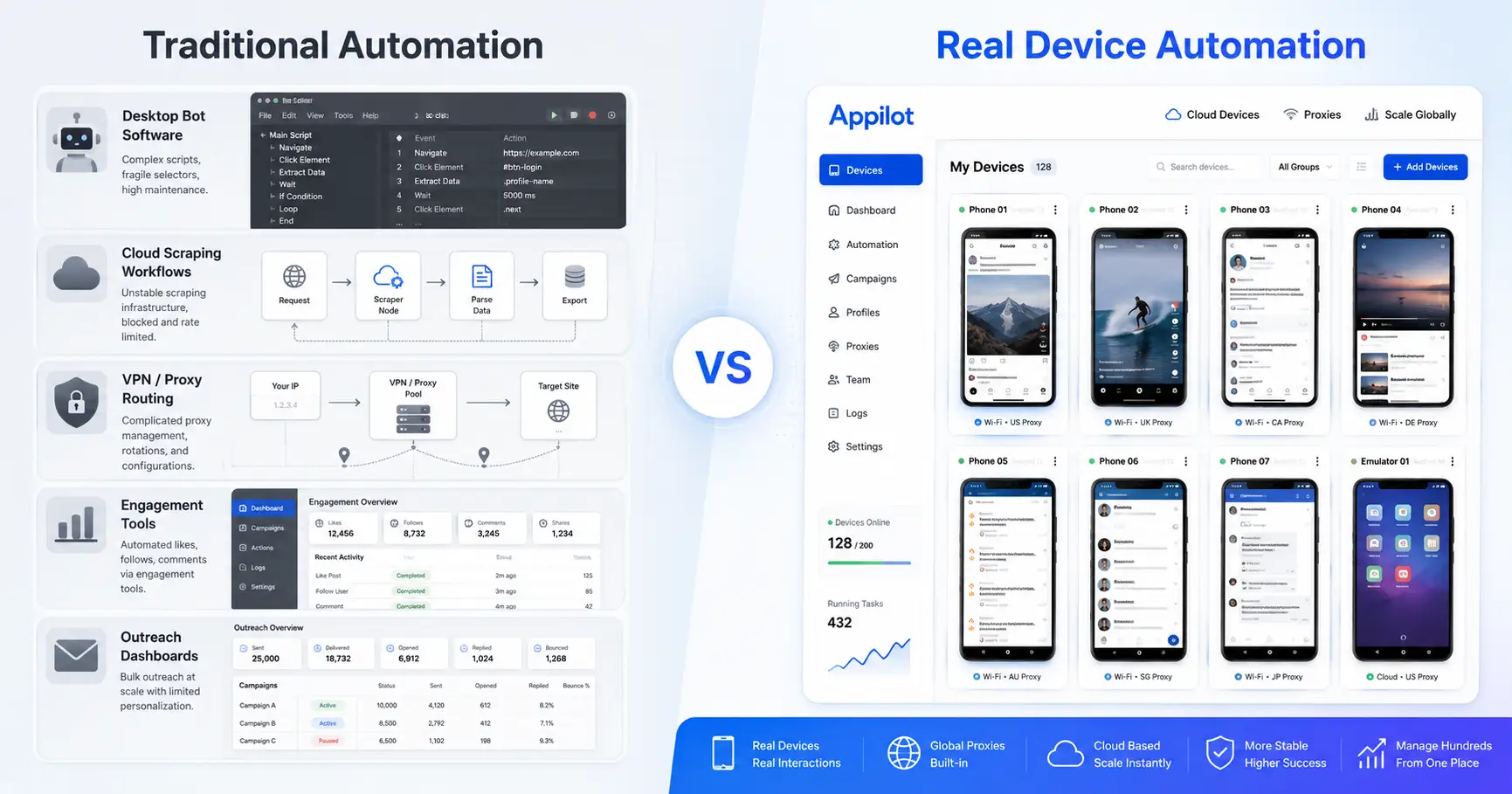
Appilot takes a different approach. It is not just an engagement boost tool. It runs bots on real Android devices and emulators through a remote web dashboard, which makes it useful for users who want broader Instagram automation and multi-account workflows.
This blog compares Appilot vs Fuelgram from a practical point of view: engagement exchange versus real-device automation, post boosts versus full workflow control, and which option makes more sense for users who care about Instagram growth in 2025.
What Is Fuelgram?
Fuelgram is best understood as an Instagram engagement exchange platform. Instead of acting like a classic Instagram bot that automatically follows, unfollows, comments, or messages random users, Fuelgram’s model has historically been based around users exchanging engagement with each other.
That means the core value is post engagement. A user publishes a post, Fuelgram detects or receives that post, and then the post can receive likes or comments from other users inside its network. The idea is to create early engagement so the post has a better chance of performing well.
This kind of tool can be attractive for creators, influencers, and brands that care mainly about boosting visible engagement on Instagram posts. It is simpler than building a full automation system and can feel easier than managing bots, devices, proxies, or custom workflows.
The limitation is that Fuelgram is not the same category as a real-device automation platform. It focuses on engagement exchange, not broad Instagram account operation. If someone wants to automate app workflows, manage many accounts, control devices remotely, or run multi-platform bots, Fuelgram is not built for that job.
What Is Appilot?
Appilot is a social media automation platform that runs bots on real Android devices and emulators. Users control automation through a web dashboard, while the actual bot activity happens inside Android app environments.
For Instagram, this matters because the platform is mobile-first. Real users scroll feeds, open profiles, watch stories, tap buttons, type messages, view Reels, and interact through the mobile app interface.
Appilot is designed around that behavior. It uses Android automation through accessibility service and UIAutomator-based workflows, which allows bots to interact with apps in a way that is closer to real mobile usage.
Appilot also works without ADB, so users do not need to keep a laptop connected, manage USB cables, deal with drivers, or troubleshoot constant device disconnects.
The platform includes a bot store with ready-to-use automations for Instagram, TikTok, Twitter/X, LinkedIn, Discord, Reddit, Snapchat, YouTube, Threads, Telegram, Gmail, Chrome, and more.
Appilot vs Fuelgram: The Main Difference
The biggest difference between Appilot and Fuelgram is scope. Fuelgram is mainly about Instagram engagement exchange, while Appilot is about real-device automation.
Fuelgram helps with the engagement layer. Its value is centered around likes, comments, and post performance signals. That may help users who want more activity on a specific Instagram post.
Appilot works at the automation layer. It gives users the ability to run bots on Android devices and emulators, manage workflows remotely, and build automation around real mobile app behavior.
This difference matters because Instagram growth is not only about getting more likes on one post. Serious growth operations often involve account warmup, profile activity, content distribution, messaging workflows, multi-account management, proxy separation, and consistent app behavior.
Fuelgram may help with one part of the visibility problem. Appilot is better suited for users who need a full automation system.
Engagement Exchange vs Real Automation
Engagement exchange tools and automation platforms solve different problems.
Fuelgram-style engagement exchange focuses on boosting post activity. The user wants more likes, comments, or views on a post, and the platform helps coordinate engagement from other users.
That can be useful when the goal is visibility. Early engagement can sometimes help a post appear more active, especially when the comments are relevant and not spammy.
But engagement exchange does not replace real automation. It does not control the full Instagram workflow. It does not manage how accounts move through the app, warm up activity, send messages, interact with profiles, or perform repeatable tasks across many accounts.
Appilot is different because it gives users an automation environment. Bots can run inside Android devices and emulators, interact with Instagram through the app interface, and be managed remotely from a dashboard.
If the goal is only to increase engagement on posts, Fuelgram may be relevant. If the goal is to automate Instagram operations, Appilot is the better fit.
Instagram Account Safety
Instagram automation always carries risk if it is done poorly. That applies to engagement exchange tools, bots, growth services, and manual multi-account operations.
Fuelgram-style engagement exchange may feel safer than fake likes or low-quality bot traffic because the engagement can come from real users. However, engagement groups and artificial engagement still sit in a risky area because the activity is designed to manipulate performance signals.
Appilot’s advantage is not that it makes automation risk-free. No honest tool should claim that. The advantage is that it runs automation through real Android environments, which better matches how Instagram users normally interact with the app.
Account safety depends on the full setup. Proxy quality, action limits, account age, warmup strategy, content quality, timing, and message relevance all matter.
For serious users, the best approach is to avoid aggressive automation, avoid spammy behavior, and use tools that give more control over how actions happen.
Multi-Account Operations
Fuelgram may be useful for creators or brands that want to improve engagement on Instagram posts, but it is not built as a full multi-account operations system.
If someone manages one account and only cares about post engagement, a tool like Fuelgram may seem simple. But if someone manages many accounts, the needs become more complex.
Multi-account operators need to separate accounts, manage proxies, control device behavior, schedule activity, monitor workflows, and avoid making every account behave the same way.
Appilot is stronger for this use case because it is built around real Android devices and emulators. Users can manage bots remotely, run workflows across accounts, and build a more stable automation setup.
For agencies, growth teams, and phone farm operators, this difference is important. Managing account operations requires more than likes and comments. It requires infrastructure.
Setup and Ease of Use
Fuelgram’s appeal is simplicity. A user does not need to build a full automation system just to get engagement on a post. The workflow is easier to understand because the goal is narrow: increase likes, comments, or views through an engagement network.
That simplicity can be valuable for creators who only want post boosts and do not want to think about devices, automation scripts, proxies, or workflow design.
Appilot is more powerful because it gives users a complete automation environment, but that also means it is aimed at users with broader goals. It is for people who want to run bots, control devices, manage workflows, and automate across platforms.
The setup is still designed to be easier than traditional mobile automation because Appilot does not require ADB or laptop dependency. Users can manage everything through a web dashboard.
So the better choice depends on the use case. Fuelgram is simpler for engagement boosts. Appilot is better for users who want actual automation control.
Remote Control and Device Layer
Fuelgram does not solve the device layer problem because it is not designed as a device automation platform. Its value is tied to post engagement, not controlling how an account behaves inside the Instagram app.
Appilot is built around the device layer. Bots run on Android devices and emulators, which makes the automation environment closer to real mobile behavior.
This matters because Instagram is not just a content feed. It is an app where user behavior includes scrolling, tapping, watching, messaging, viewing stories, opening profiles, and moving between screens.
A tool that only boosts engagement does not control those workflows. Appilot does.
The remote dashboard also makes Appilot more useful for teams. Users can manage bots without keeping a laptop connected all day, which is especially helpful for agencies and phone farm operators.
Proxy Support and Growth Infrastructure
Fuelgram-style engagement exchange may not require the same infrastructure as a full automation platform because the tool is not mainly about running many device-based actions across accounts.
Appilot is different because it is built for users who need automation infrastructure. It supports proxy-based workflows, including mobile and residential proxies, which are important for multi-account management.
Good proxies do not guarantee safety, but they help with account separation. When combined with real Android automation, careful action limits, and better warmup, they create a stronger system.
For serious Instagram growth, infrastructure matters. It is not enough to only think about likes or comments. Users need to think about how each account appears, how it behaves, where it logs in from, and how often it takes actions.
Appilot is better suited to that level of operation.
Where Fuelgram Wins
Fuelgram wins when the user only wants Instagram engagement support. If the goal is to boost likes, comments, or views on posts through an engagement network, Fuelgram’s model is easier to understand than a full automation platform.
It may also appeal to creators who do not want to run bots themselves. Instead of managing devices or workflows, they can focus on post-level engagement.
Fuelgram may also feel less technical for users who do not need broader automation. If someone only wants help with Instagram post visibility, it can be a simpler category.
The trade-off is that Fuelgram is narrow. It does not replace a real automation system for users who need account workflows, multi-account management, device behavior, or multi-platform growth.
Where Appilot Wins
Appilot wins when the user wants real Instagram automation instead of only engagement exchange.
Its biggest advantage is that bots run on real Android devices and emulators. This makes the automation environment more aligned with how Instagram is actually used.
Appilot also wins on control. Users can manage bots remotely from a web dashboard, avoid ADB, avoid laptop dependency, and run workflows across multiple accounts.
The bot store gives users ready-to-use automations, while custom bot development gives teams more flexibility when they need a specific workflow.
Appilot also works beyond Instagram. Users can automate workflows for TikTok, Twitter/X, LinkedIn, Discord, Reddit, Snapchat, YouTube, Threads, Telegram, Gmail, Chrome, and more.
For users who want a real automation platform, Appilot is the stronger choice.
Who Should Use Fuelgram?
Fuelgram is a better fit for users who only care about Instagram engagement boosts.
It may work for creators, influencers, or brands that want more likes and comments on specific posts and do not need a full automation system.
It also fits users who want something simpler than running bots or managing devices.
But anyone using engagement exchange should understand that artificial engagement can still carry risk and may not build real long-term audience quality by itself.
Who Should Use Appilot?
Appilot is better for users who want to automate Instagram workflows through real Android devices or emulators.
It is especially useful for agencies, phone farm operators, growth teams, and multi-account users who need remote control, proxy support, no ADB, no laptop dependency, and ready-to-use bots.
Appilot also fits users who want to go beyond Instagram engagement and automate across multiple platforms.
If the goal is to build a serious automation setup instead of only boosting individual posts, Appilot is the better option.
Final Verdict
Fuelgram and Appilot are not the same kind of tool. Fuelgram is best understood as an Instagram engagement exchange platform, while Appilot is a real-device automation platform.
If you only want more likes or comments on Instagram posts, Fuelgram may be relevant. It is simpler and more focused on post engagement.
If you want real Instagram automation, multi-account workflows, remote dashboard control, proxy support, no ADB, and Android-based execution, Appilot is the stronger choice.
For creators focused only on engagement boosts, Fuelgram may be enough. For agencies, phone farm operators, and growth teams that need full workflow automation, Appilot is the better fit.
You can explore Appilot’s bot store and try it at appilot.app.
FAQ
Q1: What is the biggest difference between Appilot and Fuelgram?
Fuelgram focuses on Instagram engagement exchange, while Appilot runs bots on real Android devices and emulators. Appilot is stronger for full automation workflows.
Q2: Is Appilot a Fuelgram alternative?
Yes, Appilot is a Fuelgram alternative for users who want real Instagram automation instead of only likes, comments, or engagement boosts.
Q3: Is Fuelgram a full Instagram bot?
Fuelgram is better understood as an engagement exchange platform, not a full real-device Instagram automation system. Its focus is post engagement.
Q4: Does Appilot require ADB or a laptop?
No, Appilot works without ADB and does not require users to keep a laptop connected. Bots can be managed through a remote web dashboard.
Q5: Who should use Appilot instead of Fuelgram?
Appilot is best for agencies, phone farm operators, and growth teams that need real-device automation, proxy support, and multi-account workflows.