Appilot vs Instazood: Which Tool Gives Better Instagram Growth Results?
Instagram growth tools are easy to find, but tools that still make sense in 2025 are harder to choose.
A lot of older Instagram bots promised the same thing: more followers, more likes, more comments, more DMs, and less manual work. Instazood became known in that category because it offered classic Instagram automation features like auto likes, follows, comments, unfollows, direct messages, story views, and post scheduling.
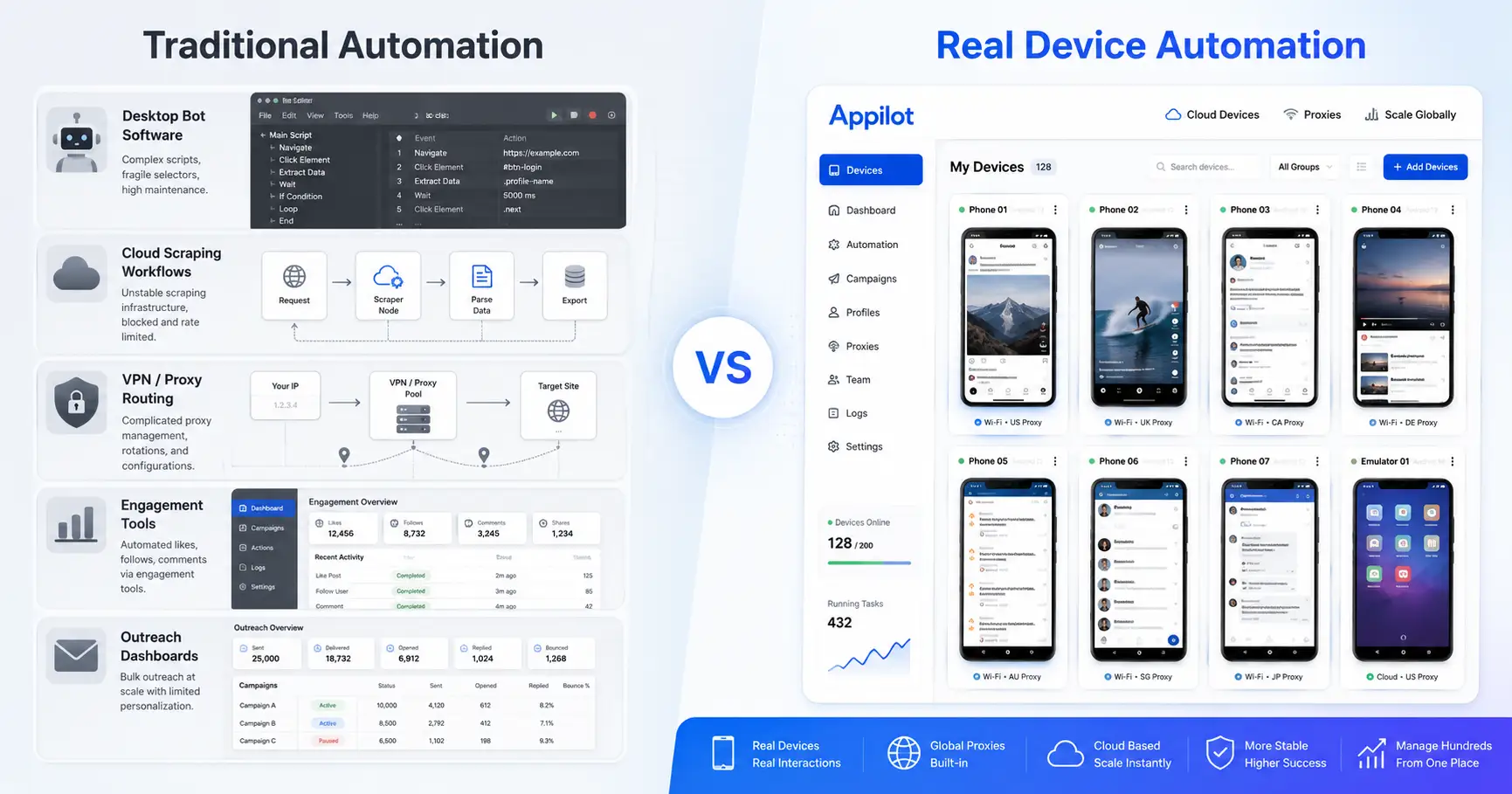
Appilot takes a different approach. Instead of being only a classic Instagram growth bot, Appilot runs automation on real Android devices and emulators through a remote web dashboard. That makes it more focused on mobile app behavior, real-device workflows, and multi-account operations.
The difference matters because Instagram growth is no longer only about performing more actions. It is about how those actions happen, what environment they come from, how natural the timing looks, how accounts are warmed up, and whether the automation setup matches real mobile usage.
This blog compares Appilot vs Instazood from a practical Instagram growth perspective: which tool is easier to trust, which one fits modern account safety better, and which one makes more sense for agencies, phone farm operators, and users managing multiple Instagram accounts.
What Is Instazood?
Instazood is known as an Instagram automation tool that helps users grow followers and engagement by automating common Instagram actions. Public listings and older reviews describe Instazood as a bot for auto liking, following, commenting, unfollowing, sending DMs, viewing stories, and scheduling posts.
That kind of feature set made Instazood attractive to users who wanted faster Instagram growth without spending hours manually engaging with accounts. The idea was simple: define targeting, let the bot interact with users, and hope that some of those interactions turn into profile visits, follows, replies, or engagement.
Instazood also included tools around post scheduling, comment management, and direct messages, which made it more useful than a basic like-and-follow bot.
The challenge is that classic Instagram bots have become riskier over time. Instagram has improved its ability to detect unnatural engagement patterns, repeated actions, weak session signals, poor proxy setups, and behavior that does not match normal user activity.
So while Instazood may still be recognized as an Instagram growth tool, users should evaluate whether its traditional bot model is the right fit for modern Instagram automation.
What Is Appilot?
Appilot is a social media automation platform that runs bots on real Android devices and emulators. Users control automation from a web dashboard, while the actual actions happen inside Android app environments.
For Instagram, this is important because Instagram is a mobile-first platform. Real users usually scroll feeds, open profiles, watch stories, view Reels, tap buttons, send messages, reply to comments, and move through the mobile app interface.
Appilot is built around that behavior. It uses Android automation through accessibility service and UIAutomator-based workflows, allowing bots to interact with apps through mobile UI actions instead of relying only on traditional bot-style workflows.
Appilot also works without ADB, which means users do not need to keep a laptop connected, manage USB cables, deal with drivers, or troubleshoot constant device disconnects.
The platform also includes a bot store with ready-to-use automations for Instagram, TikTok, Twitter/X, LinkedIn, Discord, Reddit, Snapchat, YouTube, Threads, Telegram, Gmail, Chrome, and more.
Appilot vs Instazood: The Main Difference
The biggest difference between Appilot and Instazood is the automation environment.
Instazood is best understood as a classic Instagram bot. It focuses on growth actions such as likes, follows, comments, DMs, story views, unfollows, and scheduling. That can be useful when the user wants a straightforward Instagram growth tool.
Appilot focuses on real-device automation. Instead of treating Instagram growth as a list of bot actions, Appilot runs workflows through Android devices and emulators, which creates a stronger match with how Instagram is actually used.
This matters because Instagram does not only care about whether an account liked a post or sent a DM. It can also evaluate patterns around speed, repetition, timing, device signals, session behavior, account history, and network quality.
No automation tool can guarantee complete safety. Aggressive limits, weak proxies, poor warmup, repetitive messages, and low-quality accounts can still create problems.
But Appilot gives users a better foundation because the automation happens in a mobile app environment rather than only through a traditional bot model.
Instagram Growth Results
Instazood’s growth model is based on classic engagement automation. The tool performs actions that may attract attention from other users, such as liking posts, following accounts, commenting, viewing stories, or sending direct messages.
That model can create visible activity, especially if the targeting is good and the account is already healthy. A user may get profile visits, replies, follows, or engagement from people who notice the activity.
The weakness is that Instagram growth results from this kind of automation can be inconsistent. If the targeting is poor, the account looks spammy, or the action limits are too aggressive, the result may be low-quality followers, low engagement, action blocks, or account restrictions.
Appilot is not a magic growth shortcut either. It still depends on strategy, content quality, targeting, proxies, timing, and account quality.
The difference is that Appilot gives users a better operating layer. Since bots run inside Android environments, users can build workflows that are closer to real mobile app behavior.
For long-term Instagram growth, that matters more than simply having a long list of automated actions.
Account Safety and Detection Risk
Instagram automation always comes with risk, especially when the tool performs repeated engagement actions. The platform can detect suspicious behavior when accounts follow too quickly, like too many posts, send repetitive DMs, reuse weak proxies, or behave in ways that do not match normal users.
Instazood-style bots can be useful, but classic bot workflows are more exposed to these risks because they are often built around repeated growth actions.
Appilot reduces some of this risk by focusing on real Android automation. Bots can interact with the Instagram app through mobile UI flows, including taps, swipes, typing, waiting, scrolling, and app navigation.
This does not make Appilot undetectable. No honest platform should claim that. Instagram can still flag accounts if users automate too aggressively or ignore basic safety rules.
The advantage is that Appilot’s real-device workflow is better aligned with Instagram’s mobile-first nature. For users who care about account safety, the automation environment is one of the most important parts of the setup.
Direct Messages and Outreach
Instazood includes direct message automation as part of its classic Instagram bot feature set. This can be useful for users who want to send welcome messages, promote offers, respond to followers, or start conversations with targeted users.
The challenge is that Instagram DM automation is one of the riskiest categories when used badly. Repetitive messages, mass outreach, weak personalization, and aggressive sending patterns can quickly make an account look spammy.
Appilot gives users a more flexible automation environment for DM workflows because bots can operate through Android app sessions. That means the automation can be designed around realistic timing, mobile UI navigation, and account-specific behavior.
The tool does not replace good outreach strategy. Users still need better targeting, cleaner copy, slower limits, and high-quality accounts.
But if the goal is to run Instagram DM workflows with more control over how the actions happen, Appilot is the better fit.
Scheduling and Content Workflows
Instazood has been associated with post scheduling and content management features, which can be useful for users who want to plan Instagram content in advance.
For simple scheduling, a traditional tool may be enough. Many users only need to upload content, choose a time, add captions, and publish later.
Appilot becomes more useful when the workflow goes beyond scheduling. If the user wants to combine posting with engagement, messaging, account warmup, story workflows, browsing behavior, or multi-account operations, a real-device automation system becomes more valuable.
Instagram growth is rarely just one action. A healthy account may need posting, replying, browsing, story viewing, message handling, and gradual engagement patterns.
Appilot is better suited for that broader workflow because it can run bots inside Android app environments instead of only handling isolated Instagram tasks.
Multi-Account Growth
Multi-account Instagram growth is where the difference between Appilot and Instazood becomes clearer.
A single account can sometimes be managed with a basic bot or scheduling tool. But once a user manages multiple accounts, the requirements change. They need account separation, proxy support, behavior variation, device consistency, remote control, and stable execution.
Instazood can help with Instagram actions, but the traditional growth bot model may feel limited for operators managing many accounts at scale.
Appilot is stronger because it is designed around real Android devices and emulators. Users can manage bots remotely, run workflows through mobile environments, and build more realistic operating patterns across accounts.
This makes Appilot more practical for agencies, phone farm operators, and growth teams that need more than a basic Instagram bot.
Proxy Support and Growth Infrastructure
Proxy quality matters for Instagram growth. If multiple accounts share poor IP patterns or suspicious network behavior, Instagram may connect the accounts or restrict them.
Instazood users still need to think about proxies, timing, warmup, and limits. A bot can perform actions, but it cannot fix a weak infrastructure setup.
Appilot supports proxy-based workflows, including mobile and residential proxies. This is important because real-device automation should be paired with good network separation.
A strong Instagram growth setup is not just a tool. It is a system made of account quality, proxies, timing, content, device behavior, and realistic automation.
Appilot gives users a better foundation for that system because it combines Android execution, remote control, proxy support, and ready-to-use bots.
Where Instazood Wins
Instazood wins when the user wants a straightforward Instagram growth bot with familiar actions like auto likes, follows, comments, unfollows, DMs, story views, and scheduling.
It may appeal to users who only care about Instagram and want a tool that is easy to understand from a classic growth automation perspective.
Instazood can also be useful as a reference point for users comparing older Instagram bot models. Its feature set reflects the style of automation many Instagram growth tools were built around.
The trade-off is that classic bot workflows are more sensitive in 2025. Instagram has become stricter, and users need to think beyond simple automated actions.
If someone wants more realistic mobile app behavior and better operational control, Appilot is stronger.
Where Appilot Wins
Appilot wins when the user wants Instagram automation that runs through real Android devices and emulators.
Its biggest advantage is the execution environment. Bots operate inside Android app workflows, which better matches how Instagram is used by real people.
Appilot also wins on remote control. Users can manage bots from a web dashboard without keeping a laptop connected all day.
The no-ADB setup is another major advantage. Users avoid cables, drivers, device disconnects, and battery drain issues.
Appilot also supports more than Instagram. Users can automate workflows across TikTok, Twitter/X, LinkedIn, Discord, Reddit, Snapchat, YouTube, Threads, Telegram, Gmail, Chrome, and more.
For users who want serious Instagram growth operations instead of only classic bot actions, Appilot is the better fit.
Who Should Use Instazood?
Instazood may fit users who want a traditional Instagram bot and are mainly focused on simple growth actions like liking, following, commenting, unfollowing, sending DMs, viewing stories, or scheduling posts.
It may also fit users who only want to understand older Instagram automation models and compare what classic bots offered.
However, users should be careful with aggressive Instagram automation. Classic bot actions can still lead to action blocks, poor engagement quality, or account restrictions if used carelessly.
For small, simple use cases, Instazood may be enough. For more serious operations, Appilot is more suitable.
Who Should Use Appilot?
Appilot is better for users who want Instagram automation through real Android devices or emulators.
It is especially useful for agencies, phone farm operators, growth teams, outreach teams, and multi-account users who need remote control, proxy support, no ADB, no laptop dependency, and ready-to-use bots.
Appilot also fits users who want to go beyond Instagram and manage automation across several platforms from one system.
If the goal is realistic mobile app behavior, scalable account operations, and better infrastructure for long-term Instagram growth, Appilot is the stronger choice.
Final Verdict
Instazood is a classic Instagram bot focused on actions like auto likes, follows, comments, DMs, story views, unfollows, and scheduling. It can make sense for users who want a simple Instagram growth tool and understand the risks of traditional automation.
Appilot is the stronger choice for users who want modern Instagram automation. It runs bots on real Android devices and emulators, works without ADB, does not require a laptop, supports proxy-aware workflows, and gives users remote dashboard control.
If you only need basic Instagram bot actions, Instazood may be worth reviewing. If you want better infrastructure for real-device Instagram automation and multi-account growth, Appilot is the better fit.
You can explore Appilot’s bot store and try it at appilot.app.
FAQ
Q1: What is the biggest difference between Appilot and Instazood?
Instazood is a classic Instagram bot, while Appilot runs bots on real Android devices and emulators. Appilot is stronger for mobile-first automation.
Q2: Is Appilot an Instazood alternative?
Yes, Appilot is an Instazood alternative for users who want Instagram automation with real-device workflows, proxy support, no ADB, and remote control.
Q3: Does Instazood help with Instagram growth?
Instazood is known for classic growth actions like auto likes, follows, comments, DMs, story views, and scheduling. Results depend heavily on targeting, limits, and account quality.
Q4: Does Appilot require ADB or a laptop?
No, Appilot works without ADB and does not require users to keep a laptop connected. Bots can be managed through a remote web dashboard.
Q5: Who should choose Appilot over Instazood?
Appilot is best for agencies, phone farm operators, and growth teams that need real Android automation, multi-account workflows, and safer infrastructure.