Appilot vs Jarvee: Which Social Media Automation Tool Is Better in 2025?
If you are searching for a Jarvee alternative in 2025, you are probably not just comparing two random automation tools. You are likely looking for the kind of control Jarvee used to offer, but with a setup that still makes sense for today’s social media platforms.
Jarvee was once one of the most popular social media automation tools for growth hackers, agencies, and multi-account operators. It helped users automate tasks like following, liking, commenting, direct messaging, reposting, and scheduling across different platforms from one desktop-based environment.
But Jarvee is no longer an active public service. The official Jarvee website says the service is permanently closed, and Proxyway reported in September 2022 that Jarvee became unavailable to buy or download publicly.
That makes this comparison slightly different from a normal “tool vs tool” article. The real question is not whether Jarvee was useful in its time. It clearly was. The better question is whether Appilot is a better fit for the way social media automation needs to work in 2025.
This guide compares Appilot vs Jarvee based on automation style, setup, device behavior, remote control, proxy support, multi-account workflows, and practical usability for agencies and phone farm operators.
What Was Jarvee?
Jarvee was a Windows-based social media automation tool built for people who wanted to manage many social accounts from one place. It was used by marketers, growth teams, agencies, affiliate operators, and account managers who needed to automate repetitive engagement and posting actions.
Its main strength was control. Users could configure campaigns, set delays, manage proxies, choose sources, run follow and unfollow workflows, automate engagement, and schedule content. For experienced operators, that level of control made Jarvee very attractive.
Jarvee also had a strong reputation because it supported several major platforms historically, including Instagram, Facebook, Twitter, LinkedIn, Pinterest, Tumblr, and YouTube. For years, it was one of the tools people mentioned first when discussing social media automation.
The weakness was the environment. Jarvee depended on a desktop or Windows VPS setup, which meant users had to keep that machine running, maintain the software, manage proxies, and monitor campaigns from that local or remote desktop system.
That model worked better in the older automation landscape. In 2025, social platforms are stricter, mobile behavior is more important, and desktop-style automation can be easier to identify when accounts perform repeated actions at scale.
What Is Appilot?
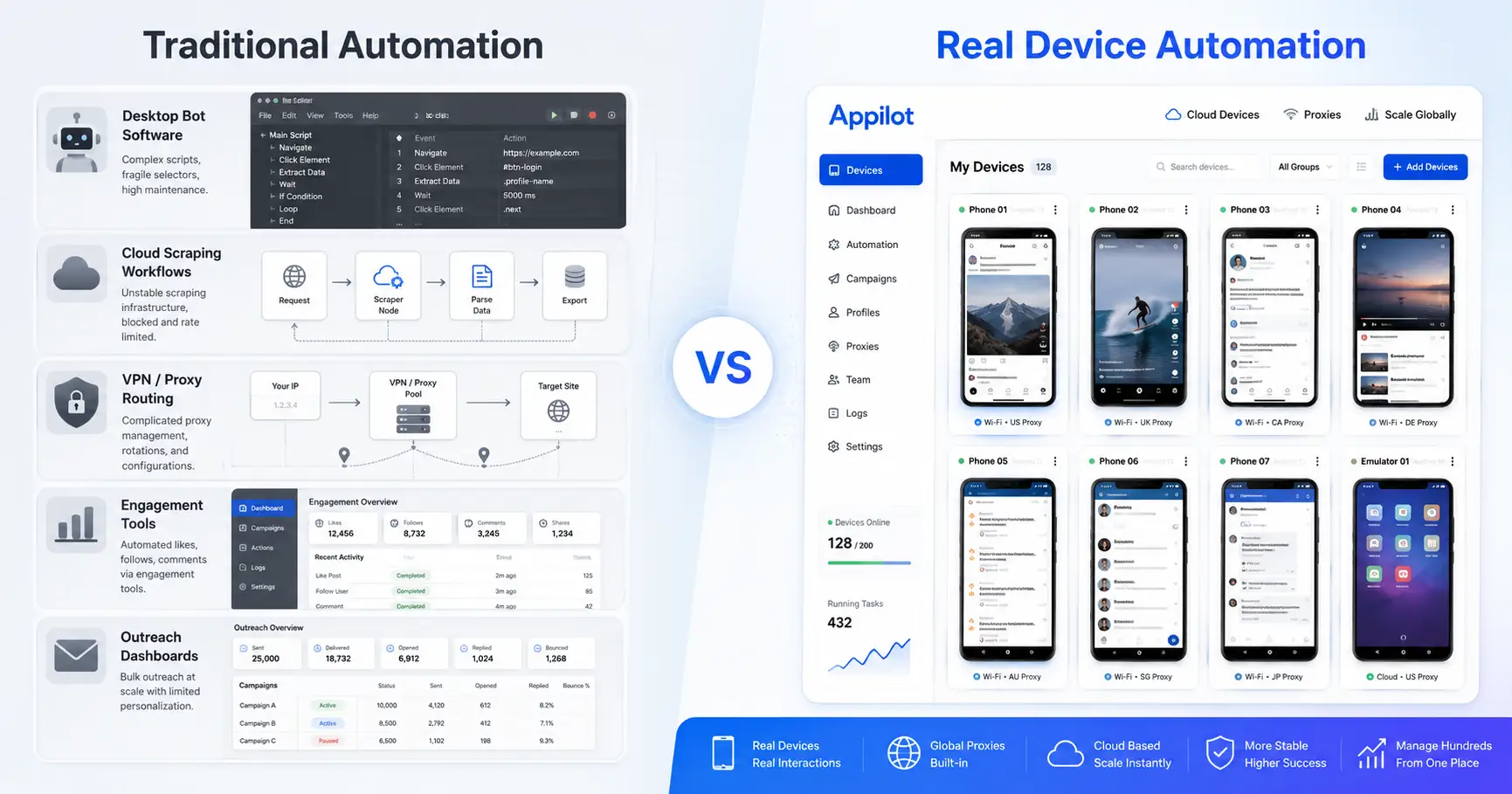
Appilot is a social media automation platform that runs bots on real Android devices and emulators through a remote web dashboard. Instead of depending on desktop scripts, browser automation, or API-style workflows, Appilot runs automation inside mobile environments where social apps naturally operate.
This is the main reason Appilot feels different from older Jarvee-style tools. It is not trying to recreate mobile behavior from a desktop machine. It lets automation happen through Android devices and emulators, using app interfaces where actions can look closer to normal mobile usage.
Appilot works without ADB, which removes a major pain point from mobile automation. Users do not need to keep devices connected to a laptop, fight driver issues, manage USB cable problems, or deal with constant device disconnects. The automation can be managed from a web dashboard, which makes it easier for agencies, phone farm operators, and remote teams.
Appilot also includes a bot store with ready-to-use automations for platforms like Instagram, TikTok, Twitter/X, LinkedIn, Discord, Reddit, Snapchat, YouTube, Threads, Telegram, Gmail, Chrome, and more.
Appilot vs Jarvee: The Main Difference
The biggest difference between Appilot and Jarvee is the automation environment. Jarvee was a desktop-based tool, while Appilot is built around real Android devices and emulators.
That difference matters because social platforms are no longer only looking at simple signals like how many actions an account performs. They can also evaluate device patterns, session behavior, login consistency, network signals, interaction timing, browser fingerprints, and whether an account behaves like a normal user over time.
Jarvee came from an era where desktop-based automation could still scale across many workflows. Appilot is built for a more mobile-first automation world, where platforms like Instagram, TikTok, Threads, Snapchat, YouTube, and Telegram are better matched with mobile app behavior.
This does not mean Appilot makes accounts impossible to detect or ban. No serious automation platform should claim that. Account safety still depends on action limits, account quality, proxy quality, warmup strategy, content behavior, and how aggressively the user runs automation.
But as a starting point, real-device automation is better aligned with how modern mobile-first platforms expect users to interact.
Setup and Ease of Use
Jarvee required a Windows environment, either on a local machine or a VPS. This was manageable for experienced users, but it created friction for beginners and teams that did not want to maintain a desktop automation setup.
Users had to install the software, keep the machine running, configure accounts, assign proxies, manage campaigns, adjust settings, and monitor performance. If the computer went offline or the VPS had issues, automation could stop.
Appilot is simpler because the user does not need to keep a laptop running. The workflow is controlled through a web dashboard, while automation runs on Android devices or emulators. This makes it easier to manage multiple accounts without turning one local computer into the center of the whole operation.
The no-ADB setup also makes a big difference. ADB is useful for developers, but it can become frustrating at scale because it introduces cable dependency, driver problems, device disconnects, and battery drain. Appilot avoids that workflow, which makes it easier for non-technical users and more stable for teams managing many devices.
For someone who wants less setup friction and more remote control, Appilot is easier to operate than the old Jarvee model.
Remote Dashboard and Laptop-Free Automation
One of the biggest problems with desktop automation is dependency. If the desktop setup stops, the automation stops. If the VPS crashes, the campaigns stop. If the user’s laptop sleeps, disconnects, or has network issues, the workflow becomes unstable.
Jarvee users often solved this by running the tool on a Windows VPS, but that still meant maintaining a remote desktop environment. For technical users, this was acceptable. For agencies and operators managing many accounts, it added another layer of maintenance.
Appilot is built around remote dashboard control. Users can manage bots, devices, and workflows from a browser without keeping a laptop connected all day. This is especially useful for phone farm operators and social media agencies that need automation to run continuously without depending on one local machine.
The dashboard-first approach also makes collaboration easier. A team can monitor workflows remotely instead of relying on one person’s computer or one desktop session. For multi-account operations, that difference can save a lot of time.
Real-Device Automation and Detection Risk
Social media automation in 2025 is not just about whether a bot can perform an action. It is about whether the action happens in an environment that looks believable.
Desktop-based tools can be useful for some workflows, especially content scheduling or light account management. But engagement automation is more sensitive. Following, liking, commenting, messaging, scraping, and repeated interactions can trigger platform checks if they happen too quickly, too frequently, or from suspicious environments.
Appilot’s real-device approach helps because the automation runs through Android app environments. Actions can happen through mobile UI flows, including taps, swipes, typing, waiting, scrolling, and app navigation.
That does not remove all risk. Bad proxies, poor account warmup, repetitive messages, aggressive limits, and low-quality accounts can still create problems. But Appilot starts from a more natural mobile environment than a legacy desktop-based tool.
For platforms that are heavily mobile-first, this is a meaningful advantage.
Proxy Support and Multi-Account Workflows
Jarvee supported proxies, and that was one of the reasons it became popular with multi-account operators. Users could assign proxies to accounts and build workflows around account separation.
Appilot also supports proxy-based workflows, including mobile and residential proxies. This matters because multi-account automation needs clean separation between accounts, especially when users are running Instagram, TikTok, LinkedIn, Twitter/X, Reddit, Discord, or Telegram workflows at scale.
The difference is that Appilot combines proxy support with real Android automation and dashboard-based control. That makes it easier to think about the full system instead of managing proxies separately from desktop sessions, device behavior, and campaign settings.
For agencies and phone farm operators, this unified workflow is more practical. They can manage devices, bots, accounts, and proxy strategy in a way that better fits modern social automation.
Supported Platforms
Jarvee historically supported several social platforms and became known for helping users manage Instagram, Facebook, Twitter, LinkedIn, Pinterest, Tumblr, and YouTube workflows. That broad support was one of its strongest selling points.
Appilot supports a more modern set of platform workflows, including Instagram, TikTok, Twitter/X, LinkedIn, Discord, Reddit, Snapchat, YouTube, Threads, Telegram, Gmail, Chrome, and more.
The important part is not only the number of platforms. It is the type of environment those platforms expect. Many newer and high-value social workflows are mobile-first, which makes Android-based automation more relevant than older desktop-based setups.
This is especially true for Instagram, TikTok, Threads, Snapchat, and YouTube workflows where mobile app behavior can matter more than browser behavior.
Where Jarvee Wins
Jarvee deserves credit for its history. It had a strong reputation, a large user base, detailed campaign controls, and years of community knowledge behind it.
For advanced users, Jarvee offered a lot of flexibility. Users could tune campaign settings, adjust delays, manage sources, run multi-account workflows, and experiment with different strategies. That made it powerful for people who were willing to spend time learning the system.
Jarvee also shaped how many marketers think about automation. Even today, people searching for a Jarvee alternative are often really searching for the same sense of control Jarvee used to provide.
But Jarvee’s biggest problem is availability. Since the official service is permanently closed, it does not make sense as a tool for new users in 2025.
Where Appilot Wins
Appilot wins because it is active, mobile-first, remote-friendly, and easier to manage without technical setup problems.
The real Android automation model is the biggest advantage. Appilot runs bots through Android devices and emulators instead of relying on a desktop environment. For modern social platforms, this creates a workflow that better matches how users actually interact with mobile apps.
The no-ADB setup is another major advantage. Users do not need to handle cables, drivers, battery drain, or connection issues. That matters a lot when someone is managing more than a few accounts.
The web dashboard also makes Appilot more practical for agencies and remote operators. Instead of keeping a laptop or VPS session open, users can manage bots and devices from anywhere.
The bot store adds another benefit. Users can start with ready-to-use automations instead of building every workflow manually. For technical teams, custom bot development is still possible. For non-technical users, the ready-made workflow is much easier.
If the goal is to replace Jarvee with a modern automation setup, Appilot is the better fit.
Who Should Use Jarvee?
Jarvee is mostly useful today for people who want to understand the history of social media automation. If someone used Jarvee before, the ideas behind it can still help them evaluate newer tools.
Concepts like warmup, proxy separation, action limits, campaign sources, and multi-account structure are still relevant. But because the original service is closed, Jarvee is not a practical choice for someone who wants to start fresh in 2025.
If you are looking for an active tool, you should treat Jarvee as a reference point rather than a real option.
Who Should Use Appilot?
Appilot is a better fit for users who want mobile-first automation without managing desktop software, ADB, cables, drivers, or always-on laptops.
It makes sense for phone farm operators, social media agencies, growth teams, outreach teams, and non-technical users who want ready-to-use bots. It is also useful for people who previously depended on Jarvee-style automation but now need something more aligned with modern platform behavior.
Appilot is especially strong for users who manage multiple accounts across mobile-first platforms and want remote dashboard control.
Final Verdict
Jarvee was one of the most important social media automation tools of its time, but it is no longer an active public service. That alone makes it hard to recommend in 2025.
Appilot is the better choice for users who want a modern Jarvee alternative. It runs automation on real Android devices and emulators, works without ADB, does not require a laptop, supports remote dashboard control, and offers ready-to-use bots for multiple platforms.
If you want to study how social automation used to work, Jarvee is still worth understanding. If you want a tool you can actually use today, Appilot is the stronger option.
You can explore Appilot’s bot store and try it at appilot.app.
FAQ
Q1: What is the biggest difference between Appilot and Jarvee?
Jarvee was a desktop-based automation tool, while Appilot runs bots on real Android devices and emulators. Appilot is more suited to mobile-first automation in 2025.
Q2: Is Jarvee still available in 2025?
No, the original Jarvee service is permanently closed and is no longer publicly available to buy or download. Its official website now only keeps the blog active.
Q3: Is Appilot a good Jarvee alternative?
Yes, Appilot is a strong Jarvee alternative for users who want real-device automation, remote control, no ADB setup, and multi-platform bot workflows.
Q4: Does Appilot require ADB or a laptop?
No, Appilot works without ADB and does not require users to keep a laptop connected. Bots can be managed through a web dashboard.
Q5: Who should use Appilot instead of Jarvee?
Appilot is best for agencies, phone farm operators, growth teams, and users managing many accounts across mobile-first social platforms.