Appilot vs Kicksta: Automation Bot vs Managed Growth Service
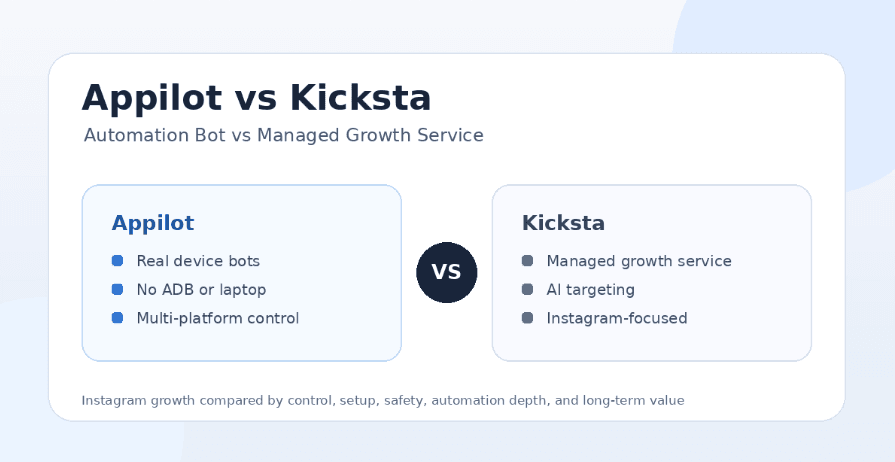
Instagram growth tools usually fall into two different categories. Some tools give users direct automation control, while others work more like managed growth services where the platform handles targeting and engagement in the background. That difference matters because the right choice depends on whether you want hands-on automation infrastructure or a simpler service that tries to grow your Instagram account for you.
That is why the Appilot vs Kicksta comparison is useful. Kicksta is mainly known as an Instagram growth service that uses AI targeting and automated engagement to help users attract real followers. Appilot is different because it is a real-device automation platform that lets users run bots on Android phones and emulators through a remote web dashboard without ADB or a laptop.
Both tools can help with Instagram workflows, but they are not built for the same type of user. Kicksta is better for people who want an Instagram-focused growth service. Appilot is better for users who want real-device bots, multi-account control, proxy support, remote device management, and automation that can expand beyond Instagram.
What Is Kicksta?
Kicksta is an Instagram growth service designed to help users attract real followers through targeting and automated engagement. Instead of giving users a full device automation environment, Kicksta focuses on growth outcomes such as follower discovery, audience targeting, analytics, and engagement-based account growth.
Its main appeal is simplicity. Users do not need to build bots, manage Android devices, connect phones, or configure technical automation flows. They choose targets such as competitors, influencers, hashtags, or niche audiences, and Kicksta’s system works around those targeting inputs.
This makes Kicksta useful for creators, influencers, small businesses, coaches, and brands that want Instagram growth support without running automation themselves. The trade-off is that users get less control over the actual automation environment compared with a real-device bot platform like Appilot.
What Is Appilot?
Appilot is a real-device automation platform that lets users run bots on Android phones and emulators remotely through a web dashboard. It is designed for users who want automation to happen inside real mobile environments instead of relying only on desktop tools, API shortcuts, browser sessions, or managed growth systems.
The biggest advantage is control. Appilot lets users manage Android automation without ADB, without a laptop, and without keeping devices physically connected to a local machine. This makes it useful for phone farm operators, agencies, growth teams, and anyone managing multiple social accounts.
Appilot also includes a bot store with ready-to-use automations for Instagram, TikTok, Twitter/X, LinkedIn, Discord, Reddit, Snapchat, YouTube, Threads, Telegram, Gmail, Chrome, and more. That makes it a broader platform than Kicksta, which is mainly focused on Instagram growth.
Appilot vs Kicksta: The Main Difference
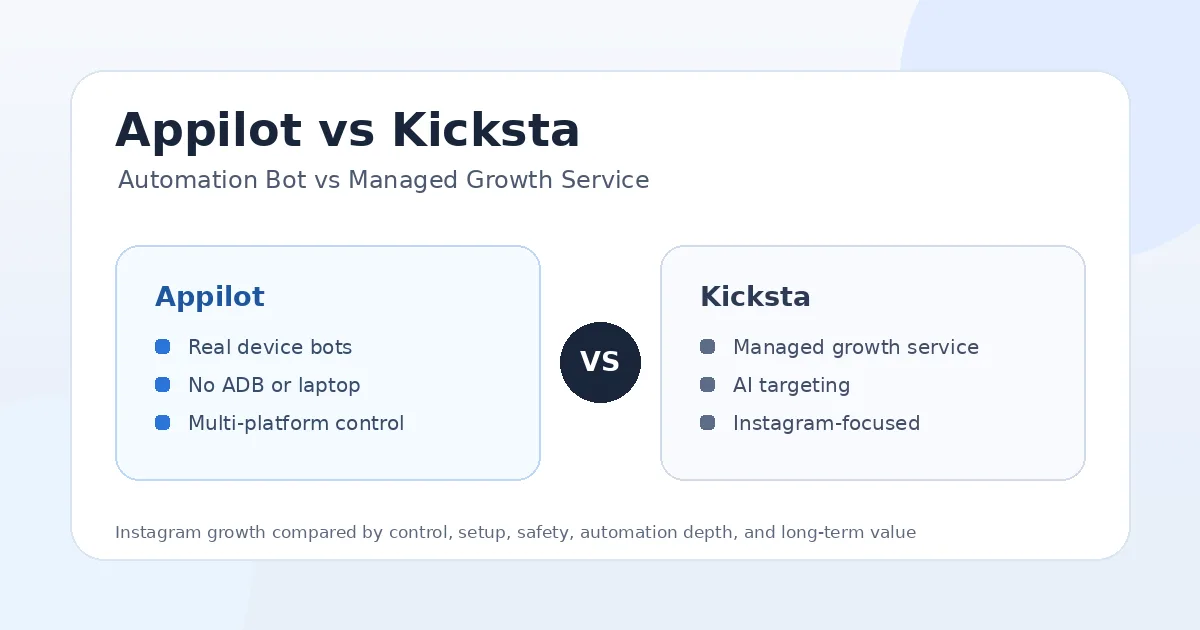
The main difference is that Kicksta is a managed Instagram growth service, while Appilot is a real-device automation bot platform. Kicksta is focused on helping users grow an Instagram audience through targeting and engagement. Appilot is focused on giving users the infrastructure to run mobile automation workflows directly on Android devices and emulators.
This difference changes the entire user experience. With Kicksta, the user is mostly buying a growth service. With Appilot, the user is buying an automation environment. One is more hands-off, while the other gives more control over devices, bots, workflows, and platforms.
If you want a service to handle Instagram growth with minimal setup, Kicksta may feel easier. If you want to control how automation runs, manage multiple accounts, use real-device behavior, and automate more than Instagram, Appilot is the stronger option.
Managed Growth vs Direct Automation Control
Kicksta’s strength is that it reduces the work required from the user. Instead of building workflows or managing bot logic, users provide targeting direction and let the service handle engagement. This can be appealing for people who want growth support but do not want to learn automation infrastructure.
Appilot gives users more direct control. Users can run specific bots, manage device environments, use proxies, organize accounts, and operate workflows from a web dashboard. This is more powerful for advanced users because they can decide what runs, where it runs, and how the workflow fits into their broader operation.
The trade-off is simple. Kicksta is easier when you want the service to do the growth work. Appilot is better when you want ownership of the automation system itself.
Setup and Ease of Use
Kicksta is easier for beginners because it does not ask users to think about devices, emulators, ADB, local scripts, or phone farm infrastructure. A user can start by connecting an Instagram account, choosing targeting inputs, and letting the platform handle the growth process.
Appilot is also built to reduce technical friction, but it is meant for a different type of workflow. Traditional mobile automation often requires cables, ADB commands, drivers, laptop uptime, and constant local troubleshooting. Appilot removes those problems by giving users a remote dashboard for Android phones and emulators.
For a single Instagram account, Kicksta may feel simpler. For multiple accounts, serious workflows, phone farms, or agencies, Appilot is easier to manage long term because it removes local device dependency while still giving users automation control.
Safety and Account Risk
No Instagram automation or growth service is completely risk-free. Any system that automates follows, likes, DMs, comments, profile visits, or engagement patterns can create issues if it is used too aggressively. Instagram accounts can still face action blocks, checkpoints, reduced reach, or trust problems when activity looks unnatural.
Kicksta’s value is that it positions itself around targeted growth rather than fake followers. That is better than buying low-quality followers, but users should still be careful because automated engagement can still create risk if activity volume, targeting, or behavior patterns are not managed properly.
Appilot’s advantage is the real-device environment. Since workflows run on Android devices and emulators, the automation can behave closer to normal mobile app usage than many desktop or API-style tools. This does not make Appilot risk-free, but it gives users a stronger foundation for mobile-first automation.
The safest approach with either tool is to move slowly, use realistic limits, avoid spammy behavior, keep targeting relevant, use strong account environments, and treat automation as support for a real content strategy rather than a shortcut around it.
Platform Support
Kicksta is mainly focused on Instagram growth. That focus can be a strength for users who only care about Instagram and want a service built around follower acquisition, targeting, and engagement.
Appilot supports Instagram, but it also supports many other platforms through its bot store. Users can run automation for TikTok, Twitter/X, LinkedIn, Discord, Reddit, Snapchat, YouTube, Threads, Telegram, Gmail, Chrome, and more. This makes Appilot a better option for teams that manage social workflows across multiple apps.
If Instagram is your only priority, Kicksta may be enough. If Instagram is one part of a bigger automation system, Appilot gives you much more flexibility.
Remote Device Control
Remote control is one of Appilot’s biggest advantages. With Appilot, users can manage Android phones and emulators from a web dashboard. This means they do not need to keep a laptop open, keep devices plugged into one machine, or sit near their phone farm to check workflows.
Kicksta does not try to solve this problem. It is a managed Instagram growth service, not a remote Android automation system. That makes it simpler, but also less flexible for users who need device-level visibility and workflow control.
For phone farm operators and agencies, this difference is important. Appilot lets users control the automation environment. Kicksta handles growth as a service, but it does not give users the same infrastructure layer.
Pricing and Value for Money
Kicksta can be worth the money if your main goal is Instagram follower growth and you want a hands-off service. You are paying for targeting, automation, analytics, and growth support rather than for device control or multi-platform automation.
Appilot becomes more valuable when you need more than one Instagram growth service. If you want real-device bots, multi-account management, proxy support, remote control, and workflows across multiple apps, Appilot provides broader value.
The better deal depends on your scale. A solo creator who only wants Instagram followers may prefer Kicksta. An agency or operator managing many accounts will likely get more value from Appilot because it supports a wider automation system instead of one growth service.
Where Kicksta Wins
Kicksta wins on simplicity and hands-off Instagram growth. It is easier for users who do not want to control bots directly or manage technical workflows. A creator, influencer, coach, or small business owner can use Kicksta without learning mobile automation.
Kicksta also wins for users who only care about Instagram follower growth. Since it is built around Instagram targeting and engagement, it may feel more focused than a broader automation platform.
Another strength is that Kicksta behaves more like a service than a tool. For users who want someone else’s system to handle growth in the background, that can be more appealing than managing their own bots.
Where Appilot Wins
Appilot wins when users need control, scale, and real-device automation. It is not limited to Instagram growth because it gives users an environment to run bots across Android phones and emulators.
Appilot also wins on multi-platform flexibility. Many users start with Instagram but later need TikTok automation, Reddit workflows, Discord management, LinkedIn outreach, Telegram tasks, or YouTube actions. Appilot supports those workflows from one dashboard, which makes it more useful for agencies and growth teams.
The no-ADB and no-laptop setup is another major advantage. Users can avoid cables, drivers, local machine dependency, and the common reliability problems that come with traditional Android automation. This makes Appilot more practical for serious long-running automation.
Appilot is also better for users who want ready-to-use bots without coding while still having the option to request custom bot development. That balance gives users both simplicity and flexibility.
Who Should Use Kicksta?
Kicksta is best for Instagram creators, influencers, small businesses, personal brands, and coaches who want a managed growth service. It is a good fit if your main goal is follower growth and you do not want to manage automation directly.
It also makes sense for users who only care about Instagram and prefer a hands-off setup. If you do not need real-device control, multi-platform workflows, phone farm management, or custom bots, Kicksta may be enough.
Who Should Use Appilot?
Appilot is best for users who want real-device automation and direct control over mobile workflows. It fits phone farm operators, agencies, growth teams, and marketers who manage multiple accounts or need automation across several platforms.
It is also better for users who are tired of laptop-based bots, ADB problems, disconnected devices, and limited single-platform tools. If you want Instagram automation alongside TikTok, Reddit, Discord, LinkedIn, Telegram, YouTube, and other workflows, Appilot is the stronger fit.
Final Verdict
If you want a hands-off Instagram growth service and your only goal is gaining more targeted followers, Kicksta may be worth considering. It is simple, focused, and designed for users who do not want to manage automation infrastructure.
If you want real-device bots, remote Android control, no ADB, no laptop dependency, proxy support, multi-account workflows, and automation across many social platforms, Appilot is the better choice. It gives users more control over how automation runs and more flexibility as their workflow grows.
For basic managed Instagram growth, Kicksta can make sense. For serious automation, phone farm operations, agency workflows, and multi-platform social media bots, Appilot is the stronger long-term investment. You can explore Appilot’s bot store and real-device workflows at appilot.app.
FAQs
Q1: Is Appilot better than Kicksta for Instagram automation?
Appilot is better if you need real-device bots, remote control, proxies, and multi-account workflows. Kicksta is better if you want a hands-off Instagram growth service.
Q2: Is Kicksta a bot or a managed growth service?
Kicksta works more like a managed Instagram growth service built around targeting and automated engagement. Appilot is a real-device automation platform for running bots directly.
Q3: Does Appilot require ADB or a laptop?
No, Appilot does not require ADB or a laptop-based setup. Users can manage Android devices and emulators remotely through a web dashboard.
Q4: Which tool is better for agencies?
Appilot is better for agencies because it supports multi-account management, real-device workflows, proxies, and automation across many platforms.
Q5: Which tool is worth the money?
Kicksta is worth considering for simple Instagram growth, while Appilot is worth more for real-device automation, scale, and multi-platform workflows.