Appilot vs Phantombuster: Mobile-Based Automation vs Cloud Scraping
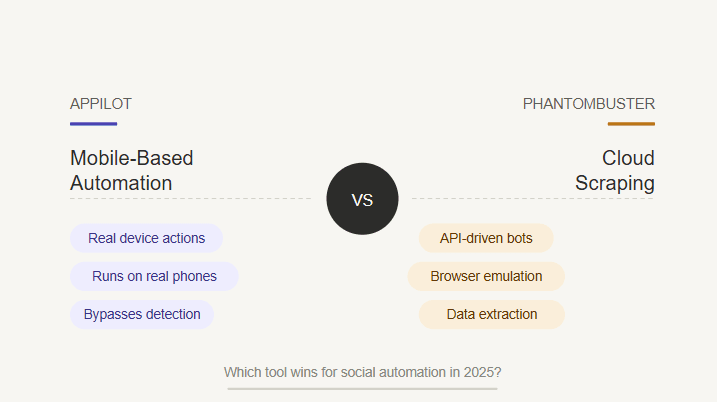
Appilot and Phantombuster both help users automate social media-related work, but they are not built for the same job.
Phantombuster is best known as a cloud-based automation and scraping platform. It helps users extract data, build lead lists, enrich prospects, and run workflows across platforms like LinkedIn, Instagram, X/Twitter, Facebook, YouTube, Reddit, GitHub, Google Maps, and more.
Appilot is different. It focuses on mobile-based automation by running bots on real Android devices and emulators through a remote web dashboard. Instead of mainly extracting data from social platforms, Appilot helps users automate actions inside mobile app environments.
That distinction matters. If your main goal is lead scraping, prospecting, and data extraction, Phantombuster may be useful. If your goal is mobile-first social media automation, phone farm workflows, real Android execution, and no-ADB bot control, Appilot is the stronger fit.
This comparison breaks down Appilot vs Phantombuster from a practical perspective: cloud scraping versus mobile automation, server-side workflows versus real-device behavior, and which tool makes more sense depending on your growth operation.
What Is Phantombuster?
Phantombuster is a cloud-based automation platform used for data scraping, lead generation, enrichment, and outreach workflows. Its automations are often called Phantoms, while multi-step sequences are commonly structured as workflows.
The platform is popular with sales teams, growth marketers, recruiters, and lead generation operators who want to collect public data from platforms like LinkedIn, Sales Navigator, Instagram, Facebook, X/Twitter, YouTube, GitHub, Reddit, Slack, Google Maps, Yellow Pages, and other sources.
Phantombuster is especially useful when the goal is to build lead lists. A user can extract profiles, collect company data, enrich prospect information, export results, and use those records for outreach or CRM workflows.
That makes Phantombuster strong for cloud scraping and prospecting. It is not mainly designed as a real mobile device automation platform, and that is where the difference with Appilot becomes clear.
What Is Appilot?
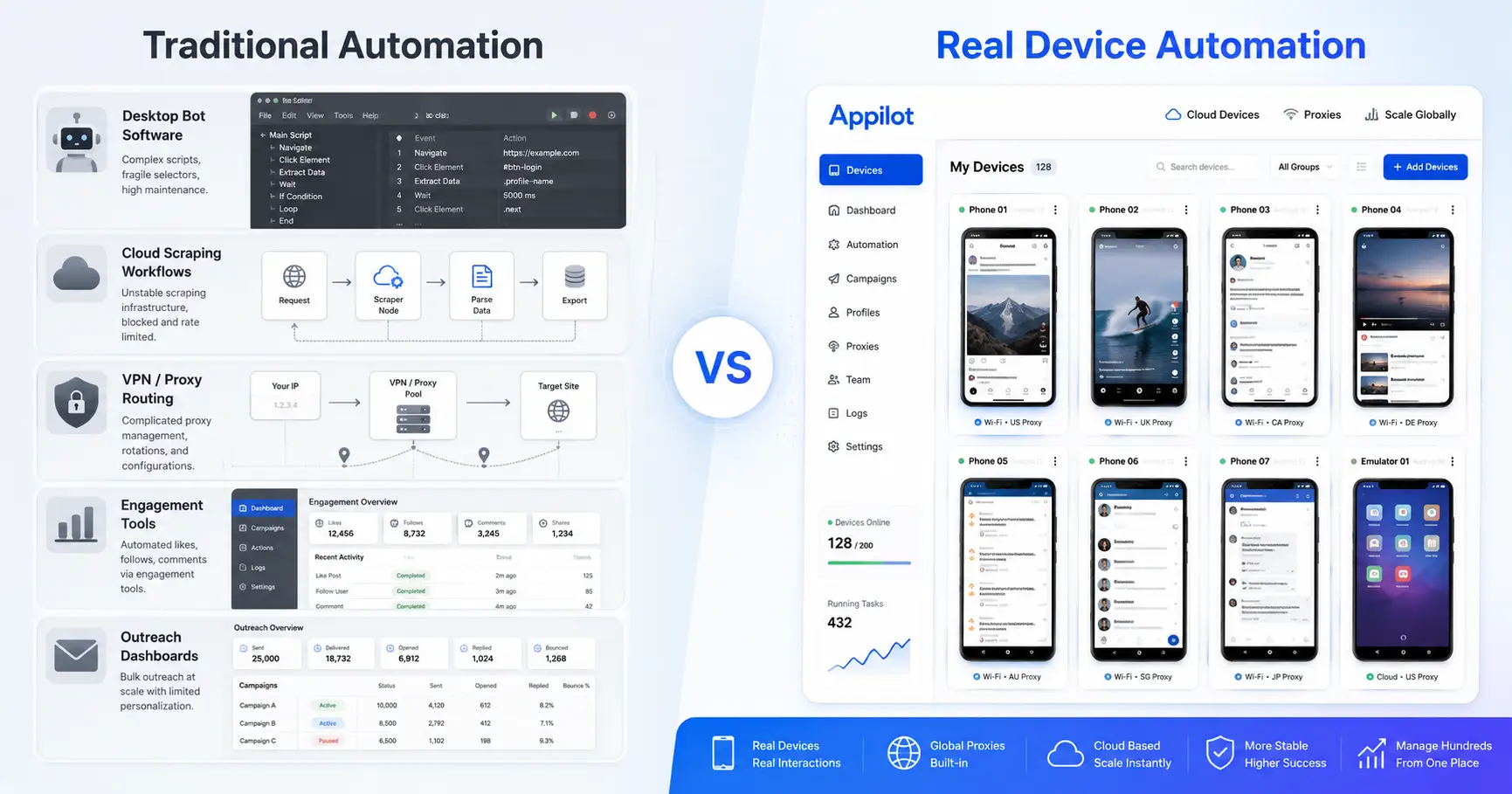
Appilot is a social media automation platform that runs bots on real Android devices and emulators. Users manage bots through a web dashboard, while the actual automation happens inside Android environments.
This matters because many social media platforms are mobile-first. Instagram, TikTok, Threads, Snapchat, Telegram, YouTube, and similar platforms are built around app behavior such as tapping, scrolling, swiping, typing, watching, messaging, and moving through mobile screens.
Appilot is designed around that app-based behavior. It uses Android automation through accessibility service and UIAutomator-based workflows, which helps bots interact with apps in a way that is closer to real mobile usage.
Appilot also works without ADB, so users do not need to keep a laptop connected, deal with USB cables, manage drivers, or troubleshoot constant device disconnects.
The platform includes a bot store with ready-to-use automations for Instagram, TikTok, Twitter/X, LinkedIn, Discord, Reddit, Snapchat, YouTube, Threads, Telegram, Gmail, Chrome, and more.
Appilot vs Phantombuster: The Main Difference
The biggest difference between Appilot and Phantombuster is the execution layer.
Phantombuster runs cloud-based automations. It is strong at scraping data, collecting leads, enriching lists, and running server-side workflows. That makes it useful when the output is data.
Appilot runs bots on Android devices and emulators. It is strong at mobile app automation, real-device workflows, remote bot control, and platform actions that need to happen inside mobile environments. That makes it useful when the output is app-based activity.
This difference matters because scraping data and operating accounts are not the same thing. A scraping platform can collect information from profiles, search results, and public pages, but it does not replace a device-based automation system when the goal is to interact through mobile apps.
If you want to collect leads from LinkedIn, scrape public Instagram profiles, or enrich contact data, Phantombuster fits that use case. If you want to run Instagram, TikTok, Threads, Telegram, YouTube, or other social bots through real Android environments, Appilot fits better.
Cloud Scraping vs Mobile-Based Automation
Cloud scraping and mobile-based automation solve different problems.
Cloud scraping is about extracting information. It helps users collect names, profiles, URLs, company data, followers, posts, emails, or other public signals from online platforms. This is useful for sales prospecting, market research, competitor analysis, recruiting, and lead generation.
Mobile-based automation is about performing actions inside apps. It helps users run workflows that involve tapping, scrolling, posting, messaging, following, watching, replying, or navigating through mobile interfaces.
Phantombuster is stronger in the first category. It gives users pre-built cloud automations for scraping and lead workflows. Appilot is stronger in the second category because it runs bots inside Android environments.
The choice depends on what you actually need. If you need structured data, Phantombuster is often the better tool. If you need real app behavior, Appilot is the better tool.
Real Device Behavior Matters for Social Bots
Modern social platforms do not only look at what action happens. They also look at how the account behaves, where the session comes from, what device signals are present, how often actions repeat, and whether the user activity feels natural.
This is where mobile-based automation becomes important.
A cloud scraper can collect data, but it cannot fully replicate a real user moving through a mobile app. It does not create the same kind of tap, swipe, scroll, wait, and navigation behavior that happens inside an Android app session.
Appilot is designed for that environment. Bots run on real Android devices and emulators, which makes the automation layer more aligned with mobile-first platforms.
This does not mean Appilot makes automation risk-free. No tool can honestly claim that. Bad proxies, aggressive limits, repetitive messages, weak accounts, and poor warmup can still cause problems.
But if the workflow depends on mobile app behavior, real-device automation is a stronger foundation than cloud scraping alone.
Setup and Ease of Use
Phantombuster is easy to understand if the user is already familiar with scraping workflows. A user chooses a Phantom, connects an account or input source, configures the task, runs the automation in the cloud, and exports the result.
That workflow is useful for teams that want data without building scrapers from scratch. Sales and growth teams can use it to collect prospect lists, scrape public profiles, enrich data, and feed results into outreach systems.
Appilot is easier for users who want app-based automation without managing mobile infrastructure manually. Users do not need to set up ADB, keep a laptop connected, or manually control Android devices all day.
The workflow is dashboard-based. Users choose or configure bots, connect Android devices or emulators, and manage automation remotely.
So the setup comparison depends on the use case. Phantombuster is easier for cloud scraping. Appilot is easier for mobile app automation.
Multi-Account Operations
Multi-account operations become complicated when users try to do everything with the wrong kind of tool.
Phantombuster can help collect data for many leads or targets. For example, users can scrape profile lists, collect followers, extract search results, or build outreach datasets. That is useful at the top of the funnel.
Appilot is better for workflows where accounts need to behave inside social apps. If a team manages several Instagram, TikTok, Telegram, Threads, YouTube, Reddit, Discord, or LinkedIn-related workflows, device behavior becomes more important.
Appilot gives users a way to manage bots remotely while the actions run on Android devices and emulators. That makes it more practical for phone farm operators, agencies, and growth teams that need operational control rather than just extracted data.
For multi-account growth, the two tools may even serve different stages. Phantombuster can help with prospect data, while Appilot can help with mobile app execution.
Proxy Support and Risk Management
Any serious automation workflow needs to think about risk. This applies to both cloud scraping and mobile automation.
Cloud scraping can run into rate limits, account restrictions, platform changes, login challenges, and data access issues. If a scraping workflow is too aggressive or depends heavily on a fragile source, it can stop working quickly.
Mobile automation has its own risks. Accounts can be flagged if actions are too fast, messages are repetitive, proxies are weak, or account warmup is poor.
Phantombuster helps users run cloud workflows, but users still need to configure tasks carefully and avoid pushing platforms too aggressively.
Appilot supports proxy-based workflows, including mobile and residential proxies, which are useful for separating accounts and improving multi-account operations. But proxies alone are not enough. A strong setup still needs realistic limits, account warmup, device consistency, and quality behavior.
The main point is simple: Phantombuster manages cloud automation risk, while Appilot manages mobile automation risk. They operate in different environments.
Platform Coverage
Phantombuster supports many platforms for scraping and lead workflows, including LinkedIn, Sales Navigator, Instagram, Facebook, X/Twitter, YouTube, GitHub, Reddit, Slack, Google Maps, Yellow Pages, and more.
That platform coverage is useful for prospecting and data extraction. Sales teams can use it to collect leads from different sources and build structured outreach lists.
Appilot supports platforms from a mobile automation angle, including Instagram, TikTok, Twitter/X, LinkedIn, Discord, Reddit, Snapchat, YouTube, Threads, Telegram, Gmail, Chrome, and more.
The difference is not only which platforms are supported. It is what the tool does on those platforms.
Phantombuster is stronger for extracting and enriching data. Appilot is stronger for running mobile app workflows.
Where Phantombuster Wins
Phantombuster wins when the goal is cloud scraping, lead generation, and prospecting.
It is useful for users who want to extract public profile data, build lead lists, collect followers, enrich prospects, scrape search results, and automate parts of sales research.
It also wins for users who do not want to manage devices. Since Phantombuster runs automations in the cloud, users can get scraping results without setting up Android devices or emulators.
For sales teams, recruiters, and growth teams focused on data collection, Phantombuster can be very useful.
The trade-off is that cloud scraping does not replace real mobile app automation. If the user needs app behavior, Phantombuster is not the best fit.
Where Appilot Wins
Appilot wins when the goal is social media automation through real mobile environments.
Its biggest advantage is that bots run on Android devices and emulators. This makes it better suited for mobile-first platforms where app behavior matters.
Appilot also wins on remote control. Users can manage bots from a web dashboard without keeping a laptop connected all day.
The no-ADB setup is another major advantage. Users avoid cables, drivers, device disconnects, and battery drain issues.
Appilot also gives users access to a bot store with ready-to-use automations, plus the option for custom bot development when a team needs a specific workflow.
For agencies, phone farm operators, and users who need mobile-based automation rather than cloud scraping, Appilot is the better choice.
Who Should Use Phantombuster?
Phantombuster is a better fit for users who want to collect data, build prospect lists, scrape public social profiles, enrich leads, and automate sales research.
It makes sense for sales teams, recruiters, growth marketers, and operators who need structured data more than app-based actions.
If the goal is LinkedIn prospecting, lead enrichment, social profile scraping, or cloud workflow automation, Phantombuster is worth considering.
But if the goal is mobile app automation, real-device social bots, or phone farm workflows, Appilot is a better fit.
Who Should Use Appilot?
Appilot is better for users who want to automate actions inside mobile apps.
It is especially useful for phone farm operators, social media agencies, growth teams, outreach teams, and multi-account users who need real Android execution, no ADB, proxy support, and remote dashboard control.
Appilot is also a strong fit for users who want automation across Instagram, TikTok, Twitter/X, LinkedIn, Discord, Reddit, Snapchat, YouTube, Threads, Telegram, Gmail, Chrome, and more.
If your workflow depends on app behavior rather than only scraped data, Appilot is the better option.
Final Verdict
Appilot and Phantombuster are both useful, but they solve different problems.
Phantombuster is better for cloud scraping, lead generation, prospecting, enrichment, and extracting data from online platforms. It is a strong tool when the goal is to collect information and feed it into a sales or growth workflow.
Appilot is better for mobile-based automation. It runs bots on real Android devices and emulators, works without ADB, does not require a laptop, supports proxy-aware workflows, and gives users remote dashboard control.
If you need data, use a scraping-focused tool like Phantombuster. If you need real mobile app automation, Appilot is the stronger fit.
You can explore Appilot’s bot store and try it at appilot.app.
FAQ
Q1: What is the biggest difference between Appilot and Phantombuster?
Phantombuster is mainly a cloud scraping and lead automation tool, while Appilot runs bots on real Android devices and emulators. Appilot is stronger for mobile app automation.
Q2: Is Appilot a Phantombuster alternative?
Appilot can be a Phantombuster alternative only if your goal is social media automation. If your goal is lead scraping or data extraction, Phantombuster fits better.
Q3: Is Phantombuster good for social media scraping?
Yes, Phantombuster is useful for scraping public data, collecting leads, and building prospect lists across multiple social platforms.
Q4: Does Appilot require ADB or a laptop?
No, Appilot works without ADB and does not require users to keep a laptop connected. Bots can be managed through a remote web dashboard.
Q5: Who should choose Appilot over Phantombuster?
Appilot is best for phone farm operators, agencies, and growth teams that need real Android automation instead of cloud scraping or lead extraction workflows.