Appilot vs Socinator: Best Social Media Bot for Phone Farm Operators
Phone farm operators do not need a basic social media scheduler. They need a system that can manage many accounts, run stable automation, support proxies, reduce setup problems, and work across platforms without depending on one laptop or one fragile desktop setup.
That is why the comparison between Appilot and Socinator matters. Socinator has been known as a social media automation and management tool for users who want to handle multiple platforms, schedule content, automate engagement, and manage accounts from one place. It is useful for people who want broad social media management and campaign-style automation.
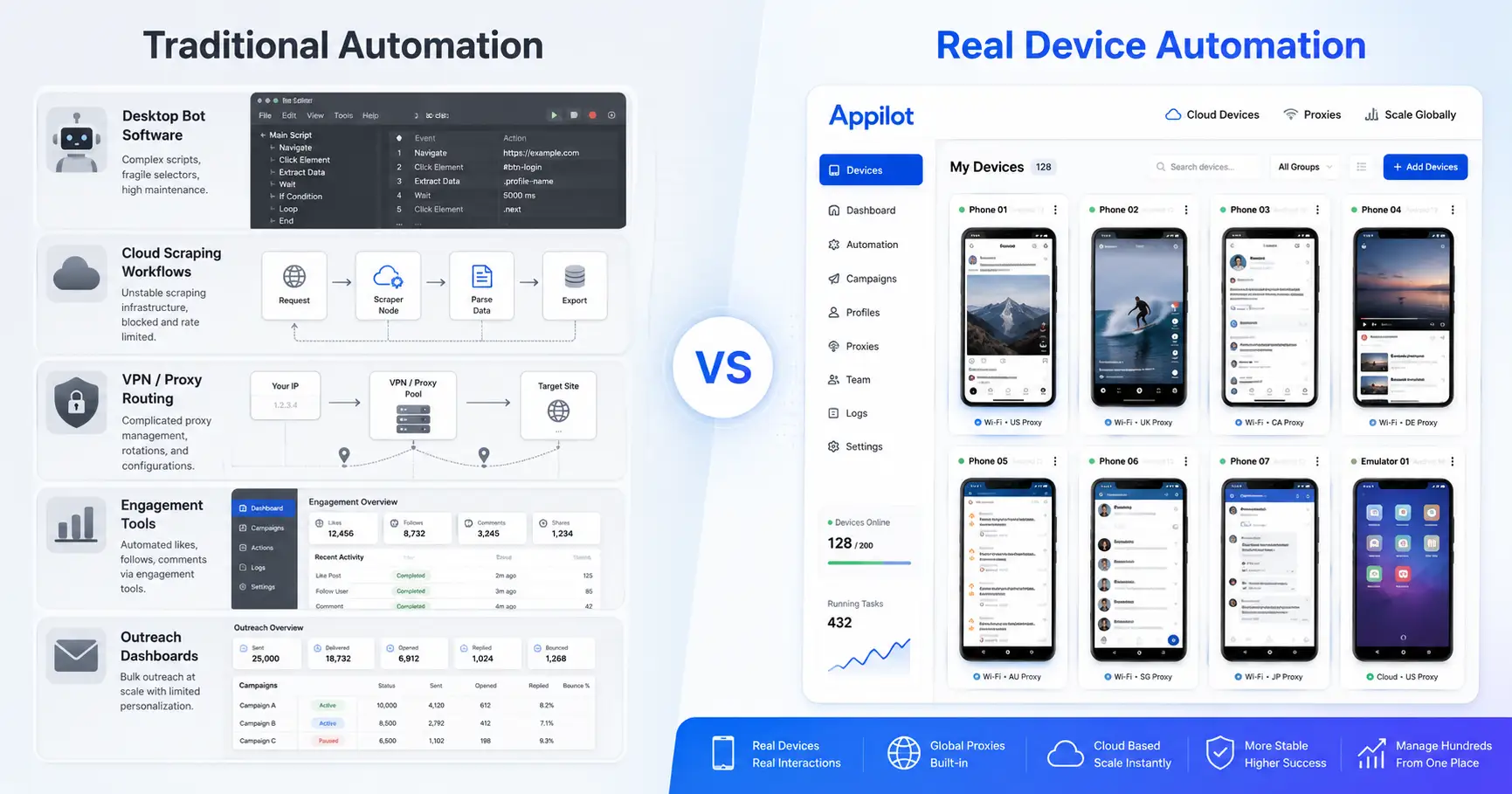
Appilot is different because it focuses on real-device automation. Instead of treating automation as something that happens mainly from a desktop-style dashboard, Appilot runs bots on real Android devices and emulators through a remote web dashboard.
For phone farm operators, that difference is important. A phone farm is not just a list of accounts. It is an operation built around devices, network separation, automation behavior, uptime, and remote control.
This blog compares Appilot vs Socinator from the perspective of phone farm operators who care about real-device workflows, multi-account growth, mobile proxies, setup simplicity, and long-term operational stability.
What Is Socinator?
Socinator is a social media automation and management tool designed to help users manage multiple social media accounts, schedule posts, automate engagement, and streamline social workflows across several platforms.
It has been positioned around platforms such as Facebook, Instagram, Twitter/X, LinkedIn, Tumblr, YouTube, Quora, Reddit, and Pinterest. Its broader value is that it gives marketers a central place to manage posting, engagement, audience targeting, and automation activities.
For marketers and social media managers, Socinator can be useful because it reduces repetitive work. Instead of manually posting, liking, commenting, following, or managing several accounts one by one, users can automate parts of that workflow.
The important point is that Socinator fits more naturally into the social media management and automation category. It is useful for managing accounts and campaigns, but it is not mainly built around real Android phone farm execution.
That distinction matters when the user is not just managing profiles but operating many mobile-first accounts at scale.
What Is Appilot?
Appilot is a social media automation platform that runs bots on real Android devices and emulators. Users manage automation through a web dashboard, while the actual bot activity happens inside Android environments.
This makes Appilot especially relevant for phone farm operators. A phone farm workflow depends on devices, app sessions, proxies, account separation, and stable remote control. Appilot is designed around those needs instead of forcing users to manage everything from a desktop-style setup.
Appilot also works without ADB. That matters because ADB can become a major headache when many devices are involved. It can create cable dependency, driver problems, battery drain, device disconnects, and setup confusion.
With Appilot, users do not need to keep a laptop connected all day. They can manage bots remotely from a web dashboard and run automation across Android devices or emulators.
Appilot also includes a bot store with ready-to-use automations for Instagram, TikTok, Twitter/X, LinkedIn, Discord, Reddit, Snapchat, YouTube, Threads, Telegram, Gmail, Chrome, and more.
Appilot vs Socinator: The Main Difference
The biggest difference between Appilot and Socinator is the execution environment. Socinator focuses on social media automation and account management, while Appilot focuses on running bots through real Android devices and emulators.
That difference matters because phone farm operators usually care about how the automation behaves at the device level. A dashboard can help organize accounts, but the real question is where the actions happen and whether the environment matches how users normally interact with social apps.
Many high-value platforms are mobile-first. Instagram, TikTok, Threads, Snapchat, Telegram, and YouTube workflows often depend on app behavior, mobile sessions, taps, swipes, scrolling, typing, waiting, and device consistency.
Appilot is built around that mobile environment. It lets automation happen through Android devices and emulators, which makes the workflow more natural for phone farm operators.
Socinator may still be useful for users who want broad social media management and automation features, but Appilot is better aligned with phone farm operations because it starts from the device layer.
Why Phone Farm Operators Need Real-Device Automation
Phone farm operators are not just trying to save time. They are trying to create a scalable system where multiple accounts can operate with proper separation, stable execution, and realistic behavior.
A traditional automation dashboard can help with scheduling and basic account management, but it does not always solve the deeper phone farm problem. Operators need to think about device identity, proxy quality, app behavior, session patterns, account warmup, and how each account looks to the platform over time.
Real-device automation helps because it runs actions inside Android environments. Instead of depending only on browser sessions, desktop-style automation, or backend workflows, bots can interact with apps in a way that is closer to real user behavior.
This does not mean automation becomes risk-free. No tool can promise that. Bad proxies, weak accounts, aggressive limits, repeated messages, and poor warmup can still cause problems.
But for phone farm operators, real-device automation gives a stronger foundation because the workflow starts from the same kind of environment the platforms expect: mobile apps running on Android devices or emulators.
Setup and Device Management
Socinator can be useful for users who want a centralized tool for managing multiple social media accounts and automating tasks. For a social media manager or small agency, that kind of setup can be enough.
Phone farm operators usually need something more specific. They need to control devices, manage automation sessions, avoid constant local troubleshooting, and run workflows without depending on one laptop.
Appilot is stronger here because it removes the ADB requirement. ADB can be useful for developers, but it becomes frustrating when the goal is to manage many devices reliably. Cables disconnect, drivers fail, devices stop responding, batteries drain, and one small issue can interrupt the whole workflow.
Appilot avoids that by using a dashboard-driven setup. Users can manage bots remotely, run automations on Android devices or emulators, and avoid turning their personal laptop into the control center of the operation.
For phone farm operators, this is one of the biggest advantages Appilot has over traditional social automation tools.
Remote Control and Uptime
Phone farm operations need uptime. If automation stops every time a laptop sleeps, a desktop app crashes, or a local connection fails, the operation becomes hard to scale.
Socinator can help users organize social media automation, but traditional social automation setups often still require users to think about the machine running the software and the environment where tasks are executed.
Appilot is built around remote control. Users can manage bots from a web dashboard without keeping a laptop connected all day.
This is useful because operators often want to check campaigns, pause bots, adjust workflows, or monitor device activity from different locations. A dashboard-based system makes that easier.
For agencies and operators managing many accounts, remote access is not a convenience. It is part of the operating model.
Proxy Support and Account Separation
Proxy support is critical for phone farm operators. If multiple accounts share poor network patterns, platforms can link them, restrict them, or treat them as suspicious.
Socinator supports social media automation workflows where proxies can be part of the setup, which makes sense for users managing multiple accounts.
Appilot also supports proxy-based workflows, including mobile and residential proxies. This is especially relevant for phone farm operators because proxy quality and device behavior need to work together.
A mobile proxy alone does not make automation safe. A real device alone does not make automation safe either. The stronger setup combines careful action limits, good proxies, account warmup, device consistency, and realistic behavior.
Appilot’s advantage is that proxy-aware automation sits inside a real Android workflow. That makes it more practical for users who want account separation across many mobile-first platforms.
Platform Coverage
Socinator has broad platform coverage and has been associated with automation for Facebook, Instagram, Twitter/X, LinkedIn, Tumblr, YouTube, Quora, Reddit, and Pinterest. That makes it useful for users who want social media management across multiple channels.
Appilot also supports broad automation workflows, including Instagram, TikTok, Twitter/X, LinkedIn, Discord, Reddit, Snapchat, YouTube, Threads, Telegram, Gmail, Chrome, and more.
The difference is that Appilot’s platform support is tied to Android execution. This makes it especially useful for mobile-first platforms where users normally operate inside apps.
For phone farm operators, the most important platforms are often Instagram, TikTok, Threads, Snapchat, Telegram, YouTube, Reddit, Discord, and X. These workflows benefit from a system that can handle real-device automation rather than only dashboard-based social management.
If the user mainly wants content scheduling and broad social account management, Socinator may be enough. If the user wants device-based automation for mobile-first growth, Appilot is the stronger fit.
Bot Store and Custom Automation
Socinator is useful for users who want built-in social media automation and management features. That can include scheduling, engagement, and account management workflows across multiple platforms.
Appilot’s bot store gives users a different kind of flexibility. Instead of being limited to one fixed set of social media actions, users can access ready-to-use bots for different platforms and workflows.
This matters for phone farm operators because their needs often change. One week they may need Instagram workflows. Another week they may need TikTok, Telegram, Reddit, Discord, Gmail, Chrome, or YouTube automation.
Appilot also supports custom bot development for teams that need a specific workflow. That makes it more flexible for operators who are not just looking for a generic social media management tool.
For advanced phone farm operations, custom automation can be a major advantage because not every workflow fits into a standard tool.
Where Socinator Wins
Socinator wins when the user wants a broad social media automation and management tool with campaign-style features.
It can make sense for marketers, small agencies, and social media managers who want to schedule posts, manage multiple accounts, automate engagement, and organize social activity across several platforms.
Socinator may also feel more familiar to users who prefer a traditional social media management dashboard rather than a device-focused automation system.
If the goal is general social media management, Socinator can be useful. It gives users a way to reduce repetitive work and manage multiple platforms from one place.
The trade-off is that phone farm operators often need more than general social media management. They need real-device execution, proxy-aware workflows, remote device control, and a setup that matches mobile-first platforms.
Where Appilot Wins
Appilot wins for phone farm operators because it is built around the device layer.
Its strongest advantage is real Android automation. Bots run on real Android devices and emulators, which makes the workflow more aligned with how mobile-first platforms are actually used.
Appilot also wins because it does not require ADB. Operators do not need to depend on cables, drivers, laptop connections, or constant device troubleshooting.
The web dashboard is another major advantage. Users can manage bots remotely, which is important for teams and operators who do not want one local machine to control the entire operation.
The bot store gives Appilot another edge because users can start with ready-made automations and expand into custom workflows when needed.
For phone farm operators, Appilot is more practical because it is not just a social media tool. It is a real-device automation system.
Who Should Use Socinator?
Socinator is a better fit for users who want broad social media management and automation from a traditional dashboard.
It may work well for marketers, small agencies, content teams, and users who want to schedule posts, automate engagement, manage multiple accounts, and handle several platforms from one place.
It can also make sense for users who do not need a phone farm workflow and are not focused on Android device-level automation.
If the main goal is general social media management, Socinator is worth considering.
Who Should Use Appilot?
Appilot is better for phone farm operators, social media agencies, growth teams, and users managing many accounts across mobile-first platforms.
It is especially useful for users who want real Android automation, no ADB setup, no laptop dependency, proxy support, remote dashboard control, and ready-to-use bots.
Appilot also fits users who need flexibility beyond standard social media management. If an operator wants to automate Instagram, TikTok, Telegram, YouTube, Reddit, Discord, Gmail, Chrome, and other workflows from one system, Appilot is more suitable.
For users building a serious phone farm operation, Appilot is the better choice.
Final Verdict
Socinator is a useful social media automation and management tool for users who want broad platform support, posting workflows, engagement automation, and account management from a traditional dashboard.
Appilot is the stronger choice for phone farm operators because it focuses on real-device automation. It runs bots on real Android devices and emulators, works without ADB, does not require a laptop, supports proxy-based workflows, and gives users a remote web dashboard for managing automation.
If your goal is general social media management, Socinator may be a reasonable option. If your goal is phone farm automation, multi-account growth, and mobile-first execution, Appilot is the better fit.
You can explore Appilot’s bot store and try it at appilot.app.
FAQ
Q1: What is the biggest difference between Appilot and Socinator?
Socinator is more of a social media management and automation tool, while Appilot runs bots on real Android devices and emulators. Appilot is stronger for phone farm workflows.
Q2: Is Appilot a Socinator alternative?
Yes, Appilot is a Socinator alternative for users who want real-device automation, no ADB, remote dashboard control, and multi-platform bot workflows.
Q3: Does Appilot work for phone farm operators?
Yes, Appilot is designed for users who need Android device automation, proxy support, and remote control across many accounts and workflows.
Q4: Does Appilot require ADB or a laptop?
No, Appilot works without ADB and does not require users to keep a laptop connected. Bots can be managed through a web dashboard.
Q5: Who should choose Appilot over Socinator?
Phone farm operators, agencies, and growth teams should choose Appilot when they need real Android automation instead of only social media dashboard management.