Appilot vs Upleap: Hands-Free Instagram Growth — Which Actually Works?
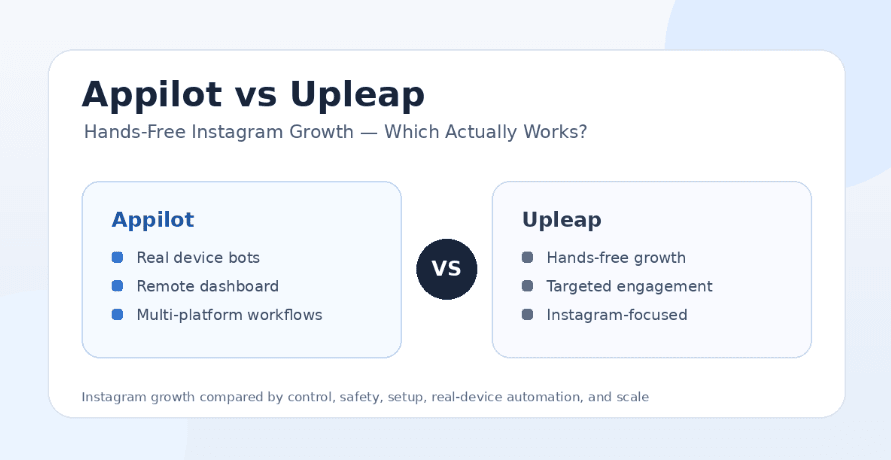
Instagram growth sounds simple until you try to make it consistent. Posting more content helps, but it takes time. Manual engagement works, but it becomes repetitive. Growth services promise hands-free results, but many users worry about account safety, fake followers, poor targeting, or losing control over how their account is being used.
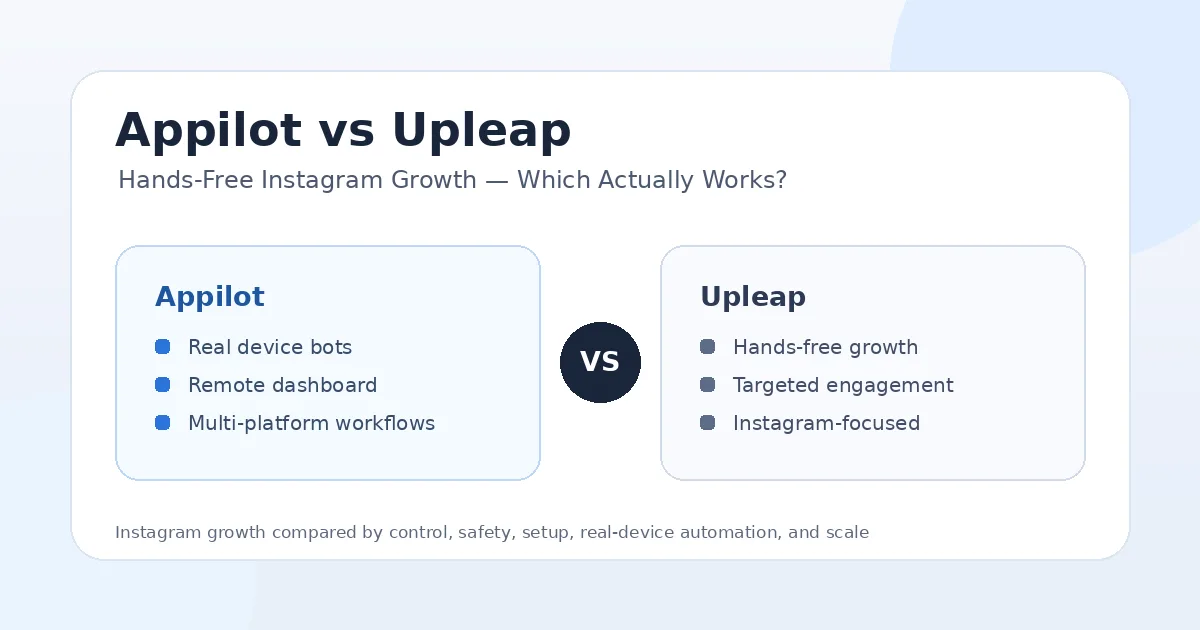
That is where the Appilot vs Upleap comparison becomes useful. Upleap is mainly positioned as an Instagram growth service that helps users grow through targeting, engagement automation, analytics, support, and hands-free follower-building features. Appilot is different because it is a real-device automation platform that lets users run bots on Android phones and emulators through a remote dashboard without ADB or a laptop.
Both tools can support Instagram growth, but they solve different problems. Upleap is closer to a hands-free Instagram growth service. Appilot is closer to a real-device automation system for people who want direct control, multi-account workflows, proxy support, and automation beyond Instagram.
What Is Upleap?
Upleap is an Instagram growth service designed to help users gain followers through targeted engagement and account growth features. It is built for people who want growth support without manually handling every follow, unfollow, like, profile visit, or outreach action themselves.
Its appeal is convenience. Users can set targeting preferences around accounts, hashtags, and audiences, while the service handles much of the growth activity in the background. Upleap also presents features like analytics, support, proxy login support, targeting filters, welcome DM automation, and growth-related account tools.
This makes Upleap attractive for influencers, creators, personal brands, small businesses, coaches, and Instagram users who want a more hands-free growth process. The limitation is that users get less control over the actual automation environment compared with a platform like Appilot, where bots run on Android devices and emulators.
What Is Appilot?
Appilot is a real-device automation platform that lets users run bots on Android phones and emulators remotely through a web dashboard. Instead of depending on desktop scripts, browser tools, API-style shortcuts, or laptop-based automation, Appilot is built around mobile environments where workflows can run directly on Android devices.
The key benefit is control. Users can manage social media bots without ADB, without keeping a laptop connected, and without relying on one local machine to keep automation alive. This matters for people who run phone farms, manage multiple accounts, or need automation that works across different apps.
Appilot also includes a bot store with ready-to-use automations for Instagram, TikTok, Twitter/X, LinkedIn, Discord, Reddit, Snapchat, YouTube, Threads, Telegram, Gmail, Chrome, and more. That makes it broader than a single Instagram growth service because it supports multi-platform workflows from one dashboard.
Appilot vs Upleap: The Main Difference
The biggest difference between Appilot and Upleap is the level of control. Upleap is a hands-free Instagram growth service, while Appilot is a real-device automation platform. With Upleap, users mostly rely on the service to manage growth activity. With Appilot, users control the bots, devices, workflows, accounts, and automation environment more directly.
This difference matters because Instagram growth is not only about getting more followers. It is also about how the growth activity happens, whether the account behavior looks natural, whether the user can manage risk, and whether the setup can scale beyond one account.
Upleap is better for users who want a simpler growth service and do not want to manage automation themselves. Appilot is better for users who want mobile-first automation, real-device behavior, proxy support, remote device management, and the ability to run workflows across many platforms.
Hands-Free Growth vs Real-Device Automation
Upleap’s main strength is hands-free growth. For users who do not want to manually engage with target accounts, research audiences, or repeat daily growth actions, a managed growth service can feel easier. The user provides targeting direction, and the platform handles much of the process.
Appilot’s strength is real-device automation. Instead of simply outsourcing growth activity, users can run bots on Android devices and emulators with more direct control over what happens. This is useful when the goal is not just follower growth, but repeatable workflows, account management, DM actions, app interactions, and multi-platform operations.
The difference is similar to hiring a service versus owning the system. Upleap handles growth for you. Appilot gives you the environment to run your own automation workflows.
Setup and Ease of Use
Upleap is easier for beginners who want Instagram growth without learning automation tools. The user does not need to think about Android devices, emulators, ADB, device pairing, scripts, or phone farm infrastructure. That simplicity makes it appealing for creators and small businesses.
Appilot is also built to make automation easier, but it solves a more technical problem. Traditional Android automation often requires laptops, cables, ADB commands, drivers, device stability, and local troubleshooting. Appilot removes that friction by letting users control Android phones and emulators through a web dashboard.
If you only want a hands-free growth service, Upleap may feel easier. If you want to run real automation workflows without dealing with laptop dependency or ADB setup, Appilot is more useful.
Safety and Account Risk
No Instagram growth tool or automation service can guarantee complete safety. Any workflow that automates follows, unfollows, likes, DMs, profile visits, comments, or repeated engagement can create risk if the activity becomes too aggressive or unnatural.
Upleap may be useful for users who want targeted growth, but hands-free does not automatically mean risk-free. Users still need to think about action volume, targeting quality, account age, posting consistency, and whether the activity matches normal Instagram behavior.
Appilot’s advantage is that automation can run on real Android devices and emulators. This gives users a stronger mobile environment compared with many desktop-based or API-style tools. Real-device behavior can reduce some obvious automation signals, but it does not remove all risk.
The safest approach with either tool is to grow slowly, avoid spammy actions, use realistic limits, keep account environments consistent, focus on real content quality, and treat automation as a support layer rather than a shortcut around strategy.
Platform Support
Upleap is mainly focused on Instagram growth. That focus is useful for users who only care about Instagram and want a service dedicated to follower growth, engagement, analytics, and targeting. A narrow tool can feel easier when the user does not need anything outside one platform.
Appilot supports Instagram, but it also supports many other social and mobile workflows. Users can run automations for TikTok, Twitter/X, LinkedIn, Discord, Reddit, Snapchat, YouTube, Threads, Telegram, Gmail, Chrome, and more from one dashboard.
This makes Appilot better for agencies, phone farm operators, and growth teams that manage many platforms. If your workflow includes Instagram plus TikTok, Reddit, Discord, Telegram, LinkedIn, or YouTube, Appilot gives you more room to scale.
Remote Control and Phone Farm Workflows
Remote control is one of Appilot’s biggest advantages. Users can manage Android devices and emulators from a web dashboard, which means they do not need to sit beside devices, keep a laptop running, or depend on ADB connections.
This matters for phone farms and multi-account operations. If you manage many Instagram accounts, one disconnected cable or sleeping laptop can interrupt the entire workflow. Appilot helps avoid that by making the dashboard the control layer.
Upleap does not try to solve device control. It focuses on hands-free Instagram growth rather than giving users an Android automation environment. That makes it simpler, but also less flexible for advanced users.
Pricing and Value for Money
Upleap can be worth the money if your only goal is hands-free Instagram growth. If you are a creator, influencer, coach, or small business owner who does not want to manually handle engagement, a service like Upleap may save time.
Appilot becomes more valuable when your needs are broader. If you need real-device bots, remote dashboard control, proxy support, multi-account workflows, and automation across multiple apps, Appilot gives more operational value than an Instagram-only growth service.
The better value depends on your goal. If you want a service to help grow one Instagram account, Upleap may be enough. If you want a system for running and managing automation workflows, Appilot is the stronger long-term investment.
Where Upleap Wins
Upleap wins on simplicity and hands-free growth. It is easier for users who do not want to control bots directly, manage devices, or learn automation infrastructure. A user can focus on Instagram growth goals while the service handles much of the engagement activity.
Upleap also wins for users who only care about Instagram follower growth. Since it is focused on one platform, it may feel more direct for creators, influencers, and small brands that do not need broader automation.
Another strength is that Upleap behaves more like a service than a tool. For people who do not want to manage workflows themselves, that hands-free model can be appealing.
Where Appilot Wins
Appilot wins when users need control, scale, and real-device behavior. It gives users a way to run bots on Android phones and emulators instead of relying only on a managed growth service or desktop automation.
Appilot also wins on flexibility. Users can automate Instagram along with TikTok, Reddit, Discord, LinkedIn, Telegram, YouTube, Snapchat, Threads, Gmail, Chrome, and more. This matters for agencies and operators who manage multiple platforms from one workflow.
The no-ADB and no-laptop setup is another major advantage. Traditional automation setups often fail because of disconnected devices, driver issues, sleeping laptops, or unstable cables. Appilot removes much of that friction by using a remote web dashboard.
Appilot is also better for users who want ready-to-use bots without coding, while still having the option to request custom bot development for more specific workflows.
Who Should Use Upleap?
Upleap is best for creators, influencers, small businesses, coaches, and personal brands that want hands-free Instagram growth. It is a good fit when the user wants follower growth support without managing automation directly.
It also makes sense for users who only care about Instagram and do not need real-device control, phone farm management, multi-platform bots, or custom workflows. If your goal is simple Instagram growth support, Upleap may be enough.
Who Should Use Appilot?
Appilot is best for users who want real-device automation and direct control over mobile workflows. It fits phone farm operators, agencies, growth teams, and marketers who manage multiple accounts across many platforms.
It is also better for users who are tired of laptop-based bots, ADB setup, disconnected devices, and single-platform growth services. If you want Instagram automation plus TikTok, Reddit, Discord, LinkedIn, Telegram, YouTube, and other workflows, Appilot is the stronger choice.
Final Verdict
If you want a hands-free Instagram growth service and do not want to manage bots yourself, Upleap may be worth considering. It is focused on Instagram growth and can save time for creators or small businesses that want a simpler setup.
If you want real-device automation, remote Android control, no ADB, no laptop dependency, proxy support, multi-account workflows, and automation across many social platforms, Appilot is the better choice. It gives users more control over how automation runs and more flexibility as their workflow grows.
For simple Instagram growth support, Upleap can make sense. For serious automation, phone farm operations, agency workflows, and multi-platform social media bots, Appilot is the stronger long-term investment. You can explore Appilot’s bot store and real-device workflows at appilot.app.
FAQs
Q1: Is Appilot better than Upleap for Instagram automation?
Appilot is better if you need real-device bots, remote control, proxies, and multi-account workflows. Upleap is better if you want hands-free Instagram growth support.
Q2: Is Upleap a bot or a growth service?
Upleap is closer to a hands-free Instagram growth service with automation features. Appilot is a real-device automation platform for running bots directly.
Q3: Does Appilot require ADB or a laptop?
No, Appilot does not require ADB or a laptop-based setup. Users can manage Android devices and emulators remotely through a web dashboard.
Q4: Which tool is better for agencies?
Appilot is better for agencies because it supports multi-account workflows, device control, proxies, and many platforms. Upleap is more focused on Instagram growth.
Q5: Which tool actually works better?
Upleap may work for simple follower growth, while Appilot works better for scalable automation control. The better choice depends on whether you want a service or a system.