Appilot vs Zenmate Social Bot: Real Devices vs VPN-Based Automation
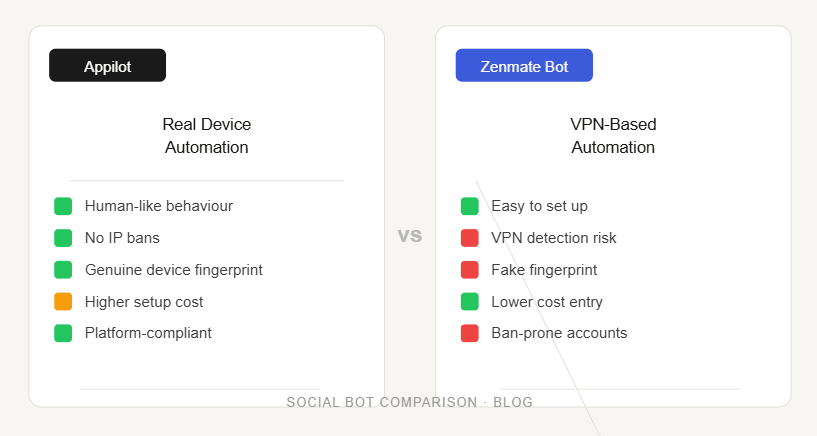
A lot of people misunderstand what makes social media automation safer. They think changing the IP address is enough. They use a VPN, connect accounts, start automation, and assume the platform will not notice anything unusual.
That is not how modern social platforms work.
A VPN can change or mask network traffic, but it does not automatically create real device behavior. It does not make a bot tap like a human, scroll like a user, wait naturally between actions, or interact with the mobile app interface in a believable way.
That is the main difference in this comparison. Zenmate is widely known as a VPN service, so a “Zenmate Social Bot” style setup is best understood as VPN-based automation: using network privacy or IP masking as the foundation for social media activity. Appilot takes a different approach by running bots on real Android devices and emulators through a remote web dashboard.
This blog compares Appilot vs Zenmate Social Bot from a practical automation perspective: real devices vs VPN-based automation, device behavior vs IP masking, and which setup makes more sense for users managing social media accounts in 2025.
What Is Zenmate Social Bot?
Zenmate itself is known primarily as a VPN product, not as a dedicated social media automation platform. A VPN can help users route traffic through another server, hide their real IP address, or access the internet from a different location.
When people talk about a Zenmate Social Bot style workflow, they usually mean using VPN-based privacy as part of a social media automation setup. In simple terms, the user runs automation while connected through a VPN, hoping that the changed IP address will reduce account risk.
That idea is understandable, but it is incomplete. Social media platforms do not only look at IP addresses. They can also evaluate device fingerprints, app behavior, login history, timing patterns, session consistency, account age, message repetition, and whether the activity looks like a normal user.
A VPN may help with one part of the setup, but it does not solve the full automation problem.
That is why VPN-based automation can feel attractive at first but weak when used as the main foundation for serious social media growth.
What Is Appilot?
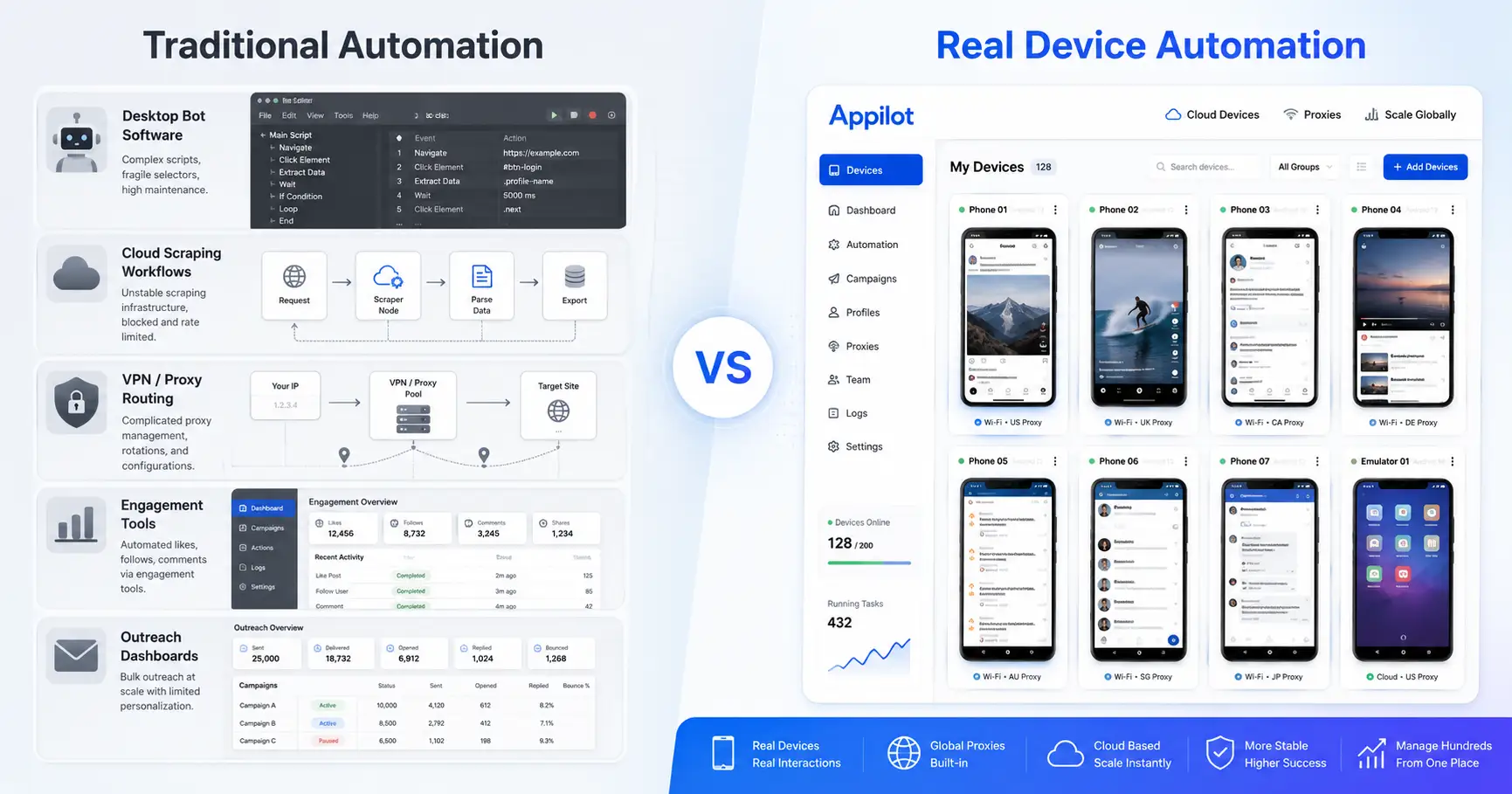
Appilot is a social media automation platform that runs bots on real Android devices and emulators. Users control automation through a web dashboard, while the actual bot activity happens inside Android environments.
This matters because many social platforms are mobile-first. Instagram, TikTok, Threads, Snapchat, Telegram, YouTube, and similar apps are designed around mobile behavior such as tapping, swiping, scrolling, typing, viewing profiles, opening messages, and interacting inside the app.
Appilot is built around that environment. It uses Android automation through accessibility service and UIAutomator-based workflows, which allows bots to operate through app interfaces instead of relying only on network tricks or desktop-style automation.
Appilot also works without ADB, which means users do not need to keep a laptop connected, manage USB cables, fix driver issues, or deal with constant device disconnects.
The platform includes a bot store with ready-to-use automations for Instagram, TikTok, Twitter/X, LinkedIn, Discord, Reddit, Snapchat, YouTube, Threads, Telegram, Gmail, Chrome, and more.
Appilot vs Zenmate Social Bot: The Main Difference
The biggest difference between Appilot and a Zenmate Social Bot style setup is that Appilot focuses on the device and behavior layer, while VPN-based automation focuses mainly on the network layer.
A VPN can change the IP address, but it does not create realistic mobile app behavior. It does not make the session look like it came from a real Android app interaction. It does not control how the account taps, scrolls, waits, types, or moves through the app.
Appilot focuses on the full automation environment. The bot runs on Android devices and emulators, which makes the workflow better aligned with how users interact with mobile-first platforms.
This does not mean Appilot makes automation risk-free. No tool can honestly promise that. Bad proxies, weak accounts, repeated messages, aggressive action limits, and poor warmup can still create account problems.
But Appilot starts from a stronger foundation because it does not treat IP masking as the whole solution. It combines device-based execution, app behavior, remote management, and proxy-aware workflows.
Why VPN-Based Automation Is Limited
VPN-based automation can help with privacy, location routing, and basic IP masking, but social media platforms have moved far beyond simple IP checks.
If an account logs in from a VPN but behaves like a bot, the VPN does not fix the problem. If the account sends repetitive messages, follows too many users, likes too quickly, or uses suspicious timing patterns, the platform can still flag it.
The same applies to device behavior. If the session does not look like a normal mobile app session, changing the IP address does not automatically make it believable.
This is why VPN-based automation is limited. It may help with one signal, but it does not solve behavior, device consistency, app interaction, account warmup, or automation quality.
For small personal use, a VPN may be enough for privacy. For serious social media automation, especially multi-account growth, VPN-only thinking is too shallow.
The automation stack needs to consider the full environment, not just the network route.
Why Real-Device Automation Works Better
Real-device automation works better because it starts where the platform expects real activity to happen: inside the app environment.
When a bot runs on an Android device or emulator, it can interact with the social app through the actual interface. That means the automation can move through screens, tap buttons, type messages, scroll feeds, open profiles, wait between actions, and follow mobile app flows.
That is very different from simply routing traffic through a VPN. A VPN changes the network path, but it does not create app-native behavior.
Appilot’s real-device approach is more useful for platforms where mobile behavior matters. Instagram, TikTok, Threads, Snapchat, Telegram, and YouTube are all heavily shaped by app usage. If the goal is to automate those platforms, the execution layer should match that reality.
Real-device automation does not remove the need for good proxies, careful limits, and smart warmup. But it gives users a better starting point than VPN-based automation alone.
Setup and Ease of Use
A VPN-based automation setup may look simple at first. The user installs a VPN, connects to a server, opens the automation tool, and starts running actions.
The problem is that this simplicity can be misleading. A VPN does not manage devices, does not handle app behavior, does not create realistic interaction patterns, and does not provide a full automation control system.
Appilot is built for users who need more than IP masking. It gives users a web dashboard for managing bots, devices, and workflows. The automation runs on Android devices or emulators, so the system is designed around the actual environment where social app behavior happens.
Appilot also avoids ADB setup. That matters because ADB can create technical problems when users manage multiple devices. It can cause cable dependency, driver issues, battery drain, and device disconnects.
With Appilot, users can manage automation remotely without keeping a laptop connected all day.
Remote Control and Multi-Account Growth
Multi-account growth requires more structure than one VPN connection. Users need to think about account separation, device identity, proxy quality, session consistency, timing, and behavior limits.
A VPN-based setup can become messy when users manage many accounts. If several accounts share weak network patterns or behave similarly, changing the IP address alone will not protect the operation.
Appilot is better suited for multi-account workflows because it gives users remote dashboard control over bots and Android-based automation environments.
For agencies, phone farm operators, and growth teams, this is important. They need to manage multiple accounts without constantly touching devices, switching laptops, or manually troubleshooting local connections.
Appilot’s dashboard makes it easier to start, stop, monitor, and adjust workflows remotely.
This is why Appilot fits serious automation better than a VPN-centered setup.
Proxy Support vs VPN Usage
VPNs and proxies are often confused, but they are not the same in practical automation workflows.
A VPN usually routes the entire device or browser connection through one server. That can be useful for privacy, but it is not always ideal for managing many social media accounts separately.
Proxies are often better suited for multi-account automation because they can be assigned more specifically to accounts, sessions, or devices depending on the setup. Mobile and residential proxies are especially common in serious account operations because they can create cleaner separation than generic VPN usage.
Appilot supports proxy-based workflows, including mobile and residential proxies. This matters because real-device automation still needs strong network separation.
The stronger setup is not “real device only” or “proxy only.” It is the combination of real Android behavior, good proxy quality, realistic limits, and remote control.
A VPN-based setup may help with privacy, but Appilot is better built for the full automation stack.
Where Zenmate Social Bot Wins
A Zenmate-style VPN setup wins when the user only needs basic privacy or wants to route traffic through a different location.
If someone is browsing, protecting personal traffic, or testing simple location-based access, a VPN can be useful. It is easy to understand and usually simple to turn on.
A VPN-based setup may also feel easier for beginners because it does not require them to think about devices, proxies, app behavior, or automation architecture.
The trade-off is that this simplicity does not solve the deeper problems of social media automation. A VPN may change the network signal, but it does not make the bot act like a real mobile user.
So Zenmate wins for privacy use cases, not for serious social media bot operations.
Where Appilot Wins
Appilot wins when the user wants actual social media automation rather than just IP masking.
Its biggest advantage is that bots run on real Android devices and emulators. This gives users a stronger environment for mobile-first platforms because the automation happens through app interfaces, not just through a changed network route.
Appilot also wins on operational control. Users can manage bots through a remote web dashboard without keeping a laptop connected all day.
The no-ADB setup is another major advantage. Users avoid cables, drivers, device disconnects, and battery drain problems.
Appilot also supports ready-to-use bots for many platforms, which makes it more practical for agencies, phone farm operators, and users managing multiple social workflows.
For serious social media automation, Appilot is clearly stronger than a VPN-based setup.
Who Should Use Zenmate Social Bot?
A Zenmate-style setup may make sense for users who only need VPN privacy or basic IP routing.
It may also fit users who are not running serious social media automation and only want to browse from another location or protect general internet traffic.
But users should not confuse VPN usage with a full automation strategy. A VPN does not replace device behavior, account warmup, action limits, proxies, or real app interaction.
If the goal is serious social media automation, a VPN-based setup is not enough by itself.
Who Should Use Appilot?
Appilot is better for users who want to run social media bots on real Android devices and emulators.
It is especially useful for phone farm operators, social media agencies, growth teams, outreach teams, and multi-account users who need remote control, proxy support, no ADB, and mobile-first automation.
Appilot is also a stronger choice for users who want automation across platforms like Instagram, TikTok, Twitter/X, LinkedIn, Discord, Reddit, Snapchat, YouTube, Threads, Telegram, Gmail, Chrome, and more.
If the goal is to run bots in a way that better matches real mobile app behavior, Appilot is the better option.
Final Verdict
Zenmate is useful as a VPN, but VPN-based automation is not enough for modern social media bots. Changing an IP address may help with privacy, but it does not create real device behavior, realistic app interaction, or a complete multi-account automation system.
Appilot is the better choice for users who want real social media automation. It runs bots on real Android devices and emulators, works without ADB, does not require a laptop, supports proxy-aware workflows, and gives users remote dashboard control.
If your goal is privacy or simple IP routing, a VPN setup can help. If your goal is serious social media automation, phone farm management, or multi-account growth, Appilot is the stronger fit.
You can explore Appilot’s bot store and try it at appilot.app.
FAQ
Q1: What is the biggest difference between Appilot and Zenmate Social Bot?
Zenmate-style automation focuses mainly on VPN or IP routing, while Appilot runs bots on real Android devices and emulators. Appilot is stronger for real social media automation.
Q2: Is a VPN enough for social media automation?
No, a VPN only changes the network layer and does not create realistic app behavior. Social platforms also look at device signals, timing, actions, and account behavior.
Q3: Is Appilot better than VPN-based automation?
Yes, Appilot is better for serious automation because it uses real Android environments, remote dashboard control, proxy support, and mobile-first workflows.
Q4: Does Appilot require ADB or a laptop?
No, Appilot works without ADB and does not require users to keep a laptop connected. Bots can be managed remotely from a web dashboard.
Q5: Who should use Appilot instead of a VPN-based bot?
Appilot is best for agencies, phone farm operators, growth teams, and multi-account users who need real-device automation instead of simple IP masking.