How to Automate Facebook Comment Replies at Scale
Facebook comment sections can become difficult to manage very quickly. A page with a few comments per day is easy to handle manually, but once you are managing multiple Facebook pages, running ads, posting regularly, or receiving hundreds of comments daily, replying manually becomes almost impossible.
Many businesses, ecommerce brands, agencies, affiliate marketers, and local service providers use Facebook comments as an important part of their engagement strategy. Comments often contain product questions, pricing requests, customer complaints, shipping concerns, location requests, booking inquiries, or simple interactions that help keep the page active.
The challenge is that manually replying to every comment takes time. As your page grows, comments start arriving faster than your team can respond. Some comments get missed completely, response times become inconsistent, and potential customers lose interest because they never receive an answer.
This is where automation becomes valuable. Instead of manually checking every post and replying to comments one by one, you can build workflows that automatically detect comments, sort them into categories, and send replies based on specific keywords, post types, or page groups.
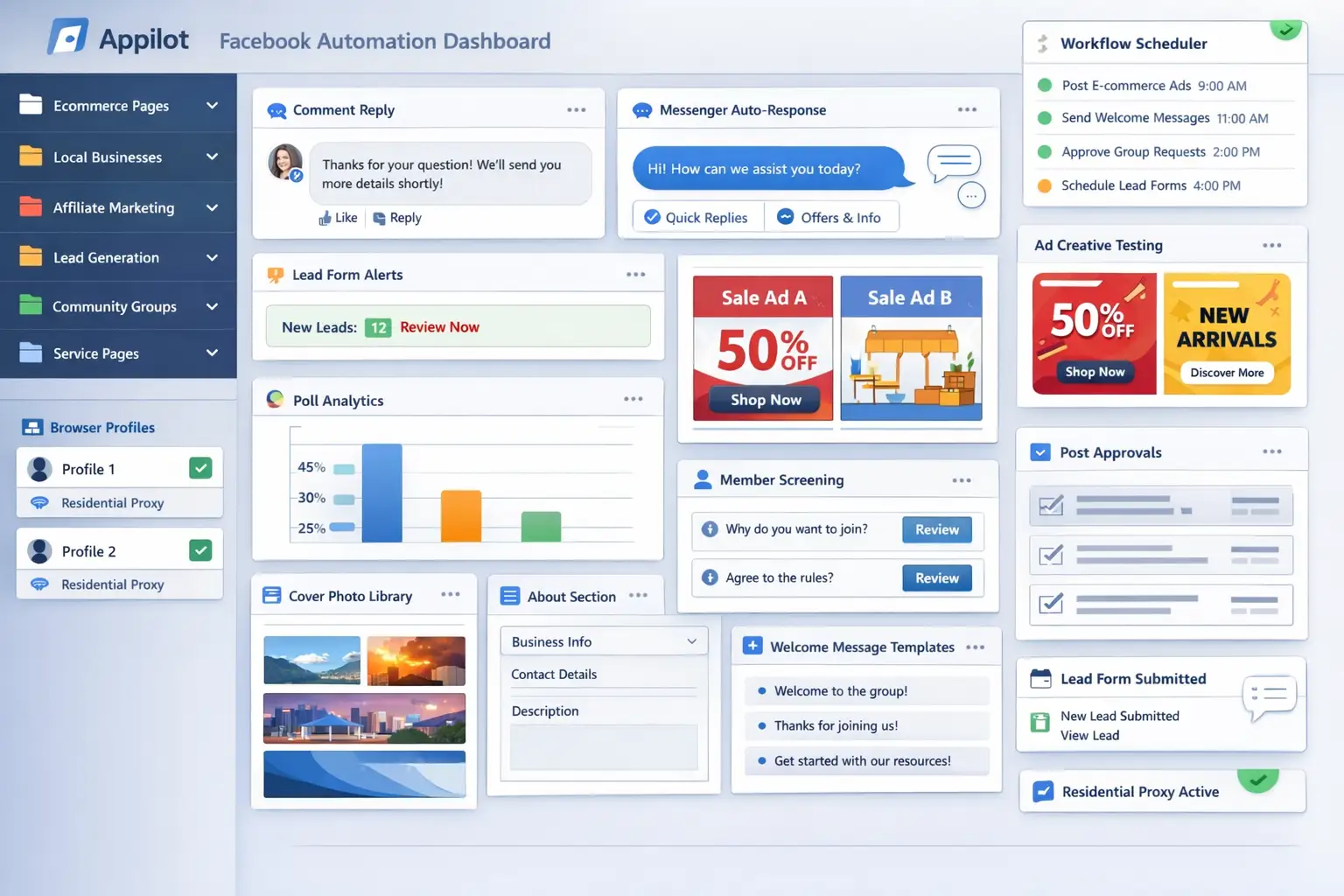
For this guide, I will use Appilot as the workflow platform. Appilot helps automate browser workflows and Android actions from one dashboard, making it easier to manage Facebook engagement across multiple accounts and business pages.
In this guide, you will learn why Facebook comment automation matters, how to organize comment types, how to connect Facebook pages with Appilot, and how to automate replies safely at scale.
Setup Time: Around 45 minutes
Difficulty: Intermediate
Estimated Time Saved: 10 to 20 hours weekly
Why Facebook Comment Reply Automation Matters
Facebook comments are often one of the first places where potential customers interact with a business.
For example, someone may ask:
How much does this cost?
Do you ship internationally?
Where are you located?
How long does delivery take?
Can I get more information?
Is this product still available?
If these questions are answered quickly, the customer is much more likely to continue the conversation or make a purchase.
The problem is that pages with high engagement often receive too many comments to handle manually. A single post can receive dozens or even hundreds of comments within a few hours.
For businesses running ads, this becomes even more difficult because comments appear across multiple campaigns, pages, and posts at the same time.
Without a system, it becomes easy to:
Miss customer questions
Delay responses
Leave complaints unanswered
Lose sales opportunities
Create inconsistent customer experiences
Overload the support team
Automation helps solve these problems by turning comment replies into repeatable workflows.
The manual approach may work for small pages with limited engagement, but it becomes difficult once comment volume grows.
With automation, you can build systems that detect comments, identify keywords, and send pre-defined replies automatically.
The biggest advantage is not only saving time. It is improving response speed and keeping engagement consistent across every post and page.
What You Need to Get Started
To automate Facebook comment replies, you need a few tools working together.
The first requirement is an antidetect browser such as GoLogin, AdsPower, Multilogin, or Dolphin Anty. These browsers help manage multiple Facebook pages and accounts separately while keeping cookies, browser fingerprints, and proxies isolated.
The second requirement is residential or mobile proxies. Proxies help make account activity look more natural and reduce the risk of multiple accounts appearing from the same IP address.
The third requirement is Appilot. Appilot helps connect browser profiles, organize Facebook pages, build reply workflows, and automate repetitive engagement tasks from one dashboard.
You should also have a list of common customer questions and reply templates ready before building workflows.
A typical setup for Facebook comment automation usually costs between $150 and $400 per month depending on the number of browser profiles, pages, and workflows involved.
Step-by-Step: Setting Up Facebook Comment Reply Automation
Step 1: Organize Your Facebook Pages
Before creating workflows, you should organize your Facebook pages into categories.
For example, you may have:
Ecommerce pages
Local business pages
Affiliate pages
Service pages
Lead generation pages
Community pages
Each type of page may require different reply styles.
For example, an ecommerce page may receive questions about price, delivery, and stock. A local business page may receive questions about location, opening hours, and bookings.
The more organized your page groups become, the easier it becomes to create useful reply workflows.
Step 2: Identify Common Comment Types
Once your page groups are ready, you should identify the most common comments that appear.
For example:
Price questions
Shipping questions
Availability questions
Booking requests
Product inquiries
Complaints
Positive comments
Spam comments
This allows you to create structured reply templates for each category.
For example:
Price comment = "Please send us a message and we will share the latest pricing details."
Shipping comment = "Yes, we ship internationally. Please send us your country so we can confirm shipping rates."
Availability comment = "Yes, this item is currently available. Please send us a message for more details."
The goal is not to automate every conversation completely. The goal is to handle repetitive questions faster.
Step 3: Connect Browser Profiles to Appilot
Once your browser profiles are ready, connect them to Appilot using your browser API key.
Inside Appilot, you can organize profile groups such as:
ecommerce-pages
local-business-pages
affiliate-pages
service-pages
lead-generation-pages
This makes it easier to assign different reply workflows to different page groups.
Step 4: Create a Comment Reply Workflow
Once everything is connected, you can create a workflow that detects comments and sends replies automatically.
For example, you may want the workflow to:
Detect comments with price-related keywords
Detect comments asking about shipping
Detect spam comments
Send automatic replies
Flag negative comments for manual review
Hide offensive comments automatically
const workflow = {
  name: "Facebook Comment Reply Workflow",
  pages: "ecommerce-pages",
  actions: [
    "Monitor new comments",
    "Detect comment keywords",
    "Match comment category",
    "Send automatic reply",
    "Flag complex comments for review"
  ],
  schedule: "Continuous"
};
The strongest workflows are usually simple and focused. Instead of trying to automate every possible comment, it is better to automate the most repetitive questions first.
Step 5: Test Before Scaling
Before using automation across every page, test the workflow on a small group first.
Choose one page and monitor how the replies perform.
Check whether:
The correct reply is being sent
Keywords are detected properly
Spam comments are filtered correctly
Complex comments are flagged for review
Customers respond positively to the replies
Once everything works correctly, you can gradually expand to more pages and more comment categories.
This helps reduce mistakes and gives you time to improve the workflow before scaling.
Best Practices for Facebook Comment Reply Automation
The best comment workflows focus on speed and relevance.
It is important to keep replies short, clear, and natural. Overly robotic replies can feel repetitive and reduce trust.
You should also avoid replying instantly to every comment. Real pages usually respond with some delay, so adding random timing helps the automation feel more natural.
Another important practice is separating simple questions from complex issues. Simple questions about pricing or availability can usually be automated, while complaints and sensitive issues should still be handled manually.
It is also useful to rotate reply templates. If the exact same message appears under every comment, it can feel repetitive and unnatural.
Real Example: Scaling Comment Replies Across 15 Pages
One agency managed 15 Facebook pages across ecommerce, local business, and lead generation niches.
At first, every comment was handled manually. Team members spent hours every day checking notifications, replying to repetitive questions, and filtering spam comments.
As the number of pages grew, response times became slower and some comments were missed completely.
The agency eventually switched to a workflow using GoLogin, residential proxies, and Appilot. Pages were grouped by category, and automated replies were created for common customer questions.
After 60 days, the agency reduced manual reply time by more than 70 percent while improving average response speed across every page.
The biggest improvement was not just saving time. It was making sure customers received answers more consistently.
Common Mistakes to Avoid
One common mistake is trying to automate every type of comment. Complex conversations usually still need a human response.
Another mistake is using the exact same reply for every comment. Repetitive replies can make the page feel unnatural.
Some teams also forget to monitor automated replies regularly. Even if the workflow is working, it is still important to review customer interactions.
It is also important not to reply too quickly to every comment. Delays usually make the activity look more realistic.
FAQ
Q1: How many Facebook pages can I manage with automated comment replies?
Most users can comfortably manage 10 to 50 Facebook pages with structured workflows. Larger teams can support even more pages by organizing them into groups.
Q2: What types of comments should be automated?
Simple questions about price, shipping, availability, booking, and location are usually the best comments to automate.
Q3: Should negative comments be automated too?
No. Complaints and sensitive comments are usually better handled manually so the response feels more personal.
Q4: Can I use different reply templates for different pages?
Yes. Most users create separate reply workflows for ecommerce pages, local businesses, affiliate pages, and service pages.
Q5: Which browser is best for Facebook comment automation?
GoLogin is usually best for smaller operations, AdsPower works well for larger profile groups, and Multilogin is useful for enterprise teams.
Conclusion
Facebook comment reply automation helps businesses save time, improve response speed, and manage large numbers of comments much more effectively.
Instead of manually replying to repetitive questions every day, you can create workflows that detect common comments, send replies automatically, and keep customer engagement consistent.
The key is to start with simple comment categories, build useful reply templates, test workflows gradually, and keep complex conversations manual.
For ecommerce brands, local businesses, agencies, and affiliate marketers, Facebook comment automation can become one of the most useful systems for improving engagement at scale.