How to Automate YouTube Description Optimization

YouTube descriptions can have a major impact on video visibility, search rankings, click-through rates, affiliate conversions, lead generation, and overall channel performance. A strong description can help YouTube understand what a video is about, help viewers find important links, and guide people toward the next action you want them to take.
The challenge is that optimizing descriptions manually becomes difficult when you are managing multiple YouTube channels, multiple content categories, and large video libraries at the same time. One channel may focus on SaaS tutorials, another may focus on ecommerce content, another may focus on affiliate marketing, and another may focus on startup growth or local business education. Each one needs different keywords, different CTAs, different links, and different formatting rules.
This is where automation becomes valuable. Instead of manually opening every video, rewriting descriptions, updating affiliate links, adding timestamps, and changing CTAs one by one, you can build workflows that optimize descriptions automatically across large groups of videos.
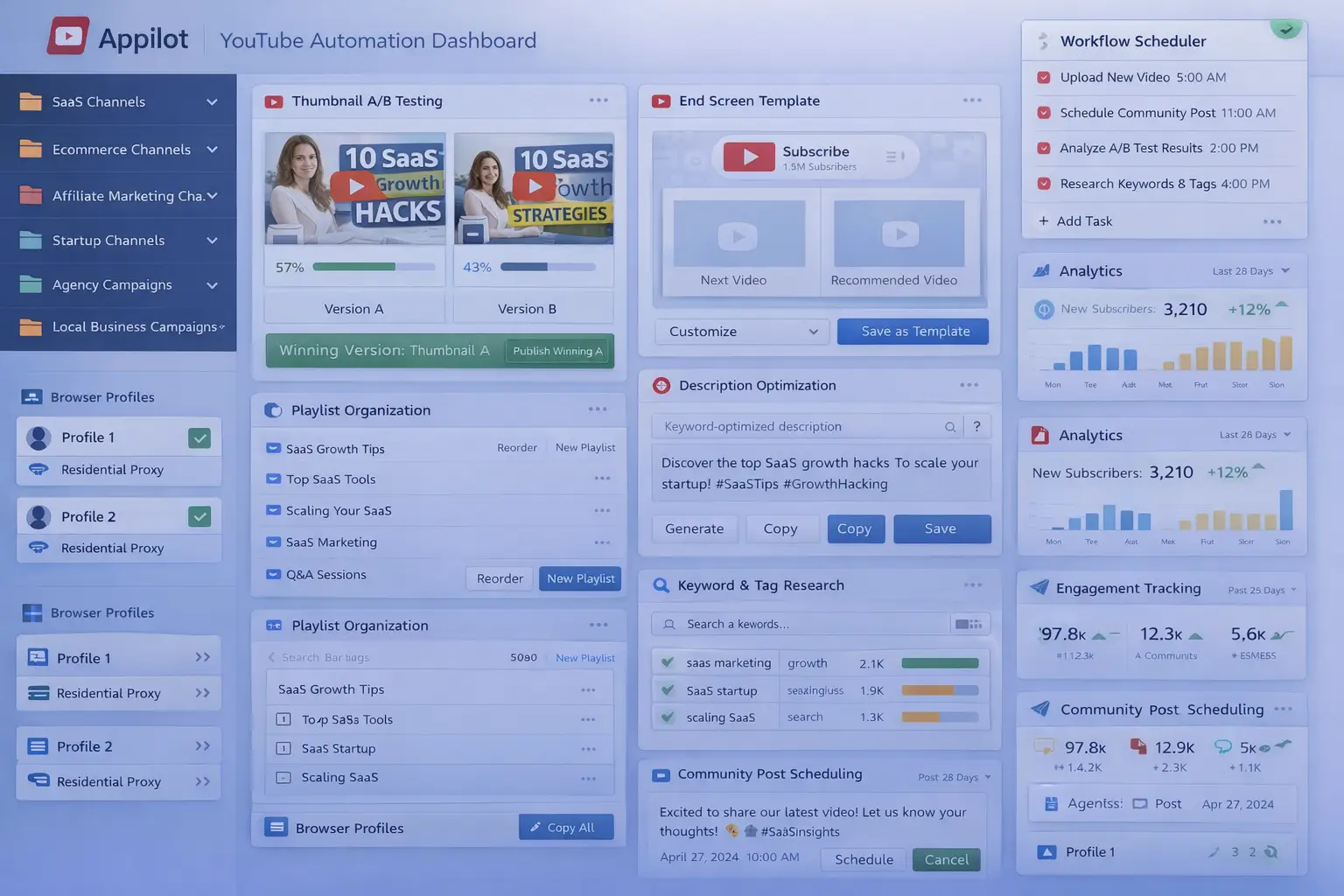
For this guide, I will use Appilot as the main workflow platform. Appilot helps automate browser workflows and Android actions from one dashboard, making it easier to manage YouTube optimization across multiple browser profiles and content campaigns.
In this guide, you will learn why YouTube description optimization matters, how to organize description templates, how to connect YouTube channels with Appilot, and how to automate description updates safely at scale.
Setup Time: Around 30 to 45 minutes
Difficulty: Beginner to Intermediate
Estimated Time Saved: 5 to 10 hours weekly
Why YouTube Description Optimization Matters
YouTube descriptions work best when they are structured, keyword-rich, and updated consistently. A good description can improve discoverability in search, increase clicks on affiliate links, drive more traffic to websites, and encourage viewers to watch more content.
For example, a SaaS channel may want to include product-related keywords, software comparisons, webinar links, and tutorial timestamps. An ecommerce channel may want to include product links, discount codes, and buying guides. An affiliate marketing channel may want to include recommended tools, landing pages, and tracking links.
If you are managing multiple channels manually, it becomes difficult to keep track of which videos have outdated descriptions, which links need updating, and which channels need new CTAs.
Without a system, it becomes easy to:
Forget to update old descriptions
Leave outdated links inside videos
Miss keyword opportunities
Use inconsistent CTAs
Waste time on repetitive editing work
Delay channel optimization
Automation helps solve these problems by turning description optimization into a repeatable workflow.
The manual approach may work for smaller YouTube operations, but it becomes difficult once you are managing multiple channels and hundreds of videos.
With automation, you can create workflows that update keywords, timestamps, affiliate links, CTAs, and related video links automatically.
The biggest advantage is not only saving time. It is making sure every channel has a reliable SEO and conversion process.
What You Need to Get Started
To automate YouTube description optimization, you need a few tools working together. The first requirement is an antidetect browser such as GoLogin, AdsPower, Multilogin, or Dolphin Anty. These browsers help manage multiple YouTube channels separately while keeping cookies, browser fingerprints, and proxies isolated.
The second requirement is residential or mobile proxies. Proxies help make account activity look more natural and reduce the risk of multiple channels appearing from the same IP address.
The third requirement is Appilot. Appilot helps connect browser profiles, organize YouTube campaigns, automate description updates, and manage repetitive optimization tasks from one dashboard.
You should also prepare a description template library before building workflows. This can include keyword blocks, affiliate links, timestamps, CTA sections, social links, and video-specific notes.
A typical setup for YouTube automation usually costs between $150 and $400 per month depending on the number of channels, browser profiles, and workflows involved.
Step-by-Step: Setting Up YouTube Description Optimization Automation
Step 1: Organize Your Channel Categories
Before creating workflows, organize your channels into categories.
For example, you may have SaaS channels, ecommerce channels, affiliate marketing channels, startup channels, local business channels, and agency channels.
Different channel types usually require different description styles.
A SaaS channel may need software-related keywords and webinar links, while an ecommerce channel may need product links and shopping CTAs.
The more organized your channel groups become, the easier it becomes to create useful description workflows.
Step 2: Build a Description Template Library
Once your channel groups are ready, prepare a library of description templates.
For example, you may want to organize templates based on:
Channel type
Video category
Keyword set
CTA section
Affiliate links
Timestamp structure
You may also want to separate templates into categories such as tutorial descriptions, product review descriptions, webinar descriptions, case study descriptions, and affiliate descriptions.
The goal is to keep description information organized so the automation can quickly assign the right variation to the right video.
Step 3: Connect Browser Profiles to Appilot
Once your browser profiles are ready, connect them to Appilot using your browser API key.
Inside Appilot, you can organize profile groups such as:
saas-channels
ecommerce-channels
affiliate-channels
startup-channels
agency-channels
This makes it easier to assign different optimization workflows to different channel types.
Step 4: Create a Description Workflow
Once everything is connected, you can create a workflow that handles description updates automatically.
For example, you may want the workflow to:
Select video library
Match video to description template
Insert keywords and timestamps
Update affiliate links and CTAs
Save optimization history
Track performance changes
const workflow = {
  name: "YouTube Description Optimization Automation",
  campaigns: "affiliate-channels",
  actions: [
    "Select video library",
    "Match video to description template",
    "Insert keywords and timestamps",
    "Update affiliate links and CTAs",
    "Track performance changes"
  ],
  schedule: "Monthly"
};
The strongest workflows are usually simple and focused. Instead of changing every description element at once, it is usually better to improve one major section at a time.
Step 5: Test Before Scaling
Before applying automation to every channel, test the workflow on a small group first.
Choose one channel and monitor how the update process performs.
Check whether the correct templates are being applied, keywords are relevant, affiliate links are working, and CTAs are improving engagement.
Once everything works correctly, you can gradually expand to more channels and more video categories.
This helps reduce mistakes and gives you time to improve the workflow before scaling further.
Best Practices for YouTube Description Optimization
The best description workflows focus on clarity, SEO, and conversions.
It is important to place the most important information near the top of the description because viewers and YouTube both prioritize the first few lines.
You should also keep keywords aligned with the audience. A SaaS audience usually searches differently than an ecommerce or affiliate marketing audience.
Another important practice is reviewing links regularly. Broken affiliate links, outdated pages, and expired promotions can hurt both trust and conversions.
It is also useful to create reusable description templates for top-performing video categories.
Real Example: Optimizing Descriptions Across 18 YouTube Channels
One agency managed YouTube channels across SaaS, ecommerce, startup, and affiliate marketing niches.
At first, description optimization was handled manually. Team members had to update keywords, add timestamps, and replace affiliate links one by one.
As the number of channels grew, the process became slower and more repetitive.
The agency eventually switched to a workflow using GoLogin, residential proxies, and Appilot. Channels were grouped by niche, description libraries were standardized, and automated optimization workflows were created for each channel type.
After 60 days, the agency reduced manual SEO work by more than 70 percent while improving search rankings, click-through rates, and affiliate conversions across every channel.
The biggest improvement was not just saving time. It was making sure every channel had a reliable description optimization process.
Common Mistakes to Avoid
One common mistake is stuffing too many keywords into the description. This can make the content look unnatural and reduce readability.
Another mistake is using the same description format across every niche. Different audiences usually respond differently.
Some teams also forget to review links regularly. Broken or outdated links can hurt trust and conversions.
It is also important not to rely only on descriptions. Strong titles, thumbnails, watch time, and retention also affect channel performance.
FAQ
Q1: How many YouTube channels can I manage with automated description optimization?
Most users can comfortably manage 10 to 50 YouTube channels with structured workflows. Larger teams can support even more by organizing channels into groups.
Q2: What description elements usually perform best on YouTube?
Keywords, timestamps, affiliate links, CTAs, social links, and related video links usually perform well.
Q3: Should every YouTube channel use the same description strategy?
No. Different audiences and channel types usually require different keywords, CTAs, and formatting styles.
Q4: How often should description templates be updated?
Most users benefit from reviewing and updating description templates every few weeks because search behavior and promotions change.
Q5: Which browser is best for YouTube automation?
GoLogin is usually best for smaller operations, AdsPower works well for larger profile groups, and Multilogin is useful for enterprise teams.
Conclusion
YouTube description optimization automation helps businesses, agencies, and creators save time while improving SEO, click-through rates, and conversions.
Instead of manually updating descriptions one by one, you can create workflows that organize templates, assign keywords, update affiliate links, track performance, and keep optimization active automatically.
The key is to organize channels carefully, prepare strong description templates, test workflows gradually, and review SEO performance regularly.
For SaaS companies, agencies, affiliate marketers, ecommerce brands, and startup founders, description optimization can become one of the most useful systems for improving YouTube growth at scale.