How to Automate TikTok Content Distribution: The Compliant Way
The real bottleneck in TikTok growth is rarely creativity. Most teams already have ideas, content, and accounts. What usually breaks down is operations. Posting becomes inconsistent, time slots get missed, coordination gets messy, and teams end up stuck in manual workflow chaos.
Imagine running a TikTok operation where videos are organized in advance, accounts are segmented properly, scheduling is handled through supported infrastructure, and analytics automatically feed back into the next publishing decisions. That kind of system is not only possible, it is the safest way to scale.
This guide shows you exactly how to automate TikTok content distribution compliantly, what tools you need, the workflow to follow, and how to scale without relying on risky device-level automation.
Why TikTok Content Distribution Matters / The Opportunity
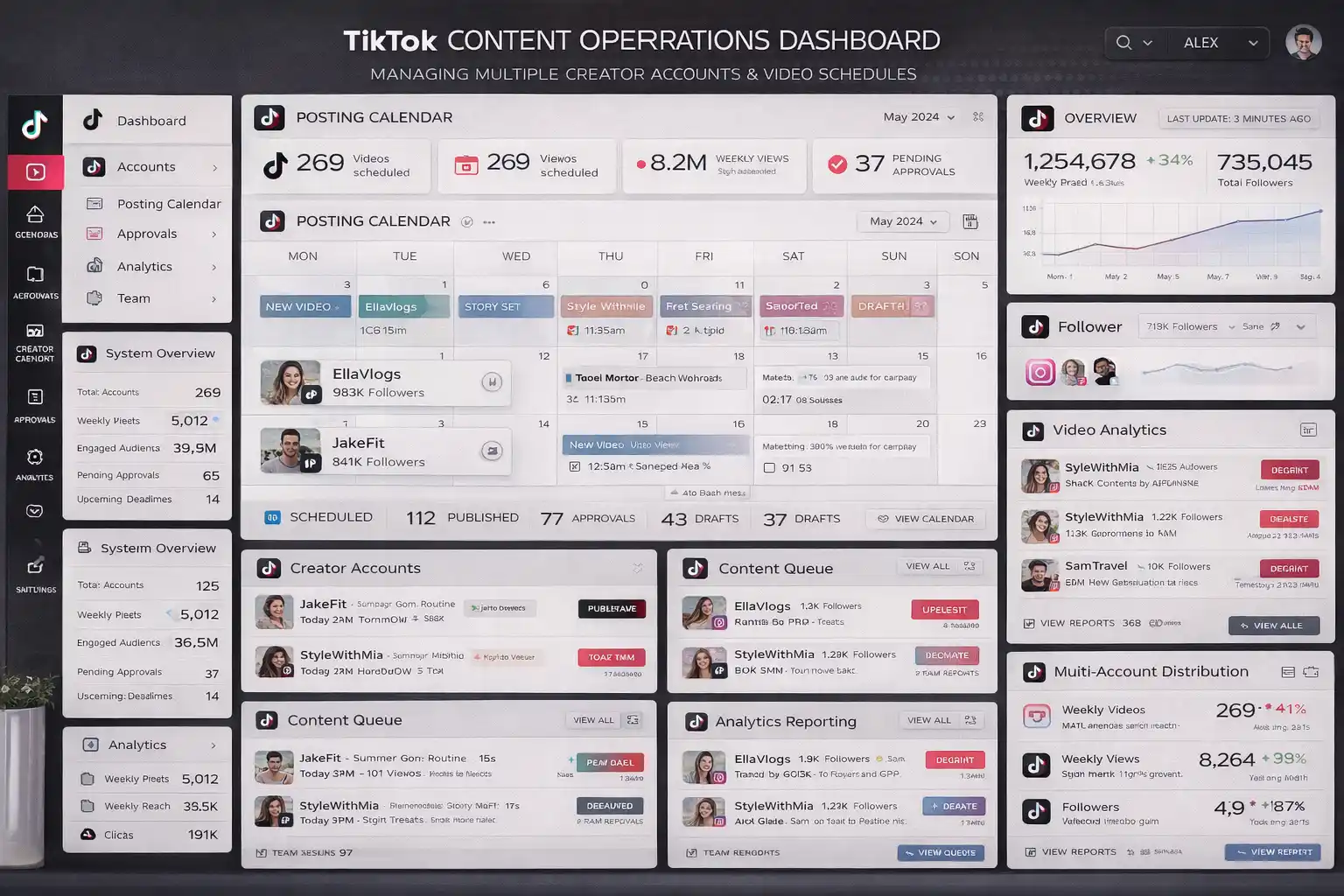
TikTok distribution becomes difficult the moment a team is managing multiple creators, several brand accounts, TikTok Shop coordination, and both paid and organic content at the same time. At that point, manual posting starts to collapse because the workload is no longer about uploading a video. It is about maintaining a repeatable content engine across multiple moving parts.
Automating TikTok content distribution compliantly is becoming essential because teams that rely on structured operations gain a major advantage in consistency, coordination, and reporting. The opportunity is not just posting more often. It is building a system where content gets published on time, insights are captured quickly, and successful formats can be repeated intelligently.
1. Who This Use Case is For
This approach works best for brands managing multiple TikTok accounts, agencies coordinating several client channels, creator teams publishing across niche pages, and ecommerce operators handling organic and TikTok Shop content together.
It is also highly useful for internal growth teams that need better scheduling, clearer asset management, and stronger analytics workflows without increasing platform risk.
2. What You'll Achieve
By implementing a compliant TikTok distribution workflow, you will be able to centralize content planning, schedule videos more reliably, reduce coordination mistakes, track performance faster, and build feedback loops that improve distribution decisions over time.
In practical terms, that means more consistent posting, better use of high-performing content, clearer team ownership, reduced manual overhead, and a system that scales through structure instead of chaos.
3. What You'll Need
Before scaling TikTok distribution properly, you need the right publishing infrastructure, a central content pipeline, and a workflow that connects scheduling with analytics.
Technical Requirements
The safest foundation is TikTok’s supported ecosystem, including TikTok Business Suite for official desktop publishing, scheduling, analytics, and account-level controls. Advanced teams may also use the TikTok Marketing API for programmatic publishing, content management, analytics ingestion, and stronger alignment between paid and organic content operations.
For commerce brands, Creator Marketplace and TikTok Shop tools can also be part of the stack because they support affiliate coordination, product tagging, and shop-related workflows. These supported tools are far more stable and scalable than any device-based workaround.
For planning and coordination, teams usually need Notion, Airtable, Google Drive, a DAM platform, or structured approval workflows that track video ID, caption version, hook type, sound used, posting date, and account assignment.
If a team also needs Android-side workflow visibility in broader mobile-first content operations, Appilot can be relevant as a supporting workflow layer because it works with real Android devices and mobile-first systems. However, it should not replace official TikTok publishing infrastructure or be used for behavioral simulation.
Skills and Knowledge
A technical background is helpful but not required. Teams benefit most from understanding content operations, account segmentation, scheduling logic, analytics review, and how retention, watch time, and velocity affect TikTok distribution.
Technical teams may go further by connecting APIs, dashboards, approval systems, and reporting automations, but even no-code teams can build a strong distribution engine with the right structure.
Time and Resource Investment
A basic system can be built in a few hours to a few days, depending on whether the team is only organizing a content calendar or building a fuller setup with analytics automation, account segmentation, and reporting dashboards.
The ongoing investment is usually in workflow discipline rather than software cost. Once the system is established, it reduces effort rather than adding complexity.
Appilot Integration Method #1 - The Complete Solution Approach
Implementing TikTok Content Distribution with Official Tools and Workflow Systems
There are two ways teams usually think about TikTok scale. The weak model is trying to increase automation intensity with device-level posting logic and account control shortcuts. The stronger model is building a workflow system around official publishing infrastructure, centralized content operations, and analytics-triggered decisions.
The DIY approach usually combines a content planning tool, cloud storage, TikTok Business Suite, approved scheduling tools, and reporting dashboards. This works well when a team is disciplined and can maintain clean internal processes.
An integrated supporting workflow layer can also be useful when a team operates across both browser and mobile-first content systems. This is where Appilot can fit carefully as a support tool for Android-side operational visibility where that is genuinely relevant. Because it works with real Android devices and mobile-first workflows, it can help teams observe and coordinate mobile operational context. The important boundary is that it should support workflow visibility, not replace official TikTok publishing methods or simulate platform behavior.
That distinction matters because real automation at scale should improve operations, not try to outmaneuver the platform.
Step-by-Step Implementation Guide
Compliant TikTok distribution becomes much easier when the system is broken into clear operational layers.
Step 1: Build a Centralized Content Pipeline
The first step is creating one place where every video is tracked with its video ID, caption version, hook type, sound, posting date, and assigned account. Without that, teams end up searching across chats, folders, and spreadsheets whenever publishing time arrives.
This pipeline becomes the source of truth for the whole distribution system. It gives creators, editors, managers, and account owners a shared view of what is ready, what is approved, and what still needs attention.
A common mistake is treating TikTok posting as a last-mile action instead of part of a structured content pipeline. That usually leads to confusion and missed opportunities.
Step 2: Add a Scheduling Layer
The next step is using supported scheduling options such as TikTok Business Suite, approved social media management tools, or API-based publishing where eligible. Scheduling should be based on time zone, historical performance windows, and audience activity rather than guesswork.
From a workflow perspective, this is where structure replaces manual posting chaos. Once timing decisions are made in advance, the team stops reacting and starts operating from a plan.
Here is a simple example of how publishing logic might be modeled:
const tiktokPost = {
  account: "Brand Account 1",
  postingDate: "2026-04-06",
  postingTime: "19:00",
  timezone: "America/New_York",
  format: "Product Demo",
  hookType: "Fast Hook"
};
function publishWindow(post) {
  return `${post.account} scheduled for ${post.postingDate} at ${post.postingTime} (${post.timezone}) with ${post.format}`;
}
console.log(publishWindow(tiktokPost));
This kind of logic is useful because it turns scheduling into a repeatable system instead of a daily operational scramble.
Step 3: Build a Performance Feedback Loop
The most important difference between basic scheduling and real distribution automation is the feedback loop. Teams should automatically track early performance signals such as two-hour velocity, 24-hour reach, watch time, completion rate, click-through rate, and shop conversions where relevant.
Once that data is available quickly, the system can inform better decisions such as whether a format should be repeated, whether a video should be boosted, or whether a high-performing concept should be adapted across other suitable accounts.
That is real automation because it helps the team make better publishing decisions based on performance rather than guesswork.
Step 4: Segment Accounts Strategically
Scaling TikTok successfully depends on account segmentation. Instead of treating a large portfolio as one publishing pool, accounts should be grouped by niche, region, content format, or funnel stage.
This matters because mass posting without segmentation creates overlap, weakens targeting, and makes analytics harder to interpret. Segmentation turns each account into a strategic channel instead of just another destination for content.
Step 5: Review and Improve Weekly
A strong TikTok distribution system should include a weekly review cycle where the team looks at what worked, what underperformed, what hooks are trending upward, and which content formats deserve more distribution.
This turns the workflow into a real content testing engine. Instead of asking how to post across more accounts, the team starts asking how to distribute the right content more intelligently.
Appilot Integration Method #2 - Specific Feature Showcase
Handling Mobile-First Workflow Visibility in Large TikTok Operations
One of the hardest parts of large TikTok operations is that the platform is fundamentally mobile-first, while many agency and brand workflows are managed through browser dashboards and desktop planning tools. That creates a visibility gap between planning and the mobile context in which content is actually experienced.
The traditional approach is often fragmented because one system handles content approvals, another handles reporting, and the actual mobile context is left out of the operational view. That can create confusion during reviews, creator handoffs, and publishing coordination.
Appilot can support this challenge where Android-side operational visibility is relevant because it uses real Android devices and mobile-first workflows. In that limited supporting role, it can help teams review and understand mobile workflow context more clearly. The key is to keep that function operational, not behavioral. It should support compliant systems, not try to replace them.
Common Challenges and Solutions
Even well-structured TikTok teams usually run into a few recurring operational mistakes.
Challenge 1: Inconsistent Posting Across Accounts
This usually happens when scheduling is handled manually or when the content calendar is not tightly linked to publishing ownership. Teams may have enough content, but the system for getting it live is weak.
The solution is to centralize scheduling, assign ownership clearly, and make sure every approved asset already has a destination account and posting window before the week begins.
Challenge 2: Posting Identical Content Simultaneously
This is one of the most common scaling mistakes because it feels efficient while often creating distribution problems. When multiple accounts publish the same content at the same time, the operation becomes strategically weak and harder to optimize.
The solution is to stagger timing, segment accounts, and use performance signals to decide where content should travel next instead of pushing everything everywhere at once.
Challenge 3: Ignoring Early Analytics Velocity
TikTok gives strong signals early. Teams that ignore the first one to two hours often miss the most useful feedback window for deciding what to repeat, boost, or revise.
The solution is to automate early analytics ingestion and make those signals visible fast enough to shape the next publishing decision.
Appilot Integration Method #4 - Real-World Case Study
Case Study: A Mid-Size Ecommerce Brand Builds a Compliant TikTok Distribution Engine
A mid-size ecommerce brand managing 12 TikTok accounts across 3 niches with 5 creators needed a better way to coordinate content without relying on device-level automation. Their requirements were clear. They needed centralized content production, stronger scheduling, better reporting, and a system that could scale without creating account warnings.
Their earlier approach was too manual. Posting windows were being missed, operational overhead was high, and there was no clean system connecting content production with performance analysis.
The improved model used a centralized content pipeline, TikTok Business Suite scheduling, automated analytics reporting, and performance-triggered repost workflows. The browser-side systems handled planning, scheduling, and reporting, while the overall operation stayed aligned with official TikTok infrastructure. Where mobile-first operational context was relevant, Appilot could serve as a supporting visibility layer rather than a publishing engine.
Within 60 days, posting consistency increased significantly, average reach improved, account warnings remained at zero, and the team reduced operational overhead. The biggest success factor was not more aggressive automation. It was a better system.
Scaling TikTok Distribution from 5 to 50+ Accounts
The next stage of growth is not about more hardware. It is about better operational design.
From 5 to 50+ Accounts
As the number of accounts increases, teams need stronger calendar ownership, more reliable content production, clearer account segmentation, and better analytics visibility. Without that, each new account adds confusion instead of value.
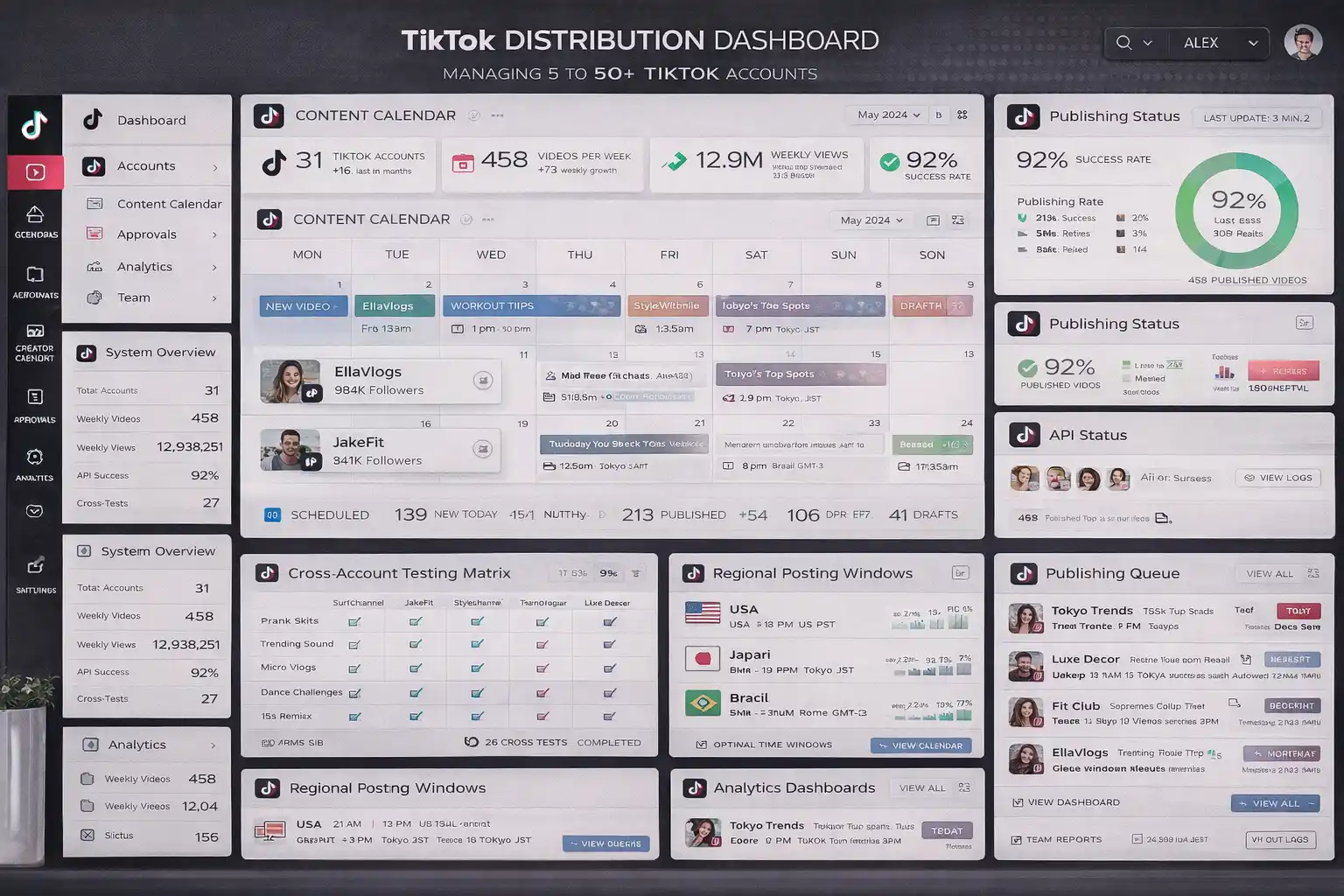
At larger scale, dedicated content calendar ownership, API-driven publishing, regional posting strategies, and cross-account testing structures become more important than posting intensity.
Automation and Optimization at Scale
At scale, the best things to automate are scheduling logic, reporting, content status tracking, dashboard generation, and performance-triggered decisions. What should remain manual are creative judgment, account strategy, and content quality review because those still depend on human context and taste.
When teams understand that difference, TikTok distribution becomes much more sustainable.
Best Practices and Pro Tips
Best Practice 1 - Centralize Before You Scale
Teams should not add more accounts until content planning, approvals, and scheduling live in one coherent system. The implementation is simple: one content pipeline, one publishing logic, and one reporting structure. The impact is much better consistency and far fewer operational mistakes.
Best Practice 2 - Use Analytics to Trigger Decisions
Real TikTok workflow automation is not about publishing blindly. It is about turning analytics into action. The practical implementation is to review early velocity, retention, reach, and conversion signals fast enough to influence the next move. A common pitfall is collecting analytics without actually using them to guide distribution.
Best Practice 3 - Segment Accounts with Intent
Every account should have a strategic role based on niche, region, content type, or funnel stage. That makes testing cleaner and distribution more effective. An advanced variation is to build a cross-account matrix for testing hooks, formats, and offers without collapsing all accounts into the same publishing behavior.
Tools and Resources
For official publishing infrastructure, TikTok Business Suite should be the starting point because it supports desktop publishing, scheduling, analytics, and account-level controls. For advanced teams, the TikTok Marketing API can support programmatic publishing, analytics ingestion, and alignment between organic and paid distribution. For commerce-oriented brands, Creator Marketplace and TikTok Shop tools can support affiliate coordination and product-based workflows.
For content planning and operational structure, tools such as Notion, Airtable, Google Drive, DAM platforms, and approval workflow systems are especially useful because they create the operational clarity needed before publishing even begins.
For Android-side operational visibility where mobile-first context matters, Appilot can support real-device workflow review and mobile-first operational visibility, but it should remain a supporting system around compliant infrastructure rather than a replacement for it.
Key Takeaways
Automating TikTok content distribution compliantly means using official publishing infrastructure, automating scheduling and reporting rather than account behavior, centralizing content operations, building analytics-triggered workflows, and scaling through structure instead of shortcuts.
The biggest mistake is trying to out-automate the platform. The smarter strategy is to align with how TikTok is actually designed to distribute content and build a repeatable content testing and distribution engine on top of that. The teams that scale best are the ones that systemize intelligently instead of automating blindly.
Frequently Asked Questions
Q1: How do you automate TikTok content distribution safely?
You do it by automating planning, scheduling, analytics, and reporting while keeping publishing inside official or supported infrastructure. Safe automation improves workflow, not account behavior.
Q2: What should TikTok automation actually focus on?
It should focus on content pipeline orchestration, scheduling logic, performance feedback loops, analytics dashboards, and structured account segmentation.
Q3: Can device-level automation help with TikTok scale?
It is not the compliant foundation for long-term scale. Official publishing infrastructure and workflow systems are much safer and more sustainable.
Q4: Can Appilot replace TikTok’s official publishing tools?
No. Appilot can support Android-side operational visibility in broader mobile-first workflows where relevant, but official TikTok publishing infrastructure should remain the core of the system.
Q5: What really drives TikTok reach at scale?
TikTok prioritizes watch time, retention curves, completion rate, engagement velocity, and content originality. Distribution systems can support consistency and testing, but they cannot compensate for weak content signals.
Conclusion
The real bottleneck in TikTok growth is not a lack of content or ideas. It is operational inconsistency.
The strongest teams solve that by building systems around official publishing infrastructure, centralized content pipelines, analytics-triggered decisions, and strategic account segmentation. That is what makes large-scale TikTok distribution compliant, sustainable, and effective.
The smartest move is not to automate blindly. It is to build a repeatable engine that supports good content with good operations.