The Hidden Costs of Getting Your Automation Detected
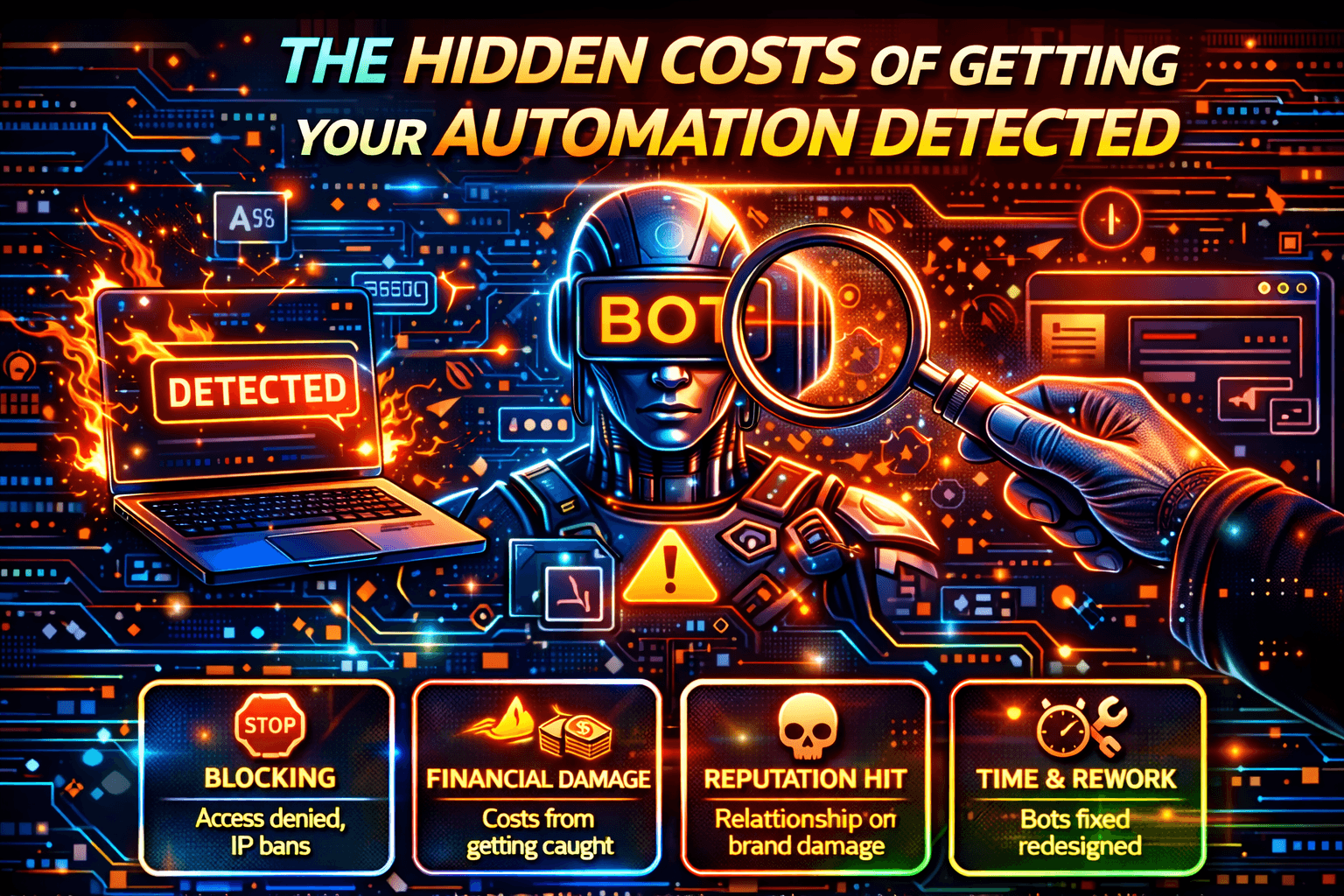
Your automation does not crash. Jobs still execute, dashboards still show green, and workflows appear to be functioning.
But underneath the surface, requests start slowing down, results begin degrading, accounts lose reach, proxy bills increase, and success rates quietly decline.
That is the real danger of automation detection.
Detection does not always block automation completely. In many cases, it simply taxes the system until it becomes slower, more expensive, and less reliable over time.
Whether you are dealing with automated threat detection, fraud detection automation, anomaly detection systems, or abuse prevention tools, modern detection is not binary. It is probabilistic.
Once trust drops, everything becomes harder.
Automation Detection Isn’t Just “Bot Blocked” Anymore
Detection used to be simple. You would get an access denied error, a CAPTCHA, or an IP block.
Today, detection is embedded into fraud systems, abuse prevention pipelines, behavioral anomaly engines, intrusion detection systems, and risk-based throttling layers.
Modern detection systems do not just stop automation. They reshape how automation is treated.
That is where the hidden costs begin.
Hidden Cost #1: Silent Degradation
The most expensive outcome is often not total failure. It is partial success.
Requests may still succeed, but they become throttled. Data may still return, but with reduced quality. Accounts may stay active, but they lose reach and visibility. APIs may still respond, but much more slowly than before.
The automation still appears to work, but it operates under suspicion.
Teams often misdiagnose this kind of degradation as market shifts, bad data, product regression, or algorithm changes when the real cause is detection pressure.
Hidden Cost #2: Infrastructure Inflation
When detection pressure rises, teams usually respond by adding more proxies, more retries, more regions, more redundancy, and more monitoring.
This increases compute costs, bandwidth usage, observability overhead, and engineering complexity.
Ironically, these reactions often make detection worse because patterns begin repeating faster, retry loops become more obvious, and behavioral correlation becomes stronger.
Fighting detection blindly can become more expensive than the detection itself.
Hidden Cost #3: Escalation Into Higher-Risk Buckets
Modern detection systems remember previous behavior.
Once automation is flagged, it may start getting routed into stricter fraud models, more aggressive rate limiting, harder authentication checks, and deeper inspection layers.
This is especially common on financial platforms, SaaS systems, ecommerce websites, social platforms, and other high-risk verticals.
At that point, fixing one broken script is not enough. Trust recovery becomes much harder and more nonlinear.
Hidden Cost #4: Engineering Time Drain
Detection does not only cost money. It also consumes focus.
Teams trapped in detection loops spend their time tweaking headers, rotating infrastructure, rewriting automation flows, debugging invisible failures, and testing stealth plugins.
Instead of building product improvements, the organization becomes reactive.
Automation stops being a strategic advantage and becomes a defensive maintenance burden.
Hidden Cost #5: Cross-System Contamination
One of the least discussed realities of automation detection is that it spreads.
If you reuse infrastructure, accounts, automation logic, or behavioral templates across multiple workflows, detection in one system can begin influencing others.
This happens through shared reputation models, behavioral fingerprinting, and correlation engines.
Suddenly, an unrelated workflow behaves differently, a separate pipeline slows down, and noise starts appearing across the system.
Detection rarely stays isolated. It bleeds sideways.
Why Teams Misunderstand Detection
The biggest misconception is that detection is based entirely on what the automation does.
In reality, detection is usually based on how the automation behaves, where it runs, how uniform it looks, how correlated it appears over time, and how stable its identity remains.
Efficiency often increases correlation, and uniformity almost always increases detectability.
Why “Fixing Detection” Rarely Works
Teams often react by switching tools, masking headers, adding superficial randomness, or expanding proxy pools.
These fixes usually fail because modern detection systems adapt over time, correlation accumulates, and surface-level changes do not repair broken trust models.
As a result, teams end up chasing symptoms rather than solving the real problem.
The Real Cost Center: Trust Erosion
At its core, detection is a trust problem.
Once trust drops, systems begin slowing automation down, increasing risk scores, degrading outcomes, and making recovery more difficult.
Detection is not usually a hard wall. It is ongoing friction, and that friction compounds over time.
What Actually Reduces Detection Costs
1. Fewer, Higher-Quality Sessions
Quality matters more than volume.
High-volume, low-quality automation erodes trust faster than smaller numbers of realistic, high-quality sessions.
2. Behavioral Diversity
Uniform automation patterns fuel detection systems.
Introduce timing variance, flow variation, and execution diversity so that sessions do not all look the same.
3. Environment Alignment
Automation should run in environments where it naturally belongs.
Highly optimized, stateless desktop automation often creates the strongest synthetic signals. Some teams reduce detection pressure by moving toward stateful workflows, persistent session identities, and more realistic execution environments.
For mobile-centric workflows, Appilot can fit naturally into this strategy because it uses real Android devices, Android Accessibility Services, and mobile-first execution rather than synthetic browser sessions.
This does not eliminate detection entirely, but it can reduce friction by making session behavior look more realistic and consistent.
Step-by-Step: Reducing Detection Systematically
Step 1: Identify Where Degradation Begins
Log outcomes at every stage of the workflow, including login, navigation, action, and completion.
Track throttling, delays, partial results, and suppression because detection often starts as subtle degradation rather than obvious failure.
Step 2: Stabilize Sessions Before Touching Proxies
Persist cookies, tokens, storage, and execution context.
Frequent session resets are powerful automation signals and often make detection worse.
Step 3: Remove Uniform Timing
Introduce variation into action timing, navigation paths, execution order, and worker synchronization.
Uniformity creates correlation, and correlation triggers detection systems.
Step 4: Stop Retry Loops
Retries often escalate risk scoring.
Instead of hammering the system repeatedly, use backoff logic, cooldown states, and session retirement thresholds.
Failing fast is usually better than retrying endlessly.
Step 5: Separate High-Risk and Low-Risk Actions
Low-risk actions such as browsing, reading, and warm-up tasks should be separated from high-risk actions such as posting, submitting forms, high-frequency extraction, and authentication resets.
Run the highest-risk actions less often and with stronger session stability.
Step 6: Evaluate Execution Surface
If detection persists, reconsider where the automation is running.
Browser-based and stateless environments amplify synthetic signals. For mobile-first systems, real-device execution can reduce automated detection triggers because session stability and behavior signals appear more natural.
This is not invisibility. It is signal alignment.
Step 7: Build a Detection Health Dashboard
Track challenge frequency, throttle rates, session invalidation, retry counts, and partial success rates.
If you only monitor whether jobs completed successfully, you may miss degradation until the costs become severe.
Long-Term Strategy: Design for Sustainability
Detection will always exist.
The goal is not complete evasion. The goal is sustainability.
That means expecting detection, designing tolerant workflows, measuring degradation early, and treating trust as a resource.
Detection-aware automation survives much longer than automation that is obsessed only with hiding itself.
Frequently Asked Questions
Q1: Is automation detection always bad?
No. Detection exists to protect systems, but it penalizes automation that is poorly aligned with how real users behave.
Q2: Can detection be avoided entirely?
No. Detection can only be reduced and managed. It cannot be eliminated completely.
Q3: Why does detection feel inconsistent?
Detection often feels inconsistent because it is probabilistic rather than rule-based. The same automation can receive different treatment depending on trust, history, and surrounding signals.
Q4: Does changing tools reset detection?
Rarely. Patterns, behavior, and trust signals matter more than the tool itself.
Conclusion
The biggest cost of automation detection is usually not bans or hard blocks.
The real cost comes from quiet degradation, rising infrastructure spend, engineering distraction, and trust erosion.
By the time automation fully fails, the organization has often already paid heavily in reduced efficiency, higher costs, and wasted time.
The teams that scale successfully are not the ones that try to beat detection entirely. They are the ones that align behavior, align environment, reduce correlation, and preserve trust.
Detection does not need to stop automation completely to become expensive. It only needs to notice it.