Understanding Battery API Fingerprinting

Most users think battery information is only used to show how much charge is left on their device, but it can also be used as a tracking signal. Even small details like battery level, charging state, and discharge rate can reveal patterns about a device. This technique is known as Battery API fingerprinting.
Understanding Battery API fingerprinting is important because it highlights how dynamic system data can be used for identification. It also explains why tracking methods go beyond static attributes and into real-time device behavior. This guide explains how Battery API fingerprinting works, why it matters, and how it is used in real-world scenarios.
What Is Battery API Fingerprinting?
Battery API fingerprinting is a technique used to identify users based on information about their device’s battery. Websites access this data through the Battery Status API, which provides details such as battery level, charging status, and estimated time remaining.
While these values may seem simple, they can vary significantly across devices and over time. When combined with other signals, battery data can contribute to a unique fingerprint.
Because battery information changes dynamically, it can also be used to track users within a session by observing how these values evolve.
The Core Principle Behind Battery API Fingerprinting
The core principle behind Battery API fingerprinting is that battery behavior differs across devices. Factors such as battery capacity, age, hardware efficiency, and usage patterns all influence how a device charges and discharges.
For example, two devices with the same battery percentage may behave differently in terms of discharge rate or charging speed. These differences create patterns that can be measured and analyzed.
Unlike static fingerprinting methods, battery fingerprinting relies on dynamic behavior, which adds another layer of complexity to tracking systems.
How Battery API Fingerprinting Differs from Other Methods
Battery API fingerprinting differs from other fingerprinting methods because it focuses on time-based behavior rather than static attributes.
For example, canvas and WebGL fingerprinting analyze rendering output, hardware fingerprinting examines system performance, and language fingerprinting looks at configuration settings. Battery fingerprinting, on the other hand, tracks how battery values change over time.
A useful way to understand this is to think of it as observing how a device behaves in real time, rather than just what it looks like at a single moment.
Why Battery API Fingerprinting Matters
Battery API fingerprinting matters because it introduces a dynamic signal that can strengthen tracking systems. Even if static attributes remain the same, changes in battery behavior can provide additional identifying information.
In fraud detection systems, battery data can help identify unusual patterns, such as multiple sessions exhibiting identical battery behavior. This can indicate automated activity or coordinated actions.
From a privacy perspective, Battery API fingerprinting raises concerns because it operates passively and is difficult for users to control. Users cannot easily manipulate how their battery behaves, making it a persistent signal.
For developers building automation systems, battery behavior adds another layer of complexity. If the reported battery data appears unrealistic or inconsistent, detection systems can flag the activity. Maintaining realistic system behavior is therefore essential.
How Battery API Fingerprinting Works in Practice
Battery API fingerprinting works by collecting battery data, analyzing patterns, and integrating the results into a broader fingerprint.
Collecting Battery Data
When a user visits a website, scripts access the Battery Status API to retrieve information about the device’s battery. This includes current charge level, whether the device is charging, and estimated charging or discharging time.
These values provide insight into the device’s current state and behavior.
Monitoring Changes Over Time
Unlike static signals, battery fingerprinting involves observing how values change over time. Websites may track how quickly the battery drains or how it behaves during charging.
These patterns can reveal characteristics of the device, such as battery health and usage habits.
Building the Fingerprint
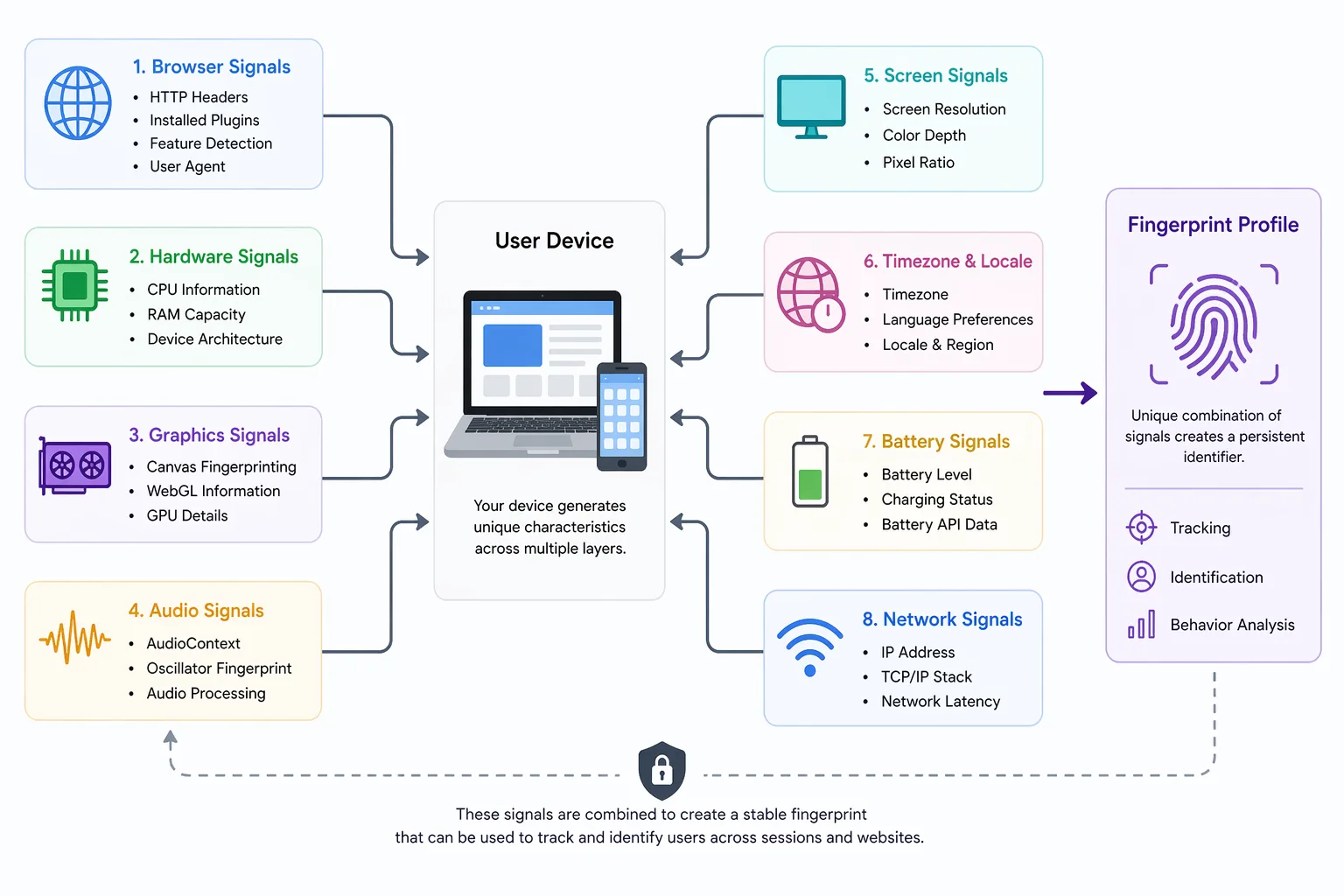
The collected data is combined with other signals to form a fingerprint. While battery data alone may not uniquely identify a user, it strengthens the overall profile by adding dynamic behavior.
Because battery patterns can persist within a session, they are particularly useful for short-term tracking.
Common Misconceptions About Battery API Fingerprinting
There are several misconceptions about Battery API fingerprinting that can lead to confusion about its effectiveness.
One common belief is that battery data is too variable to be useful, but while it changes over time, patterns in behavior can still provide meaningful signals.
Another misconception is that closing the browser stops tracking. While this may reset some data, patterns within a session can still be used for identification.
There is also a belief that battery fingerprinting alone can uniquely identify users, but it is typically used in combination with other signals. Its strength lies in enhancing overall fingerprinting accuracy.
Real-World Examples of Battery API Fingerprinting
Battery API fingerprinting is used in systems where dynamic behavior adds value to tracking and detection.
In financial platforms, it helps detect suspicious behavior by identifying sessions with unusual or identical battery patterns. This allows systems to flag potential fraud even when other signals appear normal.
In social media environments, battery fingerprinting contributes to detecting automated activity. Platforms analyze battery behavior alongside other attributes to identify bots. Tools like Appilot help address this challenge by running automation on real Android devices, where battery behavior naturally reflects real-world usage patterns instead of synthetic values.
In analytics systems, battery data can be used to track user behavior within a session, providing additional context for interaction patterns.
The Technical Side of Battery API Fingerprinting
From a technical perspective, Battery API fingerprinting relies on low to moderate entropy. While individual battery values are not highly unique, patterns over time increase their usefulness.
The process involves collecting battery data, tracking changes, and integrating the results into a broader fingerprint. This allows systems to analyze both static and dynamic aspects of device behavior.
Understanding these technical details helps explain why Battery API fingerprinting is used as a supporting signal rather than a primary identifier.
When Battery API Fingerprinting Applies
Battery API fingerprinting becomes especially relevant in scenarios where dynamic behavior is important.
It is useful in fraud detection systems, where identifying unusual patterns can help detect suspicious activity. It is also important in automation systems, where maintaining realistic behavior is necessary to avoid detection. In privacy-sensitive applications, understanding this technique helps developers account for dynamic tracking signals.
Frequently Asked Questions
Q: How does Battery API fingerprinting work?
It works by collecting battery data and analyzing how it changes over time to identify patterns that contribute to a fingerprint.
Q: What is Battery API fingerprinting used for?
It is used for fraud detection, tracking user behavior within sessions, and identifying automated activity.
Q: Can you block Battery API fingerprinting?
You can reduce its effectiveness by limiting API access or using privacy tools, but it is difficult to fully block.
Q: Is Battery API fingerprinting accurate?
It is not highly unique on its own but becomes more useful when combined with other fingerprinting methods.
Q: Does battery percentage alone identify users?
No, individual values are not unique, but patterns over time can provide useful signals.
Q: How does Battery API fingerprinting affect automation tools?
It can expose automation systems if battery behavior appears unrealistic. Tools that use real-device environments, such as Appilot, tend to produce more reliable results because they generate natural system behavior.
Key Takeaways
Battery API fingerprinting is a technique that uses battery-related data such as charge level, charging state, and discharge patterns to contribute to user identification. While it is not highly unique on its own, it adds a dynamic layer to fingerprinting systems by analyzing real-time device behavior. It is widely used in fraud detection, automation, and analytics, making it an important concept for understanding how modern tracking systems operate.