What Is Behavioral Analysis for Bot Detection?

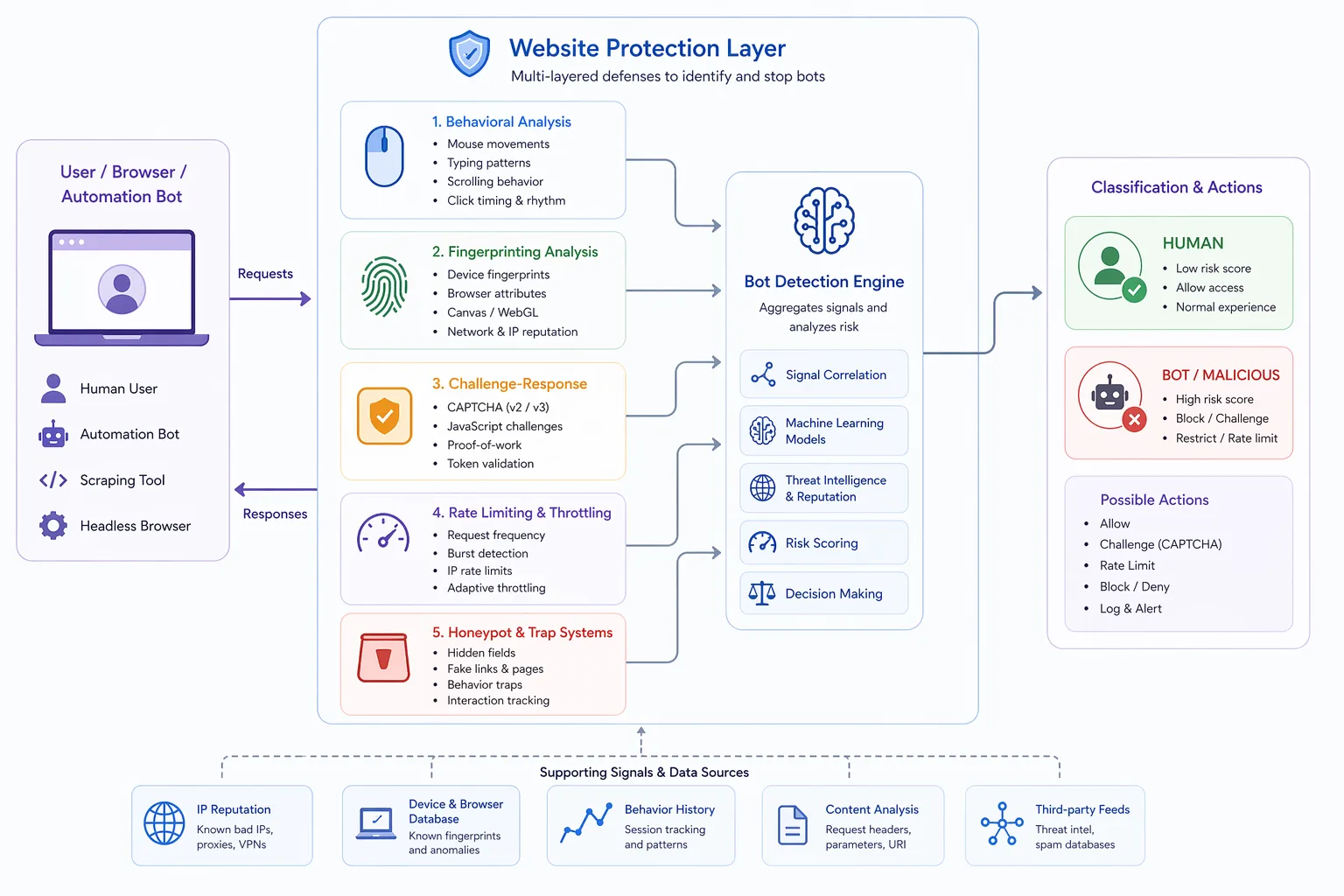
As bot detection systems evolve, one of the most powerful techniques they rely on is behavioral analysis. Instead of only checking technical signals like IP addresses or browser fingerprints, websites now analyze how users behave during interactions. This shift has made detection systems more accurate and harder to bypass.
Understanding behavioral analysis is important because it focuses on patterns that are difficult to fake. Even if an automated system mimics browser properties correctly, its behavior can still reveal that it is not human. This guide explains how behavioral analysis works and why it is central to modern bot detection.
What Is Behavioral Analysis?
Behavioral analysis is the process of evaluating how a user interacts with a website to determine whether the activity is human or automated. It focuses on patterns such as timing, movement, and interaction flow.
Unlike static detection methods, behavioral analysis looks at dynamic signals that change over time. This makes it more effective at identifying bots that attempt to mask their identity.
The goal is to detect unnatural patterns that differ from real user behavior.
The Core Principle Behind Behavioral Detection
The core principle behind behavioral analysis is variability. Human behavior is naturally inconsistent, influenced by context, attention, and decision-making.
Bots, on the other hand, tend to follow structured and repeatable patterns. Even advanced automation may struggle to replicate the subtle irregularities of human interaction.
Detection systems use this difference to identify automation.
How Behavioral Analysis Works
Behavioral analysis works by collecting interaction data and evaluating it in real time.
Interaction Timing
One of the most important signals is timing. This includes how long users take between actions, how quickly they respond, and how their timing varies.
Humans do not act at perfectly consistent intervals, while bots often produce uniform timing patterns.
Mouse and Cursor Movement
Mouse movements are analyzed for natural patterns such as curves, pauses, and speed changes.
Human movement tends to be irregular and influenced by visual feedback, while automated movement may appear linear or overly precise.
Scrolling Behavior
Scrolling patterns provide insight into how users consume content.
Humans scroll at varying speeds, pause to read, and adjust based on interest. Bots may scroll in fixed increments or follow predictable patterns.
Navigation Flow
The sequence of actions taken on a website is also analyzed.
Humans may explore pages in non-linear ways, while bots often follow predefined paths.
These differences help detection systems identify automation.
Why Behavioral Analysis Matters
Behavioral analysis is important because it addresses a key limitation of traditional detection methods.
While IP addresses and fingerprints can be modified or spoofed, behavior is much harder to replicate accurately.
This makes behavioral analysis a strong indicator of authenticity.
It is widely used in modern detection systems to improve accuracy and reduce false positives.
Common Behavioral Patterns That Indicate Bots
Detection systems look for patterns that differ from typical human behavior.
Perfectly consistent timing between actions is a strong indicator of automation.
Instant responses without delay can also raise suspicion.
Repetitive navigation patterns and lack of variability are additional signals.
These patterns are evaluated together rather than individually.
Behavioral Analysis vs Fingerprinting
Behavioral analysis and fingerprinting are often used together but serve different purposes.
Fingerprinting identifies the device or browser, while behavioral analysis evaluates how the user interacts with the system.
Fingerprinting provides static data, while behavior provides dynamic insights.
Combining both methods improves detection accuracy.
Limitations of Behavioral Analysis
Despite its strengths, behavioral analysis has limitations.
False positives can occur when human behavior deviates from typical patterns, such as during rapid interactions.
There is also the challenge of complexity. Accurately modeling human behavior requires sophisticated algorithms.
Additionally, advanced automation can attempt to mimic human behavior, making detection more difficult.
These limitations require continuous improvement of detection systems.
Behavioral Analysis vs Rule-Based Detection
Behavioral analysis differs from rule-based detection in its flexibility.
Rule-based systems rely on predefined conditions, while behavioral analysis evaluates patterns dynamically.
This allows behavioral systems to adapt to new types of automation.
However, it also increases complexity.
Behavioral Analysis vs Real-Device Environments
A key distinction in modern detection is the difference between simulated behavior and natural behavior.
Behavioral analysis can detect inconsistencies in simulated environments, even if technical signals appear correct.
Real-device approaches operate on actual hardware where behavior naturally reflects human interaction patterns. Tools like Appilot follow this approach by running automation on real Android devices, where interaction timing, input patterns, and system behavior align with real-world usage.
This reduces the need to artificially simulate behavior.
When Behavioral Analysis Is Most Effective
Behavioral analysis is most effective in scenarios where user interaction plays a significant role.
This includes login flows, form submissions, and navigation-heavy applications.
In these contexts, analyzing behavior provides strong indicators of authenticity.
Understanding this helps in designing systems that align with detection expectations.
Frequently Asked Questions
Q: What is behavioral analysis in bot detection?
It is the process of analyzing user interaction patterns to identify automation.
Q: Why is behavioral analysis effective?
Because human behavior is variable and difficult to replicate accurately.
Q: What signals are used in behavioral analysis?
Timing, mouse movement, scrolling, and navigation patterns.
Q: Can bots mimic human behavior?
They can try, but it is difficult to replicate natural variability.
Q: Does behavioral analysis replace fingerprinting?
No, both are used together for better accuracy.
Q: How do real-device solutions compare?
Real-device solutions like Appilot naturally produce human-like behavior, reducing reliance on simulation.
Key Takeaways
Behavioral analysis is a core component of modern bot detection that focuses on how users interact with websites. It evaluates signals such as timing, mouse movement, scrolling, and navigation patterns to distinguish humans from bots. By analyzing dynamic behavior rather than static data, it provides a powerful way to detect automation. While it has limitations, it remains one of the most effective methods for identifying non-human activity.