Best Alternatives to FollowingLike After It Stopped Being Updated
FollowingLike was once a familiar name for people who wanted social media automation across multiple platforms. It attracted users who needed automated posting, following, unfollowing, liking, commenting, direct messaging, and account management workflows across networks like Instagram, Facebook, Pinterest, Reddit, Tumblr, Quora, Twitter/X, YouTube, and TikTok. For a certain period, this kind of all-in-one desktop automation model felt powerful because it helped users reduce manual work and manage many accounts from one tool.
But social media automation has changed dramatically. Whether a user moved away from FollowingLike because their setup stopped feeling actively updated, became harder to maintain, or no longer matched modern platform behavior, the bigger issue is the same: old desktop automation models are no longer enough for serious multi-account workflows.
Modern platforms now look far beyond basic actions. They evaluate device behavior, session continuity, login history, IP reputation, app activity, account consistency, geographic signals, and long-term behavior patterns. A tool that simply automates likes, follows, comments, messages, or posts is not automatically reliable anymore. The environment around those actions matters just as much as the actions themselves.
That is why people searching for FollowingLike alternatives need to think carefully. The best replacement is not always another traditional social bot. In 2025 and beyond, stronger alternatives usually fall into different categories: real-device automation, social scheduling, cloud scraping, LinkedIn outreach, Instagram DM automation, analytics, and professional social media management.
This guide compares the best FollowingLike alternatives and explains which tool fits each type of workflow.
Why Users Are Moving Away From FollowingLike-Style Automation
FollowingLike belonged to an older generation of automation tools. These tools often focused on running many social actions from a desktop environment, usually with proxies, account lists, campaign settings, and platform-specific modules. For users managing many accounts, that model was attractive because it promised control, scale, and automation from one place.
The problem is that social platforms are much more sensitive now. Instagram, TikTok, Facebook, LinkedIn, Reddit, YouTube, and other platforms do not only evaluate whether an account performed an action. They evaluate how the account behaves over time. They look at whether the device environment makes sense, whether the session history is consistent, whether network behavior looks natural, and whether activity patterns match normal users.
This is where older automation models often struggle. A desktop tool may automate actions, but it may not create the kind of realistic mobile environment that modern social apps expect. If an account is supposed to behave like a mobile user but the automation environment looks disconnected from normal mobile app behavior, the workflow can become fragile.
Another issue is maintenance. Social platforms change constantly. Login flows, UI layouts, anti-spam systems, app behavior, API rules, browser behavior, and account checks evolve over time. A tool that is not consistently updated can quickly become unreliable. Even small platform changes can break workflows or create unexpected account friction.
For modern users, the goal should not be to copy FollowingLike exactly. The better goal is to choose a tool that matches the workflow you actually need today.
What to Look for in a FollowingLike Alternative
A good FollowingLike alternative should be chosen based on workflow type, not only feature count. FollowingLike tried to cover many platforms and many actions, but modern automation usually works better when the tool is more specialized and better aligned with the platform environment.
If your workflow depends on mobile apps, you should look for real-device automation. If your workflow depends on publishing and scheduling, you should look for a content management tool. If your workflow depends on scraping leads or collecting data, a cloud automation platform may be better. If your workflow depends on Instagram DMs, a messaging automation platform may be the right fit. If your workflow depends on LinkedIn outreach, a dedicated LinkedIn tool may be stronger.
The most important factors are session stability, account separation, workflow visibility, responsible pacing, realistic behavior, and long-term maintainability. A tool that gives you more actions but less stability may create more problems than it solves.
Modern social media automation should be built around controlled workflows, not aggressive activity. The best tools help you organize repetitive tasks, reduce manual work, and manage accounts more consistently without relying on outdated bot behavior.
1. Appilot
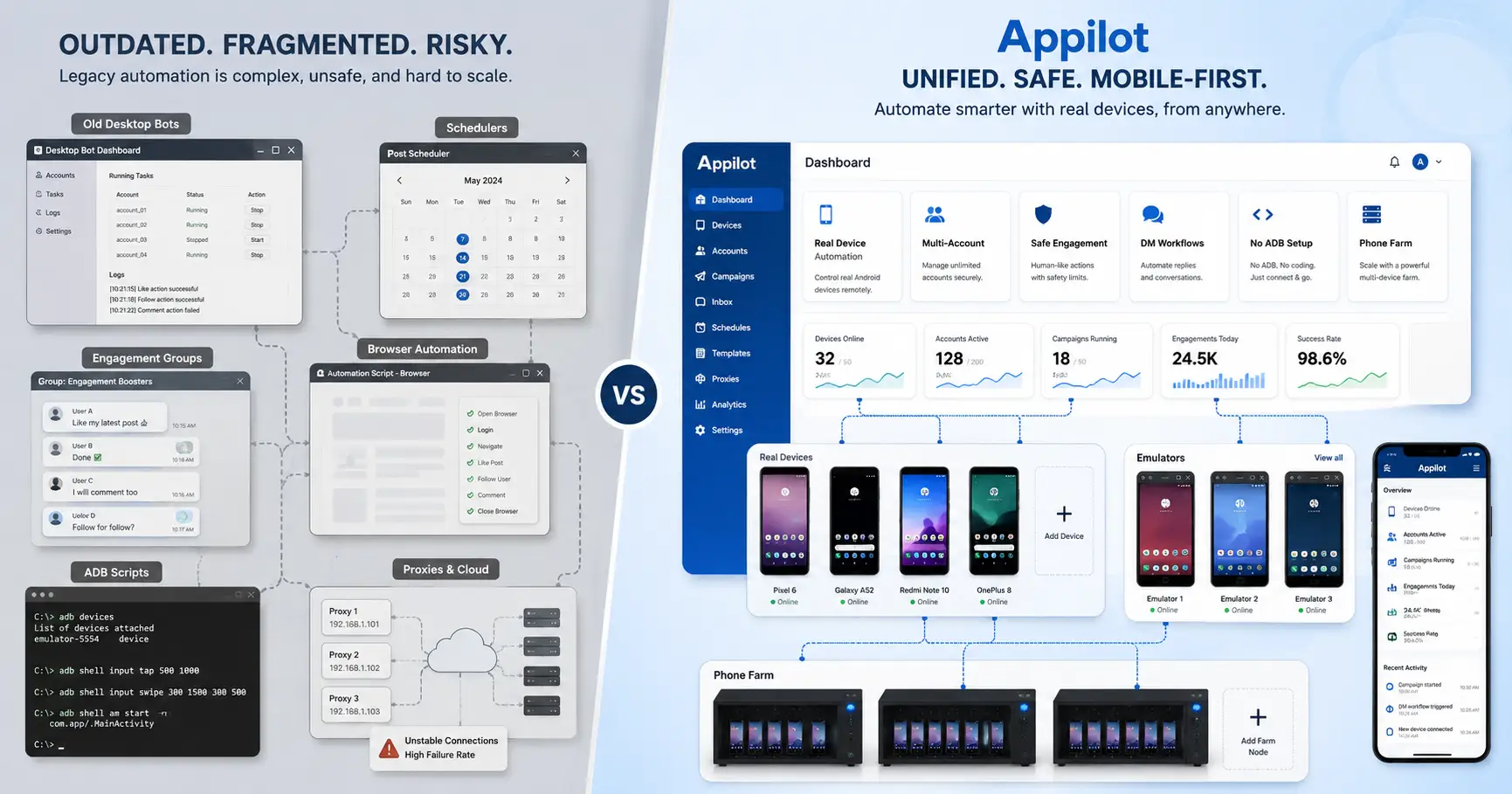
Appilot is the strongest FollowingLike alternative for users who need real-device automation and mobile-first social media workflows. While FollowingLike represents the older desktop automation model, Appilot focuses on real Android devices, emulators, and social media automation that can be managed remotely through a web dashboard. Appilot describes its platform as ready-to-use social media automation bots on real devices, Android devices, and emulators, without needing ADB or a laptop for running automations.
This difference matters because many social platforms are mobile-first. Instagram, TikTok, Snapchat, Telegram, Threads, and many other apps are designed around mobile behavior. Important workflows happen inside mobile apps, not only inside web dashboards or desktop browsers. A tool that runs closer to real mobile environments can be more suitable for these workflows than a traditional desktop bot.
Appilot is especially useful for multi-account operations, Instagram automation, TikTok workflows, Telegram tasks, app-based account management, engagement workflows, and phone-farm-style operations. Instead of treating automation as only a proxy or script problem, Appilot treats it as an environment problem. The device, session, app behavior, and workflow all matter.
For former FollowingLike users, Appilot is a natural upgrade if the main goal is to continue managing social media automation at scale but with a more modern foundation. It is not just another desktop tool. It is a mobile-first automation layer built for real-device and emulator workflows.
Appilot is best for agencies, growth teams, operators, phone farm users, and social media automation teams that need real-device control, Android automation, emulator workflows, multi-account management, and mobile app execution.
2. PhantomBuster
PhantomBuster is a strong FollowingLike alternative for users who need cloud automation, lead generation, scraping, enrichment, and prospecting workflows. It is not a real-device automation platform, but it is useful for teams that want to extract data, build lead lists, enrich profiles, and run cloud-based automations. PhantomBuster describes itself as a no-code cloud platform for lead generation and outreach automation across sources such as LinkedIn, Instagram, Facebook, X/Twitter, YouTube, Reddit, Google Maps, and more.
For former FollowingLike users, PhantomBuster makes sense if the original goal was not mobile app control but data collection. If you used FollowingLike to find profiles, collect audiences, support outreach lists, or run research workflows, PhantomBuster may be a better modern option.
The key difference is execution style. PhantomBuster runs cloud workflows, while Appilot focuses on real-device mobile workflows. PhantomBuster is better for structured data and lead generation. Appilot is better for operating inside mobile app environments.
PhantomBuster is best for sales teams, lead generation agencies, recruiters, marketers, and operators who need scraping, enrichment, prospecting, and cloud-based automation instead of mobile app execution.
3. Buffer
Buffer is a good FollowingLike alternative for users who mainly need social media scheduling and publishing. It is not a growth bot and it does not replace FollowingLike’s old engagement automation features. Instead, Buffer helps users plan, schedule, and publish content across platforms such as Instagram, TikTok, LinkedIn, Threads, YouTube Shorts, Pinterest, Facebook, Mastodon, and X.
This makes Buffer useful for creators, small businesses, agencies, and teams that want a safer way to manage social media consistency. If your FollowingLike use case was mostly posting content, keeping accounts active, or managing a publishing calendar, Buffer is a cleaner and more reliable alternative.
The limitation is that Buffer does not control mobile devices, run social bots, operate app sessions, or manage real-device workflows. It is a scheduling tool, not a mobile automation platform.
Buffer is best for users who want content planning, posting calendars, cross-platform publishing, and simple social media management without aggressive automation.
4. Later
Later is another useful alternative for users who need visual social media planning, Instagram scheduling, creator campaigns, and performance insights. Later positions itself around influencer marketing, creator campaigns, social media management, and performance tracking.
For former FollowingLike users, Later is a good fit if the main need is Instagram content organization rather than account activity automation. It helps users plan campaigns, organize content visually, and manage social media workflows in a more brand-focused way.
Later is especially useful for creators, influencers, ecommerce brands, agencies, and visual-first teams. If you care about feed planning, campaign structure, creator content, and Instagram presentation, Later can be a better fit than a traditional automation bot.
The limitation is that Later does not replace real-device automation. It cannot manage phone farms, run app-based workflows, or perform device-level account operations. It is mainly a planning and management platform.
Later is best for creators, ecommerce brands, influencers, and agencies that need visual planning, campaign management, and Instagram-first content workflows.
5. Manychat
Manychat is a strong FollowingLike alternative for users who need Instagram DM automation, comment-to-DM workflows, lead capture, and customer conversation automation. Manychat describes its Instagram product as a way to automate Instagram funnels, respond to customers, attract leads, boost engagement, and drive sales through DM marketing.
This is very different from FollowingLike’s older style of automation. Instead of automating broad engagement activity, Manychat helps users automate inbound conversations. For example, a creator can ask users to comment a keyword and then automatically send a DM with a link, offer, resource, or next step.
This is useful because many modern Instagram workflows are conversation-driven. Creators, ecommerce brands, coaches, agencies, and online businesses often need to respond quickly to engagement and turn comments into leads or sales.
The limitation is that Manychat is not a general social media bot, not a real-device automation platform, and not a phone farm management system. It works best for messaging workflows, not broad account automation.
Manychat is best for creators, ecommerce stores, coaches, agencies, and brands that need Instagram DM automation, comment triggers, automated replies, lead capture, and customer conversation flows.
6. Hootsuite
Hootsuite is a good FollowingLike alternative for teams that need professional social media management instead of bot-style automation. It brings scheduling, content creation, analytics, social listening, and engagement management into one platform.
For users who originally used FollowingLike to manage multiple social profiles, Hootsuite may be a safer and more professional option. It is better suited for brands, agencies, marketing departments, and teams that need publishing workflows, reporting, approvals, inbox management, and performance visibility.
Hootsuite is not a direct replacement for FollowingLike’s old automation model. It does not provide real-device automation, app-level workflows, or aggressive engagement automation. But that is also why it can be a better choice for teams that want reliable social operations without relying on risky bot behavior.
Hootsuite is best for agencies, brands, and marketing teams that need organized social media management, publishing, analytics, inbox workflows, and reporting.
7. Socinator
Socinator is often considered by users who still want something closer to a traditional social media automation tool. Its current positioning focuses on AI-powered social media infrastructure, modular agents, profile-level isolation, web-based centralized management, publishing workflows, and scalable multi-profile operations.
For former FollowingLike users, Socinator may feel more familiar than tools like Buffer or Hootsuite because it is closer to the automation category. It is designed around managing social profiles, automating workflows, and reducing manual social media work.
However, users should be careful with any tool that follows the older broad social automation model. The more a workflow depends on automated engagement, repeated actions, or multi-account activity, the more important it becomes to use conservative pacing, stable environments, and realistic behavior.
Socinator is best for users who want a more traditional social media automation platform and understand the risks of older automation-style workflows.
Which FollowingLike Alternative Is Best Overall?
The best FollowingLike alternative depends on what you used FollowingLike for. If you used it for real social account operations, mobile workflows, phone farm management, Instagram automation, TikTok automation, Telegram workflows, or multi-account app activity, Appilot is the strongest choice.
If you used FollowingLike for scraping and lead generation, PhantomBuster is a better fit. If you used it mainly for content scheduling, Buffer or Later may be enough. If you used it for Instagram DM workflows, Manychat is stronger. If you used it for professional social media management and reporting, Hootsuite is a better option. If you want something closer to traditional social automation, Socinator may be worth considering carefully.
The important point is that FollowingLike alternatives now belong to different categories. A scheduler, a scraping tool, a DM automation tool, a social management platform, and a real-device automation platform do not solve the same problem.
For mobile-first automation and multi-account workflows, Appilot is the best modern replacement.
Why Appilot Is the Best FollowingLike Alternative for Real-Device Automation
Appilot is the best choice for users who want to move beyond outdated desktop automation and into real mobile workflow control. It gives teams a way to manage automation on Android devices and emulators through a web dashboard, which makes it much more relevant for mobile-first platforms.
This matters because Instagram, TikTok, Telegram, Snapchat, and many other platforms are not just websites. They are mobile app ecosystems. Real users interact through devices, app sessions, touch-based workflows, notifications, inboxes, and persistent mobile environments.
FollowingLike-style tools focused heavily on automating actions. Appilot focuses on the environment where those actions happen. That is a better fit for modern automation because stability depends on more than the action itself. It depends on device consistency, session continuity, account separation, app behavior, and workflow visibility.
For agencies, operators, growth teams, and phone farm users, Appilot offers a stronger foundation because it supports the real-device layer directly. If the goal is long-term mobile automation rather than simple scheduling or scraping, Appilot is the strongest alternative.
Final Thoughts
FollowingLike was useful in an earlier era of social media automation, but many users now need tools that match modern platform behavior more closely. Social automation is no longer just about running more actions. It is about building stable workflows, realistic environments, and tool stacks that match the platform.
Appilot is the best FollowingLike alternative for real-device automation, mobile app workflows, Android devices, emulators, and multi-account operations. PhantomBuster is better for scraping and lead generation. Buffer and Later are better for scheduling and content planning. Manychat is better for Instagram DM automation. Hootsuite is better for professional social media management. Socinator is closer to traditional automation but should be used carefully.
The best replacement depends on your workflow. If you only need posting, use a scheduler. If you need lead data, use a scraping tool. If you need conversations, use a DM tool. But if you need real mobile device automation, Appilot is the strongest modern alternative to FollowingLike.
FAQs
Q1: Is FollowingLike still a good option for social media automation?
FollowingLike may still appear online, but many users look for alternatives because older desktop automation models feel outdated for modern social media workflows and platform behavior.
Q2: What is the best FollowingLike alternative for real-device automation?
Appilot is the best alternative for real-device automation because it supports Android devices, emulators, mobile app workflows, and multi-account operations from a web dashboard.
Q3: Which FollowingLike alternative is best for lead generation?
PhantomBuster is a strong choice for lead generation because it supports cloud-based scraping, enrichment, prospecting, and outreach workflows across several online sources.
Q4: Which alternative is best for social media scheduling?
Buffer and Later are good options for scheduling and content planning. Buffer is better for simple cross-platform publishing, while Later is stronger for visual Instagram planning and creator workflows.
Q5: Is Appilot better than FollowingLike for modern automation?
Yes, Appilot is stronger for modern mobile-first automation because it focuses on real devices, Android workflows, emulators, and mobile app behavior instead of relying only on older desktop automation patterns.