Best Alternatives to Fuelgram for Instagram Engagement Groups
Fuelgram became popular during the era when Instagram engagement groups, comment pods, and coordinated likes were a common growth tactic. The idea was simple: when someone published a post, other users inside the same group would quickly like, comment, or engage with it to increase early activity and make the post look more active.
For a while, this strategy attracted creators, influencers, agencies, and Instagram growth operators because it seemed like a shortcut to better engagement. Instead of waiting for organic followers to respond, users could rely on a group of accounts to help push early likes and comments.
But Instagram growth in 2025 is very different from the old engagement group era. The platform now looks at much more than raw engagement numbers. It can evaluate engagement quality, relationship signals, comment patterns, account authenticity, session consistency, audience relevance, and whether the activity around a post looks natural over time.
This means Fuelgram-style engagement groups are no longer the strongest foundation for Instagram growth. They may create activity, but that activity does not always translate into real followers, real customers, better audience quality, or long-term account strength. In some cases, engagement groups can even make a profile look less authentic if the same types of accounts repeatedly interact in predictable ways.
That is why many users now search for better Fuelgram alternatives. The best replacement is not always another engagement pod. A stronger modern growth stack may include real-device automation, better content scheduling, Instagram DM automation, analytics, influencer collaboration, and more intentional engagement workflows.
Why Users Are Moving Away From Fuelgram-Style Engagement Groups
Fuelgram-style engagement groups were built around a simple belief: more early engagement could help posts perform better. That idea made sense when Instagram users were heavily focused on likes, comments, and quick activity after posting.
The problem is that engagement quality now matters more than engagement volume. If a post receives comments from accounts that do not match the audience, do not interact naturally, or repeatedly comment in generic ways, the activity may not create meaningful growth. A post may look active, but the audience may not become more loyal, more interested, or more likely to convert.
Another issue is operational effort. Engagement groups often require users to participate manually, follow strict posting windows, comment on other members’ posts, and maintain activity inside external groups. This can become time-consuming, especially for agencies or creators managing multiple Instagram accounts.
There is also a strategic problem. Engagement groups do not fix weak content, unclear positioning, poor targeting, or inconsistent posting. They may temporarily increase numbers, but they do not replace a real Instagram growth system.
Modern Instagram growth works better when engagement comes from relevant users, strong content, consistent posting, meaningful conversations, and workflows that support real audience relationships.
What to Look for in a Fuelgram Alternative
A strong Fuelgram alternative should help you build better Instagram engagement, not just inflate activity. The goal should be to create workflows that support real growth, stronger account management, and more consistent audience interaction.
If you manage multiple accounts or run mobile-first workflows, real-device automation is important. Instagram is primarily a mobile app, so workflows that operate closer to real mobile environments can be more practical than browser-only systems or manual engagement groups.
If your main challenge is posting consistently, a scheduling tool may be more useful than an engagement group. Stronger content planning often produces better long-term results than chasing temporary comment boosts.
If your growth depends on conversations, Instagram DM automation can be more valuable than engagement pods. Comment-to-DM flows, automated replies, lead capture, and customer support can turn attention into actual relationships.
If you are an agency, you also need workflow visibility. Managing engagement across multiple accounts requires organization, account separation, activity monitoring, and repeatable systems. Manual engagement groups usually become messy as the number of accounts grows.
The best Fuelgram alternative should match the workflow you actually need, whether that is mobile automation, scheduling, analytics, DMs, influencer campaigns, or social media management.
1. Appilot
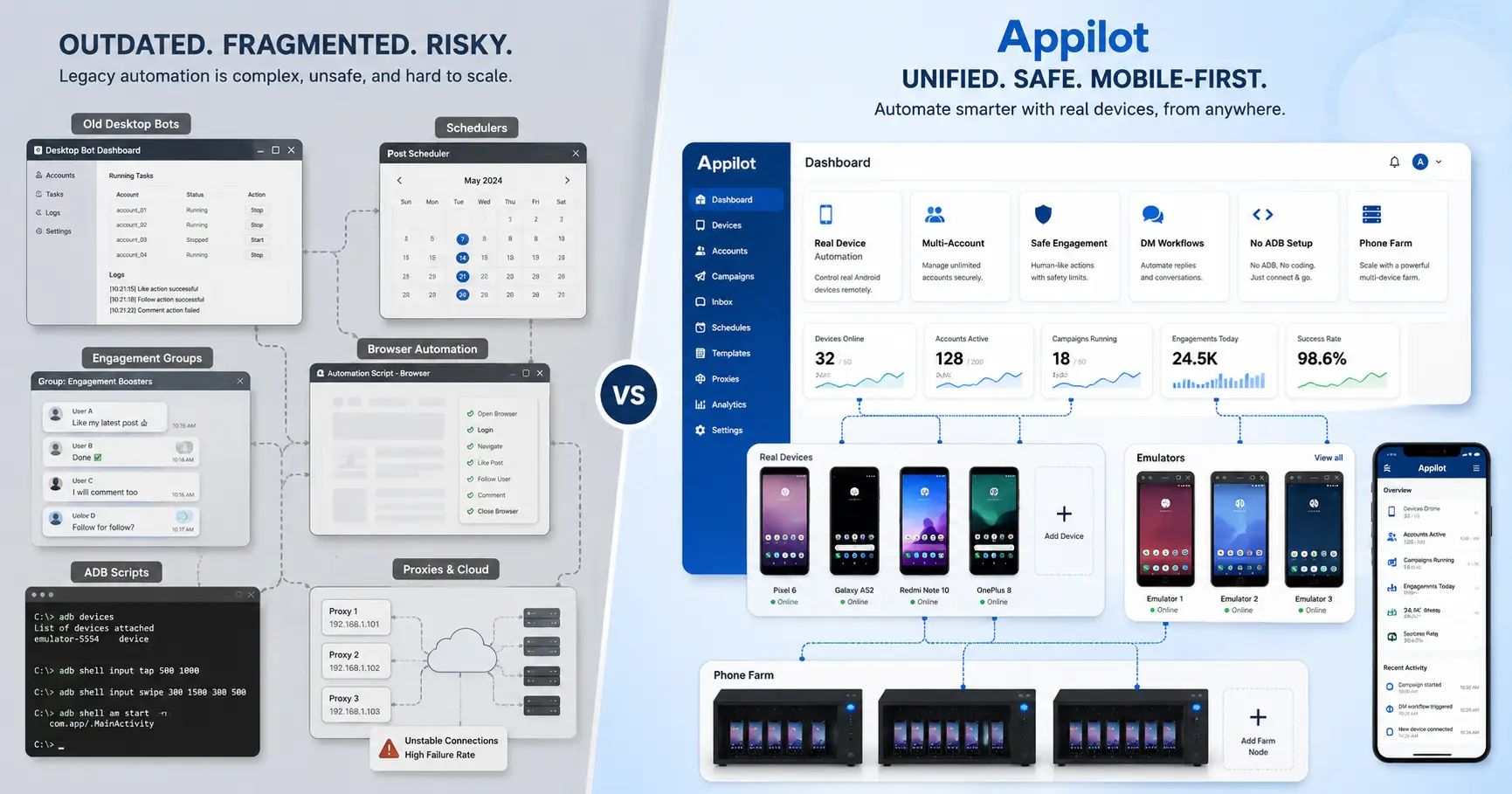
Appilot is one of the strongest Fuelgram alternatives for users who need real-device Instagram automation and mobile-first engagement workflows. While Fuelgram-style systems focused on engagement groups and coordinated activity, Appilot focuses on social media automation through real Android devices and emulators.
This matters because Instagram is a mobile-first platform. Many important workflows happen inside the app, including profile checks, DMs, engagement activity, account warming, content interaction, and multi-account management. A tool that helps teams operate through real mobile environments can be more useful than relying only on external engagement groups.
Appilot is especially useful for agencies, growth teams, phone farm operators, and social media managers who need to manage multiple Instagram accounts from a more controlled workflow. Instead of manually joining engagement pods or coordinating comments across groups, teams can use Appilot to manage mobile app workflows from a central dashboard.
The value of Appilot is not about replacing one risky shortcut with another. Its value is in helping teams create a more stable execution layer for Instagram workflows. Real-device automation gives users better control over mobile actions, device sessions, account workflows, and multi-account operations.
For users leaving Fuelgram, this is a major upgrade. Fuelgram-style engagement groups focused mostly on boosting post activity. Appilot supports broader Instagram operations, including mobile workflow control, real-device execution, and repeatable account management.
Appilot is best for agencies, Instagram operators, phone farm users, and growth teams that need real-device automation, mobile app workflows, Android and emulator support, and multi-account Instagram management.
2. Manychat
Manychat is one of the best Fuelgram alternatives for users who want engagement that turns into conversations. Instead of relying on comment pods or engagement groups, Manychat helps users automate Instagram DMs, comment-to-DM flows, customer replies, lead capture, and conversation-based growth.
This is a stronger modern alternative because it starts from real user intent. For example, a creator can ask followers to comment a keyword on a post, and Manychat can automatically send a DM with a guide, product link, discount, resource, signup page, or next step. This turns engagement into a direct conversation instead of just collecting likes or generic comments.
For ecommerce brands, coaches, creators, agencies, and service businesses, this type of automation is often more valuable than engagement groups. A comment pod may increase surface-level activity, but a DM workflow can capture leads, answer questions, qualify prospects, and move users toward conversion.
Manychat is not a full Instagram account management system and it does not control real devices. It works best alongside other tools. A team might use Appilot for mobile workflows, Buffer for scheduling, and Manychat for DM automation.
Manychat is best for creators, ecommerce brands, coaches, agencies, and businesses that want Instagram engagement to turn into DMs, leads, sales, and customer conversations.
3. Buffer
Buffer is a strong Fuelgram alternative for users who want safer Instagram growth through consistent publishing and content planning. Instead of trying to boost engagement through groups, Buffer helps users plan posts, schedule Reels, organize campaigns, and track performance.
This matters because strong content consistency is one of the most reliable foundations for Instagram growth. If a profile posts rarely, has no clear content system, or publishes randomly, engagement groups will not fix the bigger problem. A scheduling tool helps users show up consistently and build a stronger content rhythm.
Buffer is especially useful for creators, small businesses, agencies, and marketing teams that want to manage Instagram alongside other platforms. It helps users plan content in advance, avoid last-minute posting, and maintain a more organized publishing workflow.
The limitation is that Buffer is not a real-device automation tool and it does not replace mobile app workflows. It is best for content planning and scheduling, not account operation or engagement automation.
Buffer is best for users who want to replace engagement group dependency with a cleaner, content-led Instagram growth strategy.
4. Later
Later is a useful Fuelgram alternative for users who care about visual content planning, Instagram feed design, creator campaigns, and brand presentation. It is especially helpful for creators, influencers, ecommerce brands, lifestyle accounts, and agencies that depend heavily on Instagram aesthetics.
Fuelgram-style engagement groups focus on what happens after a post is published. Later helps improve what happens before the post is published. It helps users organize media, plan the grid, prepare captions, schedule content, and build a more intentional Instagram presence.
This is important because engagement quality often starts with content quality. If the post is visually weak, poorly positioned, or disconnected from the audience, engagement groups can only do so much. A better content planning workflow can improve the chances of attracting real comments, saves, shares, and followers.
Later is not a real-device automation platform and it does not manage mobile app actions. It is best for visual planning and content organization.
Later is best for creators, influencers, ecommerce stores, and agencies that want better Instagram content planning instead of relying on engagement pods.
5. Hootsuite
Hootsuite is a strong Fuelgram alternative for agencies and teams that need professional Instagram management. It helps with scheduling, analytics, inbox management, social listening, reporting, approvals, and broader social media operations.
For teams that previously used engagement groups to support client accounts, Hootsuite offers a more professional way to manage Instagram growth. Instead of focusing only on likes and comments, teams can track performance, manage campaigns, monitor engagement, and organize content workflows across multiple accounts.
This is useful for agencies because client growth needs reporting and visibility. Engagement groups may create temporary activity, but they do not provide a serious system for explaining what worked, which content performed best, or how the account is improving over time.
The limitation is that Hootsuite does not provide real-device automation. It is a social media management platform, not a mobile automation layer. For mobile app workflows, Appilot is stronger. For professional social media management and reporting, Hootsuite is useful.
Hootsuite is best for agencies, brands, and marketing teams that need organized Instagram management, analytics, reporting, and team workflows.
6. Metricool
Metricool is a good alternative for users who want to replace engagement group guesswork with analytics-driven Instagram growth. It helps users plan content, track performance, analyze engagement, review posting times, and create reports.
This is important because many users turn to engagement groups when they do not know why their content is underperforming. But more comments are not always the answer. Sometimes the issue is weak content format, poor posting time, unclear audience targeting, inconsistent Reels strategy, or low-quality captions.
Metricool helps users understand performance instead of relying on artificial engagement boosts. By reviewing analytics, users can identify which posts create real engagement, which formats perform best, and which content themes deserve more attention.
Metricool is not a real-device automation platform and it does not replace DM automation. It is best used for planning and performance analysis.
Metricool is best for creators, agencies, consultants, and marketers who want data-driven Instagram growth instead of engagement group dependency.
7. Influencer Collaboration Platforms
Influencer collaboration platforms can also be a strong alternative to Fuelgram-style engagement groups because they help brands and creators build real partnerships instead of artificial pods. Instead of exchanging comments with random accounts, users can work with creators, niche pages, micro-influencers, and communities that actually match their audience.
This approach is usually stronger because the engagement is more relevant. A comment or share from a creator in the same niche can be more valuable than dozens of generic comments from unrelated engagement group members. It can also create real discovery, audience trust, and brand visibility.
For ecommerce brands, SaaS companies, personal brands, agencies, and creators, influencer collaboration can support more authentic growth. It may take more planning than joining an engagement group, but it usually creates better audience alignment.
Influencer collaboration platforms are not automation tools. They are better for campaign discovery, partnerships, creator outreach, and audience expansion. They work well alongside Appilot, scheduling tools, analytics platforms, and DM automation tools.
Influencer collaboration platforms are best for users who want real audience growth through partnerships, creator campaigns, and niche-relevant exposure.
Which Fuelgram Alternative Is Best Overall?
The best Fuelgram alternative depends on what you are trying to replace. If you used Fuelgram because you wanted more engagement without manually managing everything, Appilot is the strongest option for real-device Instagram automation and mobile workflow control.
If you want engagement that turns into conversations, Manychat is the best choice. If you want safer growth through consistent content, Buffer and Later are strong options. If you need professional account management, Hootsuite is useful. If you want data-driven growth, Metricool is a better fit. If you want real audience exposure, influencer collaboration platforms are stronger than engagement pods.
The mistake is looking for another tool that only recreates Fuelgram’s old engagement group model. Instagram growth has moved beyond that. The better approach is to build a workflow that creates real engagement, stronger content, better conversations, and more consistent account operations.
Why Appilot Is the Best Fuelgram Alternative for Real-Device Instagram Workflows
Appilot stands out because it solves a bigger problem than engagement groups. Fuelgram focused on getting activity on posts. Appilot focuses on the mobile workflow environment where Instagram activity actually happens.
For agencies and growth teams, this is more useful. Instagram work often includes account management, DMs, profile checks, content workflows, engagement actions, app navigation, and multi-account operations. These tasks are hard to manage through manual pods or scheduling tools alone.
Appilot gives teams a way to operate Instagram workflows through Android devices and emulators from a central dashboard. This makes it more practical for users who need real-device execution and mobile app control.
It is important to use automation carefully. Real-device automation should not be used to spam, mass-message, or force unnatural engagement. The strongest use case is controlled workflow support, better account management, mobile task execution, and more organized multi-account operations.
For users moving away from Fuelgram, Appilot is the best option when the goal is to build a more modern, mobile-first Instagram growth system.
Final Thoughts
Fuelgram belonged to an older Instagram growth era where engagement groups and comment pods were seen as shortcuts to better performance. In 2025, Instagram growth requires a stronger and more realistic approach.
The best alternatives depend on the workflow. Appilot is best for real-device automation and mobile Instagram workflows. Manychat is best for Instagram DM automation. Buffer and Later are better for content planning and scheduling. Hootsuite is stronger for professional account management. Metricool is useful for analytics. Influencer collaboration platforms are better for real audience exposure.
The safest path is not to replace Fuelgram with another engagement group shortcut. The better path is to build a more complete Instagram growth system around content quality, real conversations, audience relevance, workflow control, and mobile-first execution.
For teams that need Instagram automation across real devices, Appilot is the strongest Fuelgram alternative.
FAQs
Q1: Is Fuelgram still a good option for Instagram growth?
Fuelgram-style engagement groups belong to an older Instagram growth model. In 2025, safer growth usually depends on better content, real conversations, analytics, and controlled mobile workflows.
Q2: What is the best Fuelgram alternative for real-device Instagram automation?
Appilot is the best option for real-device Instagram automation because it supports Android devices, emulators, mobile app workflows, and multi-account management.
Q3: Which Fuelgram alternative is best for Instagram DM engagement?
Manychat is the best choice for Instagram DM engagement because it supports comment-to-DM flows, automated replies, lead capture, and conversation-based growth.
Q4: Are engagement groups still useful for Instagram?
Engagement groups may create temporary activity, but they often do not build real audience trust, strong followers, or meaningful customer relationships. Content quality and relevant engagement usually matter more.
Q5: What is the safest way to replace Fuelgram?
The safest replacement is a workflow stack: use Appilot for real-device mobile workflows, Buffer or Later for scheduling, Manychat for DMs, and analytics tools like Metricool to measure real performance.