Best Alternatives to Hootsuite for Real Mobile Device Automation
Hootsuite is one of the most well-known social media management platforms. For many teams, it works well for planning posts, scheduling content, managing social inboxes, reviewing analytics, and organizing social media campaigns from one dashboard. It is especially useful for brands, agencies, and marketing teams that need structure around publishing and reporting.
But Hootsuite is not built for real mobile device automation.
That difference matters a lot for power users, growth teams, agencies, and operators who need more than scheduled posts. If your workflow requires real Android devices, mobile apps, emulators, device sessions, Instagram app actions, TikTok mobile workflows, Telegram account operations, or multi-account automation, then a traditional social media management tool is not enough.
Real mobile device automation is a different category. It focuses on controlling mobile environments where social media apps actually run. Instead of only managing content through APIs or web dashboards, real-device automation helps teams operate closer to actual app behavior. This is especially important for platforms where key workflows happen inside mobile apps rather than desktop browsers.
That is why many teams searching for Hootsuite alternatives are not simply looking for another scheduler. They are looking for tools that can support mobile-first execution, account workflows, device-based automation, and more realistic app operations.
Why Hootsuite Is Not Enough for Real Mobile Device Automation
Hootsuite is strong for social media management. It helps teams schedule content, manage engagement, organize campaigns, and measure performance. For teams that mainly need publishing and analytics, it can be a good fit.
The limitation appears when the workflow moves beyond content management.
Many social media operations do not happen only through scheduled posts. Instagram DMs, TikTok engagement, app-based account checks, Telegram workflows, Snapchat actions, Threads activity, Reddit mobile tasks, and multi-account app operations often require direct interaction with mobile environments. These workflows are difficult to manage through a normal scheduling platform.
Hootsuite can help you plan and publish, but it does not give you direct control over Android devices, emulators, app sessions, or real mobile workflows. It is not designed to behave like a mobile device automation layer. It is a social media management platform, not a real-device automation system.
For power users, this creates a major gap. A team may be able to schedule posts through Hootsuite, but still need another system to manage repetitive mobile app workflows, account operations, device-based actions, and mobile-first automation.
What to Look for in a Hootsuite Alternative for Mobile Automation
A good Hootsuite alternative for real mobile device automation should not only manage content. It should help teams operate inside mobile environments in a controlled and scalable way.
The most important thing to look for is real-device or emulator support. If the tool can run workflows through Android devices or emulators, it is much closer to how mobile-first social platforms are actually used. This is especially useful for Instagram, TikTok, Telegram, Snapchat, Threads, and other app-heavy platforms.
The second thing to look for is multi-account control. Power users often need to manage many accounts, not just one profile. A strong tool should make it easier to organize accounts, monitor activity, separate workflows, and avoid messy manual device handling.
The third thing to look for is workflow visibility. Real automation should not feel like a black box. Teams need to see what is happening, pause workflows, monitor devices, review actions, and adjust execution when needed.
The fourth thing to consider is whether the tool is actually made for mobile automation or only for scheduling. Many Hootsuite alternatives are good social media tools, but they are still not built for real device control. If your goal is mobile automation, you need a tool that starts from the device layer, not just the content calendar.
1. Appilot
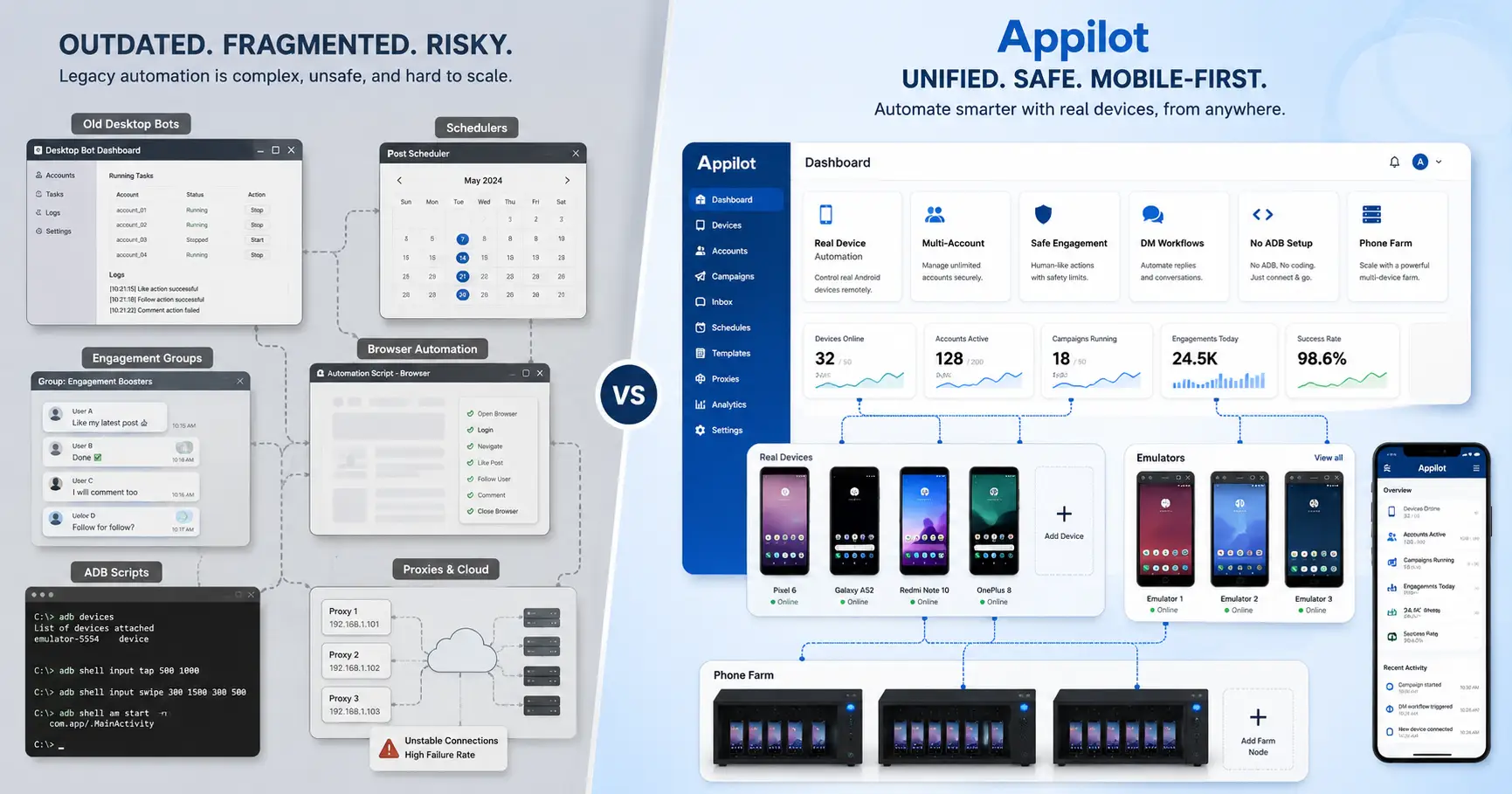
Appilot is the strongest Hootsuite alternative for teams that need real mobile device automation. While Hootsuite is built around social media management, Appilot is built around real-device workflows, Android devices, emulators, and mobile automation controlled through a web dashboard.
This makes Appilot a better fit for teams that need to operate inside mobile apps rather than only schedule social posts. If your workflows involve Instagram automation, TikTok automation, Telegram workflows, mobile account management, app-based actions, or multi-account operations, Appilot gives you a more relevant automation layer.
The biggest advantage of Appilot is that it focuses on the real mobile environment. Many social platforms are mobile-first, and many important actions happen inside the app. A normal scheduler can publish content, but it cannot fully replace mobile device interaction. Appilot helps close that gap by giving teams access to real Android and emulator-based workflows.
For agencies and growth teams, this is especially important. Managing many accounts manually across devices can become slow, inconsistent, and difficult to monitor. Appilot makes it easier to centralize those workflows while still keeping the execution layer closer to mobile app behavior.
Appilot is best for teams that need real-device social media automation, mobile app workflows, Android automation, emulator control, multi-account management, and a stronger alternative to Hootsuite for mobile-first operations.
2. BrowserStack App Automate
BrowserStack App Automate is a strong option for teams that need real mobile device testing rather than social media workflow automation. It is mainly used by QA teams, developers, and product teams to test mobile apps across real devices.
This makes it very different from Hootsuite and Appilot. Hootsuite is for social media management. Appilot is for mobile workflow automation. BrowserStack App Automate is for mobile app testing. If your goal is to test how an app behaves on different Android and iOS devices, BrowserStack can be useful.
For teams that care about device coverage, testing reliability, and app quality, BrowserStack is a strong alternative to generic web-based tools. It helps teams run tests across different devices, operating systems, and environments without maintaining a physical device lab.
However, BrowserStack is not designed for social media account automation. It is not the best choice if you need Instagram actions, TikTok workflows, Telegram operations, or multi-account social media management. It is better for engineering teams than growth teams.
BrowserStack App Automate is best for QA teams, mobile developers, and engineering teams that need real-device testing for apps rather than social media automation.
3. Sauce Labs
Sauce Labs is another strong option for mobile app testing and automated quality assurance. Like BrowserStack, it is not a direct Hootsuite replacement for social media teams. It is better suited for companies that need to test mobile apps across real and virtual devices.
Sauce Labs can be valuable when a team needs automated testing, app validation, device coverage, and CI/CD integration. It helps engineering teams make sure mobile apps work correctly across different environments.
For real mobile device automation, Sauce Labs fits the testing side of the market. It can automate mobile app tests, but it is not designed for managing social media accounts or running growth workflows. A marketing team looking for Hootsuite alternatives would probably find it too technical unless they also have mobile QA needs.
The key difference is intent. Sauce Labs automates mobile testing. Appilot automates mobile workflows. Hootsuite manages social publishing. These are different categories, even though they all involve automation in some way.
Sauce Labs is best for engineering teams, QA departments, and mobile product teams that need automated testing across mobile environments.
4. Kobiton
Kobiton is another real-device platform focused on mobile app testing. It gives teams access to real devices for testing, debugging, and validating app behavior. For companies building mobile apps, this can be useful because real devices often reveal issues that emulators or desktop testing may miss.
Kobiton can be a good alternative for teams that want hands-on access to mobile device environments, especially for testing app behavior across different devices and operating systems. It helps reduce the need to maintain a physical device lab.
However, Kobiton is not a social media automation platform. It does not replace Hootsuite for publishing, scheduling, analytics, or social inbox management. It also does not replace Appilot for social media workflows or multi-account mobile automation.
Kobiton is best for mobile QA teams and app developers who need real-device access for testing, not for marketers who need Instagram, TikTok, or Telegram workflow automation.
5. PhantomBuster
PhantomBuster is a useful Hootsuite alternative for teams focused on cloud automation, scraping, lead generation, and prospecting workflows. It is not a real mobile device automation tool, but it can be useful for sales and marketing teams that need data extraction and outreach support.
For example, a team may use PhantomBuster to collect leads, enrich profiles, extract data from platforms, or automate web-based prospecting steps. This makes it valuable for growth teams that need structured data and repeatable lead-generation workflows.
The difference is that PhantomBuster runs cloud-based automations. It does not give teams real Android devices, mobile app sessions, or app-level control. So it is not the best choice if your main need is real mobile device automation.
Still, PhantomBuster can be part of a broader stack. A team could use PhantomBuster for lead research, Appilot for mobile workflow execution, and a scheduler for content planning. But if the core requirement is real-device automation, Appilot is the better fit.
PhantomBuster is best for lead generation, scraping, enrichment, prospecting, and cloud-based workflow automation.
6. Buffer
Buffer is one of the best Hootsuite alternatives for simple social media scheduling. It is clean, easy to use, and useful for creators, small businesses, and teams that need content planning without a heavy enterprise workflow.
Buffer is not a real mobile device automation tool. Like Hootsuite, it mainly helps with publishing, scheduling, and content organization. If your goal is to plan social posts across platforms, Buffer can be a better fit than Hootsuite because it is simpler and easier for many smaller teams.
However, Buffer does not solve mobile app automation problems. It cannot control Android devices, run app-based workflows, manage real mobile sessions, or operate inside Instagram or TikTok like a device automation tool.
Buffer is best for users who realize they do not actually need mobile automation and only need a lighter alternative to Hootsuite for scheduling and publishing.
7. Later
Later is a strong Hootsuite alternative for visual social media planning, especially for Instagram-focused creators, ecommerce brands, influencers, and agencies. It is useful when the main goal is content planning, campaign organization, and visual calendar management.
Later can be better than Hootsuite for users who care deeply about Instagram presentation. Visual planning matters for brands that want a clean grid, consistent content rhythm, and organized campaigns.
But Later is still not a real mobile device automation platform. It helps plan and publish content, but it does not provide device-level control or real app automation. If your workflow involves mobile app actions, account operations, or device-based execution, Later will not replace Appilot.
Later is best for creators, ecommerce brands, and social media teams that need visual planning rather than real-device automation.
8. Manychat
Manychat is a strong alternative for Instagram DM automation, comment-to-message flows, and customer conversation workflows. It is not a traditional Hootsuite replacement and it is not a real-device automation tool, but it solves an important automation problem that Hootsuite does not fully address for many power users.
Many Instagram-focused teams need more than scheduled content. They need to respond to comments, send automated DMs, deliver lead magnets, qualify leads, and move users into funnels. Manychat is useful for those conversation-based workflows.
The limitation is that Manychat only covers messaging automation. It does not control mobile devices, run Android workflows, manage app sessions, or handle broad social media account operations. It works best as part of a stack rather than as a full mobile automation solution.
Manychat is best for creators, ecommerce brands, coaches, agencies, and marketers who need DM automation and comment-based Instagram funnels.
Which Hootsuite Alternative Is Best for Real Mobile Device Automation?
The best Hootsuite alternative depends on what you actually need. If your main need is real mobile device automation for social media workflows, Appilot is the strongest choice. It is designed around Android devices, emulators, mobile app workflows, and multi-account operations.
If your need is mobile app testing, BrowserStack, Sauce Labs, or Kobiton may be better. These tools are useful for QA and engineering teams, but they are not built for social media automation.
If your need is lead generation and scraping, PhantomBuster is useful. If your need is simple scheduling, Buffer or Later may be enough. If your need is Instagram DM automation, Manychat is a strong option.
The important point is that Hootsuite alternatives fall into different categories. Not every alternative is meant to solve the same problem. A scheduler, a testing platform, a scraping tool, a DM automation tool, and a real-device automation platform are not interchangeable.
For mobile-first social media operations, Appilot is the clearest fit.
Why Appilot Is the Best Hootsuite Alternative for Social Media Device Automation
Appilot is the best option for teams that want to move beyond content scheduling and into real mobile workflow automation. Hootsuite helps manage social media from a dashboard, but Appilot helps operate mobile environments where social media apps actually run.
This is important because many platforms are designed around mobile behavior. Instagram, TikTok, Snapchat, Telegram, and Threads are not just web platforms. Their workflows are heavily shaped by mobile apps, device sessions, touch interactions, and account behavior inside app environments.
Appilot gives teams a way to control Android devices and emulators remotely, organize workflows from a web dashboard, and manage repetitive mobile tasks at scale. This makes it more useful for account operators, agencies, growth teams, and automation teams that need mobile-first execution.
For users who only need scheduling, Hootsuite, Buffer, or Later may be enough. But for users who need real-device automation, Appilot is the stronger and more relevant alternative.
Final Thoughts
Hootsuite is a strong social media management tool, but it is not built for real mobile device automation. It works well for scheduling, analytics, inbox management, and team workflows, but it does not provide direct control over Android devices, emulators, or mobile app sessions.
For teams that need real mobile workflows, Appilot is the best alternative. It gives users a mobile-first automation layer for Android devices, emulators, app-based actions, and multi-account operations.
Other tools can still be useful depending on the workflow. BrowserStack, Sauce Labs, and Kobiton are better for mobile app testing. PhantomBuster is better for lead generation and scraping. Buffer and Later are better for scheduling. Manychat is better for DM automation.
The right choice depends on your goal. If you want a lighter scheduling tool, choose a scheduler. If you want mobile testing, choose a testing platform. If you want real-device social media automation, Appilot is the strongest Hootsuite alternative.
FAQs
Q1: Is Hootsuite a real mobile device automation tool?
No, Hootsuite is mainly a social media management platform for scheduling, analytics, engagement, and team workflows. It does not control real Android devices or emulators.
Q2: What is the best Hootsuite alternative for real mobile device automation?
Appilot is the best alternative for real mobile device automation because it supports Android devices, emulators, mobile app workflows, and multi-account operations.
Q3: Can Buffer or Later replace Hootsuite for mobile automation?
Buffer and Later can replace Hootsuite for scheduling and content planning, but they do not replace real mobile device automation tools like Appilot.
Q4: Are BrowserStack and Sauce Labs good for social media automation?
BrowserStack and Sauce Labs are better for mobile app testing, not social media account automation. They are useful for QA teams, not growth operators.
Q5: Who should use Appilot instead of Hootsuite?
Appilot is best for teams that need mobile app workflows, real-device automation, Android control, emulator operations, and multi-account social media automation.