Best Instagram Automation Bots in 2025: Appilot vs the Top 5 Alternatives
Instagram automation in 2025 is not as simple as choosing the bot with the longest feature list.
Some tools are built for DM automation. Some are built for scheduling posts. Some focus on scraping leads. Some help with comment-to-DM funnels. Some are old-style growth bots that automate likes, follows, comments, or profile visits.
Then there is a different category: real-device automation.
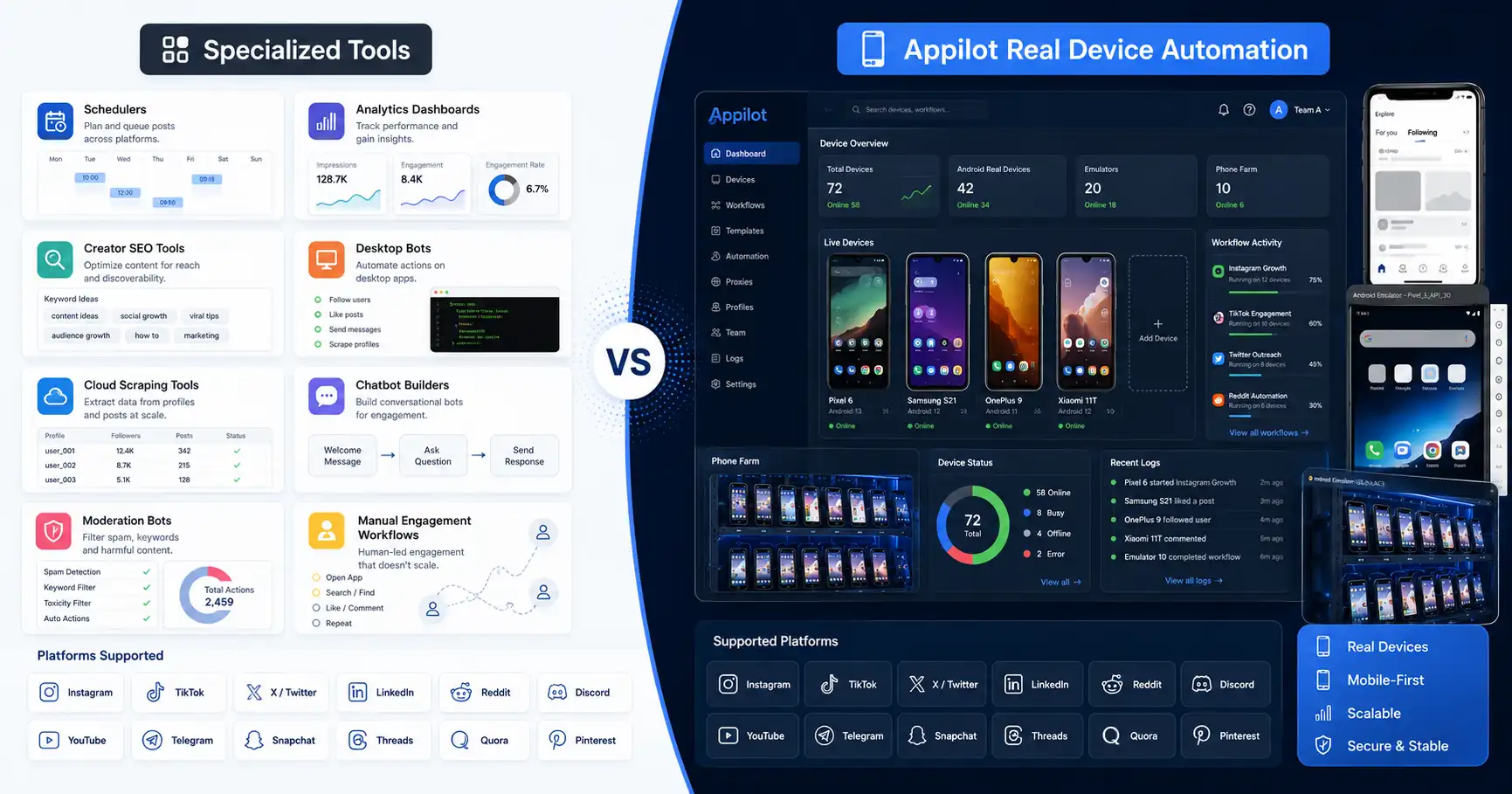
That is where Appilot stands out. Appilot runs bots on real Android devices and emulators through a remote web dashboard. Instead of relying on desktop scripts, unofficial API shortcuts, or cloud-only workflows, Appilot lets automation happen inside Android app environments where Instagram activity naturally takes place.
This matters because Instagram automation is no longer just about doing more actions. It is about how those actions happen, what environment they come from, how accounts behave, whether proxies are used correctly, and whether the workflow feels closer to normal mobile usage.
This guide compares Appilot with five top Instagram automation alternatives in 2025: ManyChat, Later, Inflact, Kicksta, and Phantombuster. Each tool has a valid use case, but they are not built for the same kind of Instagram growth.
What Makes a Good Instagram Automation Bot in 2025?
A good Instagram automation bot in 2025 should do more than save time. It should help users automate carefully without creating obvious account risk.
The best tool depends on the workflow. A creator who wants comment-to-DM automation does not need the same tool as a phone farm operator. A brand that only needs post scheduling does not need the same platform as an agency managing many Instagram accounts. A sales team scraping leads does not need the same setup as someone running mobile app workflows.
The most important thing is fit.
A good Instagram automation tool should match the action it performs. DM tools should be good at conversations and triggers. Scheduling tools should be good at content calendars. Scraping tools should be good at data extraction. Growth tools should be careful with targeting and limits. Real-device automation tools should be good at mobile app behavior, account separation, proxies, and device control.
That is why Appilot is best judged as a real-device Instagram automation platform, not just another generic Instagram bot.
What Is Appilot?
Appilot is a social media automation platform that runs bots on real Android devices and emulators through a web dashboard.
For Instagram, this is important because Instagram is a mobile-first platform. Real users scroll feeds, view Reels, open profiles, watch stories, send DMs, reply to comments, tap buttons, and move through the app interface on mobile devices.
Appilot is designed around that behavior. It uses Android automation through accessibility-service and UIAutomator-style workflows, allowing bots to interact with apps through real mobile UI actions.
Appilot also works without ADB. Users do not need to keep a laptop connected, manage USB cables, troubleshoot drivers, or fix constant device disconnects.
This makes Appilot especially useful for agencies, phone farm operators, growth teams, and users managing multiple Instagram accounts. It is also useful for users who want automation beyond Instagram, because the platform supports bots for TikTok, Twitter/X, LinkedIn, Discord, Reddit, Snapchat, YouTube, Threads, Telegram, Gmail, Chrome, and more.
Why Appilot Is Different from Most Instagram Automation Bots
Most Instagram automation tools focus on one layer of the workflow.
ManyChat focuses on Instagram DM automation. Later focuses on scheduling and content planning. Phantombuster focuses on scraping and lead workflows. Kicksta focuses on growth activity. Inflact focuses on Instagram marketing and automation features.
Appilot focuses on the execution layer.
That means Appilot is more concerned with where and how the automation runs. Instead of only giving users a cloud dashboard, Appilot runs bots through Android devices and emulators.
This is a major difference for Instagram because the app environment matters. A like, follow, message, or profile visit performed through a real mobile app workflow is not the same as a request-based shortcut or a desktop-style workflow.
Appilot does not make Instagram automation risk-free. No tool can honestly promise that. Poor proxies, aggressive limits, weak accounts, repetitive DMs, and bad targeting can still cause restrictions.
But Appilot gives users a stronger foundation because it runs automation closer to how Instagram is actually used.
Appilot vs ManyChat
ManyChat is one of the strongest Instagram automation tools for DM marketing. It is widely used for comment-to-DM flows, keyword triggers, automated replies, lead capture, and creator funnels.
If someone comments a keyword on a post or Reel, ManyChat can automatically send a direct message. This is useful for creators, coaches, e-commerce brands, educators, and businesses that want to move people from public comments into private conversations.
ManyChat is also strong because it is focused and easy to understand. It is not trying to run full mobile app automation. It is built for conversation automation, lead capture, and response flows.
Appilot is better when the user needs real Android automation instead of only DM triggers. If the workflow includes account warmup, profile visits, browsing, app navigation, multi-account operations, phone farm control, or mobile-first bot activity, Appilot fits better.
The simple answer is that ManyChat is better for Instagram DM funnels, while Appilot is better for real-device Instagram automation.
Appilot vs Later
Later is best known as a social media scheduling and content planning tool. It helps users plan Instagram posts, manage calendars, schedule content, organize media, and keep publishing consistent.
For brands and creators focused mainly on content planning, Later can be a good option. It is useful when the main problem is staying organized and posting consistently.
But Later is not a full Instagram bot platform. It does not replace real-device automation, account warmup, phone farm workflows, or app-based Instagram actions.
Appilot is stronger when the user wants automation inside the Instagram app environment. If the goal is to run bots on Android devices or emulators, manage workflows remotely, and automate beyond scheduling, Appilot is the better fit.
Later is better for content calendars. Appilot is better for mobile automation operations.
Appilot vs Inflact
Inflact is commonly known as an Instagram marketing and automation platform. It has been associated with tools for hashtags, profiles, direct messages, scheduling, analytics, downloading content, and growth-oriented workflows.
Inflact can be useful for users who want an Instagram-focused marketing toolkit. It is easier to understand for people who only care about Instagram and want several tools in one place.
The limitation is that Instagram toolkits are not the same as real-device automation platforms. A toolkit may help with planning, messaging, hashtags, or growth tasks, but the user still needs to think about how automation behaves and how account safety is handled.
Appilot wins when the user cares about Android execution. Instead of only offering Instagram-related utilities, Appilot runs bots through Android environments and supports broader social automation workflows.
Inflact may be useful for Instagram marketers who want a toolbox. Appilot is better for operators who want real-device Instagram automation and multi-account workflows.
Appilot vs Kicksta
Kicksta is known as an Instagram growth tool focused on attracting followers through targeted engagement. It is often associated with liking posts from selected audiences or competitor-related targets to increase profile visits and potential follows.
This type of tool can appeal to users who want follower growth without manually engaging all day.
The challenge is that growth automation is sensitive. Instagram can restrict accounts when engagement patterns look unnatural, when targeting is weak, or when actions happen too aggressively.
Kicksta may be useful for users who want a managed Instagram growth service and do not want to control the automation layer themselves. But users looking for deeper operational control may find it limited.
Appilot is stronger for users who want to manage how automation happens. Since Appilot runs bots on real Android devices and emulators, it gives agencies and operators more control over workflow design, device behavior, proxies, and multi-account scaling.
Kicksta is more focused on follower-growth activity. Appilot is better for users who want a broader Instagram automation operating system.
Appilot vs Phantombuster
Phantombuster is best understood as a cloud automation and scraping platform. It is useful for collecting public data, extracting leads, building prospect lists, enriching records, and running cloud-based workflows.
For Instagram, Phantombuster can be useful when the goal is data. A user may want to scrape public profiles, gather usernames, collect followers, or build outreach lists.
But scraping and real-device automation are not the same thing.
Phantombuster is strong when the output is structured data. Appilot is strong when the output is app-based behavior.
If a user wants to collect leads, Phantombuster may be useful. If a user wants to run Instagram workflows inside the mobile app, Appilot is a better fit.
For growth teams, the two tools can even serve different parts of the workflow. Phantombuster can help collect prospect data, while Appilot can help run mobile app actions through Android devices and emulators.
Which Instagram Bot Is Best for Agencies?
Agencies usually need more than one feature.
They need content planning, account safety, client separation, proxy support, reporting, messaging workflows, and reliable execution. They also need a system that team members can manage without one technical person controlling everything from a local machine.
For agencies focused mostly on comment-to-DM lead capture, ManyChat can be a strong choice. For agencies focused mostly on content calendars, Later can work well. For agencies focused on data extraction, Phantombuster can be useful.
But for agencies that need real Instagram automation across multiple accounts, Appilot is the stronger fit.
Appilot gives agencies a way to run bots on Android devices and emulators without ADB or laptop dependency. That matters because agencies need repeatable operations, not fragile desktop setups.
If an agency is managing Instagram growth, app-based workflows, DMs, warmup, and multi-account operations, Appilot provides the better foundation.
Which Instagram Bot Is Best for Phone Farm Operators?
Phone farm operators should prioritize real-device behavior, proxy support, account separation, remote control, and workflow stability.
That makes Appilot the strongest fit in this list.
ManyChat, Later, Inflact, Kicksta, and Phantombuster all have useful roles, but they are not mainly built for phone farm operations.
A phone farm is not just a dashboard. It is a device-based operating model. Operators need Android devices or emulators, account assignment, proxy strategy, app behavior, scheduling, monitoring, and long-running workflows.
Appilot is designed around that environment. It lets users manage bots remotely while automation runs on Android devices and emulators.
For serious phone farm workflows, Appilot is the best option in this comparison.
Which Instagram Bot Is Best for Creators?
Creators often need different automation than agencies.
A creator may not need phone farm workflows or multi-account operations. They may only need comment-to-DM automation, lead magnet delivery, basic replies, scheduling, and content organization.
For that use case, ManyChat and Later can be excellent choices. ManyChat helps creators turn comments into DMs. Later helps creators stay consistent with publishing.
Appilot becomes more useful when the creator starts managing multiple accounts, running deeper Instagram workflows, testing outreach, or building an automation system beyond basic DM triggers and scheduling.
So for simple creator workflows, ManyChat or Later may be enough. For advanced mobile app automation, Appilot is better.
Which Instagram Bot Is Best for Growth Teams?
Growth teams usually need flexibility.
They may need scraping, DM funnels, audience research, content scheduling, outreach, account warmup, and app-based automation. No single tool does every part equally well.
Phantombuster is useful for data collection. ManyChat is useful for DM funnels. Later is useful for publishing. Inflact and Kicksta may be useful for certain Instagram marketing or growth workflows.
Appilot is useful when the growth team needs to run mobile app workflows directly on Android devices or emulators.
For teams that need real-device Instagram automation, Appilot should be the core platform. Other tools can still be used around it for specific tasks like scheduling, lead capture, or data extraction.
Account Safety: Which Tool Has Lower Risk?
Account safety depends on the workflow, not just the brand name of the tool.
ManyChat can be relatively safe when used for allowed DM automation and reasonable comment triggers. Later is generally low-risk because scheduling is less aggressive than engagement automation. Phantombuster can be risky if scraping is too aggressive or violates platform limits. Kicksta and Inflact-style growth automation can carry more risk when engagement actions are repeated too heavily.
Appilot’s advantage is that it runs automation through Android environments. For account actions that need mobile app behavior, this gives users a more natural execution layer.
But Appilot still needs careful use. Users should avoid aggressive limits, spammy DMs, weak proxies, repeated comments, and low-quality account behavior.
The lowest-risk setup is not the tool with the biggest promise. It is the setup that matches the use case, respects limits, and behaves naturally.
Where Appilot Wins
Appilot wins when Instagram automation needs real mobile app behavior.
It is best for users who want to run bots on real Android devices and emulators, manage accounts remotely, avoid ADB, avoid laptop dependency, and support multi-account operations.
Appilot also wins when users want to grow beyond Instagram. Since it supports bots for platforms like TikTok, Twitter/X, LinkedIn, Discord, Reddit, Snapchat, YouTube, Threads, Telegram, Gmail, Chrome, and more, it works better as a broader automation system.
It is especially strong for agencies, phone farm operators, growth teams, outreach teams, and users who need real-device execution rather than only cloud automation.
Where the Alternatives Win
The alternatives win when the use case is narrower.
ManyChat wins for Instagram DM funnels, comment-to-DM automation, and creator lead capture. Later wins for post scheduling, content planning, and visual calendar workflows. Inflact wins for users who want an Instagram-specific marketing toolkit. Kicksta wins for users who want a managed follower-growth style service. Phantombuster wins for scraping, prospecting, and cloud data workflows.
None of these tools are useless. They simply solve different problems.
The mistake is choosing a tool because it appears on a “best Instagram bot” list without knowing what kind of automation you actually need.
If you need DMs, choose a DM tool. If you need scheduling, choose a scheduler. If you need data, choose a scraper. If you need real mobile app automation, choose Appilot.
Final Verdict
The best Instagram automation bot in 2025 depends on the job.
ManyChat is one of the best choices for Instagram DM automation and comment-to-DM flows. Later is strong for scheduling and content planning. Inflact is useful as an Instagram marketing toolkit. Kicksta is focused on follower-growth activity. Phantombuster is useful for scraping and lead workflows.
Appilot is the strongest option for real-device Instagram automation.
It runs bots on Android devices and emulators, works without ADB, does not require a laptop, supports proxy-aware workflows, and gives users a remote web dashboard for managing automation.
If you only need a simple DM funnel, ManyChat may be enough. If you only need scheduling, Later may be enough. If you need data scraping, Phantombuster may be better.
But if you need real Instagram automation that behaves inside Android app environments, Appilot is the best fit.
You can explore Appilot’s bot store and try it at appilot.app.
FAQ
Q1: What is the best Instagram automation bot in 2025?
Appilot is best for real-device Instagram automation, while tools like ManyChat, Later, and Phantombuster are better for narrower workflows like DMs, scheduling, or scraping.
Q2: Is Appilot safer than traditional Instagram bots?
Appilot has a stronger automation foundation because it runs bots on Android devices and emulators. Safety still depends on proxies, limits, warmup, and account behavior.
Q3: Which Instagram automation tool is best for DMs?
ManyChat is one of the strongest options for Instagram DM automation, especially comment-to-DM flows and creator lead capture.
Q4: Which Instagram automation tool is best for phone farms?
Appilot is the best fit for phone farm operators because it supports real Android automation, remote dashboard control, proxy-aware workflows, and no ADB setup.
Q5: Can I use Appilot with other Instagram automation tools?
Yes, Appilot can work alongside tools used for scheduling, DM funnels, or data scraping. Appilot is strongest when the workflow requires real mobile app automation.