Best Threads Automation Bots Compared: Who Leads the Market?
Threads automation has changed a lot since the app first launched.
In the beginning, Threads felt like a simple text-first Instagram companion. In 2025, it is more mature. Users can post short text updates, share photos and videos, join conversations, use native scheduling, build communities, and manage a growing presence around topics and interests.
That means Threads automation is no longer only about posting random updates faster. It is now about content planning, scheduling, analytics, community participation, engagement workflows, and mobile app behavior.
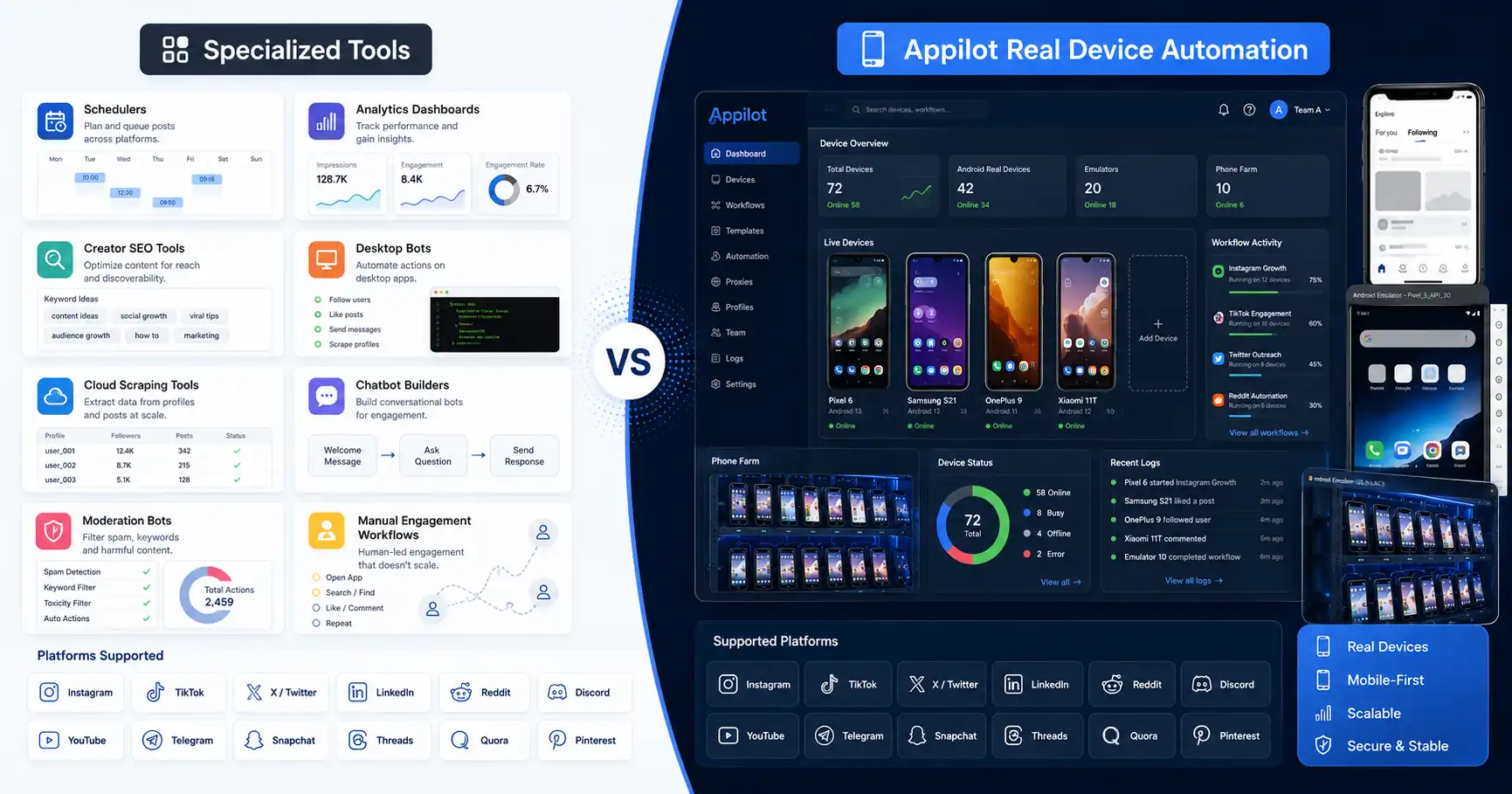
The tools in this space solve different problems. Buffer, Hootsuite, Metricool, and Later are useful for scheduling, planning, analytics, and social media management. Meta’s own Threads features help with native posting and scheduling. Appilot is different because it focuses on real-device automation by running bots on Android devices and emulators through a remote web dashboard.
So who leads the market? The honest answer is that it depends on the workflow. If you need simple publishing, a scheduler may be enough. If you need analytics, a reporting platform may be better. If you need real Threads app workflows through Android environments, Appilot is the strongest fit.
What Makes a Good Threads Automation Tool?
A good Threads automation tool should help users stay consistent without making their account look robotic.
Threads is built around conversation. That means low-quality automation can hurt more than it helps. If an account posts repetitive content, replies generically, or tries to force engagement without context, users may ignore it or report it as spammy.
The best Threads tools help with useful work. They help users schedule posts, plan content, track performance, organize ideas, manage campaigns, and support real conversations.
For creators and brands, publishing consistency matters. For agencies, content calendars and approvals matter. For growth teams, analytics and workflow visibility matter. For operators, real app execution and multi-platform automation matter.
That is why there is no single “best” Threads automation tool for every user.
Appilot leads when the workflow needs real Android automation. Traditional social media tools lead when the workflow is mostly scheduling, reporting, or team management.
What Is Appilot?
Appilot is a social media automation platform that runs bots on real Android devices and emulators through a remote web dashboard.
For Threads automation, Appilot is useful when the workflow needs Android app execution instead of only dashboard-based scheduling. It can support Threads app workflows as part of a larger automation system across many social platforms.
Appilot also works without ADB. Users do not need to keep a laptop connected, manage USB cables, troubleshoot drivers, or fix device disconnects.
The platform supports bots for Threads, Instagram, TikTok, Twitter/X, LinkedIn, Discord, Reddit, Snapchat, YouTube, Telegram, Gmail, Chrome, and more.
Appilot is especially useful for agencies, phone farm operators, growth teams, and multi-account users who want real Android automation, remote control, proxy-aware workflows, and multi-platform social bots.
What Are Native Threads Automation Features?
Threads now includes more native features than it had at launch.
Users can create posts, reply to conversations, share media, join interest-based conversations, and schedule posts directly inside Threads. Native scheduling is useful because it lets users plan content without depending on a third-party tool for basic publishing.
This is good for creators and small brands. If the only goal is to schedule a few posts ahead of time, native Threads features may be enough.
The limitation is that native features do not replace broader automation. They do not give users advanced multi-platform workflows, real Android device automation, phone farm control, cross-platform bot management, or deep social automation infrastructure.
Native Threads tools are best for simple publishing. Appilot is better for real app workflows and multi-platform automation.
Appilot vs Buffer for Threads
Buffer is one of the best-known social media scheduling tools. It is useful for users who want a clean dashboard to schedule posts, manage publishing queues, and stay consistent across platforms.
For Threads, Buffer is a good fit when the user wants simple content scheduling and social media planning. It is especially useful for creators, founders, and small teams that want a lightweight publishing workflow.
Appilot solves a different problem. It is not mainly a content calendar. It is a real-device automation platform.
If your Threads workflow is only about scheduling posts, Buffer may be enough. If your workflow needs Threads app automation through Android devices or emulators, Appilot is the better fit.
Buffer leads for simple scheduling. Appilot leads for real app execution.
Appilot vs Hootsuite for Threads
Hootsuite is a broad social media management platform for teams, brands, and larger organizations. It helps with scheduling, publishing, monitoring, analytics, approvals, and team-based social media operations.
For Threads, Hootsuite is useful when the user needs structured content planning and team visibility across multiple social channels.
It is not mainly a real-device automation platform. Hootsuite helps manage social media from a dashboard, but it does not replace Android app automation, phone farm workflows, or app-based bot execution.
Appilot is stronger when the user needs automation inside the Threads app environment or wants to manage Threads alongside other mobile-first workflows.
Hootsuite leads for team social media management. Appilot leads for Android-based automation.
Appilot vs Metricool for Threads
Metricool is useful for social media planning, analytics, reporting, and performance tracking. It helps users understand how content performs and organize publishing across platforms.
For Threads, Metricool is valuable when the user needs data. Agencies and marketers often need reports, content calendars, and performance visibility.
Metricool is not mainly a bot platform. It does not replace real mobile app automation.
Appilot is better when Threads automation needs to happen inside Android environments. This is useful for operators who care about real app behavior, multi-account workflows, no ADB, and remote device control.
Metricool leads for analytics and reporting. Appilot leads for app-based execution.
Appilot vs Later for Threads
Later is a content planning and scheduling tool. It is especially useful for creators and brands that care about visual content planning, calendars, and publishing workflows.
For Threads, Later can help users plan content and stay consistent, especially when Threads is part of a larger social content strategy.
However, Later is not built as a real-device Threads bot. It does not replace Android automation, phone farm control, app workflow execution, or multi-platform automation.
Appilot is stronger for users who need automation that runs through Android devices and emulators.
Later leads for planning and scheduling. Appilot leads for mobile app automation.
Threads Scheduling vs Threads Automation
Scheduling and automation are not the same thing.
Scheduling means preparing a post and setting it to publish later. This is useful, safe, and often enough for creators and brands that only need consistency.
Automation is broader. It can involve workflow management, app navigation, account operations, monitoring, replies, cross-platform actions, and multi-account control.
For Threads, users should not confuse a scheduler with a full automation platform. A scheduler helps with content timing. A platform like Appilot helps when the workflow needs real app execution.
This distinction is important because many tool lists mix schedulers, analytics platforms, and automation bots under one label.
The best choice depends on the actual job.
Threads Automation and Account Safety
Threads automation should be handled carefully.
Because Threads is tied closely to Instagram and Meta accounts, users should avoid spammy behavior, repetitive posting, fake engagement, aggressive replies, and suspicious third-party tools.
Even if a workflow is technically possible, it may still be a bad idea if it creates low-quality activity or violates platform expectations.
Real-device automation does not make automation risk-free. Appilot gives users a stronger app-based execution layer, but users still need realistic limits, human review, and high-quality content.
For Threads, the safest approach is to use automation to support consistency and operations, not to flood the platform with low-effort replies or posts.
Best Threads Automation Tool for Creators
For creators, the best tool depends on how advanced the workflow is.
If the creator only needs simple scheduling, native Threads scheduling or Buffer may be enough. If the creator wants broader content planning, Later can be useful. If the creator wants analytics and performance reports, Metricool may help.
Appilot becomes more useful when the creator manages multiple accounts, needs Android app workflows, or wants Threads automation alongside Instagram, TikTok, YouTube, Reddit, Discord, Telegram, and other platforms.
For simple creator publishing, a scheduler wins. For advanced app-based automation, Appilot wins.
Best Threads Automation Tool for Agencies
Agencies need more structure than individual creators.
They may need client calendars, approvals, analytics, team workflows, reports, and multi-platform visibility. Hootsuite, Metricool, Buffer, and Later can all be useful depending on the agency’s size and process.
Appilot is better when the agency also needs real-device automation and broader social bot workflows.
If an agency manages Threads as part of a social content calendar, a dashboard tool may be enough. If the agency manages Threads as part of a broader automation stack across many mobile apps, Appilot becomes more useful.
Best Threads Automation Tool for Phone Farm Operators
Phone farm operators should prioritize real-device behavior, remote control, proxy support, and multi-account workflow management.
That makes Appilot the strongest option in this comparison.
Traditional scheduling tools are useful, but they do not control Android devices or run app-based workflows.
Appilot lets users run bots on Android devices and emulators, manage workflows remotely, avoid ADB, and automate across Threads plus many other platforms.
For phone farm-style social automation, Appilot leads the market.
Where Appilot Wins
Appilot wins when Threads automation needs real app behavior.
It is best for users who want Threads workflows running on Android devices and emulators, remote dashboard control, no ADB, no laptop dependency, proxy-aware workflows, and multi-platform automation.
Appilot also wins for users who manage Threads alongside Instagram, TikTok, Twitter/X, LinkedIn, Discord, Reddit, Snapchat, YouTube, Telegram, Gmail, Chrome, and more.
For agencies, growth teams, and phone farm operators, this makes Appilot more useful than a basic scheduler.
Where Other Tools Win
Other tools win when the workflow is simpler or more dashboard-based.
Native Threads scheduling is useful for basic post planning. Buffer is strong for simple social scheduling. Hootsuite is strong for team-based management. Metricool is strong for analytics and reporting. Later is strong for content planning and calendars.
These tools are not bad. They are simply focused on publishing and management rather than real-device automation.
If your workflow is content scheduling, use a scheduling tool. If your workflow is analytics, use a reporting tool. If your workflow is real app automation, use Appilot.
Final Verdict
The Threads automation market does not have one universal winner.
Native Threads features are best for basic scheduling. Buffer is best for simple publishing. Hootsuite is best for team social media management. Metricool is best for analytics and reporting. Later is best for content planning. Appilot is best for real-device Threads automation.
So who leads the market?
For scheduling and social media dashboards, established management tools lead. For Android app workflows, phone farm operations, no-ADB automation, and multi-platform social bots, Appilot leads.
If you only need to plan posts, use a scheduler. If you need to automate Threads as part of a serious mobile social workflow, Appilot is the better fit.
You can explore Appilot’s bot store and try it at appilot.app.
FAQ
Q1: What is the best Threads automation bot in 2025?
Appilot is best for real-device Threads automation, while tools like Buffer, Hootsuite, Metricool, Later, and native Threads scheduling are better for publishing and reporting.
Q2: Does Threads support native scheduling?
Yes, Threads supports native post scheduling, which is useful for basic publishing. It does not replace broader automation or real-device workflows.
Q3: Is Appilot better than Buffer for Threads?
Appilot is better for real Android app automation, while Buffer is better for simple scheduling and content queues. The better tool depends on the workflow.
Q4: Is Threads automation safe?
Threads automation can be risky if it creates spam, fake engagement, or repetitive low-quality activity. Safer workflows use realistic limits, human review, and useful content.
Q5: Who should choose Appilot for Threads automation?
Agencies, phone farm operators, growth teams, and multi-account users should choose Appilot when Threads workflows need real-device automation, no ADB, and remote control.