Best Twitter/X Automation Bots Compared: Which Still Works in 2025?
Twitter, now X, is still one of the most powerful platforms for creators, founders, agencies, recruiters, crypto communities, SaaS companies, and growth teams. But automation on X has changed a lot.
A few years ago, people could rely on simple bots that auto-followed users, mass-liked posts, sent generic DMs, scraped profiles, or reposted content at scale. In 2025, that kind of automation is much riskier. X has stricter automation rules, API access is more controlled, and spam-like behavior is easier to flag.
That does not mean Twitter/X automation is dead. It means the old style of reckless botting is much harder to trust.
The tools that still work in 2025 are the ones that solve specific workflow problems. Some help with scheduling. Some help with writing threads. Some help with analytics. Some help with scraping and prospecting. Some help teams manage content calendars. Appilot is different because it focuses on real-device automation through Android devices and emulators.
This guide compares Appilot with five strong Twitter/X automation alternatives: Tweet Hunter, Hypefury, Buffer, Hootsuite, and Phantombuster.
What Makes a Good Twitter/X Automation Bot in 2025?
A good Twitter/X automation bot in 2025 should not be judged only by how many actions it can perform. The better question is whether the tool helps users automate without creating obvious spam signals.
X automation is sensitive because the platform has long had rules against spam, platform manipulation, deceptive activity, and harmful automated behavior. Automated accounts and API-based workflows also need to follow X’s automation and developer policies.
That means users should be careful with tools that promise aggressive growth, mass engagement, or fully hands-off account activity.
The best tools in 2025 are usually more focused. They help users schedule posts, write better content, analyze performance, manage teams, collect public data, or run controlled workflows. The safest automation is usually the automation that supports a real strategy instead of replacing human judgment.
Appilot fits a specific category: real-device automation for users who need X mobile app workflows, Android-based execution, no ADB setup, and multi-account operations.
What Is Appilot?
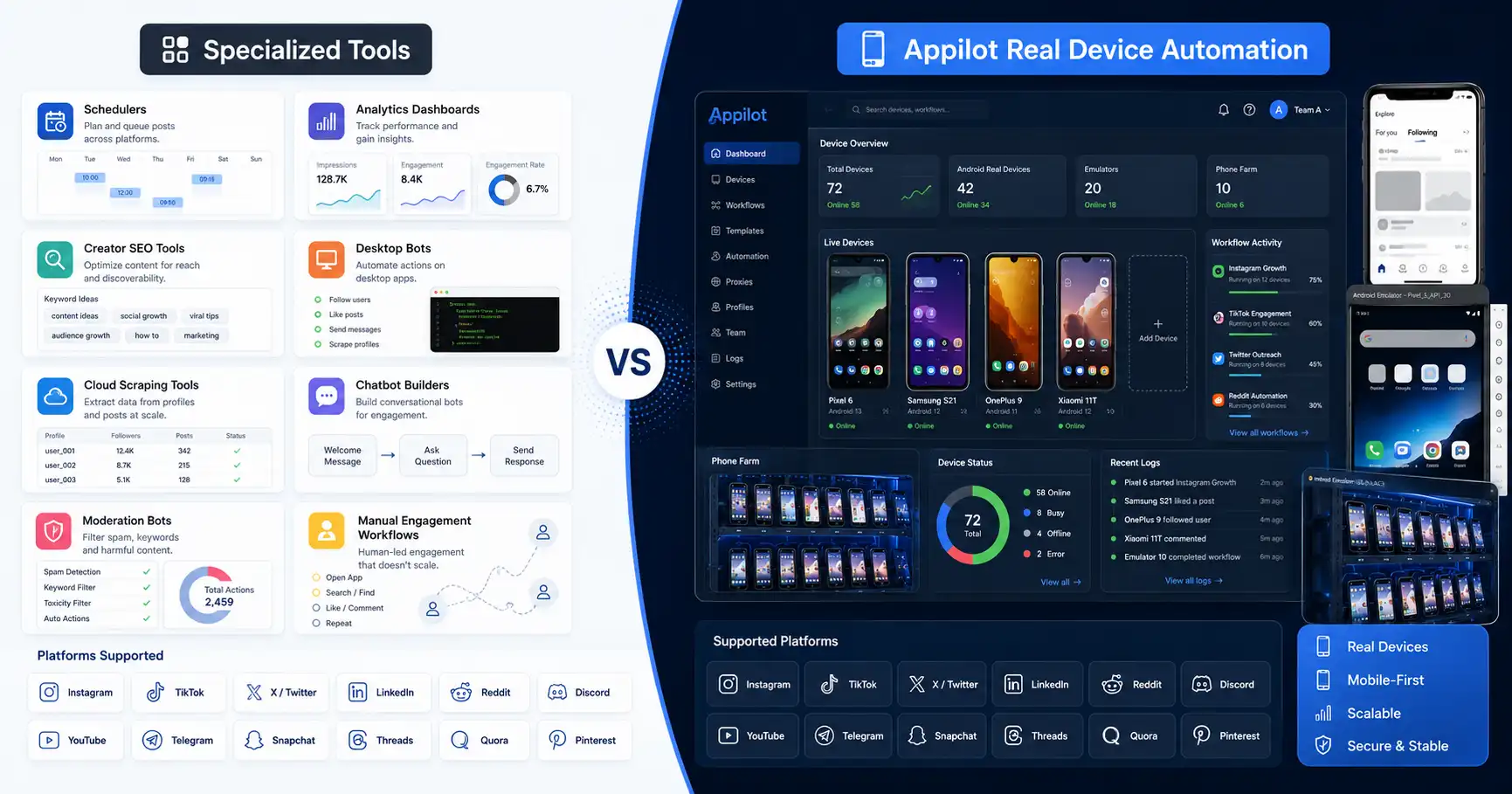
Appilot is a social media automation platform that runs bots on real Android devices and emulators through a remote web dashboard.
For Twitter/X automation, this matters because some workflows are better handled inside the mobile app environment. A real user opens the X app, scrolls the feed, reads posts, taps profiles, writes replies, checks notifications, sends messages, and moves through the app with normal mobile behavior.
Appilot is built around that kind of app-based workflow. Instead of depending only on cloud scripts, desktop bots, or API shortcuts, Appilot lets users run automation inside Android environments.
Appilot also works without ADB, so users do not need to keep a laptop connected, manage USB cables, troubleshoot drivers, or deal with constant device disconnects.
The platform includes a bot store with ready-to-use automations for Twitter/X, Instagram, TikTok, LinkedIn, Discord, Reddit, Snapchat, YouTube, Threads, Telegram, Gmail, Chrome, and more.
Why Appilot Is Different from Most Twitter/X Automation Tools
Most Twitter/X tools focus on content publishing, audience building, analytics, or scraping.
Tweet Hunter helps creators write and schedule better posts. Hypefury helps creators publish, recycle, and monetize content across platforms. Buffer helps teams schedule content. Hootsuite helps larger teams manage social channels. Phantombuster helps users extract data and run cloud workflows.
Appilot focuses on the automation execution layer.
That means Appilot is useful when the user cares about where and how automation runs. Instead of only scheduling a tweet or scraping a profile list, Appilot can support real Android app workflows from a dashboard.
This is especially useful for teams that manage many accounts, test app-based workflows, or want mobile-first automation across several platforms.
Appilot is not a replacement for every X tool. If you only need thread writing, use a creator tool. If you only need scheduling, use a scheduler. If you only need scraping, use a scraping tool.
But if you need real-device automation, Appilot is the stronger fit.
Appilot vs Tweet Hunter
Tweet Hunter is one of the most popular tools for creators who want to grow on X through better writing, scheduling, content ideas, and analytics. It is built around helping users publish more consistently and improve their content strategy.
For creators, this is valuable. Writing strong posts and threads is still one of the best ways to grow on X. Tweet Hunter can help users generate ideas, schedule posts, analyze performance, and build a repeatable posting workflow.
Tweet Hunter is not mainly a real-device automation tool. It is not designed for phone farm operations, Android app workflows, or multi-platform mobile bot execution.
Appilot is better when the user needs automation inside the X mobile app environment or wants to manage broader social workflows beyond writing and scheduling.
The simple answer is that Tweet Hunter is better for writing and publishing on X, while Appilot is better for real-device automation and multi-account operations.
Appilot vs Hypefury
Hypefury is a creator-focused social media scheduling and automation tool. It is popular with people who want to build an audience on X, repurpose content, schedule posts, create threads, and turn audience attention into email subscribers or offers.
Hypefury is strong because it supports a creator workflow. It helps users stay consistent, recycle high-performing content, and maintain a publishing system.
For founders, creators, and solo operators, Hypefury can be a good choice if the main problem is content output and monetization.
Appilot is better when the workflow goes beyond publishing. If the user needs X app workflows, Android device automation, proxy-aware multi-account operations, or automation across other platforms, Appilot is more relevant.
Hypefury is better for creator publishing. Appilot is better for mobile app automation.
Appilot vs Buffer
Buffer is one of the most established social media scheduling tools. It helps users schedule posts, plan content, manage social channels, and track basic performance from one dashboard.
For small businesses, creators, and marketing teams, Buffer is useful because it is clean, simple, and focused on publishing.
If the goal is to post consistently on X without logging in every time, Buffer may be enough.
But Buffer is not a bot platform for real-device workflows. It does not replace Android automation, phone farm management, account warmup, app-based actions, or social media bot operations.
Appilot is stronger when the user needs automation inside mobile environments rather than only scheduled posting.
Buffer is better for content calendars. Appilot is better for real-device automation.
Appilot vs Hootsuite
Hootsuite is a broad social media management platform used by teams and brands to manage multiple social accounts, schedule content, track performance, monitor conversations, and coordinate social media work.
For businesses and larger marketing teams, Hootsuite can be useful because it centralizes content planning, approvals, scheduling, analytics, and inbox workflows.
It is not mainly designed as a mobile bot platform. Its strength is social media management, not real Android app execution.
Appilot is better when the workflow requires actual mobile app automation, device-level operations, or multi-account social bot workflows.
Hootsuite is better for team-based management. Appilot is better for real-device automation.
Appilot vs Phantombuster
Phantombuster is a cloud automation and scraping platform. It is useful when the goal is data extraction, lead generation, prospecting, or public profile collection.
For X workflows, Phantombuster may be useful if a user wants to collect public profile data, monitor accounts, build prospect lists, or support outbound research.
But scraping and real-device automation are different problems.
Phantombuster is strong when the output is structured data. Appilot is strong when the output is app-based behavior.
If the user needs lead lists, Phantombuster may be useful. If the user needs X app workflows running through Android devices or emulators, Appilot is the better fit.
Which Twitter/X Automation Tool Is Best for Creators?
Creators usually need tools that help them write better content, publish consistently, and understand what works.
For that use case, Tweet Hunter and Hypefury are strong options. Tweet Hunter is useful for writing, idea generation, scheduling, and analytics. Hypefury is useful for creator publishing, thread scheduling, recycling content, and audience monetization workflows.
Buffer can also be useful for creators who want simple scheduling without a heavier creator-growth platform.
Appilot becomes more relevant when the creator needs app-based automation or manages multiple accounts and platforms. If the creator only wants writing and publishing help, a creator tool may be enough. If the creator wants broader social automation on real Android devices, Appilot is the stronger fit.
Which Twitter/X Automation Tool Is Best for Agencies?
Agencies usually need a combination of scheduling, reporting, monitoring, account separation, and operational consistency.
Hootsuite can be useful for agencies that need client dashboards, approvals, team workflows, and multi-channel social media management. Buffer can work for smaller agencies that mainly need scheduling. Phantombuster can help with prospecting and data extraction.
Appilot is better for agencies that need real-device automation or multi-platform bot workflows.
If an agency manages Twitter/X alongside Instagram, TikTok, LinkedIn, Reddit, Discord, YouTube, Telegram, Gmail, and Chrome, Appilot gives them a broader automation layer.
The best agency stack may include more than one tool. Hootsuite or Buffer can handle content planning, while Appilot handles mobile app automation workflows.
Which Twitter/X Automation Tool Is Best for Phone Farm Operators?
Phone farm operators should prioritize device behavior, account separation, proxy support, remote control, and stable workflows.
That makes Appilot the strongest option in this comparison.
Tweet Hunter, Hypefury, Buffer, Hootsuite, and Phantombuster are useful, but they are not mainly built for phone farm operations.
A phone farm workflow is not just about posting content. It may involve Android devices, app sessions, proxies, accounts, timing, behavior, monitoring, and multi-platform operations.
Appilot is built around this environment. It lets users manage bots remotely while automation runs on real Android devices and emulators.
For phone farm-style social automation, Appilot is the best fit.
X Automation and Account Safety
Twitter/X automation should be handled carefully because the platform has clear rules around automated activity, spam, manipulation, and developer/API use.
Automation that helps with scheduling, publishing, reporting, and approved workflows can be useful. Automation that imitates spam, mass engagement, deceptive behavior, or platform manipulation can put accounts at risk.
This is why users should be careful with any tool that promises easy growth through mass likes, follows, replies, reposts, or automated DMs.
Appilot’s advantage is that it can run workflows through Android environments rather than relying only on scripts or cloud shortcuts. For mobile app-based workflows, that can be more natural.
But users still need to respect limits, avoid spam, avoid deceptive activity, and use automation responsibly.
No tool should be treated as a ban-proof system.
What Still Works in 2025?
The automation that still works in 2025 is usually automation that supports real content and real workflows.
Scheduling still works when it is used to publish genuine posts. Analytics still works when it helps users understand performance. Thread writing tools still work when they improve human-created ideas. Scraping tools still work when used carefully for allowed public data workflows. Real-device automation still works best when it supports realistic mobile app behavior rather than spam.
What does not work well is careless botting.
Mass replies, repetitive DMs, aggressive following, engagement manipulation, and fake activity are much more likely to cause problems.
The future of Twitter/X automation is not about tricking the platform. It is about using the right tools for the right workflows.
Where Appilot Wins
Appilot wins when the user needs real mobile app automation.
It is best for users who want X workflows running on Android devices and emulators, no ADB setup, no laptop dependency, remote dashboard control, proxy-aware workflows, and multi-account operations.
Appilot also wins when users want automation across more than one platform. Since it supports bots for Instagram, TikTok, Twitter/X, LinkedIn, Discord, Reddit, Snapchat, YouTube, Threads, Telegram, Gmail, Chrome, and more, it works as a wider automation system.
For agencies and phone farm operators, Appilot is especially useful because it solves the device and execution layer that scheduling tools do not cover.
Where the Competitors Win
The competitors win when the use case is narrower.
Tweet Hunter wins for writing and growing through better X content. Hypefury wins for creator publishing and content recycling. Buffer wins for simple scheduling. Hootsuite wins for social media team management. Phantombuster wins for scraping and lead workflows.
These are all valid tools.
The key is knowing what you need. If you need content help, choose a creator tool. If you need scheduling, choose a scheduler. If you need reporting, choose a social media management platform. If you need lead scraping, choose a data tool. If you need real mobile app automation, choose Appilot.
Final Verdict
The best Twitter/X automation bot in 2025 depends on the workflow.
Tweet Hunter is strong for writing, scheduling, and creator growth. Hypefury is strong for creator publishing and content recycling. Buffer is strong for simple scheduling. Hootsuite is strong for team-based social media management. Phantombuster is strong for cloud scraping and lead workflows.
Appilot is the strongest choice for real-device Twitter/X automation.
It runs bots on Android devices and emulators, works without ADB, does not require a laptop, supports remote dashboard control, and fits multi-account social workflows.
If you only need to schedule posts, Buffer or Hootsuite may be enough. If you only need writing help, Tweet Hunter or Hypefury may be better. If you only need data extraction, Phantombuster may be useful.
But if you need Twitter/X automation that runs through mobile app environments, Appilot is the better fit.
You can explore Appilot’s bot store and try it at appilot.app.
FAQ
Q1: What is the best Twitter/X automation bot in 2025?
Appilot is best for real-device Twitter/X automation, while tools like Tweet Hunter, Hypefury, Buffer, Hootsuite, and Phantombuster are better for narrower workflows.
Q2: Is Twitter/X automation still allowed?
Some automation is allowed when it follows X rules and policies. Spam, manipulation, deceptive automation, and aggressive engagement bots can put accounts at risk.
Q3: Which Twitter/X tool is best for scheduling posts?
Buffer, Hootsuite, Tweet Hunter, and Hypefury are strong choices for scheduling. Appilot is better when the workflow needs mobile app automation.
Q4: Which Twitter/X automation tool is best for phone farms?
Appilot is the best fit for phone farm operators because it supports real Android automation, remote dashboard control, proxy-aware workflows, and no ADB setup.
Q5: Can Appilot work alongside other Twitter/X tools?
Yes, Appilot can work alongside tools used for writing, scheduling, analytics, or scraping. Appilot is strongest when the workflow needs real mobile app automation.