Browser API Inconsistencies That Expose Automation
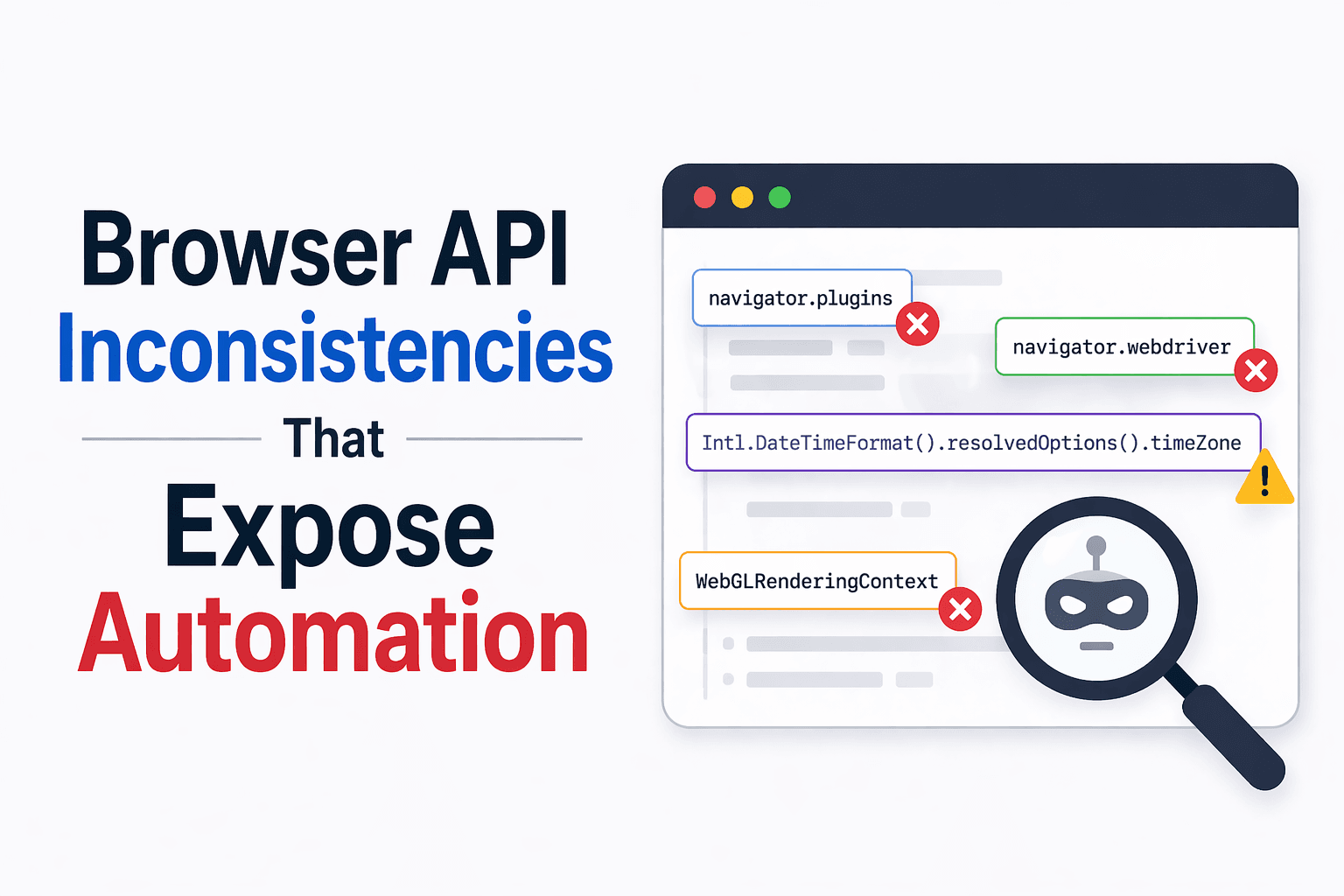
Modern bot detection systems no longer rely only on obvious signals like IP address or user agent. Instead, they analyze how different browser APIs behave and whether those behaviors are consistent with a real device. When automation tools modify or simulate environments, they often introduce subtle inconsistencies across these APIs, which can be detected.
Understanding browser API inconsistencies is important because they are one of the most reliable ways to identify automated environments. This guide explains how these inconsistencies occur and why they matter.
What Are Browser API Inconsistencies?
Browser API inconsistencies refer to mismatches between different signals exposed by browser APIs, where the data returned by one API does not align with data from another or with expected real-world behavior. These inconsistencies typically occur in environments where properties are modified, spoofed, or partially simulated, leading to contradictions that detection systems can identify. Because real devices produce internally consistent signals, any mismatch becomes a strong indicator of automation.
The Core Idea Behind API Consistency
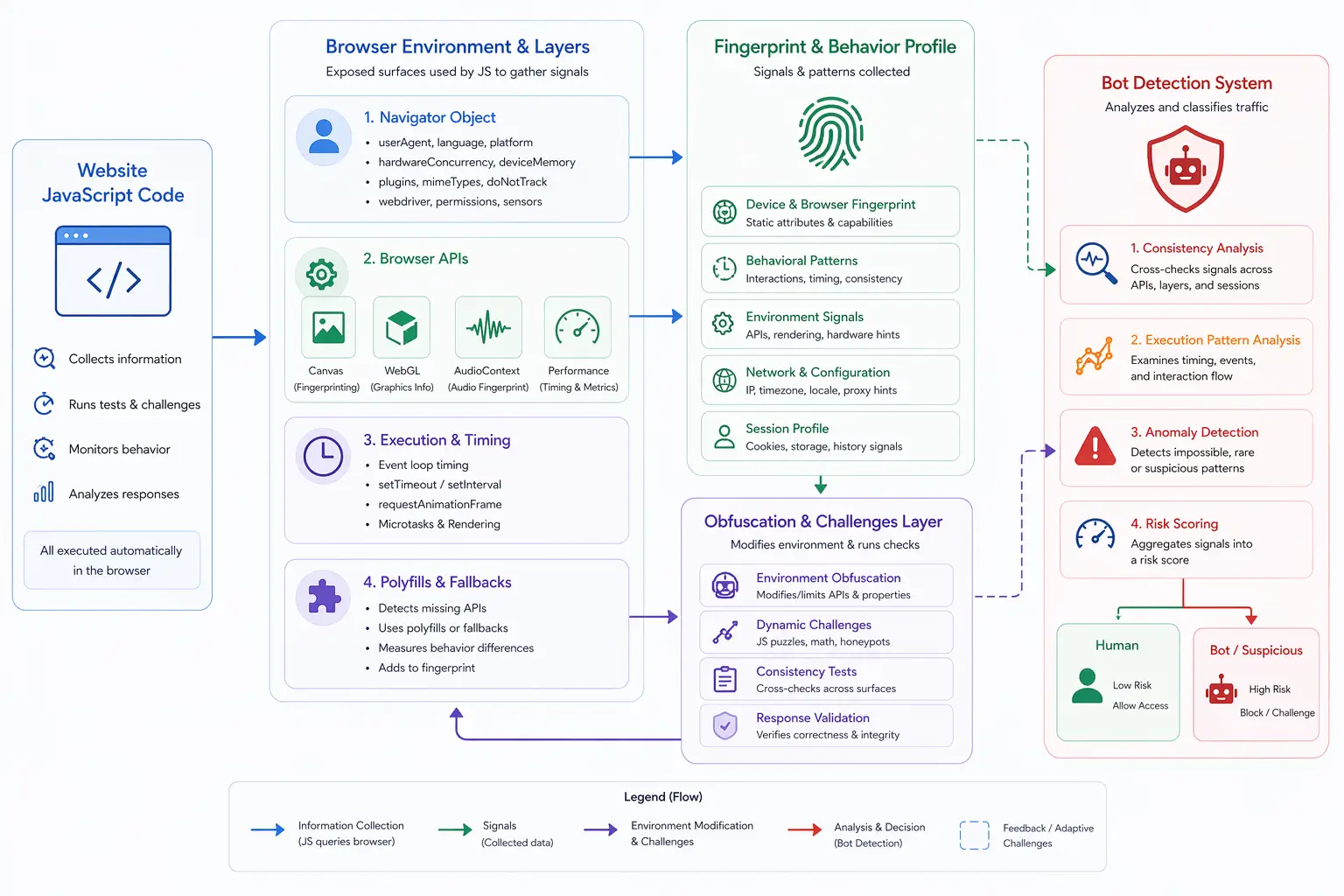
The core idea behind API consistency is that all parts of a real browser environment are interconnected, meaning that hardware, software, and browser behavior naturally align. For example, the reported operating system should match rendering behavior, performance characteristics, and available features. Detection systems rely on this principle by comparing multiple API outputs and checking whether they form a coherent profile. When they do not align, it suggests that the environment has been modified.
How API Inconsistencies Occur
API inconsistencies occur when automation tools attempt to modify certain signals without fully replicating the underlying system, where changes are often applied only at the surface level. For example, changing the user agent to mimic a mobile device may not match the actual screen resolution or hardware performance, creating a mismatch. Similarly, modifying navigator properties may not affect how Canvas or WebGL renders content, leading to detectable differences. These inconsistencies arise because it is difficult to perfectly simulate all aspects of a real environment.
Common Types of API Inconsistencies
Several types of inconsistencies are commonly observed in automated environments, where mismatches between user agent and device characteristics are one of the most obvious examples, and discrepancies between navigator properties and actual hardware capabilities are also frequent. Differences in Canvas or WebGL rendering compared to expected outputs can indicate spoofing, while missing or partially implemented APIs may reveal headless or modified browsers. Timing and performance inconsistencies, such as unrealistic execution speeds, further contribute to detection.
Why Detection Systems Focus on Inconsistencies
Detection systems focus on inconsistencies because they are difficult to eliminate completely, where even well-configured environments may still produce subtle mismatches. By analyzing relationships between multiple signals rather than relying on individual values, detection systems can identify patterns that indicate automation. This approach is more robust than checking single properties, as it reduces the chances of false negatives.
API Inconsistencies and Fingerprinting
Browser API inconsistencies directly impact fingerprinting because they affect the reliability of the fingerprint, where a fingerprint built from inconsistent data is easier to classify as artificial. Fingerprinting systems expect stable and coherent outputs across sessions, and when inconsistencies are detected, the fingerprint is flagged as suspicious. This makes API consistency a critical factor in maintaining a believable identity.
API Inconsistencies and Bot Detection
Bot detection systems use API inconsistencies as a primary signal to identify automation, where these inconsistencies are often combined with behavioral analysis and network data to confirm detection. Automated environments may pass some checks but fail others, creating a pattern of partial compliance that stands out. By correlating multiple inconsistencies, detection systems can accurately classify traffic as non-human.
Limitations of Fixing API Inconsistencies
Fixing API inconsistencies is challenging because it requires aligning all aspects of the environment, not just individual properties, where changes must be applied across multiple layers including browser configuration, hardware behavior, and network signals. Even small mismatches can be detected, and maintaining consistency across updates and different scenarios adds further complexity. This makes complete elimination of inconsistencies difficult.
API Inconsistencies vs Real-Device Environments
A key distinction in modern detection is the difference between simulated environments and real-device environments, where simulated setups often struggle to maintain consistency across all APIs, leading to detectable mismatches. Real-device environments operate on actual hardware where browser APIs, rendering behavior, and system performance naturally align, and tools like Appilot follow this approach by running automation on real Android devices, ensuring that API outputs remain consistent with real-world conditions. This significantly reduces the inconsistencies that detection systems rely on.
When API Inconsistencies Are Most Critical
API inconsistencies are most critical in scenarios where high accuracy in detection is required, such as fraud prevention, account security, and high-value transactions, where even small mismatches can trigger additional verification or blocking. In these contexts, maintaining consistency across all signals is essential for avoiding detection.
Frequently Asked Questions
Q: What are browser API inconsistencies?
They are mismatches between different browser signals.
Q: Why do they occur?
Because automation modifies some signals but not all.
Q: How are they detected?
By comparing outputs across multiple APIs.
Q: Can they be fully eliminated?
It is very difficult to achieve complete consistency.
Q: Why are they important for bot detection?
They provide strong indicators of non-human environments.
Q: How do real-device solutions compare?
Real-device solutions like Appilot maintain consistent API behavior, reducing detectable mismatches.
Key Takeaways
Browser API inconsistencies occur when different signals exposed by browser APIs do not align with each other or with expected real-world behavior, and they are one of the most reliable indicators of automation. Detection systems analyze these mismatches across multiple layers to identify non-human environments, making consistency a critical factor in avoiding detection. Understanding how these inconsistencies arise is essential for navigating modern bot detection systems.