Understanding Browser Engine Modifications for Stealth

Most fingerprinting discussions focus on modifying surface-level signals like user agent or screen resolution, but advanced detection systems analyze much deeper layers. One of the most powerful and complex approaches to avoiding detection involves modifying the browser engine itself.
Understanding browser engine modifications is important because it explains how stealth environments attempt to control behavior at the lowest level. It also highlights why this approach is difficult to implement correctly. This guide explores what browser engine modifications are, how they work, and where they fit in modern detection systems.
What Are Browser Engine Modifications?
Browser engine modifications involve altering the underlying code that powers how a browser functions. This includes components responsible for rendering, JavaScript execution, networking, and API responses.
Instead of intercepting values at runtime, modifications are made directly within the engine so that the browser naturally behaves in a certain way. This allows deeper control over fingerprinting signals compared to simple spoofing.
These modifications are often used to make automated or customized environments appear more like standard user browsers.
The Core Principle Behind Engine-Level Changes
The core principle behind browser engine modifications is control at the source. Detection systems rely on inconsistencies between reported values and actual behavior.
By modifying the engine itself, it becomes possible to ensure that all outputs are internally consistent. This reduces the need for patching values externally.
However, changing core browser behavior introduces complexity. Even small deviations from standard behavior can be detected.
How Browser Engine Modifications Work
Browser engine modifications operate by altering how internal components respond to queries and execute tasks.
Modifying JavaScript API Behavior
One of the most common areas of modification is JavaScript APIs. These APIs expose information about the browser, device, and environment.
Engine-level changes can adjust how these APIs respond, ensuring that values align with the intended fingerprint. Unlike simple overrides, these changes are built into the engine’s logic.
This approach reduces the risk of inconsistencies between declared values and actual behavior.
Adjusting Rendering and Graphics Output
Rendering behavior is a key part of fingerprinting, especially for canvas and WebGL. Engine modifications can influence how graphics are processed and displayed.
This includes controlling rendering precision, output consistency, and how data is returned to scripts. These adjustments aim to produce outputs that match real-world devices.
However, rendering is highly dependent on hardware and drivers, making it difficult to fully replicate.
Controlling Network and Header Behavior
Browser engines are responsible for constructing and sending network requests. Modifications at this level can control how HTTP headers are generated and transmitted.
This ensures that network-level signals align with browser-level behavior, reducing mismatches.
Consistency between headers and JavaScript-exposed values is critical for avoiding detection.
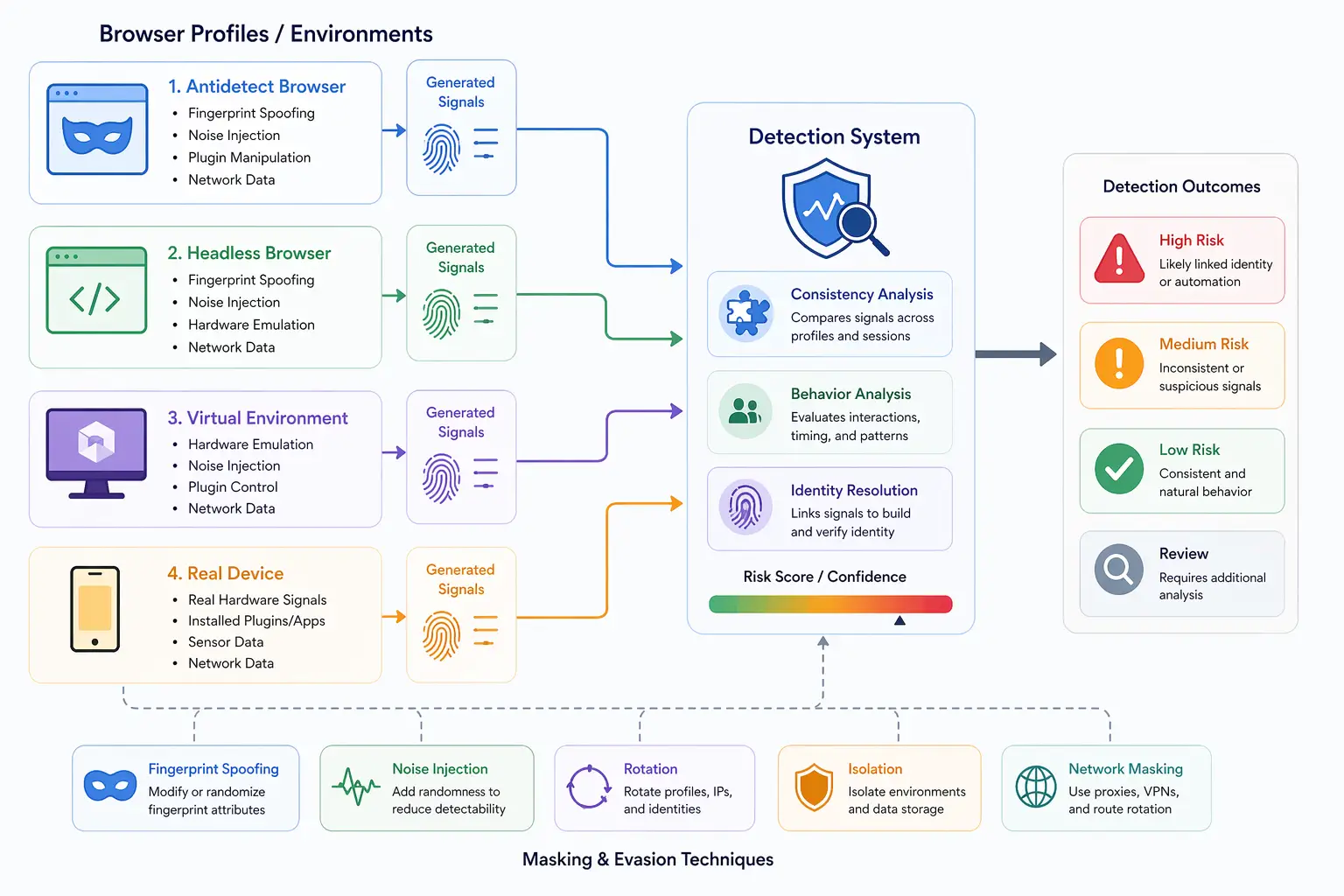
Why Browser Engine Modifications Matter
Browser engine modifications matter because they operate at a deeper level than traditional spoofing techniques. They allow environments to control how signals are generated rather than just modifying outputs.
This reduces the likelihood of mismatches between different layers of the system. For example, if both JavaScript APIs and network requests are controlled by the same logic, consistency is easier to maintain.
However, because these modifications deviate from standard browser behavior, they can introduce detectable patterns.
Challenges in Engine-Level Modifications
Browser engine modifications come with significant technical challenges.
One major challenge is complexity. Modern browser engines are large and constantly evolving, making modifications difficult to maintain.
Another challenge is compatibility. Changes to the engine can affect how websites function, leading to unexpected behavior or errors.
There is also the challenge of detection. Even small deviations from standard engine behavior can be identified by advanced detection systems.
These challenges make engine-level modifications a high-effort approach.
Engine Modifications vs Spoofing
Browser engine modifications and spoofing are often compared, but they differ fundamentally.
Spoofing works by overriding values at runtime, while engine modifications change how those values are generated in the first place.
Engine modifications offer deeper control and potentially better consistency, but they are more complex and harder to implement.
Spoofing is easier to use but more prone to inconsistencies.
Engine Modifications vs Virtual Environments
Virtual environments isolate browser instances but do not change how the browser engine itself works. Engine modifications, on the other hand, alter the core behavior of the browser.
This means that virtual environments provide separation, while engine modifications provide control over behavior.
In practice, both approaches can be combined, but each has its own limitations.
Limitations of Browser Engine Modifications
Despite their advantages, browser engine modifications have several limitations.
One limitation is maintenance. Browser engines are frequently updated, and modifications must be continuously adapted.
Another limitation is detectability. Custom modifications can introduce unique patterns that differ from standard browsers.
There is also the challenge of scalability. Implementing and maintaining modified engines across multiple environments can be resource-intensive.
These limitations make it difficult to rely solely on engine modifications.
Real-Device Approach vs Engine Modifications
A key distinction in modern detection systems is the difference between modifying browser engines and using real devices.
Engine modifications attempt to simulate realistic behavior through code changes, but they may still differ from standard browser implementations.
Real-device approaches use unmodified browsers running on actual hardware, ensuring that behavior matches real-world conditions. Tools like Appilot follow this approach by running automation on real Android devices, eliminating the need for deep engine modifications while maintaining consistency across signals.
This approach aligns more closely with how genuine users interact with the web.
When Browser Engine Modifications Make Sense
Browser engine modifications are useful in scenarios where deep control over browser behavior is required and where resources are available to maintain custom implementations.
They are often used in advanced testing environments and specialized workflows.
However, due to their complexity and maintenance requirements, they are not always practical for general use.
Understanding when to use this approach helps determine its role in a broader strategy.
Frequently Asked Questions
Q: What are browser engine modifications?
They are changes made to the core browser code to control how it behaves and generates fingerprinting signals.
Q: How are engine modifications different from spoofing?
Engine modifications change how values are generated, while spoofing overrides values at runtime.
Q: Are browser engine modifications effective?
They can improve consistency but are complex and may still be detectable.
Q: Why are engine modifications difficult to maintain?
Because browser engines are frequently updated and require continuous adjustments.
Q: Do engine modifications affect website compatibility?
Yes, changes can sometimes break or alter how websites function.
Q: How do real-device solutions compare?
Real-device solutions like Appilot use standard browsers on actual hardware, avoiding the need for custom engine modifications while maintaining natural behavior.
Key Takeaways
Browser engine modifications involve altering the core behavior of a browser to control how fingerprinting signals are generated. This approach provides deeper control and improved consistency compared to simple spoofing, but it comes with significant complexity and maintenance challenges. While it can reduce mismatches across signals, it may still introduce detectable patterns due to deviations from standard browser behavior. As detection systems continue to evolve, understanding the trade-offs between engine-level control and real-world consistency is essential for building effective environments.