Understanding Browser Noise Injection for Anonymity

Most fingerprinting discussions focus on identifying users through stable signals, but another approach attempts to disrupt this process by introducing variability. This method is known as browser noise injection. Instead of presenting a fixed fingerprint, the browser slightly alters its outputs to reduce tracking accuracy.
Understanding browser noise injection is important because it highlights a different strategy for dealing with fingerprinting. Rather than maintaining a consistent identity, it introduces controlled inconsistencies. This guide explains how noise injection works, where it is effective, and what limitations it introduces.
What Is Browser Noise Injection?
Browser noise injection is the process of adding small variations or “noise” to fingerprinting signals so that they do not remain perfectly consistent across sessions. These variations can affect outputs from APIs such as canvas, WebGL, audio processing, and other measurable signals.
The goal is to make it harder for tracking systems to generate a stable fingerprint. Instead of receiving identical outputs each time, systems encounter slight differences that reduce confidence in identification.
Noise injection is commonly used in privacy-focused tools that aim to limit tracking.
The Core Principle Behind Noise Injection
The core principle behind noise injection is disruption. Fingerprinting relies on stable and repeatable signals, so introducing variability reduces reliability.
However, real devices are not entirely random. They exhibit consistent behavior with only minor natural variations. This means that noise must be carefully controlled to avoid appearing artificial.
Detection systems can identify patterns of randomness, which can indicate manipulation.
How Browser Noise Injection Works
Browser noise injection works by modifying how certain APIs generate outputs.
Altering Rendering Outputs
One of the most common methods is adding noise to rendering outputs such as canvas and WebGL. Small changes are introduced to pixel data so that the resulting fingerprint differs slightly each time.
These changes are usually subtle enough to avoid breaking functionality while still affecting fingerprinting.
Modifying Audio Processing Signals
Audio fingerprinting relies on how sound is processed within the browser. Noise injection can introduce slight variations in audio outputs to prevent consistent identification.
This affects how audio APIs return data without significantly impacting user experience.
Adjusting Timing and Performance Data
Some implementations also introduce variability in timing and performance measurements. This can affect how scripts perceive execution speed and system behavior.
These adjustments aim to reduce the accuracy of timing-based fingerprinting methods.
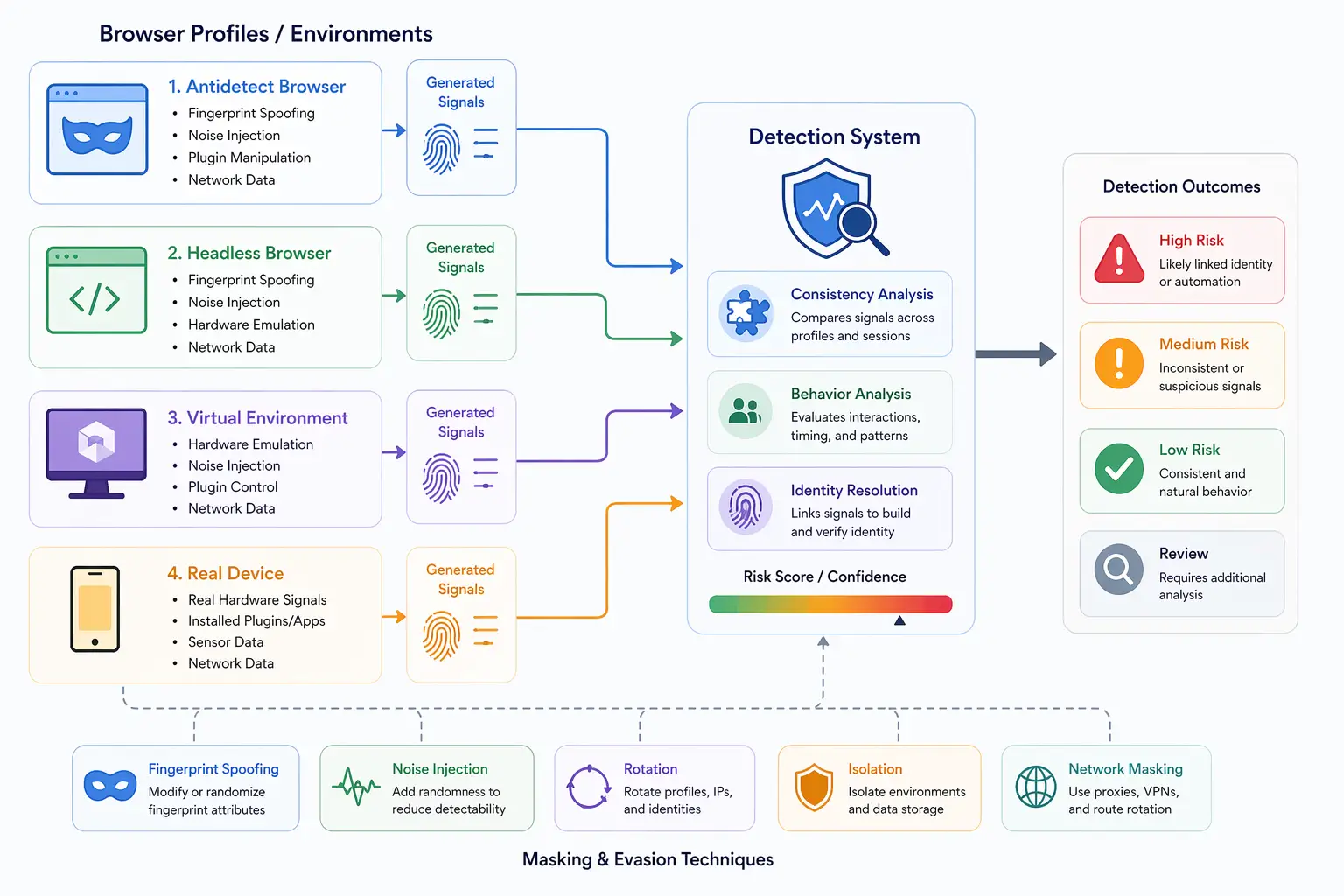
Why Noise Injection Matters
Noise injection matters because it changes the way fingerprinting systems operate. Instead of relying on stable signals, systems must deal with uncertainty.
This can reduce the effectiveness of tracking by making fingerprints less reliable over time. In privacy-focused scenarios, this helps protect user identity.
However, from a detection perspective, noise injection can introduce patterns that appear unnatural. Detection systems can analyze variability to determine whether it is consistent with real-world behavior.
Noise Injection vs Fingerprint Randomization
Noise injection is often compared to fingerprint randomization, but they are not the same.
Noise injection introduces small, controlled variations while maintaining overall consistency. Randomization, on the other hand, can involve larger and more frequent changes.
Noise injection aims to mimic natural variability, while randomization often creates more noticeable differences.
This makes noise injection a more subtle approach, but it still requires careful implementation.
Noise Injection vs Fingerprint Spoofing
Noise injection and spoofing represent different strategies.
Spoofing creates a fixed identity by setting specific values, while noise injection introduces variability to disrupt tracking.
Spoofing focuses on realism and consistency, while noise injection focuses on reducing reliability.
Each approach has its own strengths and limitations depending on the use case.
Limitations of Noise Injection
While noise injection can reduce tracking accuracy, it has several limitations.
One limitation is detectability. If the noise pattern is too consistent or too random, it can be identified as artificial.
Another limitation is partial coverage. Noise injection typically affects specific signals but does not address all aspects of fingerprinting.
There is also the challenge of maintaining functionality. Excessive noise can interfere with normal browser behavior.
These limitations mean that noise injection must be carefully balanced.
Noise Injection vs Real-Device Behavior
A key distinction in modern detection systems is the difference between artificial variability and natural variability.
Noise injection introduces artificial changes, while real devices exhibit natural variations due to hardware and system behavior.
Tools like Appilot operate on real Android devices, where variability occurs naturally without needing to inject noise. This results in signals that are both consistent and realistic.
This difference becomes important in systems that analyze patterns over time.
When Noise Injection Is Useful
Noise injection is useful in scenarios where reducing tracking accuracy is the primary goal.
It is commonly used in privacy-focused browsing environments where maintaining a stable identity is not necessary.
However, it is less suitable for scenarios that require consistent identity or long-term session stability.
Understanding when to use noise injection helps determine its role in a broader strategy.
Frequently Asked Questions
Q: What is browser noise injection?
It is the process of adding small variations to fingerprinting signals to reduce tracking accuracy.
Q: How does noise injection work?
It modifies outputs from APIs such as canvas, WebGL, and audio processing to introduce variability.
Q: Is noise injection effective?
It can reduce tracking accuracy but does not eliminate detection risk.
Q: What is the difference between noise injection and randomization?
Noise injection introduces subtle variations, while randomization involves larger and more frequent changes.
Q: Can noise injection break websites?
If implemented incorrectly, it can affect functionality, but well-designed systems minimize impact.
Q: How do real-device solutions compare?
Real-device solutions like Appilot produce natural variability without artificial noise, making signals more realistic.
Key Takeaways
Browser noise injection is a technique that introduces small variations into fingerprinting signals to reduce tracking accuracy. It works by altering outputs from APIs such as canvas, WebGL, audio processing, and timing measurements. While it can make fingerprints less reliable, it also introduces challenges related to detectability and consistency. Balancing variability with realism is essential, as excessive or unnatural noise can be identified by detection systems. Understanding the trade-offs between noise injection and other approaches helps determine when it is appropriate to use.