Browser Profile Persistence: Maintaining Consistent Fingerprints

Most discussions around fingerprinting focus on how to change or hide identity, but an equally important concept is consistency over time. Modern detection systems do not just analyze a single session; they track behavior across multiple interactions. This is where browser profile persistence becomes critical.
Understanding browser profile persistence is important because it explains why simply modifying fingerprints is not enough. If a profile changes too frequently or behaves inconsistently, it can be flagged as suspicious. This guide explains how profile persistence works, why it matters, and how it is maintained in real-world scenarios.
What Is Browser Profile Persistence?
Browser profile persistence refers to maintaining a stable and consistent identity across multiple sessions. Instead of generating a new fingerprint each time, a persistent profile ensures that the same set of signals is reused over time.
This includes attributes such as user agent, screen resolution, timezone, language, cookies, and storage data. Together, these elements form a profile that behaves like a real user returning to a website.
Persistence is essential because real users do not change their device configuration frequently. Detection systems expect stability, and deviations from this pattern can raise suspicion.
The Core Principle Behind Persistence
The core principle behind browser profile persistence is consistency. Real devices maintain the same characteristics across sessions, with only minor natural variations.
Detection systems rely on this consistency to differentiate between genuine users and synthetic environments. If a profile changes significantly between sessions, it can indicate automation or manipulation.
This means that maintaining a stable fingerprint is often more important than trying to hide it completely.
Why Consistent Fingerprints Matter
Consistent fingerprints matter because they align with real-world behavior. A user returning to a website typically uses the same device, browser, and configuration.
In fraud detection systems, consistency helps establish trust. Profiles that behave predictably over time are less likely to be flagged compared to those that exhibit sudden changes.
From a tracking perspective, consistent fingerprints allow systems to link sessions together. While this may raise privacy concerns, it also highlights why inconsistency can be suspicious.
For developers building automation systems, maintaining consistency is critical. Frequent changes in fingerprinting signals can make the environment appear artificial.
How Browser Profile Persistence Works
Browser profile persistence works by storing and reusing profile data across sessions.
Storing Profile Data
When a profile is created, its configuration is stored. This includes fingerprinting attributes, cookies, local storage, and session data.
This stored data ensures that when the profile is reopened, it resumes from the same state rather than starting fresh.
Reusing Fingerprint Signals
Instead of generating new values, persistent profiles reuse the same fingerprinting signals. This includes values exposed through browser APIs and network requests.
This consistency helps maintain a stable identity that aligns with real user behavior.
Maintaining State Over Time
In addition to static attributes, persistence involves maintaining state. This includes browsing history, session activity, and interaction patterns.
These elements contribute to a more realistic profile and reduce the likelihood of detection.
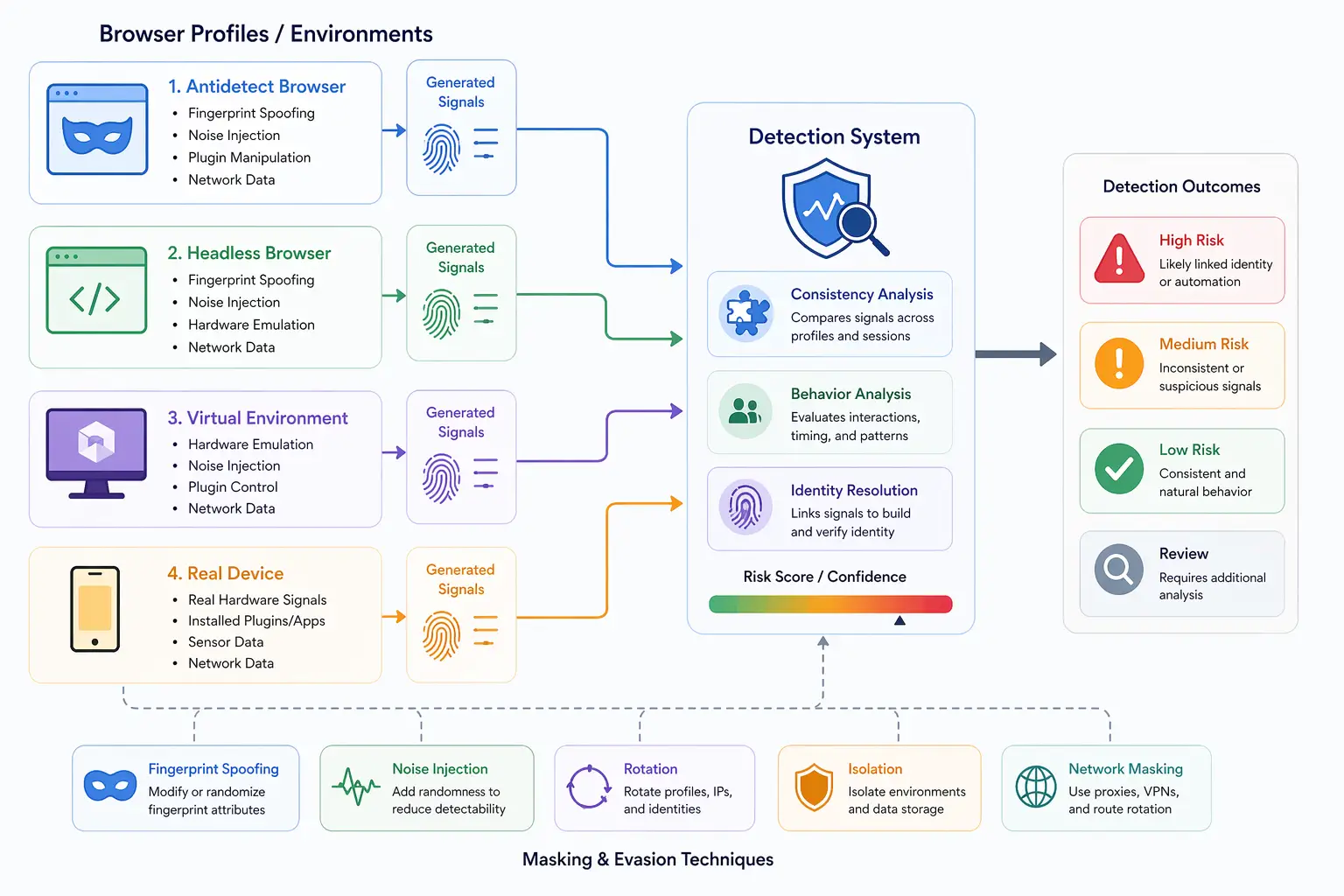
Common Mistakes in Profile Persistence
There are several common mistakes that can undermine profile persistence.
One common issue is changing fingerprint attributes too frequently. While this may seem like a way to avoid tracking, it creates inconsistency that can be easily detected.
Another mistake is failing to maintain alignment across signals. For example, changing the timezone without updating related attributes can create mismatches.
There is also the issue of incomplete persistence, where some data is stored while other elements are reset. This creates gaps that can reveal artificial behavior.
Persistence vs Randomization
Browser profile persistence is often compared to fingerprint randomization, but they serve different purposes.
Persistence focuses on maintaining a stable identity over time, while randomization introduces variability to prevent tracking. In practice, persistence is more aligned with real-world behavior.
Randomization can reduce tracking but often introduces patterns that appear unnatural. Detection systems can identify these patterns, making persistence a more reliable approach in many scenarios.
Persistence vs Spoofing
Persistence and spoofing are closely related but distinct concepts.
Spoofing involves setting specific fingerprint values, while persistence ensures that those values remain consistent over time. Spoofing without persistence can lead to frequent changes, which increases detection risk.
Effective setups combine both approaches, ensuring that spoofed values are realistic and stable across sessions.
Limitations of Browser-Level Persistence
While browser profile persistence is important, it has limitations.
One limitation is that it primarily operates at the browser level. Deeper signals such as hardware behavior, rendering output, and network characteristics may still remain constant across profiles.
Another limitation is that maintaining consistency requires careful configuration. Any mismatch between stored data and real behavior can create detectable inconsistencies.
This highlights the importance of aligning all layers of the environment.
Real-Device Consistency vs Simulated Persistence
There is a key difference between simulated persistence and real-device consistency.
Antidetect browsers simulate persistence by storing and reusing values, but they do not change the underlying hardware or system behavior. This can lead to subtle inconsistencies.
In contrast, real-device approaches naturally maintain persistence because the same physical device is used. Tools like Appilot follow this approach by running automation on real Android devices, where fingerprints remain consistent without artificial manipulation.
This difference becomes increasingly important in advanced detection systems.
When Profile Persistence Is Critical
Browser profile persistence becomes critical in scenarios where long-term consistency is required.
It is essential for workflows that involve repeated interactions with the same platform, where maintaining a stable identity is necessary.
It is also important in environments where detection systems analyze behavior over time rather than in isolated sessions.
Understanding when persistence matters helps determine how to configure profiles effectively.
Frequently Asked Questions
Q: What is browser profile persistence?
It is the practice of maintaining consistent fingerprinting signals and data across multiple sessions.
Q: Why is consistency important in fingerprinting?
Because real users maintain stable configurations, and inconsistencies can indicate artificial behavior.
Q: Is persistence better than randomization?
Persistence is more aligned with real-world behavior, while randomization can appear unnatural if not implemented carefully.
Q: Can persistence prevent detection?
It reduces detection risk but does not eliminate it, especially if other signals are inconsistent.
Q: How is persistence implemented in antidetect browsers?
By storing profile data and reusing the same fingerprinting signals across sessions.
Q: How do real-device solutions compare to persistence?
Real-device solutions like Appilot naturally maintain consistent fingerprints without relying on simulated storage and reuse.
Key Takeaways
Browser profile persistence is the practice of maintaining a stable and consistent fingerprint across sessions, ensuring that a browsing profile behaves like a real returning user. It works by storing and reusing fingerprinting signals, session data, and configuration over time. Consistency is a key factor in avoiding detection, as modern systems analyze behavior across multiple sessions. While persistence improves realism, it must be combined with proper configuration and alignment across all signals to be effective. As detection systems become more advanced, understanding the difference between simulated persistence and real-device consistency becomes increasingly important.