How to Build Stable Automation Environments with Mobile Proxy Infrastructure
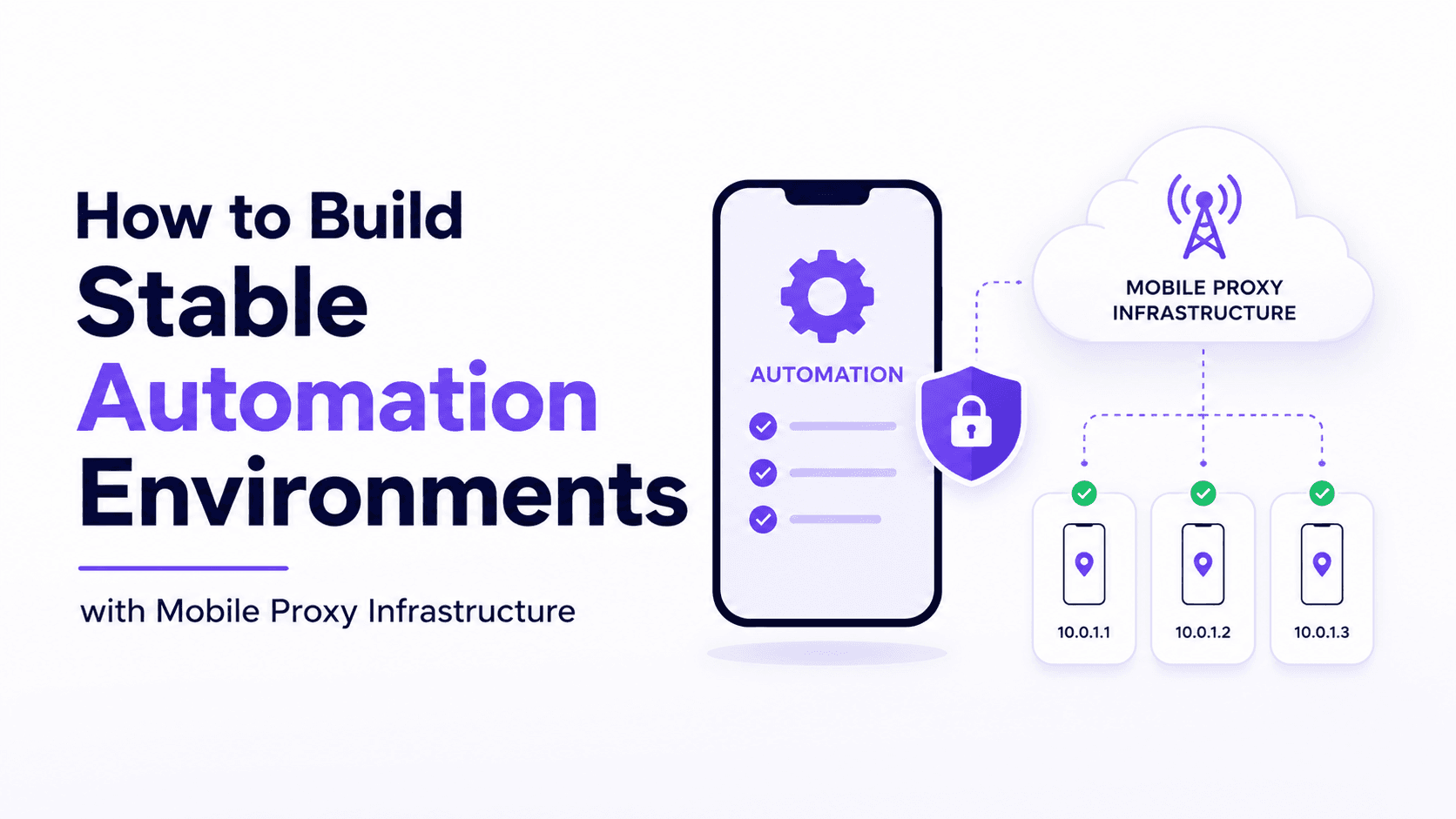
A few years ago, most automation problems looked relatively predictable.
If workflows started failing, teams usually searched for obvious causes: browser fingerprints, request timing, account quality, proxy rotation frequency, or action limits. In many environments, scaling was treated almost like a technical race — faster execution, larger account volumes, more concurrency, more aggressive rotation strategies.
And for a while, that approach actually worked.
But the automation ecosystem in 2026 behaves very differently from the environments many teams were used to several years ago.
Today, platforms rarely evaluate isolated actions alone. Instead, they observe how the entire environment behaves over time. Session continuity, infrastructure consistency, geographic stability, traffic reputation, browser-network alignment, and long-term behavioral patterns now influence whether workflows remain operational far more than many automation teams initially expected.
This is one of the biggest reasons why some systems that appear technically “correct” still become unstable surprisingly quickly.
The issue often has very little to do with automation logic itself.
In many cases, instability begins much deeper — at the infrastructure layer.
And over the last two years, that realization quietly changed the way experienced teams approach automation architecture altogether.
Why modern automation environments fail more often despite “better” tooling
One of the more frustrating shifts in recent years is that workflows can now begin deteriorating even when teams improve their automation stack.
Browsers became more advanced. Fingerprinting environments became more sophisticated. Device emulation improved significantly. Automation frameworks evolved rapidly. Yet despite all of this, many long-running systems started experiencing shorter operational lifespans than before.
At first, this seemed contradictory.
But eventually, many teams started noticing a pattern: the instability often wasn’t coming from the visible automation layer at all.
It was coming from environmental inconsistency.
Modern platforms continuously compare dozens of surrounding signals simultaneously. Browser behavior alone is no longer enough to create a believable environment if the infrastructure surrounding the session behaves unnaturally over time.
And this is exactly where many automation environments slowly begin breaking apart.
A session may look normal at the browser level while the surrounding network environment constantly changes regions, rotates through overcrowded IP ranges, accumulates poor traffic reputation, or generates conflicting geographic behavior. Individually, these inconsistencies may appear relatively minor. Together, however, they gradually create an environment that platforms begin treating with increasing caution.
This usually does not happen instantly.
Instead, workflows slowly become “heavier” operationally:
more verification pressure
weaker session persistence
inconsistent account stability
degraded reliability over time
rising friction across browser environments
Many teams initially try solving these problems by modifying browser behavior again. But increasingly, the underlying issue exists at the infrastructure level itself.
Why infrastructure quality became part of automation architecture
Several years ago, proxies were often treated as interchangeable technical resources.
In many automation communities, discussions revolved almost entirely around volume: larger pools, faster rotation, lower pricing, broader geographic coverage. The assumption was that infrastructure simply existed to distribute requests.
That assumption no longer reflects how modern environments behave.
In 2026, infrastructure quality directly influences how platforms interpret browser sessions themselves. Traffic reputation, environmental consistency, geographic continuity, and network behavior became deeply interconnected with automation stability.
This is one of the reasons why mobile proxy infrastructure gradually became much more important across modern automation ecosystems.
Unlike traditional datacenter environments, mobile carrier networks naturally produce traffic behavior that resembles ordinary user activity much more closely. Real mobile users constantly transition between network states, towers, and IP assignments as part of completely normal device behavior.
Modern platforms already expect these kinds of environmental variations inside mobile ecosystems.
That distinction matters more than many people realize.
The goal is no longer simply to “hide automation.” Mature systems increasingly focus on reducing environmental contradictions altogether. The fewer inconsistencies platforms observe between browser behavior, network activity, geography, and session continuity, the more stable workflows tend to remain over long periods of time.
And in practice, mobile infrastructure often aligns with those expectations far more naturally than heavily shared datacenter ecosystems.
Why long-running workflows depend on environmental continuity
One of the clearest industry shifts over the last few years is that long-term session stability became significantly more valuable than aggressive short-term scaling.
This is especially visible inside workflows operating continuously for days or weeks.
Once platforms begin accumulating behavioral history around sessions, environmental inconsistency becomes much easier to detect. Sudden regional shifts, unstable traffic patterns, contradictory network behavior, and fragmented infrastructure gradually create sessions that stop looking operationally believable over time.
And modern systems remember far more context than many automation teams assume.
This is why workflows that initially perform well can slowly degrade weeks later despite using the same automation logic. The environment surrounding the sessions accumulates instability faster than the browser layer itself can compensate for it.
As a result, many experienced teams quietly changed their operational priorities.
Today, far more attention goes toward:
session continuity
infrastructure stability
geographic consistency
traffic reputation
predictable environmental behavior
Because sustainable automation increasingly depends less on isolated browser actions and far more on whether the surrounding ecosystem behaves coherently over time.
Why realistic environments now outperform aggressive scaling
One of the more interesting realities of the current automation landscape is that smaller but well-structured systems frequently outperform larger unstable environments.
Several years ago, many workflows were built almost entirely around volume. More accounts, faster scaling, larger proxy pools, heavier concurrency.
But modern anti-bot systems evolved alongside those strategies.
Today, platforms increasingly evaluate whether environments behave naturally rather than simply how much activity they generate. Infrastructure fragmentation itself became one of the strongest sources of operational instability across long-running automation systems.
And because of this, realistic environments became significantly more valuable than pure scale.
This is also why real-device ecosystems and mobile infrastructure gained so much attention across automation communities recently. Platforms increasingly compare browser behavior against expected device conditions, connection patterns, environmental continuity, and surrounding network reputation simultaneously.
Once those layers stop aligning naturally, stability usually begins deteriorating — sometimes gradually, sometimes very quickly.
At that point, infrastructure quality stops being a secondary technical detail and becomes part of workflow architecture itself.
Why mobile proxy infrastructure became part of stable automation ecosystems
The growing role of mobile proxies in automation environments is not really about bypassing platforms.
It is about building infrastructure that creates fewer environmental contradictions over time.
This is one of the reasons why providers focused on mobile proxy ecosystems, such as Coronium.io, became integrated into long-running automation workflows where operational continuity matters more than short-term scaling spikes.
The conversation inside experienced automation teams increasingly shifted away from:
“How many proxies can we rotate?”
toward questions like:
how stable is the environment?
how believable is session continuity?
how naturally does the traffic behave?
how much verification pressure does the infrastructure generate over time?
And in 2026, those questions often determine whether automation environments remain sustainable at all.
Final thoughts
Modern automation environments became dramatically more sensitive to infrastructure quality than they were only a few years ago.
Today, platforms evaluate browser behavior, traffic reputation, geographic consistency, environmental continuity, and network stability simultaneously. Because of this, workflow reliability increasingly depends not only on automation logic itself, but on how naturally the surrounding environment behaves over time.
This is exactly why mobile proxy infrastructure became such an important part of stable automation architecture in 2026.
Not because it “defeats” modern detection systems, but because stable environments increasingly rely on infrastructure that behaves consistently, predictably, and naturally inside modern traffic ecosystems.
Some teams building long-running automation environments use mobile proxy infrastructure from Coronium.io for these types of workflows. New users can also use promo code START15 to receive 15% off their first order.