What Is Challenge-Response Authentication? (Beyond CAPTCHA)

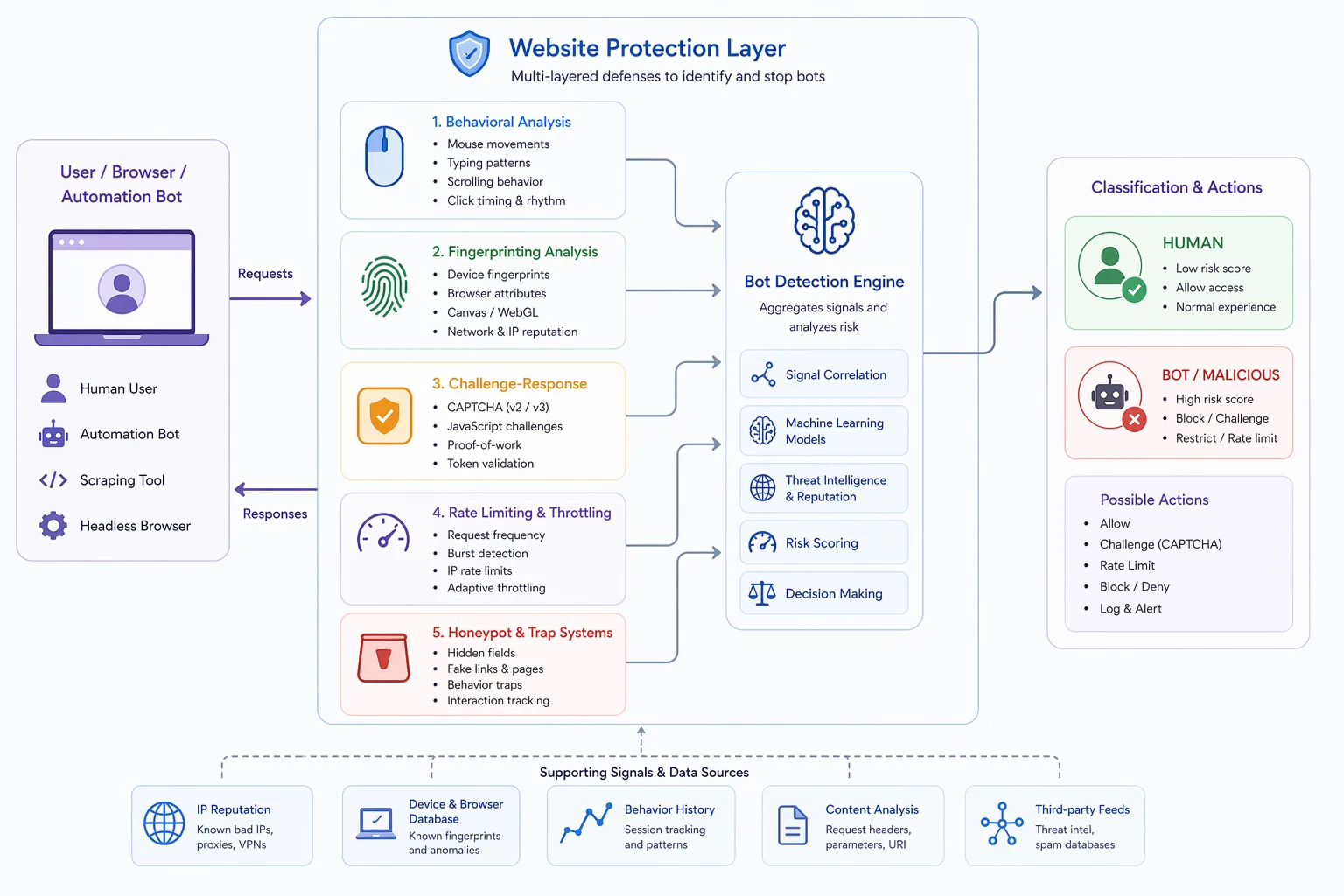
As bot detection systems become more sophisticated, simple verification methods like traditional CAPTCHAs are no longer sufficient on their own. Websites now rely on more advanced mechanisms to verify users without always interrupting their experience. One of these mechanisms is challenge-response authentication.
Unlike visible challenges that require direct user input, challenge-response systems can operate in the background, testing whether a client behaves like a real user environment. This makes them a powerful tool for detecting automation while minimizing friction. This guide explains how challenge-response authentication works and how it goes beyond CAPTCHA.
What Is Challenge-Response Authentication?
Challenge-response authentication is a method where a system sends a test, or challenge, to a client and evaluates the response to determine whether the client is legitimate.
The challenge can take many forms, including executing JavaScript, solving computational tasks, or responding to behavioral prompts. The response is then analyzed to assess authenticity.
The key idea is not just whether the challenge is completed, but how it is completed.
The Core Principle Behind Challenge-Response Systems
The core principle behind challenge-response authentication is verification through interaction. Instead of trusting static signals, the system actively tests the client.
These tests are designed to reveal differences between real users and automated systems. Real environments respond naturally and consistently, while automated setups may produce incomplete or inconsistent responses.
This dynamic approach improves detection accuracy.
How Challenge-Response Authentication Works
Challenge-response systems operate by issuing tests and analyzing responses in real time.
JavaScript Execution Challenges
One of the most common forms of challenge-response is JavaScript execution.
The system sends scripts that probe browser capabilities, timing, and environment behavior. These scripts check for inconsistencies that may indicate automation.
Computational Challenges
Some systems require the client to perform lightweight computations.
These tasks are easy for real devices but can reveal limitations in automated or constrained environments.
The response time and accuracy are analyzed.
Behavioral Challenges
Behavioral challenges involve observing how users respond to prompts or interact with elements.
This may include clicking, scrolling, or navigating in a way that reflects human behavior.
The system evaluates the interaction patterns.
Cryptographic or Token-Based Challenges
In some cases, challenge-response involves generating and validating tokens.
The client must produce a valid response based on a secret or algorithm. This ensures that the interaction comes from a legitimate environment.
Why Challenge-Response Authentication Matters
Challenge-response authentication is important because it provides a dynamic way to verify users.
Unlike static checks, it actively tests the client’s capabilities and behavior.
This makes it more effective against bots that attempt to mimic browser properties but cannot fully replicate real-world behavior.
It also allows websites to reduce reliance on intrusive challenges.
Challenge-Response vs CAPTCHA
CAPTCHA is a specific type of challenge-response mechanism, but not all challenge-response systems are CAPTCHAs.
Traditional CAPTCHAs require visible user interaction, such as solving puzzles or identifying images.
Challenge-response systems can operate invisibly, using background checks and behavioral analysis.
This reduces friction while maintaining security.
Common Use Cases of Challenge-Response Systems
Challenge-response authentication is widely used in modern web security.
It is applied in login systems, form submissions, and API protection.
It is also used in bot management platforms to verify traffic before allowing access.
These use cases highlight its flexibility.
Limitations of Challenge-Response Authentication
Despite its advantages, challenge-response authentication has limitations.
False positives can occur, especially when legitimate users fail challenges due to device limitations or network conditions.
There is also the challenge of complexity, as designing effective challenges requires careful balance.
Additionally, advanced automation may attempt to mimic responses.
These limitations require continuous improvement.
Challenge-Response vs Static Detection Methods
Challenge-response differs from static detection methods in its dynamic nature.
Static methods rely on fixed signals such as IP or fingerprints, while challenge-response actively tests the client.
This makes it more adaptive and harder to bypass.
However, it also increases system complexity.
Challenge-Response vs Real-Device Environments
A key distinction in modern detection is the difference between simulated environments and real-device environments.
Challenge-response systems are designed to expose inconsistencies in simulated setups, even if static signals appear correct.
Real-device approaches operate on actual hardware where responses naturally align with expected behavior. Tools like Appilot follow this approach by running automation on real Android devices, where JavaScript execution, input handling, and system responses reflect real-world usage.
This reduces reliance on solving or bypassing challenges.
When Challenge-Response Is Most Effective
Challenge-response authentication is most effective in scenarios where verification is critical.
This includes authentication flows, sensitive transactions, and high-risk interactions.
In these contexts, actively testing the client provides strong assurance of legitimacy.
Understanding this helps in applying the right level of verification.
Frequently Asked Questions
Q: What is challenge-response authentication?
It is a method where a system sends a test and evaluates the response to verify users.
Q: How is it different from CAPTCHA?
CAPTCHA is a type of challenge-response, but challenge-response can also operate invisibly.
Q: What types of challenges are used?
JavaScript execution, computation, behavioral prompts, and token-based challenges.
Q: Why is it effective against bots?
Because it actively tests the client rather than relying on static signals.
Q: Can it be bypassed completely?
No, detection risk can be reduced but not eliminated.
Q: How do real-device solutions compare?
Real-device solutions like Appilot naturally respond to challenges in a consistent way, reducing reliance on simulation.
Key Takeaways
Challenge-response authentication is a dynamic method of verifying users by issuing tests and analyzing responses. It goes beyond traditional CAPTCHAs by operating in the background and evaluating behavior, execution, and computation. This approach makes it more effective against modern bots while reducing friction for real users. While it has limitations, it remains a key component of advanced bot detection systems.