Che Browser and Appilot Integration Guide
Che Browser is designed for users who need separate browser profiles, different fingerprints, isolated sessions, and better account separation. This makes it useful for social media management, e-commerce operations, affiliate marketing, web scraping, and multi-account workflows.
Managing a few Che Browser profiles manually is usually not difficult. You can open a profile, complete a task, close the session, and move on. But once you start handling dozens of profiles, the process becomes much harder to manage.
You begin dealing with repeated actions, missed schedules, profile confusion, and constant switching between browser windows. This is where Appilot becomes useful.
Appilot helps you manage Che Browser profiles from one centralized dashboard so you can organize workflows, assign schedules, and monitor browser activity more efficiently.
Why Use Che Browser with Appilot
Che Browser is useful because it helps separate browser fingerprints, cookies, proxies, and sessions across multiple accounts.
This helps reduce the chances of account overlap and makes it easier to manage different browser identities.
But profile separation alone is not enough when you are managing large numbers of accounts.
You also need a way to schedule workflows, organize browser profiles, manage timing, and monitor activity without manually opening every profile one by one.
Appilot helps solve this problem by acting as the management layer above Che Browser.
Instead of relying on spreadsheets, reminders, or manual browser sessions, you can manage everything from one place.
How the Che Browser and Appilot Integration Works
The integration process is usually simple.
First, you create or import your browser profiles inside Che Browser. Each profile can have its own fingerprint, proxy, cookies, session data, and account information.
Once the profiles are ready, you can connect them to Appilot for workflow management.
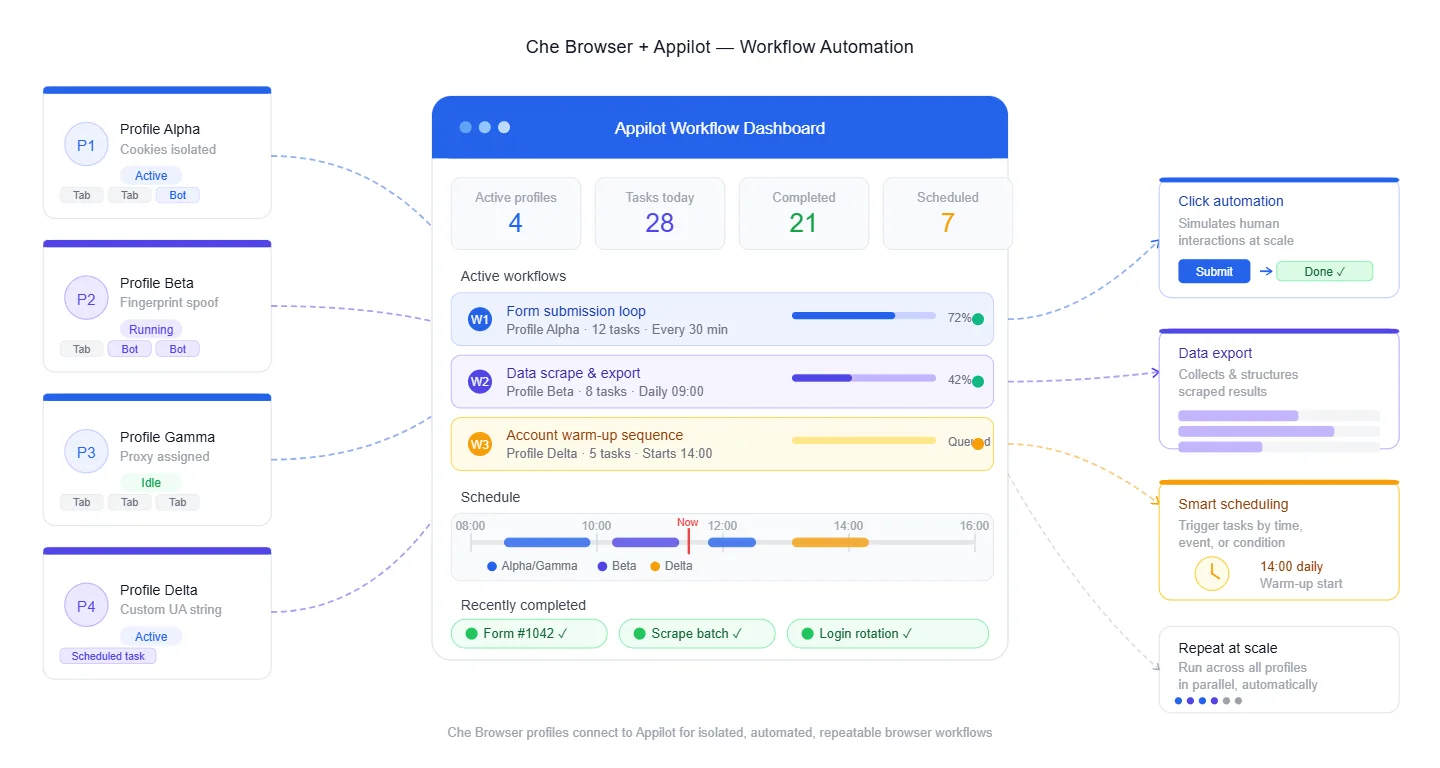
Inside Appilot, you can organize profiles into groups, assign schedules, create reusable workflows, and monitor profile performance.
For example, you may have one profile group for Facebook accounts, another for e-commerce monitoring, another for affiliate campaigns, and another for scraping tasks.
Each group can have its own workflow, timing rules, and activity patterns.
This makes it much easier to manage large numbers of browser profiles without constantly switching between browser windows.
Benefits of Connecting Che Browser to Appilot
One major benefit is better profile organization.
When you are managing many browser profiles manually, it becomes easy to lose track of which account belongs to which task. Appilot makes this easier by allowing you to organize profiles into groups based on campaign, account type, region, or workflow.
Another major benefit is scheduling.
Instead of launching tasks manually every day, you can schedule browser actions to happen automatically. One profile group might run in the morning, another in the afternoon, and another at night.
This saves time and also makes browser behavior appear more natural.
Appilot also makes it easier to reuse workflows.
For example, if you have one workflow for account warmups, another for scraping, and another for e-commerce monitoring, you can apply those workflows across multiple Che Browser profiles without rebuilding them every time.
Monitoring is another major advantage.
Instead of opening multiple browser windows to check activity, you can review workflow performance, failed tasks, proxy issues, and profile health from one dashboard.
Best Practices for Managing Che Browser Profiles
One of the most important rules is to keep your browser profiles organized.
You should use clear naming conventions so it is easy to understand which profile belongs to which workflow.
For example, a profile named US-Facebook-Account-01 is much easier to understand than Browser-01.
You should also avoid running every browser profile at the exact same time. Repetitive timing patterns can make activity look suspicious.
Instead, spread tasks across different time windows and use random delays between actions.
It is also important to keep proxy settings stable. If a profile constantly changes IP addresses or locations, it can create login issues and security warnings.
You should also review profile health regularly because cookies expire, sessions log out, and browser settings change over time.
Finally, start with a small number of profiles before scaling. It is much easier to test workflows with five profiles than with fifty.
Common Mistakes to Avoid
One common mistake is giving profiles vague names. If you have dozens of profiles called Browser-1, Browser-2, and Browser-3, it becomes difficult to understand which accounts belong to which workflows.
Another mistake is using the same proxy across too many profiles. Sharing one IP address across a large number of accounts can increase the risk of detection.
Some people also make the mistake of scaling too quickly. They create too many profiles, assign too many workflows, and run everything at once before testing properly.
Running identical schedules across every profile is another major issue. If every browser profile performs the same action at the exact same time, the behavior becomes much easier to detect.
The best approach is to stay organized, build simple workflows first, and scale gradually as your setup becomes more stable.
Frequently Asked Questions
Q1: Why should I connect Che Browser with Appilot?
Connecting Che Browser with Appilot makes it easier to manage browser profiles, schedule workflows, organize tasks, and monitor profile activity from one dashboard.
Q2: Can Appilot manage multiple Che Browser profiles at once?
Yes. Appilot can help organize and manage large numbers of Che Browser profiles more efficiently than manual methods.
Q3: Can I schedule browser tasks across Che Browser profiles?
Yes. Appilot allows you to create schedules, assign workflows, and run browser tasks automatically across different profile groups.
Q4: Why is profile organization important?
Profile organization makes it easier to assign workflows, manage proxies, reduce confusion, and avoid mistakes.
Q5: What is the biggest mistake when managing Che Browser profiles?
The biggest mistake is poor organization. Without clear naming rules, schedules, and proxy assignments, browser profile management becomes much harder.
Conclusion
Che Browser is useful for creating separate browser identities, but managing large numbers of profiles manually becomes difficult very quickly.
Appilot helps solve this problem by giving you one centralized dashboard where you can organize profiles, assign workflows, create schedules, and monitor activity.
The best approach is to stay organized, avoid repetitive behavior patterns, and scale gradually as your browser setup becomes more stable.