Client-Side Bot Detection: JavaScript Techniques
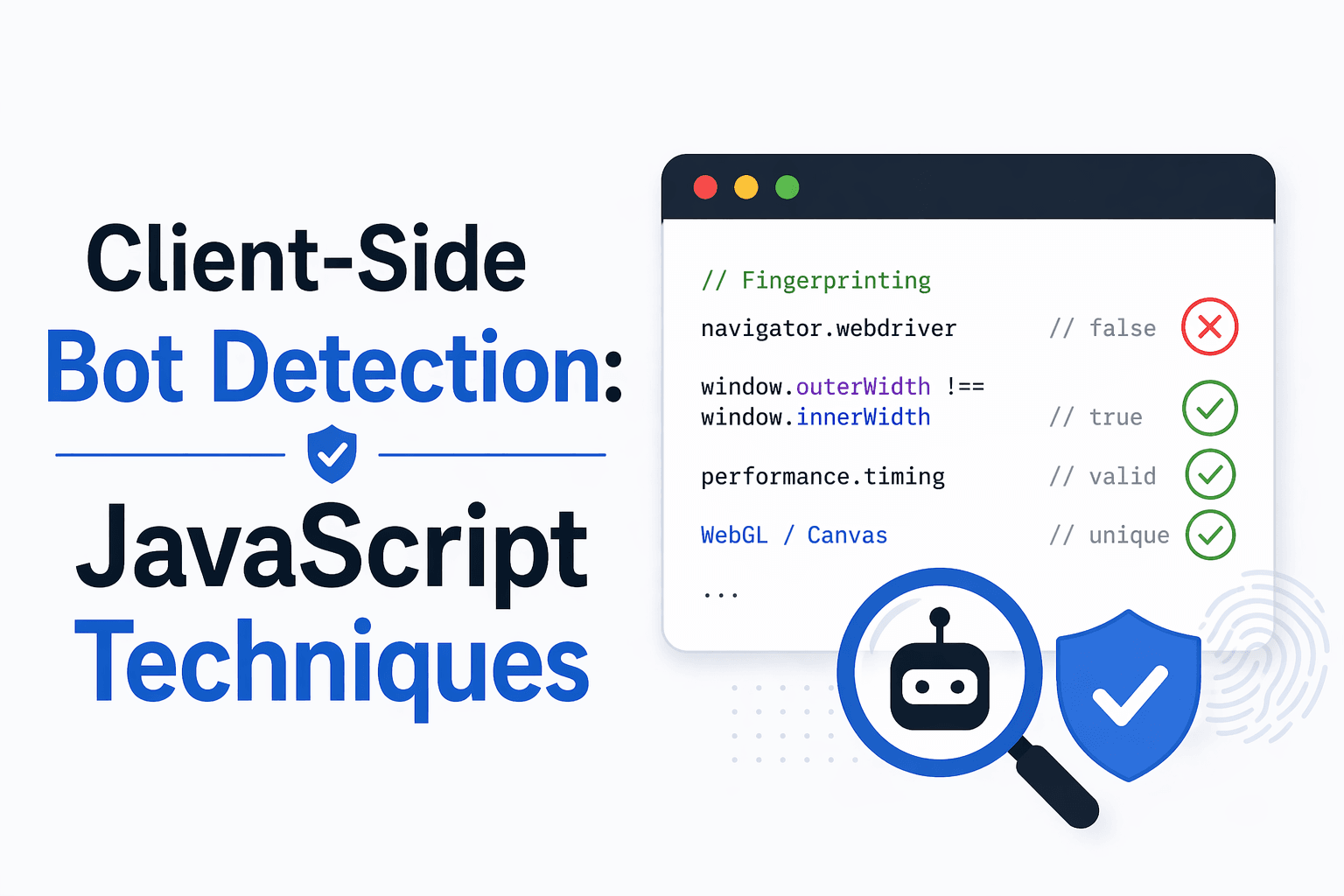
Modern bot detection systems increasingly rely on client-side techniques to identify automated traffic. Instead of analyzing requests only on the server, websites execute JavaScript directly in the browser to observe how the environment behaves in real time. This approach allows detection systems to gather richer data and identify inconsistencies that are difficult to fake.
Understanding client-side bot detection is important because it forms the foundation of many modern anti-bot systems. This guide explains how JavaScript is used to detect automation and why these techniques are effective.
What Is Client-Side Bot Detection?
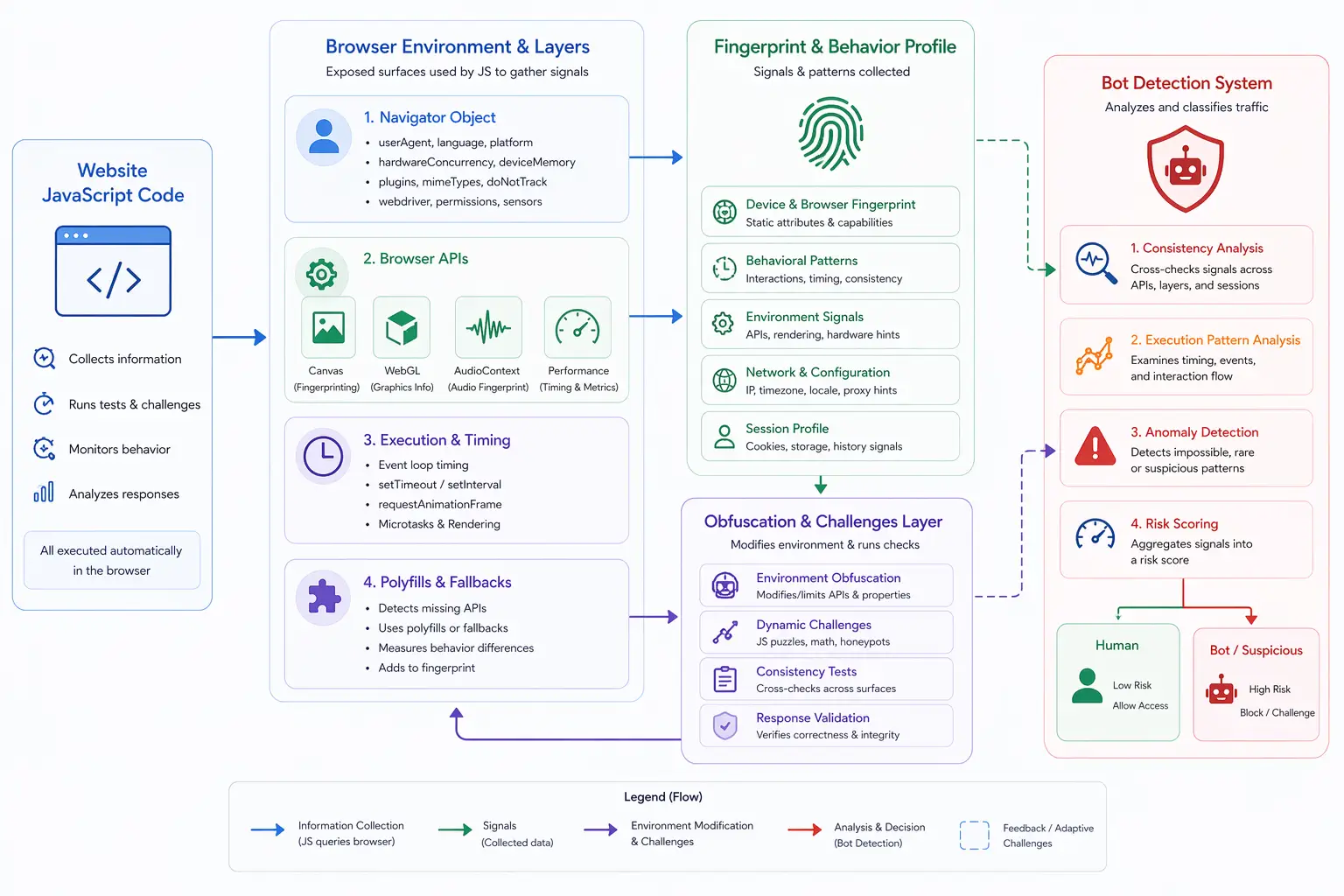
Client-side bot detection refers to the use of JavaScript executed in the browser to analyze and identify whether a user is human or automated, where instead of relying solely on server-side logs or network data, the website actively interacts with the browser environment to collect signals. These signals include API behavior, execution patterns, and interaction responses, all of which help determine whether the environment matches that of a real user. Because this process happens within the browser, it provides deeper visibility into how the system operates.
The Core Idea Behind JavaScript-Based Detection
The core idea behind JavaScript-based detection is verification through behavior, where rather than trusting reported values, the system observes how the browser executes code and responds to conditions. This allows detection systems to identify discrepancies between expected and actual behavior, which are often indicative of automation. By focusing on execution rather than static data, these techniques become more resistant to simple spoofing.
How JavaScript Detects Bots
JavaScript detects bots by running scripts that test different aspects of the browser environment and analyzing the results, where these scripts can access APIs, measure execution timing, and simulate interactions to evaluate authenticity. The collected data is then compared against known patterns of real users, and any deviations are flagged as potential automation. This process can occur continuously during a session, allowing detection systems to adapt in real time.
Common JavaScript Detection Techniques
JavaScript-based detection uses a variety of techniques to identify automation, where one approach involves checking browser APIs such as navigator, Canvas, WebGL, and Audio to ensure they behave consistently with real devices, while another technique analyzes execution timing using the Performance API to detect unrealistic speed or consistency. Interaction-based checks, such as monitoring mouse movements and keystrokes, help verify human behavior, and environment checks look for signs of automation frameworks, such as specific properties or missing features. These techniques are often combined to create a comprehensive detection strategy.
Why Client-Side Detection Is Effective
Client-side detection is effective because it operates directly within the browser, where it can observe real-time behavior that is difficult to replicate in automated environments. Unlike server-side detection, which relies on external signals, client-side techniques can access internal browser data and execution patterns. This makes it harder for bots to mimic real users without fully replicating the entire environment.
Client-Side Detection vs Server-Side Detection
Client-side detection focuses on browser behavior and execution, while server-side detection analyzes network requests, IP addresses, and traffic patterns. Both approaches provide different perspectives, and combining them creates a more robust detection system. Client-side techniques are particularly useful for identifying subtle inconsistencies that are not visible at the network level.
Client-Side Detection and Fingerprinting
Client-side detection is closely tied to fingerprinting because it relies on collecting data from browser APIs and combining it into a profile, where fingerprinting provides the baseline identity and detection techniques validate that identity through behavior. Together, they form a powerful system for identifying users and detecting automation.
Limitations of Client-Side Detection
Despite its effectiveness, client-side detection has limitations because it depends on JavaScript execution and browser capabilities, where users with restricted environments or disabled JavaScript may not provide complete data. Additionally, advanced automation tools may attempt to replicate real browser behavior more closely, reducing the effectiveness of simple checks. Detection systems must continuously evolve to address these challenges.
Client-Side Detection vs Real-Device Environments
A key distinction in modern detection is the difference between simulated environments and real-device environments, where client-side detection often reveals inconsistencies in setups that attempt to mimic real browsers through modification or spoofing. Simulated environments may struggle to maintain consistency across APIs, execution timing, and interaction behavior. Real-device approaches operate on actual hardware where all signals naturally align, and tools like Appilot follow this approach by running automation on real Android devices, ensuring that JavaScript-based detection checks produce results consistent with real-world usage. This reduces the likelihood of detection due to mismatched signals.
When Client-Side Detection Is Most Critical
Client-side detection is most critical in scenarios where accurate identification of users is required, such as login systems, payment platforms, and high-security applications, where distinguishing between human users and automated traffic is essential. In these contexts, JavaScript techniques provide a reliable way to validate browser behavior.
Frequently Asked Questions
Q: What is client-side bot detection?
It is detecting bots using JavaScript executed in the browser.
Q: What does it analyze?
Browser APIs, execution timing, and interaction behavior.
Q: Why is it effective?
Because it observes real-time behavior inside the browser.
Q: Is it used alone?
No, it is combined with server-side detection.
Q: Can bots bypass it?
Advanced bots can, but inconsistencies are often detected.
Q: How do real-device solutions compare?
Real-device solutions like Appilot produce consistent browser behavior, reducing detection risk.
Key Takeaways
Client-side bot detection uses JavaScript to analyze browser behavior, API responses, and execution patterns in real time, making it a powerful tool for identifying automation. By focusing on how the browser behaves rather than what it reports, these techniques are more resistant to spoofing and can detect subtle inconsistencies. While effective, they have limitations and are most powerful when combined with server-side detection and fingerprinting methods.