Clients Won’t Pay More Despite Your Efficiency? Here’s Why (And How to Fix It)
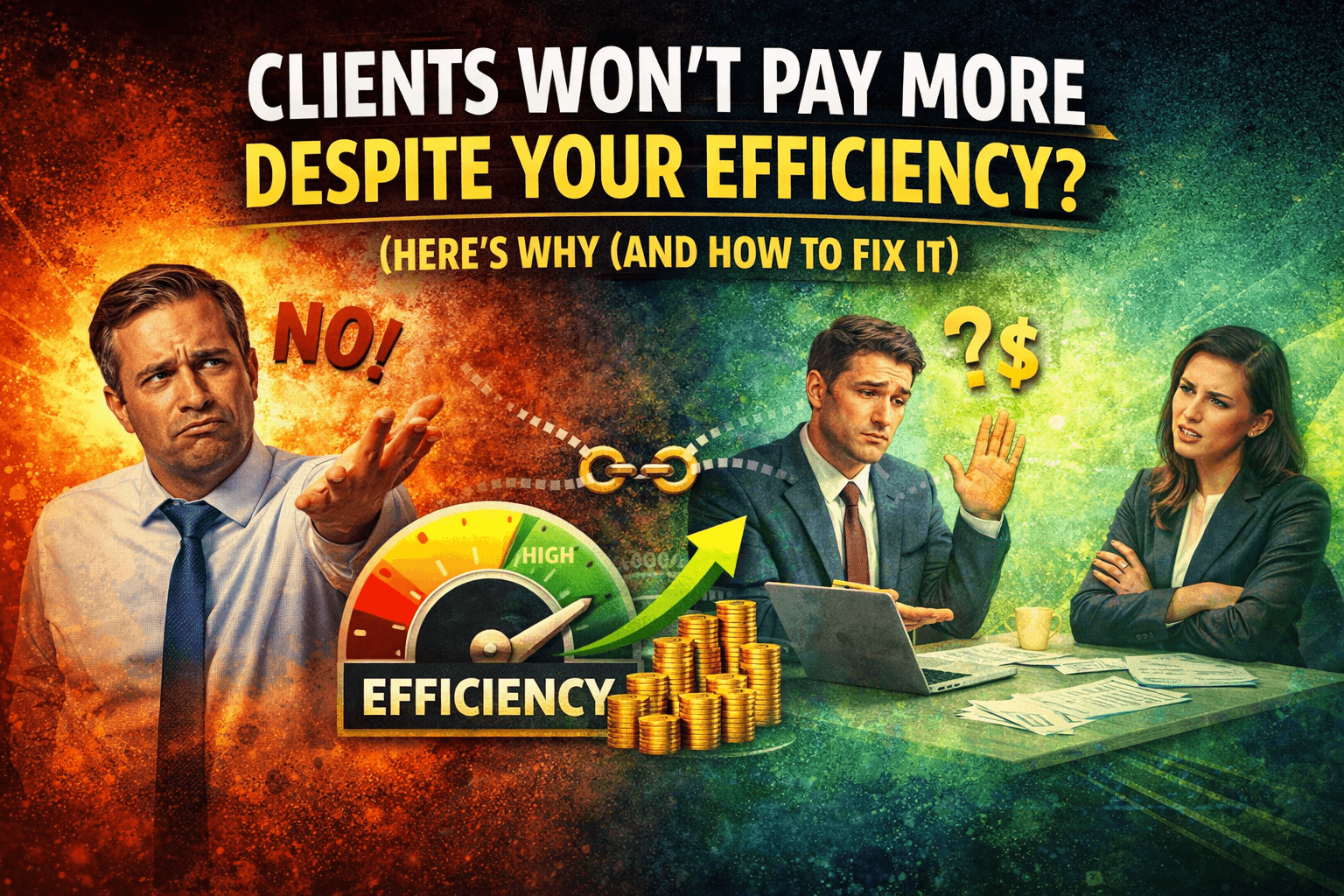
You’re Doing More… Faster… But Getting Paid the Same
You improved your system. Tasks that used to take hours now take minutes. Workflows are smoother, delivery is faster, and your overall efficiency has increased significantly.
Naturally, you expect this to translate into higher pricing.
But it doesn’t.
Clients still push back on price increases. They still negotiate. They still compare you to cheaper alternatives. And in many cases, they expect faster delivery without paying more for it.
This is where frustration builds. You’ve improved your operation, but your revenue hasn’t caught up.
The problem is not your efficiency. The problem is how that efficiency is perceived.
Why Efficiency Doesn’t Increase Your Price
The biggest misconception is that working faster automatically makes your service more valuable.
From your perspective, efficiency is an upgrade. From the client’s perspective, it often looks like the opposite.
If something takes you less time, clients assume it is easier. If it is easier, they assume it should cost less, not more.
This creates a disconnect where:
You see optimization
They see reduced effort
And pricing is almost always tied to perceived effort unless you change the narrative.
The Hidden Problem: You’re Selling Work, Not Outcomes
If clients are paying based on time, tasks, or deliverables, then efficiency will never increase your income.
Because the more efficient you become, the less “work” it appears you are doing.
This is the core issue.
You are being paid for:
Posts
Tasks
Hours
Actions
Instead of:
Results
Growth
Revenue impact
Business outcomes
As long as your pricing is tied to activity, efficiency will reduce your perceived value.
What Clients Actually Pay More For
Clients do not pay more for speed. They pay more for certainty.
They pay when they feel:
Results are predictable
Systems are reliable
Outcomes are consistent
Risk is reduced
Efficiency only matters if it contributes to these things.
Otherwise, it is invisible.
The Real Reason They Won’t Pay More
It comes down to one thing:
Your efficiency is internal, but your pricing is external.
Clients don’t see:
Your systems
Your automation
Your optimization
They only see:
What they get
How it affects them
If that hasn’t changed, your price won’t change either.
The Fix: Shift from Effort-Based Pricing to Outcome-Based Pricing
The only way to increase pricing is to change what you are selling.
Instead of selling tasks, you need to sell outcomes.
For example:
Instead of:
“We post 30 times per month”
You move to:
“We ensure consistent growth and visibility”
Instead of:
“We manage your accounts”
You move to:
“We deliver predictable performance and engagement”
This shifts the conversation from work to results.
Step-by-Step: How to Actually Charge More
First, you redefine your deliverables.
You stop listing tasks and start framing outcomes. Clients should understand what changes for them, not what you do.
Second, you make your work visible.
If your system is efficient but invisible, it has no pricing power. You need to show consistency, activity, and progress in a way clients can see.
Third, you connect your work to business impact.
Even if you are not directly responsible for revenue, you can connect your work to:
Leads
Reach
Engagement
Growth trends
Fourth, you remove time from the equation.
The less your pricing is tied to hours or tasks, the more room you have to increase it.
Where Most Teams Get Stuck
Most teams try to increase prices without changing positioning.
They say:
“We’re more efficient now”
“We improved our system”
But clients don’t pay for internal improvements.
They pay for external results.
Until that shift happens, pricing stays flat.
The System Advantage (Where Tools Like Appilot Come In)
Efficiency alone doesn’t increase price, but consistent systems do.
When your workflows run through structured systems like Appilot:
Execution becomes consistent
Output becomes predictable
Activity becomes trackable
This allows you to:
Show proof of work
Demonstrate consistency
Build trust through visibility
And that’s what clients actually pay for.
Not speed, but reliability.
Why Reliability > Efficiency in Pricing
Once your service feels predictable, everything changes.
Clients stop asking:
“Did you post?”
“What’s happening?”
And start feeling:
“This just works”
That feeling is what increases pricing power.
Because now you are not just a service, you are a system they rely on.
How to Prevent This Problem Going Forward
As you scale, you need to maintain alignment between:
What you improve internally
What clients perceive externally
You ensure that every efficiency gain is translated into:
Better visibility
Better consistency
Better outcomes
Otherwise, it stays invisible.
Common Mistakes That Keep Prices Low
One of the most common mistakes is selling tasks instead of outcomes.
Another mistake is hiding efficiency instead of using it to improve consistency and visibility.
Some teams try to justify higher pricing with effort, which becomes weaker as efficiency improves.
The most critical mistake is assuming clients understand your improvements automatically.
They don’t.
You have to show them.
Conclusion: Efficiency Doesn’t Increase Price, Perception Does
If clients are not willing to pay more, it is not because your service is not better.
It is because your improvement is not visible in a way that affects them.
Once you shift from:
Work → Outcomes
Speed → Reliability
Effort → Results
Pricing changes naturally.
You can continue becoming more efficient internally, but unless that efficiency translates into perceived value, your revenue will stay the same.
At some point, you either reposition your service or keep working faster for the same price.
That is where structured systems like Appilot help, not by making you faster, but by making your work visible, consistent, and valuable in a way clients are actually willing to pay for.