Understanding Cloudflare Bot Management

As websites face increasing levels of automated traffic, many rely on advanced protection systems to filter out bots. One of the most widely used solutions is Cloudflare Bot Management. It is designed to identify and manage automated activity in real time while allowing legitimate users to pass through without friction.
Understanding how Cloudflare Bot Management works is important because it represents one of the most advanced and commonly encountered detection systems. It combines multiple layers of analysis to classify traffic accurately. This guide explains how it works and what signals it uses to detect automation.
What Is Cloudflare Bot Management?
Cloudflare Bot Management is a security system that analyzes incoming traffic to determine whether it originates from a human user or an automated bot. It assigns a score to each request based on various signals and uses that score to decide how to handle the traffic.
Depending on the classification, requests may be allowed, challenged with captchas, or blocked entirely.
Unlike simple detection systems, Cloudflare uses a combination of machine learning and real-time analysis to improve accuracy.
The Core Principle Behind Cloudflare Bot Detection
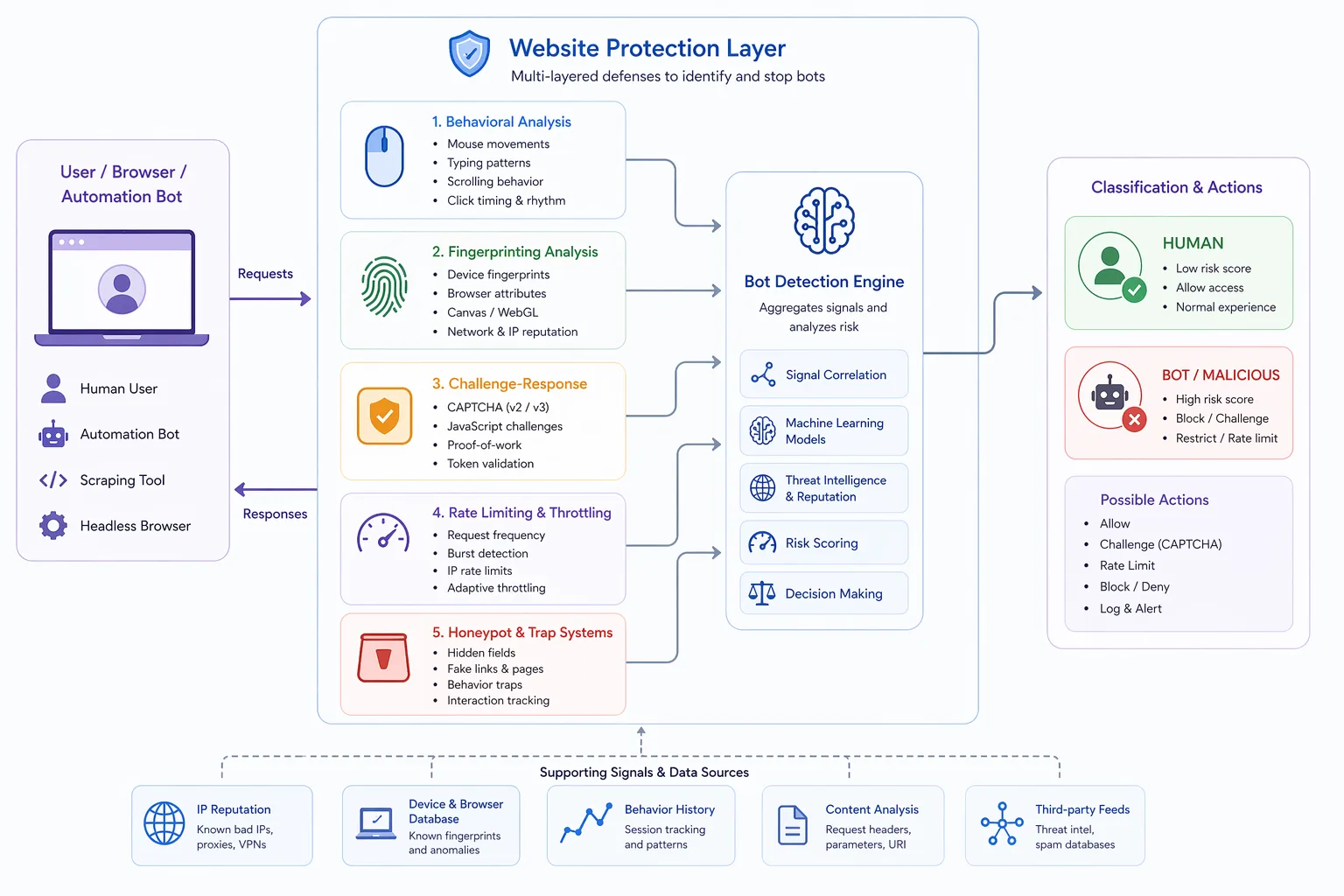
The core principle behind Cloudflare Bot Management is multi-layered analysis. Instead of relying on a single signal, it evaluates multiple factors simultaneously.
This includes browser behavior, network characteristics, and interaction patterns. By combining these signals, Cloudflare can detect subtle inconsistencies that indicate automation.
This layered approach makes it more effective than basic detection methods.
How Cloudflare Bot Management Works
Cloudflare processes incoming requests through a series of checks before allowing access to the website.
Request Scoring System
Each request is assigned a bot score based on its characteristics. This score represents the likelihood that the request is automated.
Low-risk requests are allowed to proceed, while higher-risk requests may face additional verification steps.
This scoring system enables flexible responses rather than simple blocking.
JavaScript Challenges
Cloudflare often uses JavaScript challenges to test whether the browser behaves like a real user environment.
These challenges execute scripts that check browser properties, timing, and behavior. Automated environments may fail these checks or produce inconsistent results.
This helps identify bots that rely on modified or incomplete browser setups.
Behavioral Analysis
Cloudflare monitors how users interact with a website over time.
This includes mouse movements, scrolling behavior, and interaction timing. Real users exhibit natural variability, while bots often show predictable patterns.
Behavioral data is used to refine bot scores.
Network and IP Reputation
Cloudflare evaluates IP reputation based on historical data and shared intelligence.
IPs associated with suspicious activity or known proxy networks may receive lower trust scores. Location consistency and request patterns are also considered.
This helps identify potentially risky traffic.
Why Cloudflare Bot Management Matters
Cloudflare Bot Management is widely used across the internet, making it one of the most common systems encountered in automation.
Its advanced detection capabilities make it effective at filtering out bots while minimizing disruption for real users.
For websites, it provides protection against abuse, scraping, and malicious activity. For automation systems, it represents a significant challenge.
Understanding how it works helps explain why certain requests are blocked or challenged.
Common Detection Signals Used by Cloudflare
Cloudflare relies on a combination of signals to identify bots.
Consistency across signals is critical. If browser data, IP location, and behavior do not align, the request may be flagged.
Timing patterns are also important. Instant or perfectly timed actions can indicate automation.
JavaScript execution results provide insight into the browser environment. Missing or altered features can reveal automation setups.
These signals are combined to form a comprehensive assessment.
Cloudflare Challenges and Responses
When Cloudflare detects suspicious activity, it can respond in different ways.
Low-risk traffic is allowed without interruption. Medium-risk traffic may face challenges such as captchas or JavaScript verification.
High-risk traffic may be blocked entirely.
This graduated response allows Cloudflare to balance security with user experience.
Limitations of Cloudflare Bot Management
Despite its advanced capabilities, Cloudflare Bot Management has limitations.
False positives can occur, where legitimate users are challenged or blocked. This can affect user experience.
There is also the challenge of evolving threats. As automation techniques improve, detection systems must continuously adapt.
This creates an ongoing cycle of improvement.
Cloudflare vs Basic Bot Detection
Cloudflare Bot Management is more advanced than basic bot detection systems.
While simple systems rely on individual signals such as IP or user-agent, Cloudflare uses a combination of factors and machine learning.
This allows for more accurate classification but also increases complexity.
Cloudflare vs Anti-Detection Techniques
Cloudflare Bot Management is specifically designed to counter anti-detection techniques.
It looks for inconsistencies that arise when signals are modified or masked. Even well-configured environments can produce subtle differences that are detected.
This makes it more challenging to bypass compared to simpler systems.
Cloudflare vs Real-Device Environments
A key distinction in modern detection is the difference between simulated environments and real-device environments.
Cloudflare analyzes multiple layers of signals, and inconsistencies in simulated setups can be detected even if individual signals appear correct.
Real-device approaches operate on actual hardware where signals naturally align. Tools like Appilot follow this approach by running automation on real Android devices, where browser behavior, network patterns, and device characteristics match real-world usage.
This reduces reliance on masking techniques.
When Cloudflare Detection Is Most Strict
Cloudflare applies stricter detection in environments with high security requirements or high levels of automated traffic.
This includes platforms that handle sensitive data or experience frequent abuse.
In these cases, more advanced checks and stricter thresholds are used.
Understanding this helps in adapting to different scenarios.
Frequently Asked Questions
Q: What is Cloudflare Bot Management?
It is a system that detects and manages automated traffic using multiple signals.
Q: How does Cloudflare detect bots?
By analyzing browser behavior, IP reputation, JavaScript execution, and interaction patterns.
Q: What is a bot score?
It is a rating that indicates the likelihood that a request is automated.
Q: What happens if Cloudflare detects a bot?
The request may be challenged with a captcha or blocked.
Q: Can Cloudflare be bypassed completely?
No, detection risk can be reduced but not eliminated.
Q: How do real-device solutions compare?
Real-device solutions like Appilot provide consistent signals across all layers, reducing reliance on masking techniques.
Key Takeaways
Cloudflare Bot Management is an advanced detection system that uses multi-layered analysis to identify automated traffic. It evaluates browser behavior, network data, JavaScript execution, and interaction patterns to assign a bot score. Based on this score, it decides whether to allow, challenge, or block requests. While highly effective, it is not perfect and must continuously evolve to keep up with new automation techniques. Understanding how Cloudflare works is essential for navigating modern bot detection systems.