Understanding DataDome: Behavioral Bot Detection

As bot detection systems evolve, many platforms are shifting toward behavior-driven analysis rather than relying only on static signals. One of the leading solutions in this category is DataDome. It focuses heavily on real-time behavioral detection combined with device and network intelligence to identify automated traffic.
Understanding DataDome is important because it represents a modern approach to bot detection that prioritizes how users behave rather than just what they look like. This guide explains how DataDome works, the signals it analyzes, and why it is effective against automation.
What Is DataDome?
DataDome is a bot detection and mitigation platform that analyzes incoming traffic to determine whether it originates from a human or an automated system. It operates in real time, scoring each request and applying actions based on risk level.
Unlike traditional systems that rely heavily on static fingerprints, DataDome emphasizes behavioral analysis. It continuously evaluates how users interact with a website and adapts its detection accordingly.
This allows it to detect both simple bots and more advanced automation setups.
The Core Principle Behind DataDome
The core principle behind DataDome is behavioral consistency. Real users interact with websites in unpredictable and context-driven ways, while bots tend to follow structured and repeatable patterns.
By analyzing interaction patterns, timing, and session flow, DataDome can identify anomalies that indicate automation.
This behavior-first approach makes it more resilient to simple masking techniques.
How DataDome Works
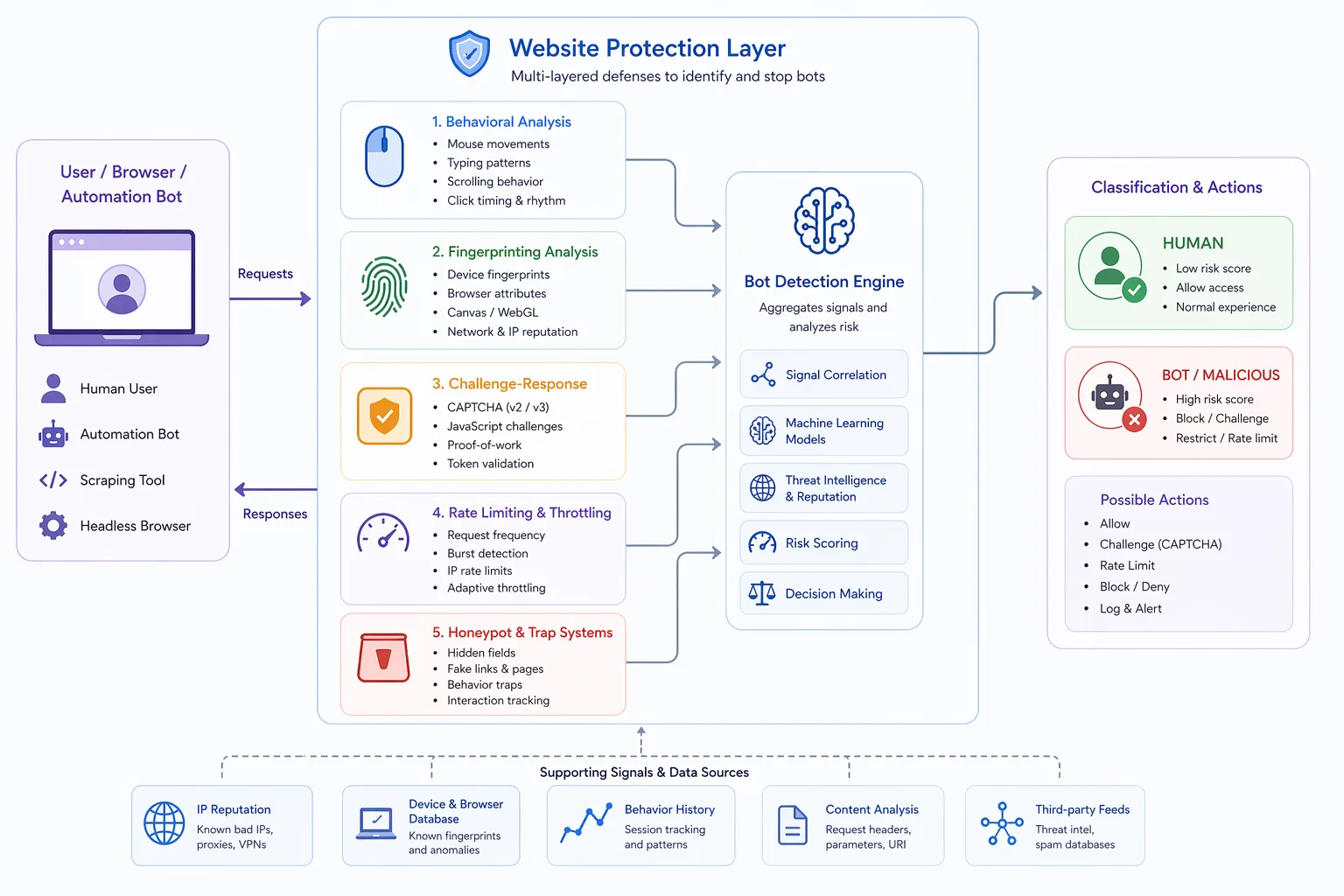
DataDome evaluates traffic using multiple layers of analysis.
Real-Time Request Scoring
Each request is analyzed and assigned a risk score in real time. This score determines how the system responds.
Low-risk requests are allowed, while higher-risk requests may be challenged or blocked.
This dynamic scoring allows DataDome to adapt quickly to changing patterns.
Behavioral Analysis
DataDome closely monitors user interactions such as navigation flow, click patterns, and timing between actions.
Humans tend to exhibit irregular behavior, while bots often follow predictable sequences.
Behavioral signals are one of the strongest indicators used by DataDome.
Device and Browser Signals
The system collects data about the browser and device, including fingerprinting signals and API behavior.
It looks for inconsistencies that suggest automation, such as missing features or altered values.
These signals complement behavioral analysis.
Network and IP Intelligence
DataDome evaluates IP reputation, geolocation consistency, and request patterns.
Suspicious IPs or unusual traffic patterns can contribute to higher risk scores.
Network-level data is combined with other signals for a complete assessment.
Why DataDome Matters
DataDome is widely used across industries that require strong protection against automated abuse.
Its focus on behavioral detection makes it effective against bots that attempt to mimic browser characteristics but fail to replicate human interaction patterns.
For businesses, it provides real-time protection with minimal impact on user experience. For automation systems, it presents a unique challenge.
Understanding its approach helps explain why some interactions are flagged even when technical signals appear correct.
Common Detection Signals Used by DataDome
DataDome relies on a combination of signals to identify bots.
Behavioral patterns are the most important, including timing variability and navigation flow.
Consistency across signals is also critical. Mismatches between device data, network location, and behavior can raise suspicion.
Session continuity is analyzed to detect unnatural transitions or patterns.
These signals are evaluated together to form a comprehensive risk profile.
DataDome Response Mechanisms
DataDome responds to detected bots in different ways depending on risk level.
Low-risk traffic is allowed without interruption. Medium-risk traffic may be challenged with captchas or verification steps.
High-risk traffic can be blocked entirely.
This flexible response system allows DataDome to balance security and usability.
Limitations of DataDome
Despite its advanced capabilities, DataDome has limitations.
False positives can occur, especially in cases where user behavior deviates from typical patterns.
There is also the challenge of evolving automation techniques, which require continuous updates to detection models.
These limitations highlight the dynamic nature of bot detection.
DataDome vs Traditional Detection Systems
DataDome differs from traditional systems by focusing more on behavior than static signals.
While older systems rely heavily on IP reputation and fingerprints, DataDome emphasizes how users interact with the site.
This makes it more effective against bots that attempt to mask technical signals.
DataDome vs Other Bot Detection Platforms
Compared to systems like Cloudflare or Akamai, DataDome places greater emphasis on real-time behavioral analysis.
While other systems use multi-layered approaches, DataDome’s strength lies in its ability to detect subtle behavioral anomalies.
Each system has its own focus, but all aim to identify automation.
DataDome vs Real-Device Environments
A key distinction in modern detection is the difference between simulated behavior and natural behavior.
DataDome’s behavioral analysis can detect inconsistencies in simulated environments, even if technical signals appear correct.
Real-device approaches operate on actual hardware where behavior and signals naturally align. Tools like Appilot follow this approach by running automation on real Android devices, where interaction patterns and system signals reflect real-world usage.
This reduces reliance on simulation.
When DataDome Detection Is Most Strict
DataDome applies stricter detection in environments with high levels of automated abuse or sensitive operations.
This includes e-commerce platforms, ticketing systems, and services that require strong protection against bots.
In these scenarios, behavioral analysis is more aggressive.
Understanding this helps in adapting to different contexts.
Frequently Asked Questions
Q: What is DataDome?
It is a bot detection platform that uses behavioral analysis and real-time scoring.
Q: How does DataDome detect bots?
By analyzing user behavior, device signals, and network data.
Q: What is a risk score?
It is a value that represents the likelihood that a request is automated.
Q: What happens when a bot is detected?
The request may be challenged or blocked.
Q: Is DataDome behavior-based?
Yes, it emphasizes behavioral detection over static signals.
Q: How do real-device solutions compare?
Real-device solutions like Appilot produce natural behavior and signals, reducing inconsistencies compared to simulated environments.
Key Takeaways
DataDome is a modern bot detection system that focuses on behavioral analysis combined with device and network signals. It evaluates interactions in real time, assigning risk scores to determine how traffic is handled. By prioritizing behavior, it can detect automation even when technical signals appear normal. Understanding how DataDome works is essential for navigating advanced detection systems and building reliable automation environments.