E-commerce Account Management with AdsPower and Appilot
Managing multiple e-commerce accounts becomes difficult very quickly once you are working across different stores, marketplaces, suppliers, and regions. Many sellers operate more than one Shopify store, Amazon account, Etsy profile, supplier dashboard, or competitor monitoring workflow at the same time.
As the number of accounts grows, so does the amount of manual work. Users often end up spending hours every day opening browser profiles, checking store dashboards, reviewing orders, monitoring inventory, comparing competitor pricing, and switching between multiple platforms.
AdsPower already helps solve one major problem by giving each browser profile its own fingerprint, cookies, proxy settings, timezone, browser version, and browsing environment. This makes it easier to separate e-commerce accounts and reduce the risk of profiles becoming linked together.
The next challenge is workflow management. Once you have many stores and accounts running at the same time, manual work becomes slower and harder to track. That is where Appilot becomes useful. Appilot helps organize browser profiles into workflows so you can automate repeated actions, assign schedules, and manage multiple store operations from one place.
Instead of manually opening every store profile every day, you can build a cleaner workflow that saves time and makes your e-commerce account management much easier to scale.
Why E-commerce Sellers Use AdsPower and Appilot
E-commerce sellers often work across multiple platforms at the same time. One seller may manage several Shopify stores, Amazon accounts, supplier dashboards, competitor tracking tools, Facebook ad accounts, and customer service portals.
The problem is that most of these accounts need to stay separated. Logging into multiple stores or marketplaces from the same browser environment can create unnecessary account overlap and confusion.
AdsPower solves this problem by giving every store or account its own isolated browser profile. Each profile can have different cookies, browser fingerprints, proxy settings, timezones, and browsing history.
This is especially useful for sellers managing multiple brands, multiple marketplaces, different supplier accounts, or stores across different regions.
Appilot takes that setup further by helping automate the daily work happening inside those browser profiles. Instead of opening store dashboards one by one every day, you can create workflows that launch profiles, review dashboards, monitor orders, check inventory, and close sessions automatically.
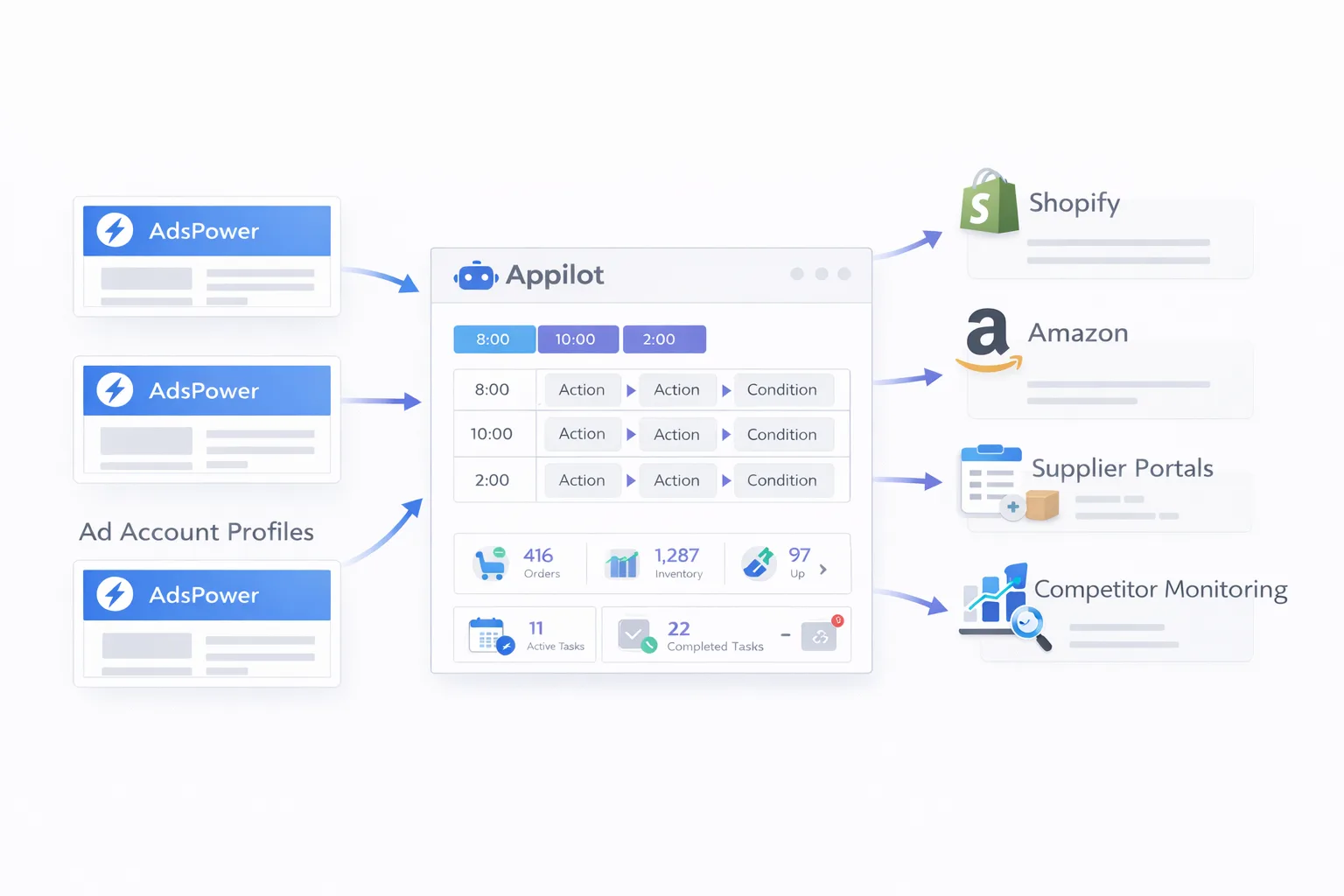
Common E-commerce Workflows You Can Automate
One of the most common workflows is store monitoring. Sellers often need to open store dashboards, check orders, review inventory levels, monitor product performance, and track customer activity.
Another common workflow is supplier management. Users may need to log into supplier portals, review stock levels, check shipping updates, and compare product availability across different suppliers.
Competitor monitoring is also important for many sellers. This may involve opening competitor websites, checking product pricing, reviewing promotions, and monitoring inventory changes.
Some users also create workflows for marketplace management. They may need to review Amazon dashboards, Etsy shops, eBay accounts, or Facebook Marketplace profiles throughout the day.
Appilot makes these workflows easier because browser profiles can be grouped by store, marketplace, supplier, or region and then assigned different schedules.
Organizing Browser Profiles for E-commerce Accounts
One of the best ways to manage e-commerce workflows is to keep browser profiles organized.
For example, you may want one browser profile group for Shopify stores, another for Amazon seller accounts, another for supplier portals, and another for competitor tracking.
If you manage multiple brands or regions, you can separate browser profiles further by country, product category, or client.
This makes it much easier to understand which browser profiles belong to which accounts and which workflows should apply to each group.
Once browser profiles are grouped properly inside AdsPower, Appilot can assign schedules, launch times, and repeated tasks more efficiently.
Best Practices for E-commerce Account Management
The best way to manage e-commerce accounts is to keep different store environments separated. Each store, supplier portal, or marketplace account should have its own browser profile instead of sharing the same browser session.
You should also keep browser fingerprints, timezone settings, and proxies aligned with the geography of the account. If a store profile claims to be in one country but the proxy comes from another region, it may create unnecessary issues.
Another good practice is to use staggered profile launches instead of opening all store accounts at the same time. This creates a more stable workflow and reduces system load.
You should also separate workflows by use case. Store dashboards, supplier portals, competitor tracking, and customer service profiles usually need different schedules and different workflow timing.
Starting with smaller workflows and expanding gradually is usually much safer than trying to automate every account immediately.
Common Problems and How to Avoid Them
One common problem is poor browser profile organization. If store accounts, supplier portals, and competitor monitoring sessions are all mixed together, workflows can become difficult to understand.
Another common issue is profile overload. Launching too many browser profiles at once can slow down systems and create workflow failures.
Some users also run into timezone mismatches between browser profiles and proxies. This can create suspicious behavior patterns or scheduling issues.
Expired cookies, broken browser settings, and outdated proxies can also cause problems.
The safest approach is to keep browser profile groups organized, use realistic settings, and build workflows gradually over time.
Frequently Asked Questions
Q1: Can AdsPower separate different e-commerce accounts into separate browser profiles?
Yes. AdsPower allows you to create isolated browser profiles for different stores, marketplaces, suppliers, and customer accounts.
Q2: Can Appilot automate e-commerce workflows?
Yes. Appilot can automate workflows for store monitoring, supplier management, competitor tracking, inventory checks, and other repeated tasks.
Q3: Do I need coding skills to use AdsPower and Appilot for e-commerce management?
No. Most users can create browser profiles, organize workflows, and automate tasks directly from the dashboard without writing code.
Q4: Can I create separate workflows for different stores or marketplaces?
Yes. Most users create separate browser profile groups and schedules for Shopify stores, Amazon accounts, supplier portals, and competitor monitoring.
Q5: Is it safe to automate e-commerce account workflows?
Automation can save a lot of time, but it should be used carefully. It is important to use realistic browser settings, good proxies, and gradual workflow expansion.
Conclusion
Managing multiple e-commerce accounts becomes much easier when browser profiles and workflows are properly organized. AdsPower helps by separating browser environments, while Appilot helps automate the tasks happening inside those profiles.
Together, AdsPower and Appilot create a cleaner setup for Shopify stores, Amazon accounts, supplier portals, competitor monitoring, and marketplace management.
The best approach is to keep browser profiles organized, build simple workflows first, and gradually scale over time.