Facebook Ads Delivery "Learning Limited"? Here's the Fix
The Campaign Is Running But Facebook Cannot Optimize Properly
One of the most frustrating things in Facebook advertising is launching a campaign, seeing impressions start to come in, and then noticing the delivery status says “Learning Limited.” The ads are technically active, but performance stays inconsistent, costs remain high, and Facebook does not seem able to optimize properly.
This happens because Facebook’s system needs enough conversion data to understand who is most likely to take the action you want. If the campaign is not generating enough signals, Facebook struggles to learn and delivery becomes unstable.
The issue is usually not that the campaign is completely broken. The problem is that Facebook does not have enough data, budget, audience size, or conversion volume to optimize effectively.
Why Campaigns Become Learning Limited
Most campaigns become Learning Limited because they are too small for the conversion goal being used.
For example, if you optimize for purchases but only get a few purchases per week, Facebook does not have enough data to learn. The same thing happens when the audience is too narrow, the budget is too low, or there are too many ad sets splitting the same amount of traffic.
Facebook generally wants around 50 optimization events per week for each ad set. If the campaign cannot generate enough conversions, it stays stuck in Learning Limited and performance becomes much less stable.
The Biggest Mistake: Creating Too Many Small Ad Sets
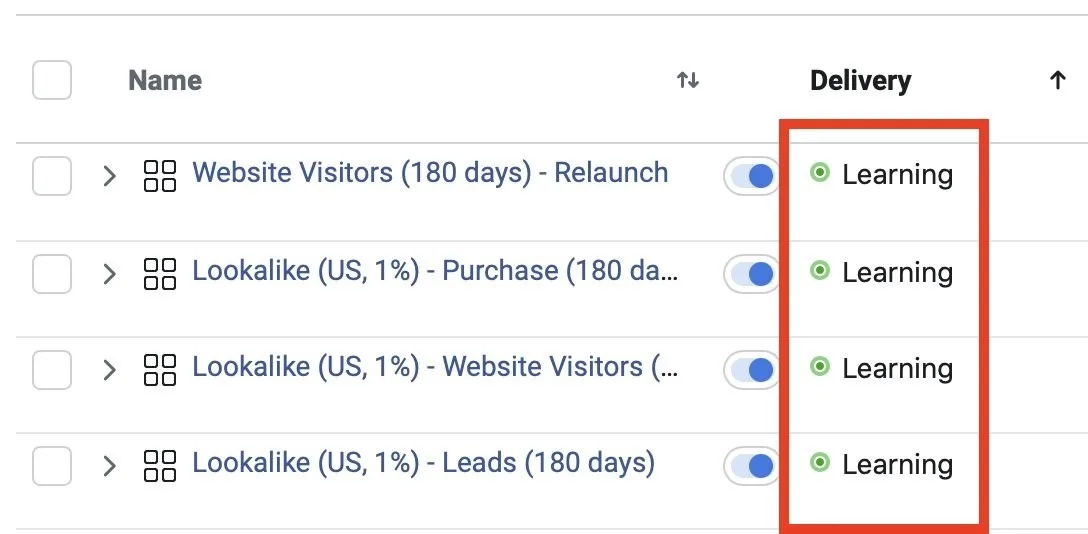
One of the biggest reasons campaigns get stuck in Learning Limited is because advertisers split the budget too aggressively.
They create too many ad sets, too many audiences, too many placements, or too many small tests all at once.
For example, instead of spending $100 per day on one strong ad set, they may spread that budget across five ad sets with only $20 each. That means none of the ad sets get enough data to optimize properly.
The stronger approach is consolidating campaigns.
Use fewer ad sets, broader audiences, and larger budgets per ad set so Facebook has enough room to learn. It is usually better to have one ad set with enough data than five ad sets with almost no data.
Why Narrow Audiences Make The Problem Worse
A lot of campaigns become Learning Limited because the audience is too small.
If you narrow the targeting too much by layering age, interests, behaviors, lookalikes, locations, and exclusions, Facebook may not have enough people to optimize against.
This becomes even worse when the campaign is optimizing for a rare conversion event like purchases, booked calls, or completed applications.
The smaller the audience and the rarer the conversion, the harder it becomes for Facebook to exit the learning phase.
That is why broader targeting often performs better than people expect.
Why Constant Changes Reset The Learning Phase
Another common mistake is changing campaigns too often.
Every time you change the budget significantly, pause ads, replace creatives, adjust targeting, or edit the optimization goal, Facebook may reset the learning phase.
That means the campaign keeps starting over before it ever has enough time to stabilize.
A lot of advertisers make this worse by panicking too early. They see weak performance after one day, start making changes immediately, and then keep the campaign trapped in a constant cycle of restarting.
The better approach is giving campaigns enough time to gather data before making major edits.
Why Better Campaign Structure Matters
Learning Limited problems become much worse when campaigns, audiences, creatives, budgets, and reporting are spread across different systems. You may have one place for creatives, another for audience notes, another for tracking, and another for account management. That makes it difficult to see which campaigns are getting enough data and which ones are too fragmented.
This is one of the reasons Appilot becomes useful when advertising operations start scaling. Instead of keeping browser workflows, Android automations, campaign assets, audience notes, budget tracking, and task history spread across different systems, everything can stay visible from one dashboard. That makes it easier to compare ad set performance, identify fragmented campaigns, monitor delivery issues, and improve campaign structure across multiple accounts.
Conclusion: Learning Limited Usually Means Facebook Does Not Have Enough Data To Optimize
If your Facebook campaign is stuck in Learning Limited, the issue is usually not that the ad itself is bad. The problem is that the campaign does not have enough budget, enough audience size, enough conversion volume, or enough stability for Facebook to optimize properly.
Once you consolidate ad sets, broaden audiences, increase conversion volume, and stop making constant changes, it becomes much easier for campaigns to exit the learning phase and perform more consistently.