Facebook Group Member Screening Automation

Facebook groups often grow very quickly once they become active. A small group with a few join requests each day is easy to manage manually, but once the group reaches thousands of members, screening every new request becomes much more difficult.
Many Facebook groups use screening questions to protect the group from spam, fake accounts, scammers, bots, and irrelevant members. This is especially important for ecommerce groups, affiliate marketing communities, local business groups, real estate groups, job boards, and niche discussion communities.
The challenge is that manually reviewing every member request can take hours every day. Group owners often need to check whether someone answered the questions properly, whether their profile looks real, whether they follow the group rules, and whether they are likely to be a good fit for the community.
This becomes even more difficult when you are managing multiple groups at once. One group may focus on ecommerce, another on local business networking, and another on affiliate marketing or job opportunities. Each group may require different screening rules and different approval standards.
This is where automation becomes valuable. Instead of manually reviewing every join request one by one, you can build workflows that check answers, detect suspicious profiles, approve safe members automatically, and flag risky requests for manual review.
For this guide, I will use Appilot as the main workflow platform. Appilot helps automate browser workflows and Android actions from one dashboard, making it easier to manage Facebook groups across multiple browser profiles and moderation systems.
In this guide, you will learn why Facebook group member screening automation matters, how to organize approval rules, how to connect Facebook groups with Appilot, and how to automate member screening safely at scale.
Setup Time: Around 45 to 60 minutes
Difficulty: Intermediate
Estimated Time Saved: 10 to 20 hours weekly
Why Facebook Group Member Screening Automation Matters
The quality of a Facebook group often depends on the quality of its members.
For example, a group may want to avoid:
Spam accounts
Fake profiles
Scammers
Irrelevant members
Duplicate accounts
Accounts with suspicious activity
People who ignore the group rules
At the same time, the group may want to approve:
Real people
Active community members
Local business owners
Customers
Industry professionals
Relevant niche members
People who answer screening questions properly
The problem is that manual screening becomes harder as the group grows. A group with thousands of members may receive dozens or hundreds of join requests every day.
Without a system, it becomes easy to:
Approve fake accounts accidentally
Delay approval for real members
Miss suspicious profiles
Overload moderators
Create inconsistent screening standards
Reduce group quality over time
Automation helps solve these problems by turning member screening into a repeatable workflow.
The manual approach may work for smaller groups, but it becomes difficult once member requests increase.
With automation, you can create workflows that detect suspicious accounts, approve real members automatically, and flag risky requests for manual review.
The biggest advantage is not only saving time. It is improving group quality and making sure genuine members join faster.
What You Need to Get Started
To automate Facebook group member screening, you need a few tools working together.
The first requirement is an antidetect browser such as GoLogin, AdsPower, Multilogin, or Dolphin Anty. These browsers help manage multiple Facebook accounts and groups separately while keeping cookies, browser fingerprints, and proxies isolated.
The second requirement is residential or mobile proxies. Proxies help make moderation activity look more natural and reduce the risk of multiple accounts appearing from the same IP address.
The third requirement is Appilot. Appilot helps connect browser profiles, organize Facebook groups, automate moderation tasks, and manage repetitive workflows from one dashboard.
You should also create a screening guide before building workflows. This can include required answers, blocked keywords, profile quality checks, suspicious indicators, and group-specific rules.
A typical setup for Facebook group automation usually costs between $150 and $400 per month depending on the number of groups, browser profiles, and workflows involved.
Step-by-Step: Setting Up Member Screening Automation
Step 1: Organize Your Facebook Groups
Before creating workflows, organize your groups into categories.
For example, you may have ecommerce groups, local business groups, affiliate marketing groups, job groups, real estate groups, and community groups.
Different group types usually require different screening rules.
An ecommerce group may want to approve customers and store owners, while a job group may want to approve recruiters and job seekers.
The more organized your group categories become, the easier it becomes to create useful screening workflows.
Step 2: Define Screening Rules
Once your group categories are ready, define the types of members that should be approved automatically and the types that should be flagged for review.
For example, safe member requests may include people who answer all questions properly, have older Facebook accounts, use real profile pictures, and show activity related to the group niche.
Risky member requests may include empty profiles, no profile picture, spam links, suspicious usernames, repeated requests, or copied answers.
The goal is to create clear rules so the automation can make better decisions.
Step 3: Connect Browser Profiles to Appilot
Once your browser profiles are ready, connect them to Appilot using your browser API key.
Inside Appilot, you can organize profile groups such as:
ecommerce-groups
local-business-groups
affiliate-groups
job-groups
real-estate-groups
This makes it easier to assign different screening workflows to different group types.
Step 4: Create a Member Screening Workflow
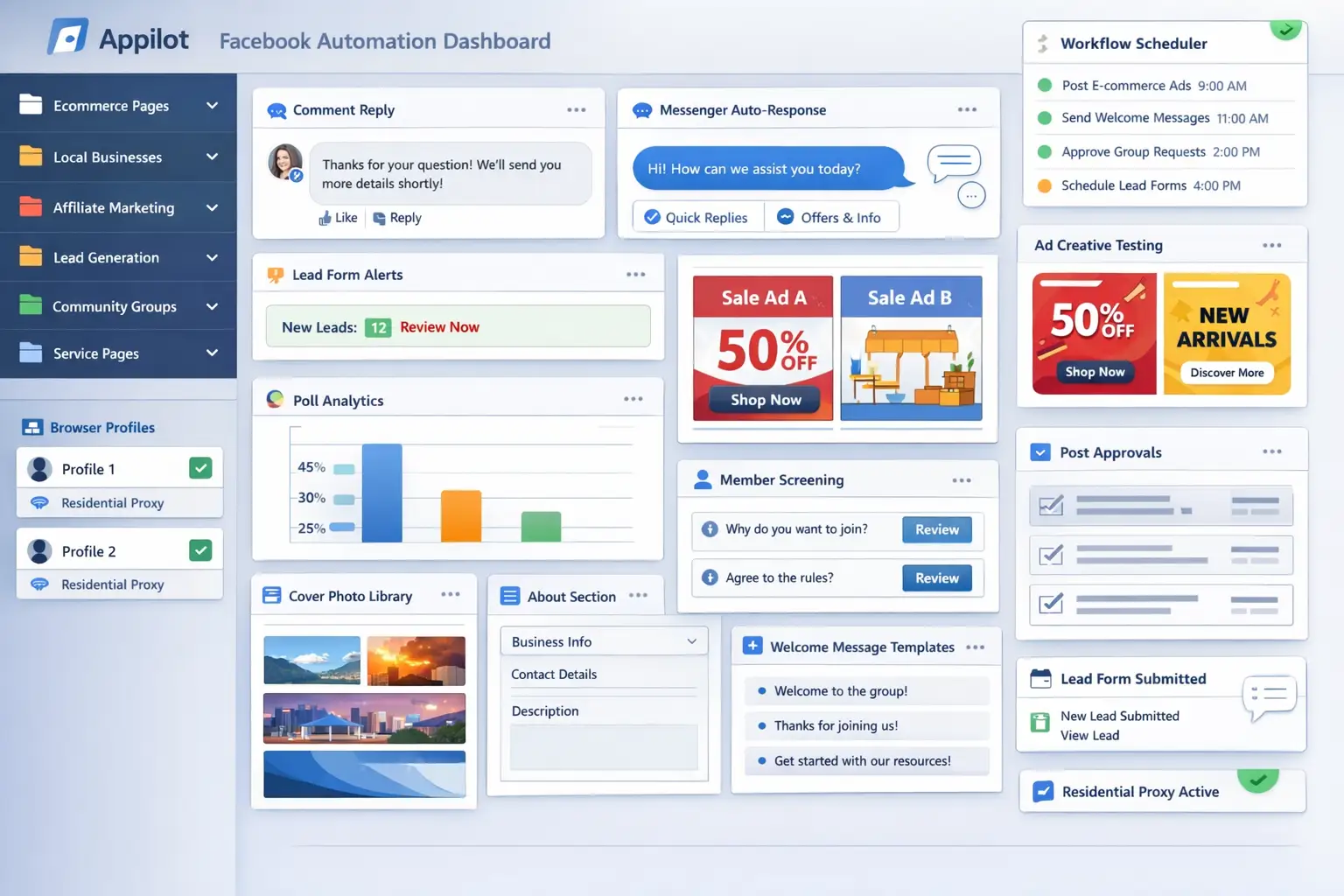
Once everything is connected, you can create a workflow that reviews join requests automatically.
For example, you may want the workflow to:
Check screening question answers
Review profile age
Detect suspicious usernames
Look for missing profile pictures
Approve safe members automatically
Flag risky requests for review
const workflow = {
  name: "Facebook Group Member Screening",
  groups: "community-groups",
  actions: [
    "Monitor join requests",
    "Check profile quality",
    "Review screening answers",
    "Approve safe members",
    "Flag risky requests for review"
  ],
  schedule: "Continuous"
};
The strongest workflows are usually simple and focused. Instead of trying to automate every screening decision, it is better to automate obvious approvals and obvious rejections first.
Step 5: Test Before Scaling
Before applying automation to every group, test the workflow on a small group first.
Choose one group and monitor how the screening performs.
Check whether safe members are being approved correctly, suspicious profiles are being flagged, screening questions are being reviewed properly, and duplicate requests are being detected.
Once everything works correctly, you can gradually expand to more groups and more screening categories.
This helps reduce mistakes and gives you time to improve the workflow before scaling further.
Best Practices for Facebook Group Member Screening Automation
The best screening workflows focus on speed and consistency.
It is important to approve genuine members quickly because delays can reduce engagement and discourage people from joining.
You should also avoid making the screening rules too strict. If too many real people are rejected, group growth can slow down.
Another important practice is reviewing flagged requests manually. Even if the workflow is working well, some member requests will still require a human decision.
It is also useful to update screening rules regularly. Spam tactics, fake profiles, and suspicious account behavior often change over time.
Real Example: Scaling Member Screening Across 15 Facebook Groups
One agency managed 15 Facebook groups across ecommerce, local business, and affiliate marketing niches.
At first, member requests were handled manually. Team members spent hours every day reviewing profiles, checking answers, and removing fake accounts.
As the groups grew, approval times became slower and some suspicious profiles slipped through.
The agency eventually switched to a workflow using GoLogin, residential proxies, and Appilot. Groups were organized by category, and automated screening workflows were created for each group type.
After 60 days, the agency reduced manual moderation work by more than 70 percent while improving approval speed and group quality.
The biggest improvement was not just saving time. It was making sure genuine members joined faster while suspicious profiles were filtered more consistently.
Common Mistakes to Avoid
One common mistake is making the screening rules too strict. If too many requests are rejected, group growth can slow down.
Another mistake is relying entirely on automation without reviewing flagged requests. Some profiles still need a manual decision.
Some teams also forget to update screening rules regularly. Fake accounts and spam methods change all the time.
It is also important not to approve every request instantly. Small delays can make moderation activity feel more natural.
FAQ
Q1: How many Facebook groups can I manage with automated member screening?
Most users can comfortably manage 10 to 50 Facebook groups with structured workflows. Larger teams can support even more groups by organizing them into categories.
Q2: What types of members should be approved automatically?
Members with complete profiles, clear answers, real profile pictures, and activity related to the group niche are usually the safest to approve automatically.
Q3: What types of profiles should be flagged for review?
Empty profiles, suspicious usernames, no profile picture, spam links, copied answers, and repeated join requests are usually best flagged for manual review.
Q4: Should every group use the same screening rules?
No. Different group types usually require different approval standards and screening questions.
Q5: Which browser is best for Facebook group automation?
GoLogin is usually best for smaller operations, AdsPower works well for larger profile groups, and Multilogin is useful for enterprise teams.
Conclusion
Facebook group member screening automation helps businesses, agencies, and community managers save time while keeping groups active, relevant, and free from fake accounts and spam.
Instead of manually reviewing every join request one by one, you can create workflows that approve genuine members, block obvious fake profiles, and flag risky requests for manual review.
The key is to organize groups carefully, create clear screening rules, test workflows gradually, and continue reviewing flagged requests regularly.
For ecommerce groups, local business communities, affiliate marketing groups, and niche discussion groups, member screening automation can become one of the most useful systems for improving group quality at scale.