Facebook Lead Form Response Automation
Facebook lead forms are one of the fastest ways to collect potential customer information. Businesses use them to gather names, emails, phone numbers, booking requests, quote requests, and other important details directly from Facebook ads.
The challenge is that collecting leads is only the first step. The real value comes from responding quickly.
Most leads lose value if they are not contacted within a short period of time. A person who fills out a lead form may be interested right now, but if they wait too long for a response, they may move on to another company.
This becomes even harder when you are running multiple Facebook campaigns across multiple pages and ad accounts. One account may focus on local services, another on ecommerce, and another on lead generation for real estate, insurance, or education.
This is where automation becomes valuable. Instead of manually checking Facebook lead forms and replying one by one, you can build workflows that collect lead information, send instant responses, organize leads by category, and notify your team automatically.
For this guide, I will use Appilot as the main workflow platform. Appilot helps automate browser workflows and Android actions from one dashboard, making it easier to manage Facebook lead forms across multiple accounts and campaigns.
In this guide, you will learn why lead response automation matters, how to organize lead categories, how to connect Facebook accounts with Appilot, and how to automate responses safely at scale.
Setup Time: Around 45 to 60 minutes
Difficulty: Intermediate
Estimated Time Saved: 8 to 20 hours weekly
Why Facebook Lead Form Response Automation Matters
Fast lead response times often have a direct impact on conversions.
For example, someone may fill out a lead form asking for:
A price quote
A service estimate
A product consultation
An appointment booking
A demo request
A callback request
If the person receives a response quickly, they are more likely to continue the conversation.
The problem is that many businesses respond too slowly. Leads may sit inside Facebook for hours or even days before someone notices them.
Without a system, it becomes easy to:
Miss leads completely
Delay responses
Forget follow-ups
Lose valuable contact details
Create inconsistent customer experiences
Overload the sales team
Automation helps solve these problems by turning lead handling into a repeatable workflow.
The manual approach may work for small campaigns, but it becomes difficult once lead volume increases.
With automation, you can create workflows that detect new leads, send immediate responses, assign lead categories, and notify the correct team member automatically.
The biggest advantage is not only saving time. It is improving lead response speed and increasing the chances of conversion.
What You Need to Get Started
To automate Facebook lead form responses, you need a few tools working together.
The first requirement is an antidetect browser such as GoLogin, AdsPower, Multilogin, or Dolphin Anty. These browsers help manage multiple Facebook accounts and ad accounts separately while keeping cookies, browser fingerprints, and proxies isolated.
The second requirement is residential or mobile proxies. Proxies help make account activity look more natural and reduce the risk of multiple accounts appearing from the same IP address.
The third requirement is Appilot. Appilot helps connect browser profiles, organize Facebook pages, monitor lead forms, and automate repetitive response workflows from one dashboard.
You should also have a lead management system ready. This can include Google Sheets, Airtable, Notion, CRM software, or any other structured storage platform.
A typical setup for Facebook lead automation usually costs between $150 and $400 per month depending on the number of accounts, browser profiles, and workflows involved.
Step-by-Step: Setting Up Facebook Lead Form Response Automation
Step 1: Organize Your Campaigns by Lead Type
Before creating workflows, organize your campaigns into groups.
For example, you may have:
Ecommerce leads
Local business leads
Real estate leads
Insurance leads
Education leads
Service booking leads
Demo request leads
Different lead types usually require different response styles.
For example, a real estate lead may need property details, while a service lead may need booking information.
The more organized your lead groups become, the easier it becomes to create useful workflows.
Step 2: Create Response Templates
Once your lead groups are ready, create reply templates for each type of lead.
For example:
Quote request = "Thank you for your inquiry. We received your request and our team will contact you shortly with pricing details."
Booking request = "Thank you for your booking request. Please let us know your preferred date and time so we can assist you."
Demo request = "Thank you for your interest. We received your request and a team member will contact you shortly to schedule a demo."
The goal is to make sure every lead receives a fast and useful response.
You can also create different templates based on industry, location, or campaign type.
Step 3: Connect Browser Profiles to Appilot
Once your browser profiles are ready, connect them to Appilot using your browser API key.
Inside Appilot, you can organize profile groups such as:
ecommerce-leads
local-business-leads
real-estate-leads
insurance-leads
education-leads
This makes it easier to assign different lead workflows to different campaign groups.
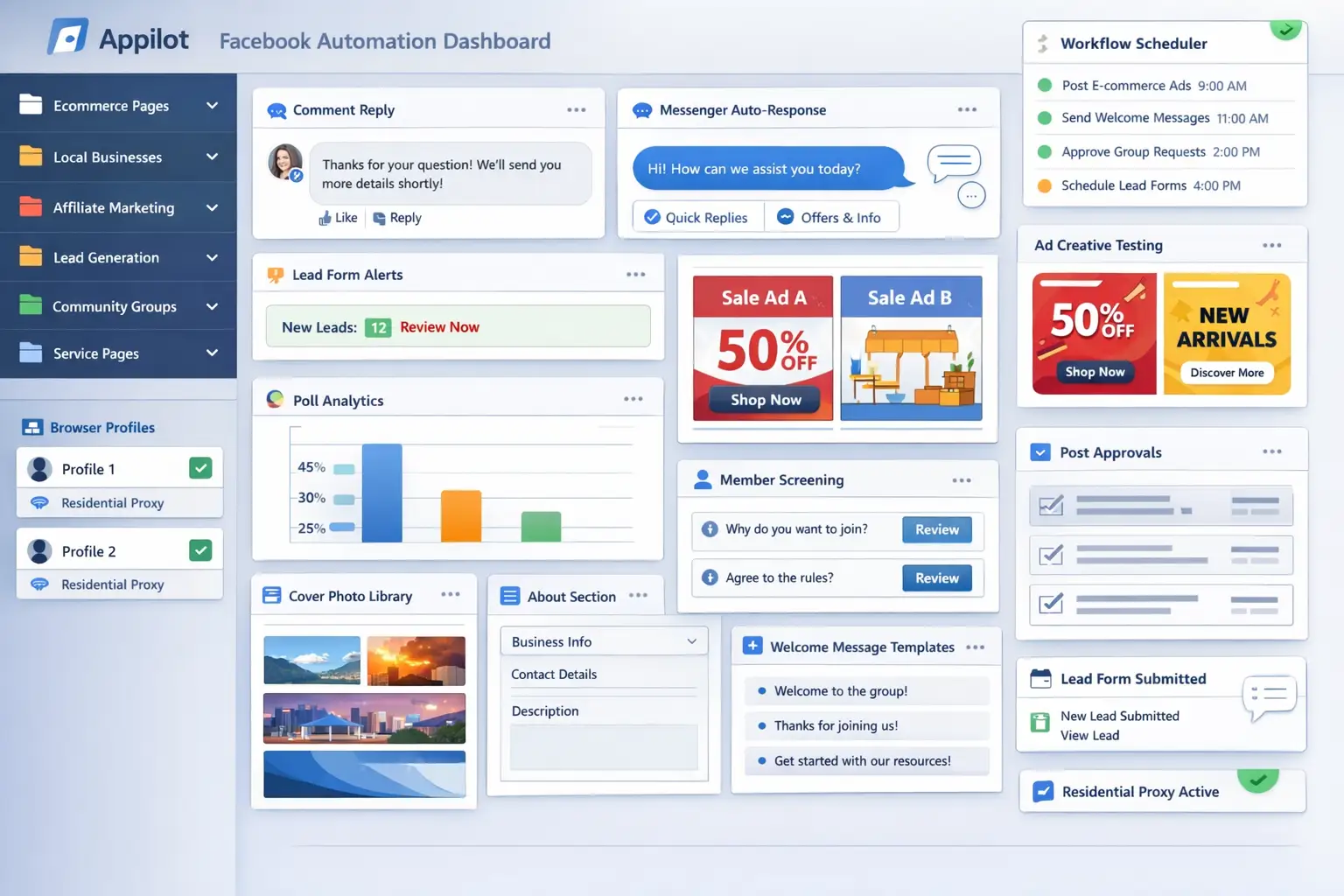
Step 4: Create a Lead Response Workflow
Once everything is connected, you can create a workflow that detects new leads and sends responses automatically.
For example, you may want the workflow to:
Detect new lead form submissions
Save lead details into a spreadsheet or CRM
Send an automatic response
Notify the sales team
Assign the lead category
Flag urgent leads for faster follow-up
const workflow = {
  name: "Facebook Lead Form Response",
  accounts: "local-business-leads",
  actions: [
    "Monitor new lead forms",
    "Save lead details",
    "Send automatic response",
    "Notify sales team",
    "Assign lead category"
  ],
  schedule: "Continuous"
};
The strongest workflows are usually simple and focused. Instead of trying to automate the full sales process, it is better to focus on fast lead response and structured lead organization first.
Step 5: Test Before Scaling
Before applying automation to every campaign, test the workflow on a small group first.
Choose one campaign and monitor how the responses perform.
Check whether:
Leads are being detected correctly
Contact details are being saved properly
The correct response is being sent
Sales notifications are working
Urgent leads are flagged correctly
Once everything works correctly, you can gradually expand to more campaigns and more lead categories.
This helps reduce mistakes and gives you time to improve the workflow before scaling further.
Best Practices for Facebook Lead Form Response Automation
The best lead workflows focus on speed and organization.
It is important to respond quickly because most leads lose value over time.
You should also keep response messages short, clear, and helpful. Overly long replies can reduce engagement.
Another important practice is separating urgent leads from lower-priority leads. For example, a person asking for an immediate quote may require faster attention than someone requesting general information.
It is also useful to store every lead inside a CRM or spreadsheet so the sales team can follow up later.
Real Example: Scaling Lead Responses Across 25 Campaigns
One agency managed 25 Facebook campaigns across local services, real estate, education, and insurance industries.
At first, lead form responses were handled manually. Team members checked Facebook regularly, copied lead details into spreadsheets, and replied manually.
As the number of campaigns grew, response times became slower and some leads were missed completely.
The agency eventually switched to a workflow using GoLogin, residential proxies, and Appilot. Campaigns were grouped by lead type, and automated responses were created for common lead categories.
After 60 days, the agency reduced manual lead handling time by more than 70 percent while improving average response speed across every campaign.
The biggest improvement was not just saving time. It was making sure every lead received a fast response.
Common Mistakes to Avoid
One common mistake is waiting too long before contacting new leads. Delayed responses often reduce conversion rates.
Another mistake is using the exact same response template for every lead type. Different industries usually require different messaging.
Some teams also forget to organize leads properly after they are collected. Large lists of unorganized leads become difficult to manage later.
It is also important not to overload the sales team with every lead equally. Prioritization helps focus attention on the most valuable opportunities.
FAQ
Q1: How many lead forms can I manage with automated workflows?
Most users can comfortably manage hundreds of lead forms with structured workflows. Larger teams can support even more by organizing campaigns into groups.
Q2: What types of leads should be automated?
Simple inquiries, booking requests, quote requests, demo requests, and callback requests are usually the best lead types to automate.
Q3: Should urgent leads be handled differently?
Yes. Urgent leads should usually be flagged for faster manual follow-up.
Q4: Can I use different response templates for different industries?
Yes. Most users create separate templates for ecommerce, local business, real estate, insurance, education, and service leads.
Q5: Which browser is best for Facebook lead automation?
GoLogin is usually best for smaller operations, AdsPower works well for larger profile groups, and Multilogin is useful for enterprise teams.
Conclusion
Facebook lead form response automation helps businesses save time, improve lead response speed, and manage large numbers of campaigns much more effectively.
Instead of manually checking lead forms every day, you can create workflows that detect new leads, send responses automatically, organize lead details, and notify the correct team members.
The key is to organize campaigns carefully, create useful reply templates, test workflows gradually, and focus on fast response times.
For agencies, ecommerce brands, local businesses, and service providers, Facebook lead automation can become one of the most useful systems for improving lead conversion at scale.