Understanding Fingerprint Spoofing vs Randomization
Most discussions around browser fingerprinting focus on how tracking works, but a critical question is how systems attempt to avoid it. Two common approaches are fingerprint spoofing and fingerprint randomization. While they may seem similar at a surface level, they operate very differently and have distinct implications for detection.
Understanding the difference between spoofing and randomization is important because it directly affects how detectable an environment is. It also explains why some setups fail despite appearing to mask identity. This guide breaks down both approaches in technical detail and explains when each is effective.
What Is Fingerprint Spoofing?
Fingerprint spoofing is the process of deliberately setting specific values for fingerprinting signals to make a browser appear as a particular device or environment. Instead of relying on default system values, spoofing overrides them with chosen attributes.
For example, a browser may be configured to report a specific user agent, screen resolution, timezone, and language to simulate a real device profile. The goal is to create a consistent and believable identity.
Spoofing is commonly used in environments where stability is important. Since the fingerprint does not change frequently, it allows sessions to appear consistent across time.
The Core Principle Behind Spoofing
The core principle behind spoofing is consistency. Detection systems expect real devices to behave in predictable ways, so spoofing aims to replicate those patterns.
A well-spoofed fingerprint aligns all signals so that they match a realistic device configuration. For example, a mobile profile would include appropriate screen dimensions, touch capabilities, and matching headers.
The effectiveness of spoofing depends on how accurately it mimics real-world environments. Poorly configured spoofing can create mismatches that are easy to detect.
What Is Fingerprint Randomization?
Fingerprint randomization is the process of frequently changing fingerprinting signals so that each session appears different. Instead of maintaining a stable identity, randomization introduces variability.
For example, a browser may generate different screen resolutions, user agents, or rendering outputs on each session. This makes it difficult to link multiple sessions together.
Randomization is often used in privacy-focused tools, where the goal is to reduce tracking rather than maintain a consistent identity.
The Core Principle Behind Randomization
The core principle behind randomization is unpredictability. By constantly changing signals, it prevents tracking systems from building a stable profile.
However, real devices do not behave randomly. They maintain consistent characteristics over time. This means that excessive randomization can appear unnatural.
Detection systems can identify patterns of randomness, which may indicate that the environment is not genuine.
Key Differences Between Spoofing and Randomization
The main difference between spoofing and randomization lies in how identity is managed. Spoofing creates a stable and consistent identity, while randomization creates constantly changing identities.
Spoofing is focused on realism and coherence, ensuring that all signals align with each other. Randomization is focused on variability, reducing the ability to link sessions.
In practice, spoofing is more suitable for scenarios where maintaining a believable identity is important, while randomization is more suited for general privacy use where linkage prevention is the goal.
Why Detection Systems Treat Them Differently
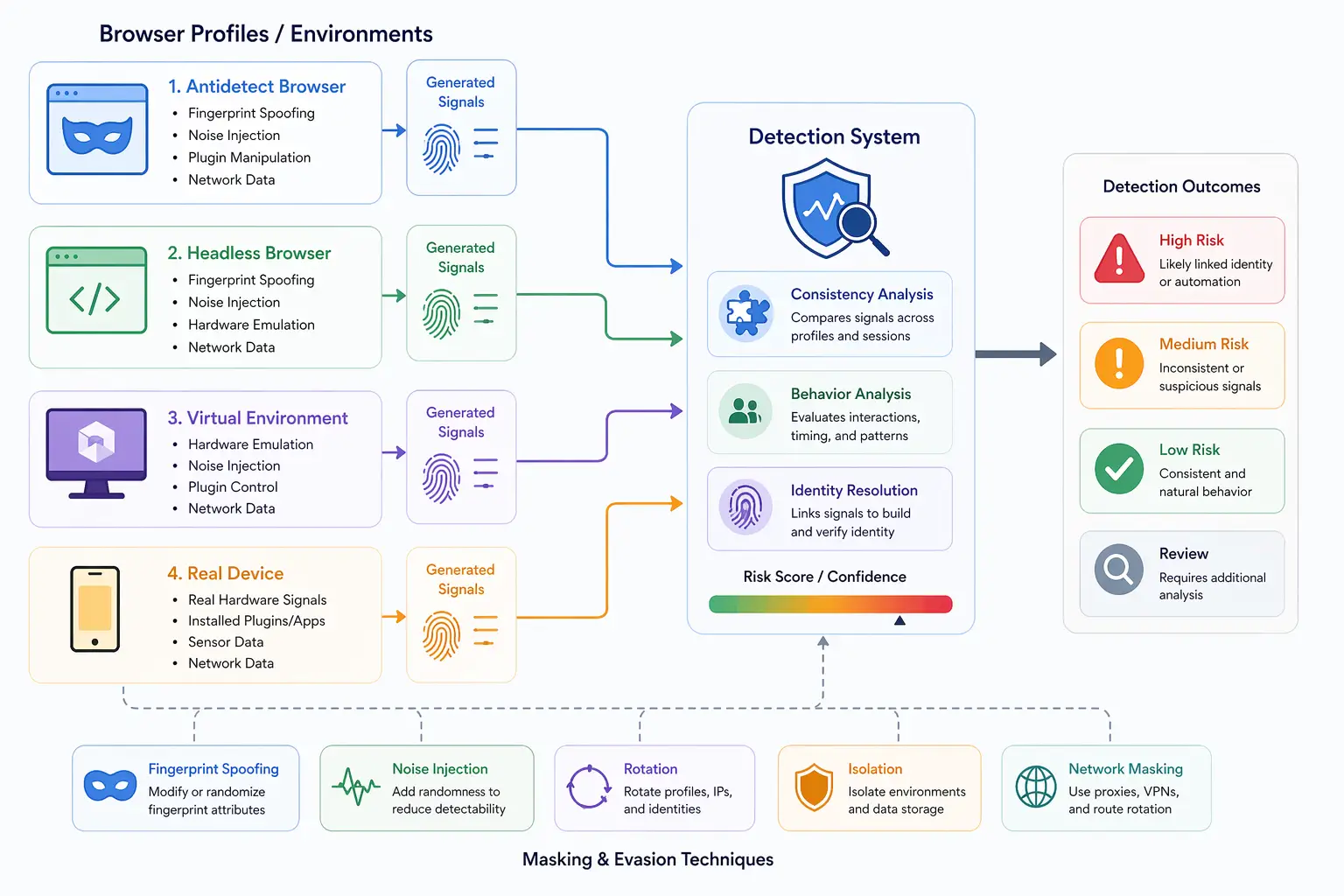
Detection systems are designed to identify patterns, both in consistency and inconsistency. This means they evaluate spoofing and randomization in different ways.
With spoofing, systems look for mismatches between signals. If a profile claims to be a specific device but behaves differently, it can be flagged.
With randomization, systems look for unnatural variability. If signals change too frequently or in unrealistic ways, it can indicate automation or manipulation.
This is why both approaches have trade-offs and require careful implementation.
Real-World Behavior vs Simulated Behavior
One of the biggest challenges in both spoofing and randomization is replicating real-world behavior. Real devices exhibit consistent yet slightly dynamic patterns.
Spoofing often struggles with deeper signals such as hardware performance and rendering behavior. Randomization, on the other hand, can introduce variability that does not exist in real environments.
This creates a gap between simulated behavior and actual device behavior, which detection systems can exploit.
Tools like Appilot address this challenge by operating on real Android devices, where signals are naturally consistent and dynamic in the way real systems behave. Instead of spoofing or randomizing values, the environment produces authentic signals without artificial manipulation.
When Spoofing Works Best
Spoofing works best in scenarios where maintaining a stable identity is important. This includes workflows where sessions need to appear as the same user over time.
It is effective when all signals are carefully aligned and match real-world configurations. However, it requires a deep understanding of how different attributes interact.
Without proper configuration, spoofing can introduce inconsistencies that increase detection risk.
When Randomization Works Best
Randomization works best in scenarios where the goal is to reduce tracking rather than maintain identity. This includes general browsing and privacy-focused use cases.
It can help prevent long-term tracking by making it difficult to link sessions. However, it is less suitable for environments where consistency is required.
Excessive or poorly implemented randomization can lead to unnatural behavior that is easy to detect.
Limitations of Both Approaches
Both spoofing and randomization have limitations because they rely on manipulating signals rather than replicating real device behavior.
Spoofing can fail if signals are inconsistent or do not match actual behavior. Randomization can fail if variability appears unnatural.
Modern detection systems analyze multiple layers, including hardware, rendering, and network behavior, making it increasingly difficult for purely simulated approaches to remain undetected.
Frequently Asked Questions
Q: What is fingerprint spoofing?
It is the process of setting specific fingerprint values to simulate a particular device or environment.
Q: What is fingerprint randomization?
It is the process of changing fingerprint values frequently to prevent tracking across sessions.
Q: Which is better, spoofing or randomization?
It depends on the use case. Spoofing is better for maintaining a consistent identity, while randomization is better for reducing tracking.
Q: Can spoofing and randomization be used together?
Yes, but combining them incorrectly can create inconsistencies that increase detection risk.
Q: Why do detection systems flag randomization?
Because real devices do not behave randomly, excessive variability can appear unnatural.
Q: How do real-device solutions compare?
Real-device solutions like Appilot produce natural and consistent signals without relying on spoofing or randomization, making them more aligned with real-world behavior.
Key Takeaways
Fingerprint spoofing and randomization are two different approaches to managing browser identity, each with its own strengths and limitations. Spoofing focuses on creating a consistent and realistic identity by aligning all fingerprinting signals, while randomization focuses on introducing variability to prevent tracking across sessions. Detection systems analyze both consistency and unpredictability, making it important to balance realism and variability. As tracking methods become more advanced, relying solely on signal manipulation becomes less effective, highlighting the importance of understanding how these approaches fit within the broader landscape of detection and identification.