FraudFox VM Browser Automation with Appilot

FraudFox VM Browser is designed for people who need stronger browser isolation and separate environments for managing multiple accounts. Unlike standard antidetect browsers that run directly on your device, FraudFox VM Browser works inside virtual machines, which adds another layer of separation between accounts, sessions, fingerprints, and browsing activity.
This setup is useful for affiliate marketers, media buyers, crypto users, web scrapers, social media managers, and agencies that need to manage multiple accounts without linking them together. The challenge is that once you start managing many virtual machines and browser sessions, the amount of repetitive work becomes difficult to handle manually.
Opening virtual machines one by one, assigning proxies, launching the correct browser profiles, logging into websites, checking dashboards, scraping data, or posting content across multiple accounts can quickly become time-consuming. This is where Appilot becomes useful. FraudFox VM Browser handles browser isolation and virtual machine separation, while Appilot helps automate the workflows that normally require manual work.
What Makes FraudFox VM Browser Different
Most antidetect browsers focus on profile isolation by creating separate browser fingerprints and storing cookies independently. FraudFox VM Browser takes that a step further by using virtual machine environments. Each browser session can run inside its own isolated machine with separate operating system settings, IP addresses, timezone configurations, browser fingerprints, and hardware-level differences.
This makes it harder for platforms to link accounts together because the separation is stronger than what you typically get from a standard browser profile. A Facebook advertising account can run in one VM, a Shopify store can run in another, and a crypto wallet can run in a third without overlapping browser data or system information.
For users managing a small number of accounts, this may still be manageable without automation. The problem appears when the number of virtual machines grows. Running ten or twenty isolated browser environments manually every day is slow and repetitive, especially if the same tasks need to happen repeatedly.
Why Use Appilot with FraudFox VM Browser
FraudFox VM Browser handles the isolation side, but it does not remove the repetitive work involved in managing browser tasks. You still need to launch the virtual machine, open the correct browser, log into accounts, perform actions, and close everything afterward.
Appilot helps automate these actions. Instead of manually opening every virtual machine and browser profile, you can create workflows that launch specific environments, run actions, collect information, and close sessions automatically.
For example, you can schedule a workflow that opens several FraudFox VM Browser environments every morning, logs into advertising accounts, checks campaign performance, exports reports, and closes the sessions afterward. You can also automate scraping tasks, affiliate dashboard checks, crypto wallet monitoring, social media engagement workflows, and e-commerce operations.
This saves time and makes it easier to manage larger operations without needing a larger team. It also reduces mistakes such as opening the wrong virtual machine, using the wrong proxy, or mixing account environments together.
Common FraudFox VM Browser Workflows
One of the most common use cases is affiliate marketing. Many affiliate marketers manage multiple advertising accounts, landing pages, and tracking dashboards at the same time. FraudFox VM Browser keeps those environments separate while Appilot helps automate campaign reviews, account checks, and reporting tasks.
Social media teams often use isolated browser environments for managing different client accounts. With Appilot, they can automate profile launches, notification checks, engagement monitoring, message reviews, and content posting workflows.
E-commerce sellers can use FraudFox VM Browser for managing separate storefronts, supplier accounts, payment accounts, and marketplace logins. Appilot can automate tasks such as logging into stores, checking inventory, reviewing orders, and exporting reports.
Crypto users frequently rely on isolated browser environments for wallet access, exchange logins, NFT activities, and airdrop farming. Since these activities often involve multiple accounts, Appilot helps automate repetitive actions and reduces the amount of manual work required.
Web scraping teams can also benefit from this setup. FraudFox VM Browser provides isolated browser environments with separate proxies and fingerprints, while Appilot helps automate browser launches, website visits, data collection, and session closures.
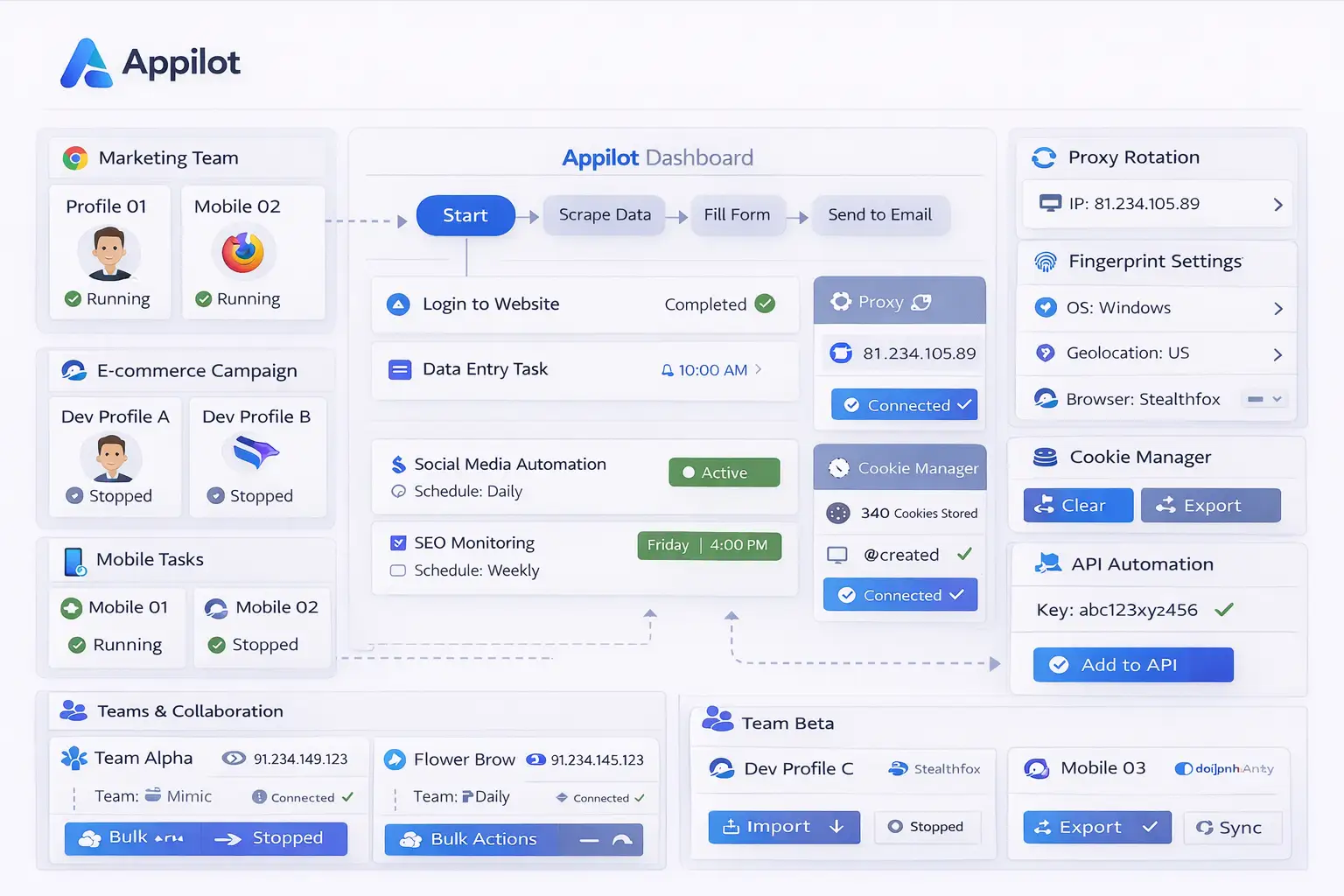
Setting Up Automated Workflows
The easiest way to start is with a simple workflow that only includes a few virtual machine environments. Begin by selecting the browser environments you want to use and assign a small number of actions.
For example, you could create a workflow that launches three FraudFox VM Browser environments every morning, opens specific websites, checks account activity, collects information, and closes the sessions afterward. Once this process works correctly, you can add more actions and expand the number of environments.
You can also build workflows around specific use cases. A social media workflow may include logging into Instagram, checking notifications, posting content, and replying to messages. An e-commerce workflow may involve opening store dashboards, reviewing orders, and exporting data. A scraping workflow may involve launching multiple browser environments with different proxies and collecting information from websites.
The key is to start with something simple and then scale up gradually once the workflows are stable.
Benefits of Automating FraudFox VM Browser Tasks
One of the biggest benefits is time savings. Tasks that may normally take several hours every day can be reduced to a few minutes of setup. Once the workflows are built, they can repeat automatically without constant manual input.
Another major benefit is consistency. Automated workflows follow the same sequence every time, which reduces the chance of mistakes. Manual work often leads to small errors such as opening the wrong environment, forgetting a proxy, or skipping an important step.
Automation also makes it easier to scale. Managing five isolated browser environments manually is possible, but managing fifty becomes much harder. Appilot helps make larger operations more manageable by organizing workflows into one central dashboard.
The centralized view also makes it easier to monitor performance. Instead of opening virtual machines individually and checking them one by one, you can see which workflows are running, which sessions failed, and which environments need attention.
Best Practices for FraudFox VM Browser Automation
The best approach is to begin with a small number of environments and test everything carefully before scaling up. This helps prevent large workflow failures and makes troubleshooting easier.
You should also use separate proxies for separate environments whenever possible. Sharing the same proxy across too many virtual machines increases the chance of account linking.
Keeping virtual machine environments organized is also important. Separate social media environments from e-commerce environments, affiliate marketing environments, crypto environments, and scraping environments so that workflows remain easier to manage.
It is also a good idea to review task logs regularly. Even if workflows are mostly automated, there will still be times when a login expires, a website changes layout, or a proxy stops working. Monitoring logs helps you catch these issues early.
Finally, avoid making workflows too complicated at the beginning. A simple workflow that works consistently is usually better than a larger workflow that fails frequently.
Common Problems and Troubleshooting
One common issue is that the virtual machine launches correctly, but the browser profile does not load the right proxy or fingerprint settings. In these cases, checking the profile configuration usually solves the problem.
Another issue is that browser tasks stop working because the target website changes its layout. If a website changes button locations, login fields, or page structures, the automation may need to be updated.
Proxy problems are also common. If a proxy becomes blocked or stops responding, browser environments may fail to load websites correctly. Testing proxies regularly helps avoid these problems.
Users sometimes also run too many virtual machines at the same time. Since FraudFox VM Browser environments can use a large amount of memory and processing power, launching too many sessions simultaneously can slow down the system.
Frequently Asked Questions
Q1: How many FraudFox VM Browser environments can I automate at once?
The number depends on your hardware resources, proxy setup, and the complexity of the workflows. Most users begin with a small number of environments and increase gradually.
Q2: Is FraudFox VM Browser better than a standard antidetect browser for isolation?
FraudFox VM Browser provides stronger separation because each browser can run inside its own virtual machine environment rather than only relying on browser profile isolation.
Q3: Can Appilot automate browser launches inside virtual machines?
Yes. Appilot can automate the workflow around launching browser environments, running tasks, collecting information, and closing sessions.
Q4: Is this setup useful for affiliate marketing and media buying?
Yes. Affiliate marketers and media buyers often use isolated browser environments to manage multiple advertising accounts and campaigns without linking them together.
Q5: Can I automate proxy rotation across virtual machine environments?
Yes. Different virtual machine environments can be configured to use different proxies so that workflows remain separated and more difficult to detect.
Conclusion
FraudFox VM Browser provides stronger account isolation through virtual machine environments, separate fingerprints, and dedicated browser sessions. Appilot adds workflow automation, scheduling, centralized task management, and profile grouping on top of that setup.
Together, they create a more efficient way to manage multiple isolated browser environments without spending hours every day repeating the same tasks manually.