Growing Instagram Organically vs Using Automation: Honest Pros and Cons
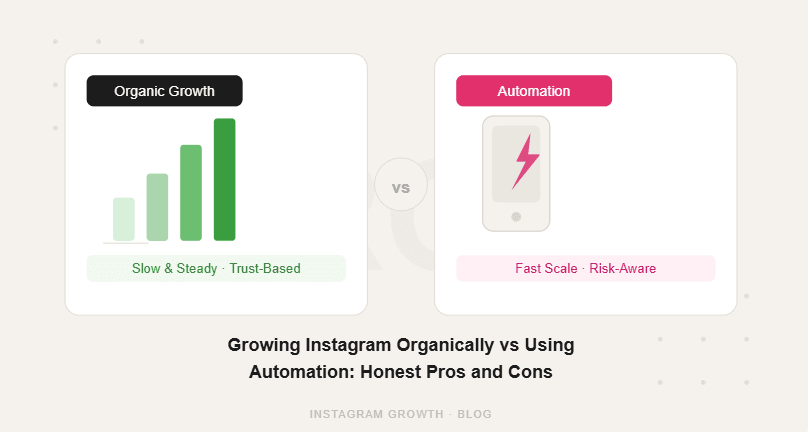
Instagram growth has always had two competing paths. One path is organic growth, where creators, brands, agencies, and businesses grow through content quality, audience relationships, consistency, community engagement, and trust. The other path is automation, where tools help reduce manual work, speed up repetitive tasks, manage workflows, and support account operations at scale.
Both approaches have advantages. Both also have problems.
Organic growth is safer and more authentic, but it can be slow, inconsistent, and demanding. Automation can save time and help teams manage more accounts, but it can become risky when used aggressively or without a clear strategy. Instagram also states that accounts can be restricted when activity goes against its terms around automated access, which means automation must be treated carefully and responsibly.
The honest answer is that neither approach is perfect by itself. The best Instagram growth strategy in 2025 is usually organic-first, supported by careful automation for workflow efficiency, not artificial engagement. Instagram’s own creator guidance emphasizes creating engaging content that resonates with the audience, which shows why real content and audience relevance still matter most.
What Organic Instagram Growth Really Means
Organic Instagram growth means growing without relying on paid ads, aggressive bots, fake engagement, mass follow/unfollow activity, or artificial shortcuts. It usually comes from consistent content, strong positioning, valuable posts, Reels, carousels, Stories, DMs, comments, collaborations, and audience trust.
Organic growth is not just “posting and hoping.” A serious organic strategy includes understanding the target audience, creating content that solves problems or entertains, testing hooks, improving visuals, posting consistently, responding to comments, building relationships, and reviewing performance data.
For example, a fitness coach growing organically might post workout Reels, client transformation stories, meal prep tips, educational carousels, and Q&A Stories. Over time, the audience starts trusting the account because the content provides value. That trust can turn into followers, DMs, leads, and customers.
Organic growth is slower than many automation tactics, but it usually builds a stronger foundation.
What Instagram Automation Really Means
Instagram automation means using tools to reduce manual work or repeat certain workflows. This can include scheduling posts, managing DMs, replying to comments, monitoring accounts, handling repetitive mobile app tasks, organizing multi-account workflows, or supporting engagement operations.
Not all automation is the same. Scheduling a post is very different from mass-following hundreds of users. A comment-to-DM workflow is very different from spam messaging. Real-device workflow automation is different from browser-only botting. Automation can be helpful or harmful depending on how it is used.
Safe automation supports real workflows. Risky automation tries to fake popularity, force engagement, or perform unnatural actions at scale. That difference matters.
For example, using automation to schedule posts, deliver a requested guide in DMs, or manage repetitive mobile workflows is usually more practical than using automation to spam follows, comments, or messages.
Pros of Growing Instagram Organically
The biggest advantage of organic growth is trust. When people follow because they actually like the content, they are more likely to watch Reels, save posts, reply to Stories, comment naturally, share content, and eventually buy or inquire.
Organic growth also builds a healthier audience. Followers gained through strong content are usually more relevant than followers gained through random automation. A smaller audience that cares can be more valuable than a large audience that ignores every post.
Another advantage is long-term account safety. Organic growth does not depend on suspicious activity patterns. It is more aligned with how Instagram wants creators and businesses to use the platform. Instagram’s creator resources focus on growing by making engaging content that resonates with people, not by forcing artificial activity.
Organic growth also improves brand perception. A creator or business that grows through useful content, real replies, and genuine community feels more credible than one that relies on obvious growth hacks.
Cons of Growing Instagram Organically
The biggest downside of organic growth is speed. It can take months to build momentum, especially in competitive niches. Some posts may perform well, while others fail without a clear reason.
Organic growth also requires consistency. You need to create, edit, post, test, reply, analyze, and improve. For business owners, agencies, and creators, this can become exhausting.
Another problem is unpredictability. Instagram reach can fluctuate. A post that took hours to create may get weak engagement, while a simple Reel may perform better. This can make organic growth frustrating.
Organic growth also needs skill. Good hooks, strong visuals, clear captions, Reels pacing, storytelling, offers, profile optimization, and audience research all matter. Posting randomly is not enough.
Pros of Using Instagram Automation
The biggest advantage of automation is efficiency. It can save time on repetitive work like scheduling, responding to common messages, organizing workflows, checking accounts, or managing multiple profiles.
Automation is especially useful for agencies and teams. A person managing one account may be able to do everything manually, but a team managing 20 or 50 accounts needs systems. Automation helps reduce manual switching, missed replies, and inconsistent execution.
Automation can also improve response speed. For example, DM automation can instantly send a guide, link, discount code, or booking step when someone comments a keyword. This can increase conversions because interested users receive the next step immediately.
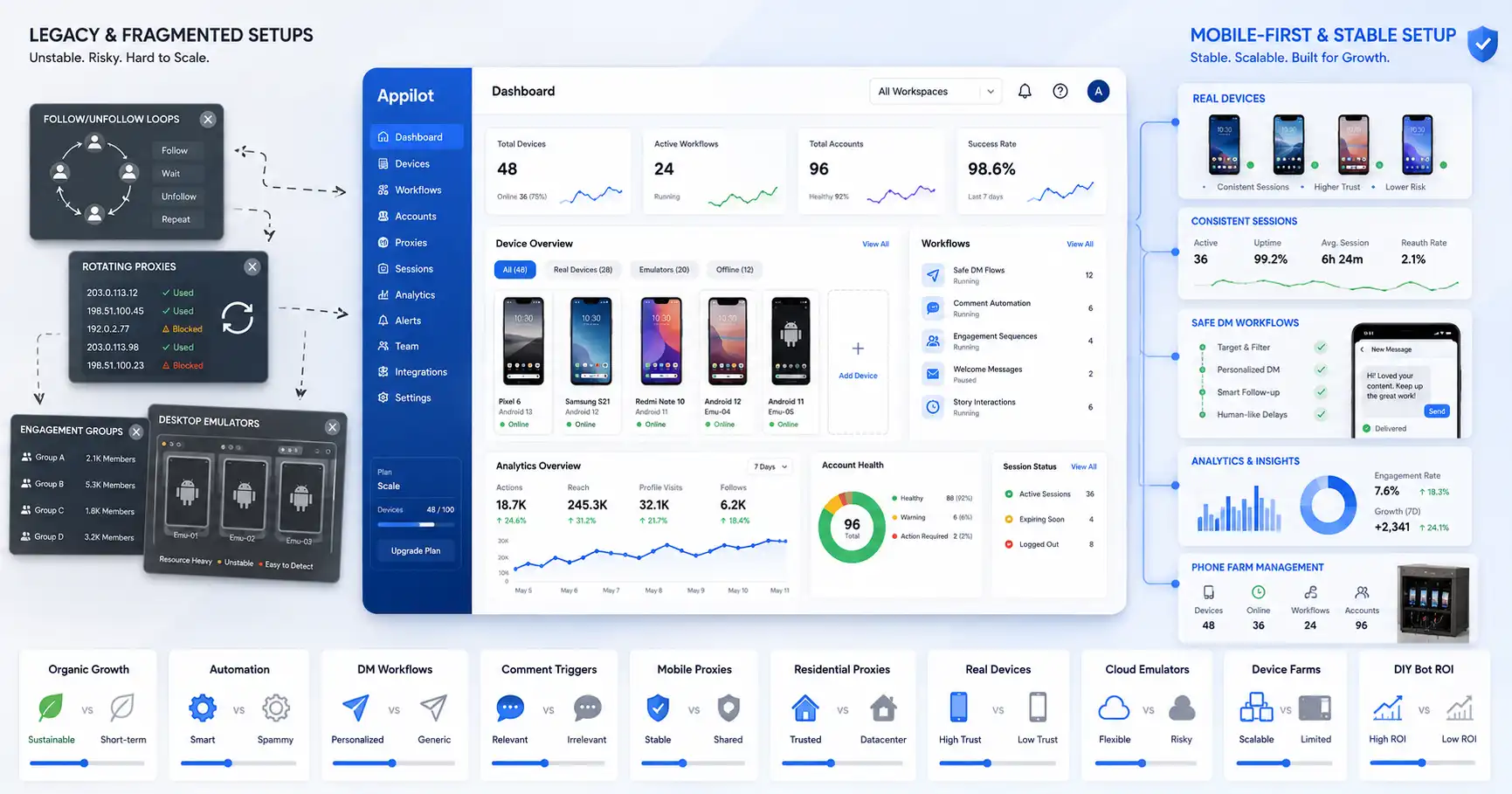
For mobile-first workflows, real-device automation can also help teams manage app-based tasks more efficiently. This is where Appilot fits well. Appilot helps teams control Android devices, emulators, and mobile workflows from a web dashboard, making it useful for agencies, phone farm users, and multi-account operators who need more than simple scheduling.
Cons of Using Instagram Automation
The biggest downside of automation is risk when it is misused. If automation performs too many actions, sends repetitive messages, comments unnaturally, follows aggressively, or creates suspicious account behavior, it can harm the account.
Instagram can restrict accounts when it detects activity that violates its rules around automated access or scraping behavior. This means automation should never be treated as a shortcut to spam or manipulate engagement.
Automation can also damage brand trust. If users receive robotic DMs, generic comments, or obvious bot interactions, they may lose interest quickly. A bad automation flow can make a brand feel less human.
Another issue is overdependence. Some users rely on automation instead of improving their content, offer, profile, or audience targeting. Automation cannot fix weak positioning. It can only support a workflow that already makes sense.
Organic Growth vs Automation: Which Is Better?
Organic growth is better for long-term trust, audience quality, brand strength, and account health. Automation is better for efficiency, repeatable workflows, multi-account management, and faster response handling.
So the better question is not “organic growth or automation?” The better question is “what should be organic, and what should be automated?”
Content strategy should be organic. Audience understanding should be organic. Brand voice should be organic. Real conversations should stay human when they matter. But repetitive workflow tasks can be automated carefully.
For example, a creator should personally define the content message, but automation can help schedule the post. A brand should create a real offer, but automation can send the offer link when someone requests it. An agency should build a growth strategy, but Appilot can help manage mobile workflows across devices.
The strongest Instagram growth strategy combines both approaches.
When Organic Growth Is the Better Choice
Organic growth is the better choice when the account is new, brand trust matters, the niche depends on credibility, or the business wants long-term customer relationships.
It is also better when the account has not yet figured out its content-market fit. If the content is not resonating, automation will not solve the real problem. The account needs better hooks, better topics, better visuals, clearer offers, and stronger audience understanding.
Organic growth is also the right choice for personal brands. If a coach, consultant, founder, creator, or service provider relies on trust, obvious automation can hurt more than it helps.
When Automation Is the Better Choice
Automation is useful when the workflow is repetitive, predictable, and not sensitive. Scheduling posts, organizing DMs, sending requested resources, managing account checks, monitoring workflows, and handling multi-account operations are good examples.
Automation is also useful for agencies. When managing many accounts, manual work becomes inefficient. Tools can help teams stay organized and avoid operational chaos.
Automation is better when it supports real interest. For example, comment-to-DM automation works well because the user asks for something first. That is very different from sending unsolicited spam messages.
Automation should be used to improve speed and consistency, not to fake engagement.
Where Appilot Fits Into the Organic vs Automation Debate
Appilot fits the middle ground between manual organic work and risky automation. It is designed for real-device mobile workflows, Android devices, emulators, and multi-account operations from a web dashboard.
For teams growing Instagram organically, Appilot can support the operational layer. A team can still create real content, build real audience relationships, and use authentic growth strategies, while Appilot helps manage repetitive app-based workflows across devices.
This matters because Instagram is mobile-first. Many workflows happen inside the app, not only inside a content scheduler. Agencies and operators may need to manage DMs, account checks, app actions, device sessions, and multi-account tasks. Appilot gives teams a mobile-first workflow layer for those operations.
The best use of Appilot is not aggressive spam automation. The best use is controlled workflow support, real-device execution, and better operational management for teams that already care about account quality.
The Best Hybrid Strategy
The best strategy is organic-first automation. This means the content, audience, offer, and brand relationship stay real, while automation supports the repetitive parts.
A strong hybrid workflow might look like this: create useful Reels and carousels, post consistently, use comment-to-DM automation for requested resources, use scheduling tools for planning, use Appilot for mobile workflow management, and use analytics to improve future content.
This kind of system is safer because it does not rely on fake engagement. It uses automation to help real content perform better and to help interested users move faster toward the next step.
The goal is not to replace human connection. The goal is to remove repetitive work so the team can focus more on strategy, content, and real conversations.
Common Mistakes to Avoid
The first mistake is using automation before fixing the content. If the profile is weak, the offer is unclear, or the posts do not resonate, automation will only create more activity around a weak foundation.
The second mistake is automating too aggressively. More actions do not always mean more growth. Too much automation can create account friction and damage trust.
The third mistake is using generic DMs and comments. Automation should feel helpful and relevant. If every message sounds robotic, users will notice.
The fourth mistake is ignoring analytics. Organic growth and automation both need measurement. Track what content creates saves, shares, comments, DMs, leads, and sales.
The fifth mistake is treating all Instagram accounts the same. A creator, ecommerce store, local business, SaaS brand, and agency client may all need different workflows.
Final Verdict
Organic Instagram growth is better for building trust, long-term audience quality, and brand strength. Automation is better for saving time, improving workflow consistency, managing multiple accounts, and responding faster to interested users.
The best approach is not choosing one side completely. The best approach is using organic growth as the foundation and automation as the support system.
Create real content. Build real relationships. Study your audience. Improve your offer. Then use automation carefully for scheduling, DM delivery, comment triggers, account operations, and mobile workflow management.
For teams that need mobile-first automation, Appilot provides a stronger operational layer by helping manage Android devices, emulators, and Instagram workflows from one dashboard. Used responsibly, it can support organic growth without replacing the human strategy behind it.
FAQs
Q1: Is organic Instagram growth better than automation?
Organic growth is better for long-term trust, audience quality, and brand reputation. Automation is better for saving time and managing repetitive workflows.
Q2: Is Instagram automation risky?
Automation can be risky if used aggressively for spam, mass actions, fake engagement, or repetitive behavior. It is safer when used for workflow support and user-requested interactions.
Q3: Can automation help organic Instagram growth?
Yes, automation can support organic growth by helping with scheduling, DMs, comment triggers, account checks, and multi-account workflow management.
Q4: What is the safest way to use Instagram automation?
The safest way is to automate repetitive support tasks while keeping content, strategy, offers, and important conversations human and authentic.
Q5: How does Appilot help with Instagram growth?
Appilot helps teams manage real-device Instagram workflows across Android devices and emulators, making it useful for mobile-first operations, agencies, and multi-account teams.