Hardware Fingerprinting: CPU, RAM, and Device Detection

Most users assume tracking happens at the browser level, but modern systems go deeper and analyze the underlying hardware itself. Even if you change browsers, clear cookies, or rotate IP addresses, your device can still be identified through its physical characteristics. This approach is known as hardware fingerprinting.
Understanding hardware fingerprinting is important because it represents one of the most persistent and difficult-to-avoid tracking methods. It also explains why many detection systems are able to identify users even when they attempt to mask their identity. This guide explains hardware fingerprinting, how it works, and why it matters in real-world scenarios.
What Is Hardware Fingerprinting?
Hardware fingerprinting is a technique used to identify users based on characteristics of their physical device, such as CPU behavior, memory configuration, and system performance patterns. Unlike browser-based fingerprinting, which relies on software-level signals, hardware fingerprinting focuses on attributes that are tied directly to the device itself.
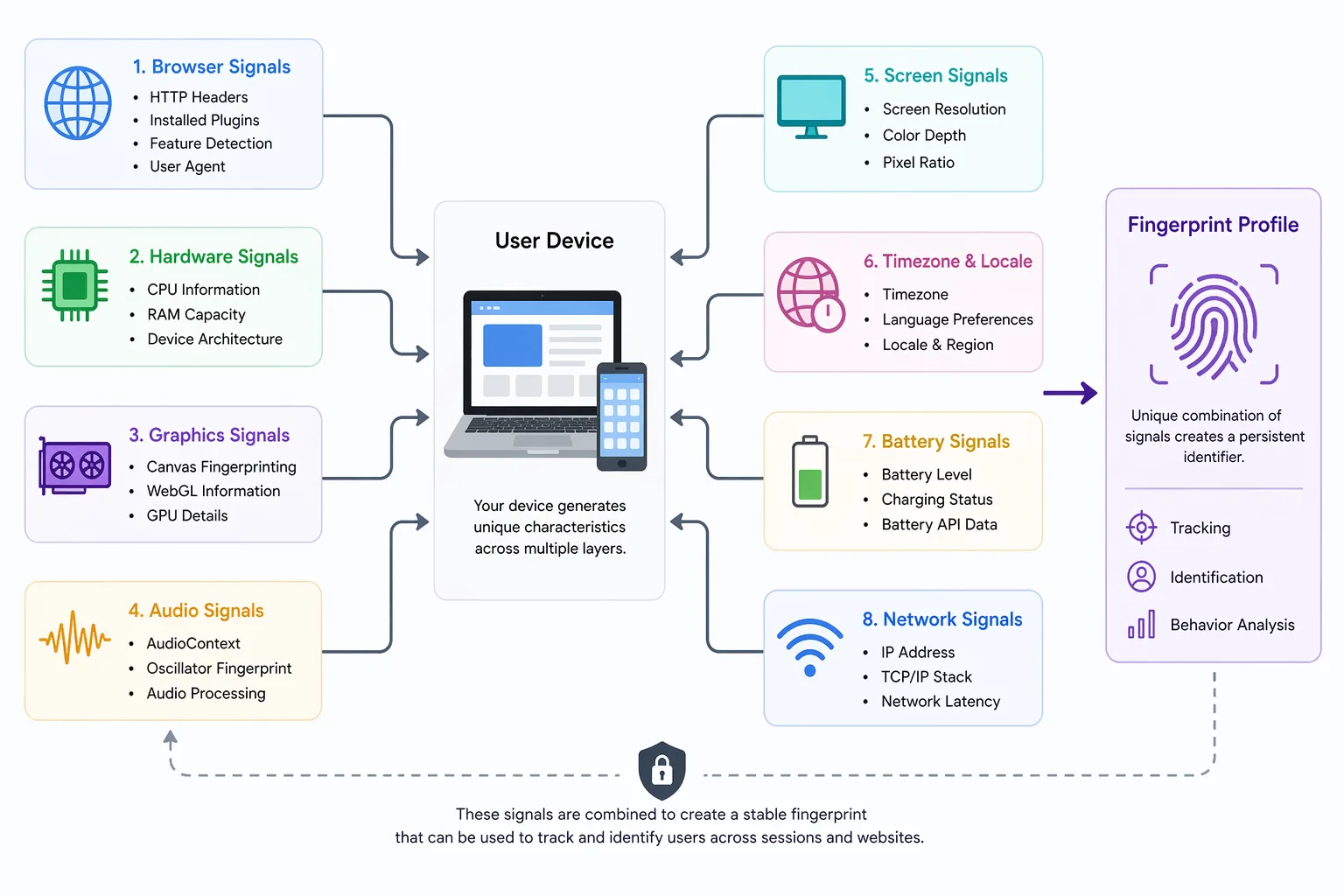
Websites and platforms collect this information indirectly through browser APIs and system behavior. For example, they may analyze processing speed, memory availability, or how the device handles certain computations. These signals are then combined to form a profile that represents the device.
Because hardware characteristics change less frequently than software settings, hardware fingerprinting is considered more stable and persistent. This makes it a powerful signal in fingerprint detection systems.
The Core Principle Behind Hardware Fingerprinting
The core principle behind hardware fingerprinting is that no two devices behave exactly the same, even if they have similar specifications. Small differences in CPU performance, memory handling, and system timing create unique patterns that can be measured.
For example, the way a CPU processes floating-point calculations or the way memory is allocated can vary slightly across devices. These variations may seem insignificant, but when combined, they create a distinctive signature.
This approach relies on behavior rather than static values, which makes it more difficult to manipulate or replicate. As a result, hardware fingerprinting provides high entropy and strong identifying power.
How Hardware Fingerprinting Differs from Browser Fingerprinting
Hardware fingerprinting differs from browser fingerprinting in terms of depth and persistence. Browser fingerprinting focuses on attributes such as screen resolution, fonts, and rendering behavior, while hardware fingerprinting analyzes the underlying system itself.
A useful way to understand the difference is to think of browser fingerprinting as identifying the environment around the device, while hardware fingerprinting identifies the device at its core. Because hardware signals are harder to change, they provide a more stable form of identification.
Why Hardware Fingerprinting Matters
Hardware fingerprinting matters because it enables identification at a level that is difficult to reset or disguise. It plays a critical role in systems that require high accuracy, such as fraud detection, security monitoring, and bot prevention.
In fraud detection systems, hardware fingerprinting helps identify patterns across accounts and sessions by linking activities that share similar device characteristics. This allows platforms to detect suspicious behavior even when other signals, such as IP addresses, are changed.
From a privacy perspective, hardware fingerprinting raises significant concerns because it operates passively and is difficult for users to control. Unlike cookies, which can be deleted, hardware characteristics remain consistent over time, making tracking more persistent.
For developers building automation systems, hardware fingerprinting introduces a major challenge. If the device behavior appears artificial or inconsistent, detection systems can flag the activity. This is why using realistic environments is essential when designing automation workflows.
How Hardware Fingerprinting Works in Practice
Hardware fingerprinting works by collecting system-level signals, analyzing behavior, and generating a unique profile.
Collecting Hardware Signals
When a user interacts with a website, scripts collect information about the device’s capabilities and performance. This may include CPU-related data such as processing speed, number of cores, and execution timing, as well as memory-related data such as available RAM and allocation patterns.
Although browsers do not expose all hardware details directly, enough information can be inferred through APIs and performance measurements to build a meaningful profile.
Measuring System Behavior
Beyond static attributes, hardware fingerprinting relies heavily on behavioral analysis. Websites may run computational tasks and measure how long they take to execute, or analyze how the system handles memory allocation and garbage collection.
These measurements reveal patterns that depend on the underlying hardware, creating a unique behavioral signature. Because these patterns are difficult to replicate artificially, they provide strong identifying power.
Building and Matching the Device Profile
The collected data is combined into a profile that represents the device. This profile can be stored or compared across sessions to identify returning users.
Because hardware characteristics change infrequently, this profile remains relatively stable over time, making it a reliable signal for long-term tracking and detection.
Common Misconceptions About Hardware Fingerprinting
There are several misconceptions about hardware fingerprinting that can lead to misunderstandings about how it works.
One common belief is that changing browsers prevents tracking, but hardware fingerprinting operates independently of the browser and continues to function regardless of which browser is used.
Another misconception is that using a VPN or proxy prevents identification. While these tools change network-level signals, they do not affect the underlying hardware characteristics that are used in fingerprinting.
There is also a belief that hardware fingerprinting is always perfectly accurate, but like other fingerprinting methods, it is probabilistic. While it provides strong identifying power, it is not guaranteed to uniquely identify every device in all situations.
Real-World Examples of Hardware Fingerprinting
Hardware fingerprinting is widely used in systems that require accurate identification and detection.
In financial platforms, it helps detect fraudulent behavior by linking activities that share similar hardware characteristics. This allows systems to identify suspicious patterns even when other signals change.
In social media environments, hardware fingerprinting contributes to detecting automated behavior. Platforms analyze device-level signals alongside other attributes to identify bots. Tools like Appilot help address this challenge by running automation on real Android devices, which produce authentic hardware signals instead of synthetic ones that are easier to detect.
In analytics and tracking systems, hardware fingerprinting helps maintain continuity in identifying users across sessions. Even when other identifiers are reset, the device profile can remain consistent.
The Technical Side of Hardware Fingerprinting
From a technical perspective, hardware fingerprinting relies on entropy, which measures how much identifying power a signal provides. Behavioral signals derived from CPU and memory performance have high entropy because they vary across devices.
The process involves collecting performance data, analyzing patterns, and combining the results into a structured profile. This profile can be stored or hashed for efficient comparison.
Understanding these technical details helps explain why hardware fingerprinting is effective and why it is difficult to bypass using simple methods.
When Hardware Fingerprinting Applies
Hardware fingerprinting becomes especially relevant in scenarios where accurate and persistent identification is required.
It is critical when building automation systems, where maintaining realistic device behavior is necessary to avoid detection. It is also important in fraud prevention systems, where identifying suspicious activity can protect platforms from abuse. In privacy-sensitive applications, understanding hardware fingerprinting helps developers design systems that better account for tracking risks.
Frequently Asked Questions
Q: How does hardware fingerprinting work?
It works by collecting and analyzing system-level signals such as CPU performance and memory behavior to create a unique device profile.
Q: What is hardware fingerprinting used for?
It is used for fraud detection, security monitoring, and identifying users across sessions.
Q: Can you block hardware fingerprinting?
You can reduce its effectiveness with privacy tools, but it is difficult to fully block because it relies on core device behavior.
Q: Is hardware fingerprinting accurate?
It is highly effective but not perfect, as it relies on probabilistic identification rather than exact matching.
Q: Does changing devices stop hardware fingerprinting?
Yes, switching to a different device changes the hardware profile, which can prevent identification.
Q: How does hardware fingerprinting affect automation tools?
It can expose automation systems if their device behavior appears artificial. Tools that use real-device environments, such as Appilot, tend to produce more reliable results because they generate authentic hardware signals.
Key Takeaways
Hardware fingerprinting is a powerful technique that identifies users based on the physical characteristics and behavior of their device, and it plays a central role in modern detection systems. It works by analyzing CPU performance, memory behavior, and system-level patterns to create a stable device profile that persists across sessions. Because it relies on underlying hardware rather than software settings, it is more difficult to reset or manipulate, making it an essential concept for understanding how advanced tracking and detection systems operate.