Understanding hCaptcha vs reCAPTCHA

As websites continue to defend against automated traffic, CAPTCHA systems remain one of the most visible layers of bot detection. Two of the most widely used solutions today are hCaptcha and reCAPTCHA. While both serve the same purpose, they differ in how they operate, what signals they use, and how they balance security with user experience.
Understanding the differences between hCaptcha and reCAPTCHA is important because they are encountered frequently in login forms, sign-ups, and checkout flows. This guide explains how each system works and how they compare.
What Is reCAPTCHA?
reCAPTCHA is a bot detection system developed by Google that verifies whether a user is human through behavioral analysis and risk scoring. It operates in multiple versions, including visible challenges and invisible background checks.
Instead of always requiring user interaction, reCAPTCHA evaluates signals such as behavior, browser data, and network context to determine whether a request is legitimate.
It is widely used due to its integration with Google’s ecosystem and data intelligence.
How reCAPTCHA Works
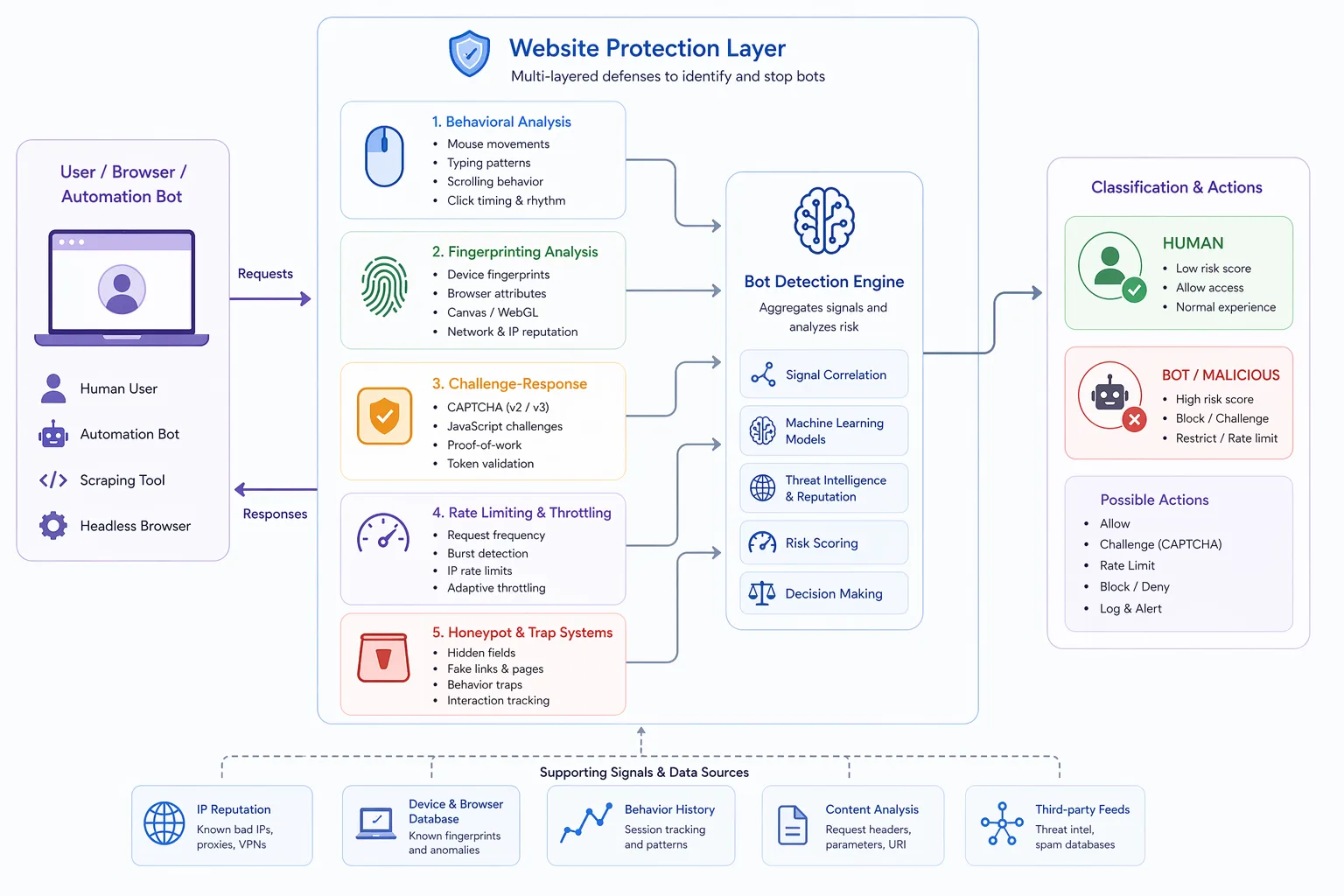
reCAPTCHA analyzes user behavior, including mouse movements, typing patterns, and interaction timing. It also collects browser and device data to detect inconsistencies.
In newer versions like v3, it assigns a score to each interaction and allows websites to decide how to respond based on that score.
This approach reduces friction for real users while maintaining strong detection capabilities.
What Is hCaptcha?
hCaptcha is a bot detection system that provides similar functionality to reCAPTCHA but with a stronger emphasis on privacy and independence from large data ecosystems.
It verifies users through challenges and behavioral analysis, often requiring users to solve image-based tasks.
hCaptcha is designed to give websites more control over data usage while still providing effective bot protection.
How hCaptcha Works
hCaptcha presents challenges that require users to identify objects in images or complete tasks. These challenges are used to verify human interaction.
It also analyzes behavior and environment signals, similar to reCAPTCHA, but relies less on external data sources.
This makes it appealing to platforms that prioritize privacy.
Key Differences Between hCaptcha and reCAPTCHA
The primary difference between hCaptcha and reCAPTCHA lies in their approach to data and detection.
reCAPTCHA leverages Google’s vast data ecosystem to improve accuracy, while hCaptcha focuses on privacy and independence. This affects how each system evaluates risk and user behavior.
reCAPTCHA often provides a smoother user experience with fewer visible challenges, especially in its newer versions. hCaptcha, on the other hand, may present more frequent challenges but gives websites more control over data usage.
Both systems use behavioral analysis and environmental signals, but their implementation differs.
Accuracy and Detection Capabilities
reCAPTCHA benefits from large-scale data analysis, which can improve detection accuracy. It can identify patterns across multiple platforms and sessions.
hCaptcha relies more on direct interaction and challenge-based verification. While effective, it may require more user input to achieve the same level of confidence.
Both systems are capable of detecting advanced automation, but their methods differ.
User Experience Differences
User experience is a key factor in choosing between hCaptcha and reCAPTCHA.
reCAPTCHA often operates invisibly, allowing users to pass without interruption unless risk is detected. This creates a smoother experience.
hCaptcha may require users to complete challenges more frequently, which can add friction but increases transparency.
The choice depends on the balance between usability and control.
Privacy Considerations
Privacy is one of the main reasons some platforms choose hCaptcha over reCAPTCHA.
reCAPTCHA collects data as part of Google’s broader ecosystem, which may raise concerns for privacy-focused applications.
hCaptcha is designed to minimize reliance on external data and provide more control over how information is used.
This makes it a preferred option in environments where privacy is a priority.
hCaptcha vs reCAPTCHA in Bot Detection Context
Both systems use multi-layered detection, including behavior, browser signals, and network data.
However, reCAPTCHA places more emphasis on risk scoring and background analysis, while hCaptcha relies more on direct verification through challenges.
This difference affects how each system responds to suspicious activity.
Limitations of Both Systems
Both hCaptcha and reCAPTCHA have limitations.
False positives can occur, where legitimate users are asked to complete challenges unnecessarily.
Challenges can also impact accessibility, especially for users who have difficulty with visual tasks.
Additionally, as automation techniques improve, both systems must continuously evolve.
hCaptcha vs reCAPTCHA vs Real-Device Environments
A key distinction in modern detection is the difference between simulated behavior and natural behavior.
Both hCaptcha and reCAPTCHA analyze multiple signals, and inconsistencies in simulated environments can be detected even if individual signals appear correct.
Real-device approaches operate on actual hardware where signals naturally align. Tools like Appilot follow this approach by running automation on real Android devices, where behavior, browser data, and network signals reflect real-world usage.
This reduces reliance on solving or bypassing challenges.
When to Choose hCaptcha vs reCAPTCHA
Choosing between hCaptcha and reCAPTCHA depends on the priorities of the platform.
If ease of use and minimal friction are important, reCAPTCHA may be the better choice. If privacy and control over data are priorities, hCaptcha may be more suitable.
Both systems provide strong protection, but their trade-offs differ.
Frequently Asked Questions
Q: What is the main difference between hCaptcha and reCAPTCHA?
reCAPTCHA uses Google’s data for risk scoring, while hCaptcha focuses on privacy and challenge-based verification.
Q: Which is more user-friendly?
reCAPTCHA is generally smoother due to fewer visible challenges.
Q: Which is better for privacy?
hCaptcha is designed to prioritize privacy and reduce data sharing.
Q: Are both systems effective against bots?
Yes, both use multi-layered detection methods.
Q: Can they be bypassed completely?
No, detection risk can be reduced but not eliminated.
Q: How do real-device solutions compare?
Real-device solutions like Appilot align signals naturally, reducing reliance on CAPTCHA challenges.
Key Takeaways
hCaptcha and reCAPTCHA are both CAPTCHA-based bot detection systems that use behavioral analysis and environmental signals to distinguish humans from bots. reCAPTCHA leverages Google’s data ecosystem to provide smooth and accurate detection, while hCaptcha focuses on privacy and challenge-based verification. Each system has its own strengths and limitations, and the choice between them depends on the balance between user experience, privacy, and detection requirements.