What Is Honeypot Detection? Hidden Form Fields Explained

What Is Honeypot Detection? Hidden Form Fields Explained
URL Slug: /honeypot-detection-hidden-fields
Meta Description: Learn how honeypot detection works using hidden fields to trap bots and prevent automated form submissions.
As websites look for simple yet effective ways to block bots, one technique that remains widely used is honeypot detection. Unlike complex systems that rely on behavioral analysis or fingerprinting, honeypots use deception to identify automated activity.
This method works by placing hidden elements in forms that real users never interact with, but bots often do. By monitoring how these elements are handled, websites can quickly detect automation. This guide explains how honeypot detection works and why it is effective.
What Is Honeypot Detection?
Honeypot detection is a technique used to identify bots by embedding hidden fields or elements within a webpage. These elements are invisible to human users but detectable by automated scripts.
When a bot interacts with these hidden fields, it reveals itself as non-human.
The system then uses this signal to block or flag the request.
The Core Principle Behind Honeypots
The core principle behind honeypot detection is deception. Instead of actively testing the user, the system sets a trap that only bots are likely to trigger.
Human users do not see or interact with hidden fields, while bots that scan and fill all form inputs may unknowingly complete them.
This difference allows websites to identify automation with minimal effort.
How Honeypot Detection Works
Honeypot systems are implemented directly within web forms.
Hidden Input Fields
Developers add input fields that are hidden using CSS or other techniques.
These fields are not visible to users but remain in the HTML structure.
Bots that automatically fill all fields may populate these hidden inputs.
Field Validation
When the form is submitted, the system checks whether the hidden fields contain any data.
If a hidden field is filled, it is a strong indicator that the submission is automated.
The request can then be rejected or flagged.
Timing-Based Honeypots
Some honeypot systems also track how quickly a form is submitted.
Humans take time to read and fill out forms, while bots may submit them instantly.
Submissions that occur too quickly can be flagged as suspicious.
JavaScript-Based Honeypots
Advanced honeypots may use JavaScript to dynamically create or modify hidden fields.
Bots that do not execute JavaScript correctly may fail these checks.
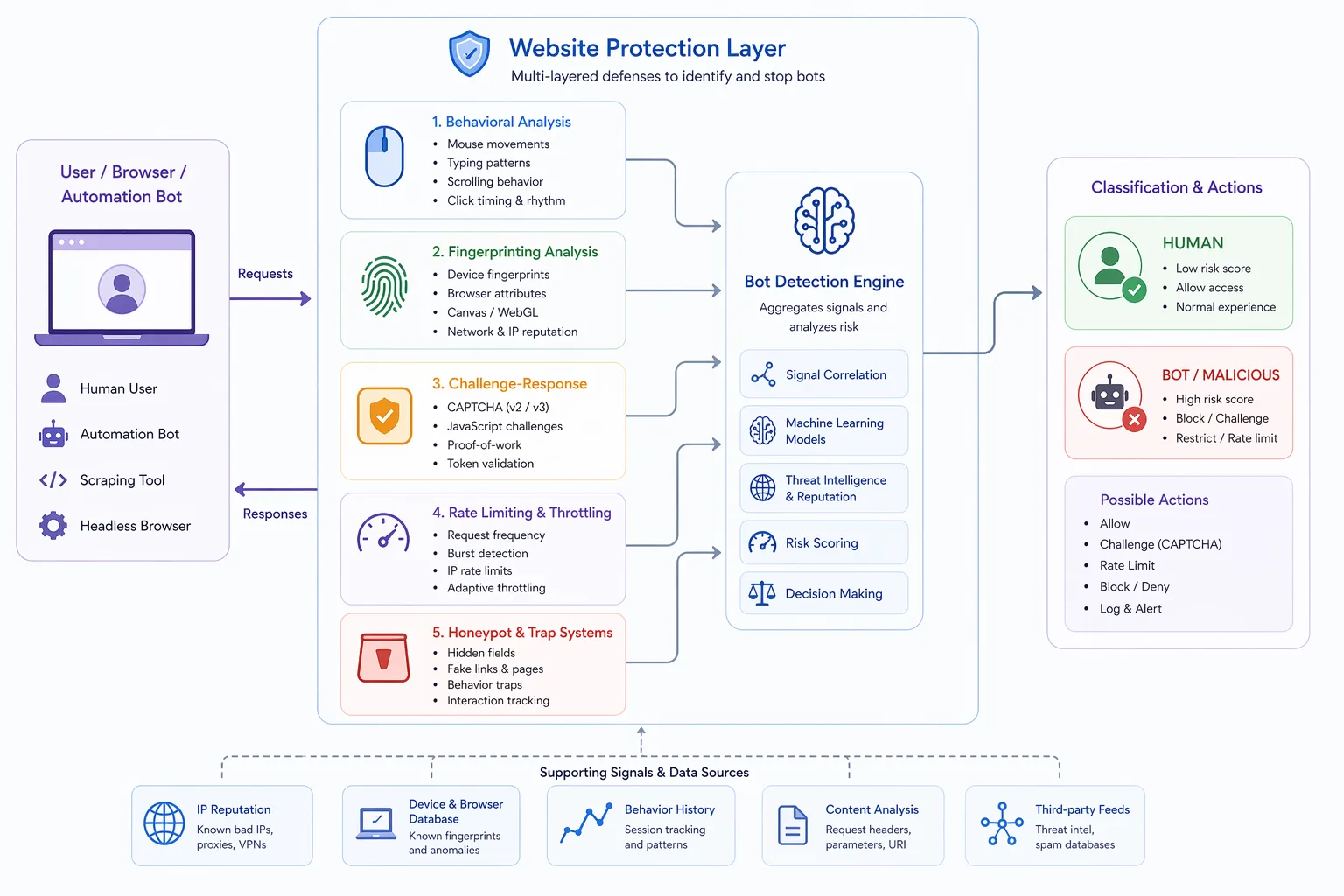
Why Honeypot Detection Matters
Honeypot detection is important because it provides a low-cost and low-friction way to detect bots.
It does not require user interaction, making it invisible to legitimate users.
It is also easy to implement and can be combined with other detection methods.
While simple, it is effective against basic automation.
Common Honeypot Techniques
Websites use different variations of honeypot detection.
Hidden fields are the most common, but other techniques include invisible links and fake buttons.
Some systems randomize field names to prevent bots from recognizing them.
Others combine honeypots with timing checks to improve accuracy.
These variations make detection more robust.
Honeypot Detection vs CAPTCHA
Honeypots differ from CAPTCHAs in that they do not require user interaction.
CAPTCHAs actively challenge users, while honeypots passively detect bots.
This makes honeypots less intrusive but also less effective against advanced automation.
Both methods are often used together.
Limitations of Honeypot Detection
Despite its simplicity, honeypot detection has limitations.
Advanced bots can be programmed to ignore hidden fields.
False positives can occur if accessibility tools interact with hidden elements.
Honeypots also do not analyze behavior or environment, limiting their effectiveness against sophisticated bots.
These limitations require additional detection layers.
Honeypot Detection vs Behavioral Analysis
Honeypot detection focuses on specific traps, while behavioral analysis evaluates interaction patterns over time.
Behavioral analysis provides deeper insights but requires more complex systems.
Honeypots are simpler and faster to implement.
Combining both methods improves overall detection.
Honeypot Detection vs Real-Device Environments
A key distinction in modern detection is the difference between naive automation and more advanced environments.
Honeypot detection is most effective against simple bots that do not account for hidden elements.
Real-device approaches operate on actual interfaces where interactions are driven by visible elements. Tools like Appilot follow this approach by running automation on real Android devices, where interactions naturally avoid hidden fields because they are not part of the visible UI.
This reduces the likelihood of triggering honeypots.
When Honeypot Detection Is Most Effective
Honeypot detection is most effective in scenarios involving form submissions.
This includes contact forms, registration pages, and comment sections.
In these contexts, bots often attempt to submit data automatically, making honeypots a useful filter.
Understanding this helps in applying honeypots effectively.
Frequently Asked Questions
Q: What is honeypot detection?
It is a method of detecting bots using hidden fields in forms.
Q: How does a honeypot work?
It traps bots by detecting interaction with invisible elements.
Q: Do users see honeypot fields?
No, they are hidden from human users.
Q: Can bots avoid honeypots?
Advanced bots can be programmed to ignore them.
Q: Is honeypot detection enough on its own?
No, it works best when combined with other methods.
Q: How do real-device solutions compare?
Real-device solutions like Appilot naturally interact only with visible elements, reducing the chance of triggering honeypots.
Key Takeaways
Honeypot detection is a simple and effective bot prevention technique that uses hidden fields to trap automated systems. By detecting interactions with elements that humans cannot see, it can identify bots without disrupting user experience. While it has limitations and can be bypassed by advanced automation, it remains a valuable first layer of defense when combined with other detection methods.