How Antidetect Browsers Work: Technical Breakdown

Most explanations of antidetect browsers focus on what they do, but very few explain how they actually work under the hood. Modern tracking systems rely on dozens of signals across different layers, and antidetect browsers attempt to manipulate many of these at once. Understanding the technical breakdown is important because it reveals both their strengths and their limitations.
This guide explains how antidetect browsers work at a deeper level, including how they modify fingerprints, isolate profiles, and interact with detection systems.
The Core Idea Behind Antidetect Browsers
At a technical level, antidetect browsers are built around one goal: to make each browsing session appear as a completely different user. This is done by controlling and modifying the signals that websites use for fingerprinting.
Instead of relying on default browser behavior, antidetect browsers intercept and override values returned by browser APIs. These values include information about the device, environment, and capabilities.
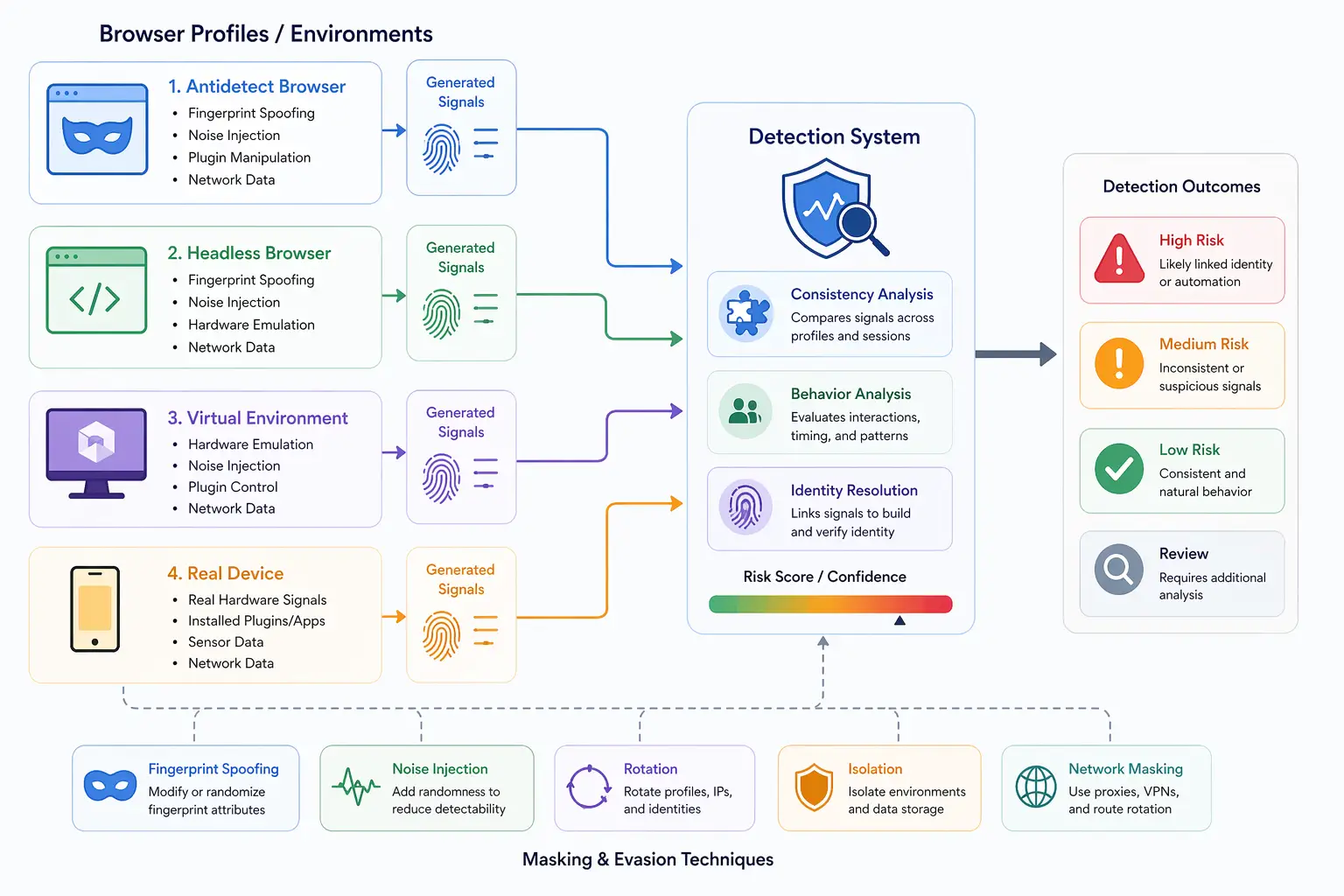
The challenge is not just changing these values, but ensuring they remain consistent across all layers. Detection systems are designed to identify mismatches, so the effectiveness of an antidetect browser depends heavily on how well it maintains coherence.
Profile Isolation Architecture
One of the foundational components of an antidetect browser is its profile system. Each profile is designed to function as an independent environment with its own storage, configuration, and identity.
When a profile is created, it is assigned its own cookies, local storage, cache, and session data. This ensures that activities in one profile do not leak into another. From a technical perspective, this isolation is similar to running multiple browser instances, each with a separate user directory.
This architecture allows users to manage multiple accounts simultaneously without direct data overlap. However, isolation alone does not prevent fingerprint linkage if the underlying signals remain similar.
Fingerprint Spoofing Mechanisms
The most critical component of an antidetect browser is its ability to spoof fingerprinting signals. This involves modifying the output of various browser APIs that websites use for detection.
At the JavaScript level, antidetect browsers override properties such as navigator.userAgent, screen dimensions, timezone, and language settings. These values are returned to websites when scripts query the browser.
More advanced implementations also modify APIs related to canvas, WebGL, and audio processing. This may involve injecting noise into rendering outputs or altering how data is returned.
While this approach provides flexibility, it introduces risk. If the spoofed values do not align with actual behavior, detection systems can identify inconsistencies.
Handling Rendering-Based Fingerprints
Rendering-based fingerprinting methods, such as canvas and WebGL, are particularly challenging to spoof because they depend on real hardware behavior.
Antidetect browsers typically address this by modifying the output of rendering APIs. For example, they may add slight noise to canvas data or adjust WebGL parameters to produce different results.
However, these modifications can sometimes appear artificial. Detection systems can analyze patterns in rendering output to determine whether it has been manipulated.
This is one of the reasons why purely simulated environments struggle to match the consistency of real devices.
Network and Proxy Integration
Antidetect browsers are often used in combination with proxies to manage network identity. Each profile can be assigned a different proxy, allowing requests to originate from different IP addresses.
From a technical standpoint, this involves routing traffic through proxy servers and ensuring that network-level signals align with the browser profile.
However, proxies only affect network-level data. They do not influence browser or hardware-level signals, which must still be handled separately.
HTTP Header Manipulation
Another important aspect of antidetect browsers is the ability to modify HTTP headers. These headers provide information about the browser and device in every request.
Antidetect browsers adjust headers such as User-Agent, Accept-Language, and others to match the configured profile. This helps create a consistent identity at the network level.
The challenge is ensuring that header values align with JavaScript-exposed values. Any mismatch between headers and browser behavior can be detected.
Consistency Across Signals
One of the biggest technical challenges in antidetect browsers is maintaining consistency across all signals. Changing individual attributes is relatively easy, but ensuring that everything aligns is much more complex.
For example, a profile configured with a mobile user agent must also have matching screen resolution, touch support, and rendering behavior. If any of these elements do not align, detection systems can flag the inconsistency.
This is why modern detection systems focus on cross-signal validation rather than relying on individual attributes.
Limitations of Spoofing-Based Approaches
While antidetect browsers provide control over many signals, they have inherent limitations due to their reliance on spoofing.
One limitation is that spoofed values are often static, while real devices exhibit dynamic behavior. For example, hardware performance, battery behavior, and rendering output naturally vary over time.
Another limitation is that spoofing does not fully replicate the complexity of real hardware and system interactions. Detection systems can analyze subtle patterns that are difficult to simulate accurately.
This creates a gap between simulated environments and real-world behavior.
Real-Device Approach vs Spoofing
A key distinction in modern detection systems is the difference between spoofing-based approaches and real-device environments.
Antidetect browsers rely on modifying signals to simulate different identities, but they do not change the underlying hardware or system behavior. This can lead to detectable inconsistencies, especially in advanced detection systems.
In contrast, real-device approaches operate on actual hardware, where signals are naturally consistent across all layers. Tools like Appilot follow this approach by running automation on real Android devices, ensuring that browser behavior, hardware signals, and system configurations align without requiring artificial manipulation.
This approach reduces the need for spoofing and provides a more realistic environment.
When Antidetect Browsers Are Effective
Antidetect browsers are most effective in scenarios where detection systems rely primarily on browser-level signals and where deep validation is limited.
They can be useful for testing, basic account management, and controlled environments where the risk of detection is lower.
However, as detection systems become more advanced, relying solely on spoofing becomes less effective. Understanding this limitation is critical when choosing the right approach.
Frequently Asked Questions
Q: How do antidetect browsers spoof fingerprints?
They override browser APIs and modify values such as user agent, screen size, and rendering outputs to simulate different environments.
Q: What is profile isolation in antidetect browsers?
It is the separation of browsing sessions into independent environments with their own data and configuration.
Q: Are antidetect browsers reliable against detection?
They can be effective against basic detection systems but may struggle against advanced systems that analyze multiple layers.
Q: Do proxies replace the need for antidetect browsers?
No, proxies handle network identity, while antidetect browsers modify browser-level signals. Both are often used together.
Q: Why is consistency important in fingerprinting?
Detection systems look for mismatches across signals, so consistent environments are critical to avoid detection.
Q: How do real-device solutions compare to spoofing?
Real-device solutions like Appilot rely on actual hardware, producing naturally consistent signals, while spoofing-based approaches simulate these signals artificially.
Key Takeaways
Antidetect browsers work by creating isolated profiles and modifying fingerprinting signals at the browser level to simulate different user identities. They rely on techniques such as API overriding, header manipulation, and proxy integration to control how a browser appears to websites. While they provide flexibility and control, their reliance on spoofing introduces challenges in maintaining consistency across signals. Modern detection systems analyze multiple layers, including hardware and behavioral patterns, making it increasingly difficult for purely simulated environments to remain undetected. As a result, antidetect browsers are useful in certain scenarios, but their effectiveness depends on how well they handle cross-signal consistency and evolving detection techniques.