How DeFi Projects Use Telegram Automation to Onboard Users
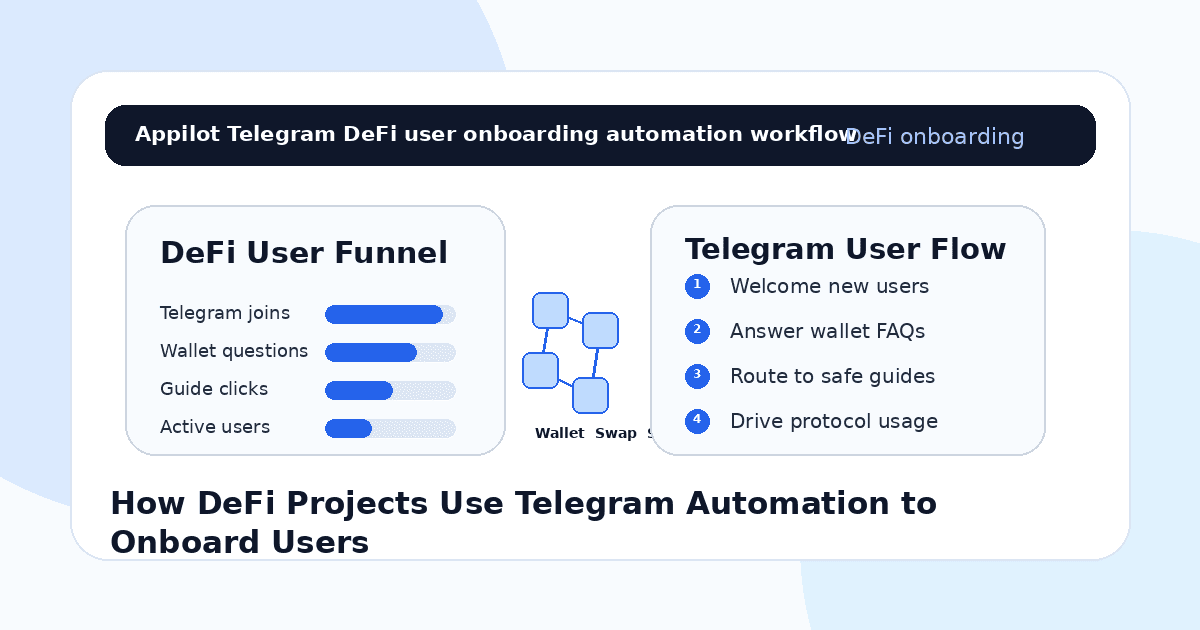
A new user joins your DeFi project’s Telegram group. They saw a Twitter/X thread, clicked through from a launch post, or heard about the protocol from a friend.
They enter the chat and immediately ask the same questions new users always ask. Where is the official app link? Which wallet works? Is the contract address verified? How do they bridge funds? Where are the docs? Is there a staking guide? Is this the real group?
If the team is online, they may get help quickly. If not, the user may leave, make a mistake, or fall for a scam link somewhere else.
That is why Telegram automation matters for DeFi projects. It helps new users find official information, understand the protocol, avoid unsafe links, and move toward real product usage without waiting for a moderator to answer every repeated question manually.
The goal is not to replace community managers. The goal is to make onboarding safer, faster, and more consistent.
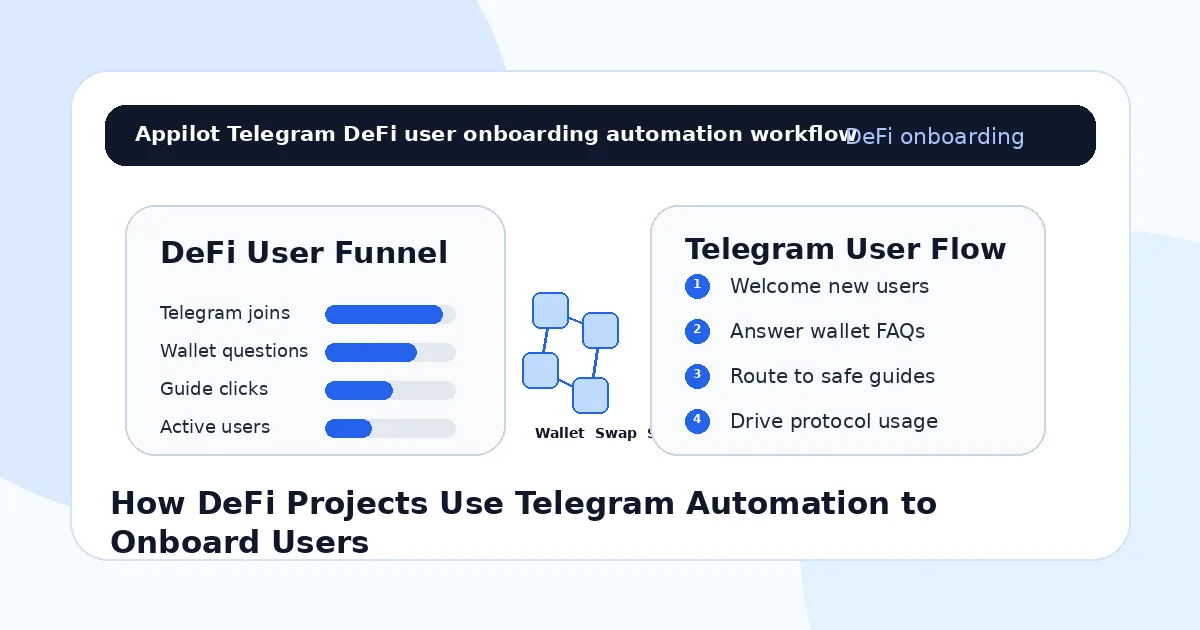
Why Telegram Matters for DeFi User Onboarding
Telegram is one of the most common support and community channels for DeFi projects because it is fast, public, and easy for users to join.
People use it to ask about wallets, contracts, swaps, staking, liquidity pools, airdrops, governance, bridge steps, claims, gas fees, audits, and troubleshooting. During launches or market events, these questions can arrive every few seconds.
That makes Telegram useful, but also risky.
A messy Telegram group can confuse new users. If official links are buried, users may click fake links. If repeated questions go unanswered, users may assume the project is inactive. If moderators are overwhelmed, real onboarding suffers.
Automation helps create structure inside the speed of Telegram.
What Telegram Automation Means for DeFi Projects
Telegram automation means using bots and workflows to handle repeated community actions. For DeFi projects, that can include welcome messages, official link menus, FAQ replies, wallet setup guidance, command-based help, support ticket routing, anti-spam protection, scam warnings, announcement reminders, and user segmentation.
Automation works best when it handles general, repeatable information while humans handle sensitive questions.
A platform like Appilot can fit into the wider DeFi onboarding system by helping teams connect Telegram with social automation across Twitter/X, Discord, Reddit, Instagram, and TikTok. Appilot runs workflows through Android devices or emulators from a browser dashboard, without coding, ADB setup, or manual device handling. That means DeFi teams can manage social discovery and repeated community touchpoints more consistently while Telegram bots organize the first user experience inside the group.
Telegram becomes the support and onboarding layer. Social platforms bring attention in. Automation helps users move safely from curiosity to product usage.
Step 1: Welcome Users With Official Links
The first message a new user sees should reduce confusion.
A Telegram bot can welcome new members, explain the project briefly, and show official links for the app, docs, contract address, bridge guide, audits, announcements, Discord, Twitter/X, and support.
This matters because DeFi users are constantly exposed to fake links, impersonators, and scam groups. A pinned message helps, but a welcome flow makes the safe path clearer from the beginning.
The welcome message should be short. It should not overwhelm the user with a wall of text. It should point them to the most important starting points and remind them that admins will never ask for seed phrases or private keys.
A safe first impression is part of onboarding.
Step 2: Automate the Most Common DeFi Questions
New DeFi users often ask the same questions.
They ask how to connect a wallet, which chain the protocol uses, where to find the official contract, how to bridge funds, how to swap, how to stake, how rewards work, how to claim, where to report bugs, and whether the project has been audited.
These questions are perfect for automation because they repeat constantly.
A Telegram bot can respond to commands like “/docs,” “/contract,” “/bridge,” “/stake,” “/claim,” “/fees,” or “/support.” It can also detect common keywords and point users toward the correct guide.
Keep the replies factual and official. Do not let the bot improvise sensitive financial or technical advice.
The best bot acts like a fast help desk, not a financial advisor.
Step 3: Route Users to Safe Guides Instead of Giving Risky Instructions
DeFi onboarding often involves wallet actions, transactions, bridges, swaps, staking, or claims.
These steps can be risky if users misunderstand them. A bot should not casually tell users what to do with their funds. Instead, it should route them to official step-by-step guides, documentation, and support channels.
For example, if a user asks how to stake, the bot can send the official staking guide and remind them to verify the URL. If a user asks about bridging, the bot can link to the official bridge guide and warn them to check chain selection carefully.
This is where Appilot fits naturally into the broader workflow. DeFi teams can use Appilot to manage social touchpoints across platforms while Telegram automation gives users safe, official onboarding paths once they enter the community.
Fast answers matter, but safe answers matter more.
Step 4: Use Automation for Anti-Scam Protection
DeFi Telegram groups are common targets for scammers.
Fake admins, phishing links, fake support accounts, fake airdrops, malicious wallet prompts, and impersonator groups can appear quickly. Automation can help reduce this risk.
Telegram bots can filter suspicious links, block spam, warn users about scams, remove repeated phishing messages, and remind users that admins will not DM first or ask for seed phrases.
Security reminders should appear in welcome flows, pinned messages, and support replies.
This is especially important during launches, airdrops, claims, token listings, or bridge events because scammers often target users when urgency is high.
Automation cannot eliminate scams completely, but it can reduce confusion and make official paths easier to follow.
Step 5: Segment Users by Need
Not every Telegram member needs the same information.
Some are new users trying to understand the protocol. Some are liquidity providers. Some are token holders. Some are developers. Some are governance participants. Some are looking for support. Some are only there for airdrops.
Automation can help segment users by intent.
A bot can ask new members what they need: “Learn the protocol,” “Use the app,” “Stake,” “Provide liquidity,” “Read docs,” “Join governance,” or “Get support.” Based on the response, it can send the right guide or channel.
This keeps the main chat cleaner and helps users move faster.
Good onboarding does not force every user through the same path. It gives them the next step that matches their intent.
Step 6: Create Support Tickets for Complex Issues
Some questions should not be handled in the public chat.
A user may have a stuck transaction, wallet connection issue, claim problem, missing role, bug report, or account-specific issue. Public chat can make these situations messy and risky.
Telegram automation can route these users into a support ticket or private support process.
The bot can collect basic information like chain, transaction hash, wallet type, error message, and issue category. Then a moderator or support team member can review it.
The bot should never ask for private keys, seed phrases, or sensitive wallet credentials.
A structured support flow makes the project look more professional and protects users from unsafe public troubleshooting.
Step 7: Connect Telegram With the Full DeFi Growth Funnel
Telegram should not sit alone.
Most DeFi projects bring users in from Twitter/X, Discord, Reddit, referral campaigns, ecosystem partnerships, influencer posts, docs, airdrops, and product pages. Telegram is where many of those users ask questions before taking action.
A strong onboarding system connects these channels.
Twitter/X explains the launch. Discord supports deeper community roles. Docs explain technical details. Telegram handles fast questions. The app turns users into active protocol participants.
Appilot can support the wider social layer by helping DeFi teams run workflows across Android devices or emulators, while Telegram automation organizes the user’s first questions and routes them to official resources.
The stronger the connection between channels, the smoother the onboarding experience feels.
Step 8: Track Onboarding Quality
Do not measure Telegram automation only by group size.
For DeFi projects, better metrics include welcome flow completion, official link clicks, docs visits, support tickets resolved, scam messages blocked, active users, app connections, staking participation, liquidity participation, governance activity, user retention, and repeated support questions.
If many users keep asking the same question, your docs or onboarding message may need improvement.
If many users click the bridge guide but do not complete the next step, the guide may be confusing. If support tickets spike after a launch, the product flow may need clearer instructions.
Automation gives you signals. The team still needs to improve the product and onboarding based on those signals.
Common Mistakes DeFi Projects Should Avoid
Sending Users to Unverified Links
DeFi users are at high risk of phishing. Automated flows should only share official, verified links controlled by the project.
Letting Bots Give Financial Advice
Bots should not tell users what to buy, stake, swap, bridge, or risk. They should share official information and guides.
Ignoring Scam Protection
A Telegram group without anti-spam and anti-phishing protection can quickly become unsafe for new users.
Overloading New Members
A giant welcome message can confuse users. Keep onboarding short, structured, and easy to follow.
Measuring Only Group Members
Telegram member count does not equal product adoption. Track app usage, support quality, retention, and active participation.
Is Telegram Automation Right for DeFi Projects?
Telegram automation is a good fit if your project has active users, repeated support questions, launch traffic, airdrops, staking, liquidity pools, wallet onboarding, or protocol documentation. It works especially well for DeFi protocols, wallets, bridges, DEXs, staking platforms, DAO tools, yield products, and Web3 infrastructure projects.
It may not be right if the project has no official documentation, weak security practices, or no support process. Automation can speed up onboarding, but it cannot fix unclear product flows or unsafe communication.
Think of Telegram automation as onboarding infrastructure. It helps users get oriented, but the product and team still need to earn trust.
Final Thoughts
DeFi projects use Telegram automation to onboard users by making official information easier to find, repeated questions easier to answer, and support safer to manage.
The strongest workflow starts with welcome messages, official links, FAQ commands, safe guide routing, scam protection, user segmentation, support tickets, and quality tracking. Automation handles repeated onboarding tasks while the team handles trust, product improvement, and complex support.
If you want to connect Telegram with wider social automation, Appilot gives DeFi teams a browser-based way to control Android devices, emulators, and ready-to-use bots for Telegram, Twitter/X, Discord, Reddit, Instagram, TikTok, and more. You can check it out at appilot.app.
FAQs
Q1: Can DeFi projects use Telegram automation for onboarding?
Yes, Telegram automation can welcome users, share official links, answer FAQs, route support, and guide users to safe docs.
Q2: What should DeFi teams automate first in Telegram?
Start with welcome messages, official links, FAQ commands, anti-scam warnings, support routing, and docs or app link delivery.
Q3: Is Telegram automation safe for DeFi communities?
It is safer when bots only share verified links, avoid financial advice, block scams, and route sensitive issues to humans.
Q4: Can Appilot help DeFi projects automate Telegram?
Yes, Appilot can support Telegram and wider social automation workflows across Android devices or emulators from a web dashboard.
Q5: Should Telegram bots give DeFi investment advice?
No. Bots should not give financial advice. They should share official resources, safety reminders, and support routing.