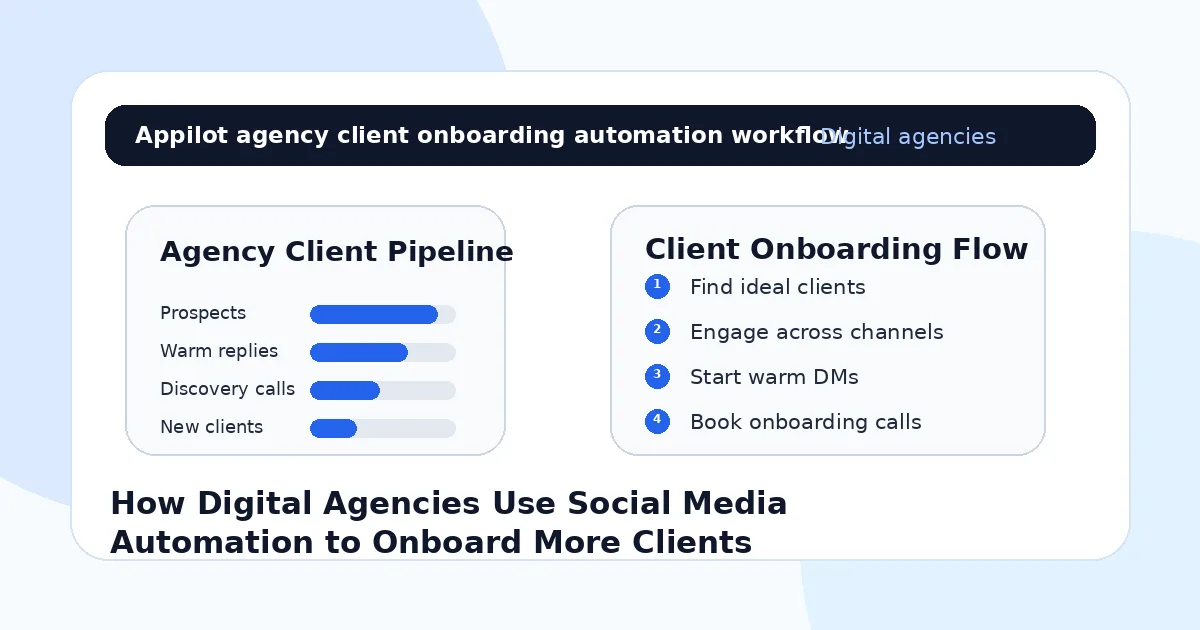
How Digital Agencies Use Social Media Automation to Onboard More Clients
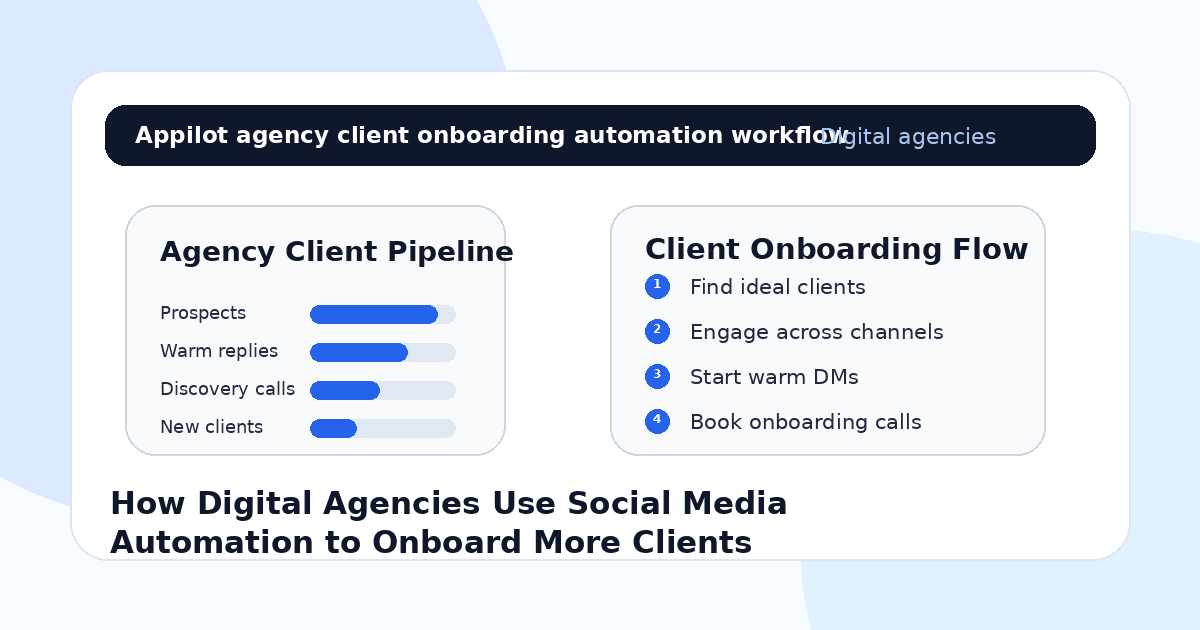
You run a digital agency, and your ideal clients are everywhere online. They are posting on Instagram, asking questions on LinkedIn, launching products on TikTok, sharing updates on Twitter/X, and looking for growth help without always saying it directly.
You know the opportunity is there.
But manually finding, engaging, messaging, qualifying, and onboarding those prospects takes time. Your team might send a few DMs one day, reply to posts the next, forget follow-ups during client work, and then wonder why the pipeline feels inconsistent.
That is where social media automation helps digital agencies. It turns scattered prospecting into a repeatable system for visibility, warm conversations, discovery calls, and client onboarding.
The goal is not to spam business owners. The goal is to show up consistently around the right prospects and move serious leads into a proper sales process.
Why Digital Agencies Struggle to Onboard Clients Consistently
Most digital agencies do not lose clients because they cannot deliver. They struggle because client acquisition happens in bursts.
When work is slow, the agency prospects hard. When client projects pick up, outreach stops. Then the pipeline dries up again, and the cycle repeats.
Social media makes this worse because every platform needs different attention. Instagram is strong for visual brands and local businesses. LinkedIn is better for B2B decision-makers. TikTok works for e-commerce, creators, and product-led brands. Twitter/X works for SaaS, founders, creators, and niche communities.
Trying to manually stay active everywhere can quickly become overwhelming.
The biggest mistake agencies make is treating social media as only a posting channel. Posting is useful, but most client conversations start from engagement. A prospect sees your reply, checks your profile, watches a case study, replies to a story, downloads a resource, or asks a question in DMs.
Automation helps agencies create more of those touchpoints without relying on random manual effort.
What Social Media Automation Means for Agencies
Social media automation means using software to handle repeated actions like profile visits, story views, connection requests, comment replies, follow-ups, DMs, lead routing, and campaign monitoring.
For digital agencies, automation can support prospecting across Instagram, LinkedIn, Twitter/X, TikTok, Reddit, Discord, and other platforms depending on the client niche.
The safest and most practical approach is real-device automation, where actions run through Android devices or emulators instead of fragile desktop scripts or risky API shortcuts. This matters because many social platforms are mobile-first, and real-device workflows often feel closer to normal app usage.
A platform like Appilot is built for this kind of setup. It lets agencies run automation on Android devices and emulators from a browser dashboard, without coding, ADB setup, or keeping a laptop connected all day. That makes it easier to manage prospecting and engagement workflows while the agency team focuses on strategy, sales calls, proposals, and delivery.
Automation should create more qualified conversations. It should not replace the relationship-building that closes clients.
Step 1: Define the Agency’s Ideal Client Before Automating
Before running any automation, the agency needs a clear ideal client profile.
A vague target like “small businesses” or “brands that need marketing” is too broad. A stronger target is “Shopify stores doing consistent sales but weak retention,” “fitness studios that rely on Instagram leads,” “SaaS startups with low demo volume,” or “local service businesses with strong reviews but weak social content.”
This matters because automation magnifies your targeting.
If the agency targets broadly, the bot only helps reach more bad-fit prospects faster. If the agency targets sharply, automation helps more ideal prospects discover the agency.
Start with the niche, platform behavior, pain point, offer fit, budget range, buying trigger, and decision-maker. Then build the automation workflow around that specific audience.
Good onboarding starts with good targeting.
Step 2: Use Platform-Specific Automation
Every social platform has a different role in agency growth.
Instagram works well for e-commerce brands, coaches, consultants, local businesses, creators, fitness studios, beauty clinics, restaurants, and event promoters. Agencies can use Instagram automation for story views, comment replies, targeted profile engagement, DM flows, and lead magnet delivery.
LinkedIn is better for B2B clients, SaaS companies, recruiters, consultants, founders, and professional service buyers. Agencies can use LinkedIn automation for connection requests, profile visits, follow-ups, and sales conversations.
Twitter/X works well for SaaS, founders, creators, tech communities, agencies, and thought leadership. Automation can help find relevant conversations, reply with useful insight, and drive profile visits.
TikTok can support product-led brands, dropshippers, Amazon sellers, musicians, creators, and trend-driven businesses. Automation can help with discovery, engagement, comment monitoring, and creator-style campaign support.
Appilot fits naturally here because it gives agencies one dashboard to run mobile-first workflows across different social platforms on Android devices or emulators. Instead of juggling manual device work, scripts, or platform-specific tools, the agency can manage repeated actions from one place.
The strategy should still be platform-specific. The automation layer simply makes execution easier.
Step 3: Warm Up Prospects Before the First Message
Cold outreach works better when the prospect has seen you before.
For agencies, that might mean viewing a story, liking a relevant post, leaving a useful comment, connecting on LinkedIn, replying to a public thread, or engaging with a business owner’s recent content before sending a DM.
This warm-up step matters because social platforms are personal. A message from a familiar profile feels less random than a pitch from someone who appeared out of nowhere.
Automation can support this carefully. It can help with profile visits, story views, light engagement, and follow-up actions around a targeted prospect list.
For example, an agency targeting Shopify brands might engage with posts about new product drops, comment on launch content, and then send a short message about improving conversion from social traffic. An agency targeting SaaS founders might reply to Twitter/X threads about growth problems before inviting a deeper conversation.
The goal is to create recognition before asking for attention.
Step 4: Use DMs to Start Conversations, Not Pitch Services Immediately
A good agency DM should not feel like a full sales page.
The first message should be short, relevant, and easy to answer. It should connect to something visible about the prospect’s business.
For example, instead of saying, “We help brands grow with digital marketing services,” a better message might say, “Saw you’re getting strong comments on your product reels. Are most of those people converting through DMs or your product page right now?”
That starts a conversation.
For a B2B prospect, the message might be, “Noticed your team is posting a lot around outbound growth. Are you mainly trying to improve reply rates or book more demos right now?”
These messages work because they are tied to a real business problem.
Appilot can help agencies manage these repeated outreach workflows without coding or ADB setup, but the message quality still comes from the agency. Automation sends the message. Strategy earns the reply.
Step 5: Qualify Leads Before Booking Calls
Not every interested reply should become a sales call.
Some prospects are curious but not ready. Some have no budget. Some need a smaller service than your agency offers. Some are not decision-makers. Some may be perfect-fit clients.
Qualify gently before pushing the calendar link.
Ask what they are currently doing, what is not working, what they want to improve, how urgent the problem is, and whether they have tried solving it before.
For example, a social media agency might ask, “Are you mainly trying to increase content output, improve lead quality, or turn more DMs into calls?” A paid ads agency might ask, “Are you already running ads, or are you still relying mostly on organic traffic?”
These questions keep the sales process cleaner.
Automation can help start the conversation, but human judgment should handle qualification.
Step 6: Turn Warm Leads Into Onboarded Clients
Once a lead is qualified, move them into a structured onboarding path.
That might include a discovery call, audit, proposal, onboarding form, kickoff meeting, asset collection, account access, strategy document, and first campaign plan.
This is where many agencies lose momentum. They create interest but do not have a clean next step. The prospect asks for details, and the agency responds slowly or sends scattered information.
A strong onboarding workflow should be simple. After a good DM conversation, send the next step clearly. If it is a call, send the booking link. If it is an audit, explain what you need. If it is a proposal, set expectations.
Automation can help route leads and send basic next steps, but the final onboarding experience should feel personal and professional.
The prospect should feel like they are entering a system, not chasing a freelancer.
Step 7: Track the Right Metrics
Social media automation should not be judged only by follower growth, views, or message volume.
For agencies, the important metrics are qualified replies, discovery calls booked, show-up rate, proposals sent, clients closed, revenue generated, and time saved by the team.
You should also track which platform produces the best clients. Instagram might bring more local business leads. LinkedIn might bring higher-ticket B2B clients. Twitter/X might bring founder-led SaaS clients. TikTok might bring product or creator clients.
This helps the agency decide where to scale.
More automation is not always better. Better targeting, stronger messaging, and cleaner follow-up usually matter more.
Common Mistakes Digital Agencies Should Avoid
Targeting Too Broadly
Broad outreach creates weak leads. Focus on specific niches, business models, platforms, and pain points where your agency has a clear advantage.
Sending Generic DMs
Messages that sound like copy-paste pitches get ignored. Tie your outreach to something specific about the prospect’s business.
Automating Without a Strong Profile
If your agency profile does not show proof, positioning, case studies, or a clear offer, more traffic will not convert.
Pushing Calls Too Early
A calendar link before relevance can feel lazy. Start a useful conversation first, then suggest a call when the fit is clear.
Ignoring the Onboarding System
Getting replies is only the first step. Agencies need a clean path from DM to discovery call, proposal, kickoff, and client delivery.
Is Social Media Automation Right for Digital Agencies?
Social media automation is a good fit if your agency has a clear niche, a repeatable offer, and prospects who are active on social platforms. It works especially well for agencies serving e-commerce brands, SaaS companies, local businesses, creators, coaches, consultants, event promoters, and B2B companies.
It may not be right if your offer is unclear, your profile has no proof, or your team cannot handle replies quickly. Automation can create more conversations, but it cannot fix weak positioning or poor sales follow-up.
Think of automation as a client acquisition assistant. It keeps activity consistent, but your strategy, proof, and sales process close the deal.
Final Thoughts
Digital agencies use social media automation to make client acquisition more predictable.
The best workflow starts with sharp targeting, then uses platform-specific engagement, warm DMs, lead qualification, and a clean onboarding process. Automation handles the repetitive actions, while the agency team handles trust, strategy, and closing.
If you want to run social media automation without coding, ADB setup, or manual device management, Appilot gives digital agencies a browser-based way to control Android devices, emulators, and ready-to-use bots for Instagram, LinkedIn, Twitter/X, TikTok, Reddit, Discord, and more. You can check it out at appilot.app.
FAQs
Q1: Can social media automation help agencies get more clients?
Yes, it can help agencies find prospects, create visibility, start warm conversations, qualify leads, and book more discovery calls.
Q2: Which platforms should digital agencies automate first?
Start with the platforms where your ideal clients are active, such as Instagram for consumer brands, LinkedIn for B2B, and Twitter/X for founders.
Q3: Is social media automation safe for agencies?
It is safer when activity is targeted, gradual, and relevant. Spam-style DMs or aggressive actions can still damage trust and account health.
Q4: Can Appilot help agencies automate social media outreach?
Yes, Appilot can run automation across Android devices or emulators from a browser dashboard without coding or ADB setup.
Q5: Does automation replace agency sales work?
No. Automation supports prospecting and follow-up, but agencies still need human qualification, discovery calls, proposals, and onboarding.