How Dropshippers Use TikTok Bots to Find Winning Products Faster
You find a product on TikTok at midnight. The comments are full of people asking, “Where can I buy this?” The video has strong views, the demo is simple, and the product looks like something you could test quickly.
Then you search AliExpress, check a few competitors, look at comments, scroll through more videos, save a few creators, and suddenly two hours are gone.
That is the daily reality for a lot of dropshippers. Product research is not hard because there are no products. It is hard because there are too many signals and not enough time to check them properly.
TikTok moves fast. A product can look boring on Monday, start appearing in short demo videos on Wednesday, and become saturated by the weekend. If you are still researching manually, you are already behind the people using faster discovery systems.
TikTok bots do not replace product judgment. But they can help dropshippers collect trend signals faster, monitor more niches, and spot potential winners before they become obvious.
Why Dropshippers Struggle With Product Research on TikTok
Most dropshippers are not short on product ideas. They are short on clean, repeatable research time.
You might check hashtags like #TikTokMadeMeBuyIt, #AmazonFinds, #GadgetTok, #BeautyFinds, or #HomeHacks. Then you open creator profiles, scan comments, look for buyer intent, compare engagement, and try to guess whether a product is early, peaking, or already dead.
That is a lot to do manually.
The bigger problem is that TikTok product research is messy. View count alone does not mean a product will sell. A video can go viral because it is funny, strange, controversial, or visually satisfying. That does not always translate into purchase intent.
What matters more is the pattern around the product. Are people asking where to buy it? Are multiple creators posting similar demos? Are comments mentioning price, shipping, color, size, or availability? Are saves and shares strong compared to likes?
Most beginners get this wrong. They chase one viral video instead of tracking repeated signals across a niche.
That is where automation starts to help.
What TikTok Bots Do for Dropshipping Research
A TikTok bot can automate repetitive discovery tasks that dropshippers normally do by hand. It can visit profiles, watch niche videos, track hashtags, collect engagement signals, monitor competitor accounts, and surface product patterns faster than manual scrolling.
The safest approach is real-device automation. That means the bot runs TikTok through an actual Android device or emulator instead of hammering unofficial APIs or browser scripts. It behaves more like a real mobile user because it is interacting with the real app interface.
A platform like Appilot is built around this kind of workflow. Instead of keeping a phone connected with ADB or running fragile desktop scripts, Appilot lets you control Android devices and emulators through a web dashboard. For dropshippers, that means the research process can keep moving while you focus on supplier checks, landing pages, creatives, and test campaigns.
The goal is not to let a bot “choose” products blindly. The goal is to let automation collect the boring signals so you can make better decisions faster.
How Dropshippers Use TikTok Bots in Practice
The first use case is hashtag monitoring. A dropshipper can track product-heavy hashtags in beauty, gadgets, home improvement, fitness, pet products, kitchen tools, or fashion accessories. Manually, this means scrolling for hours and saving videos one by one. With automation, the bot can repeatedly scan the same niche areas and help you notice which products keep appearing.
The second use case is competitor tracking. If three or four dropshipping stores are already testing a product, their TikTok pages can tell you a lot. You can watch which videos they post, which hooks they use, what comments they receive, and whether engagement is growing or fading. A bot can help monitor these accounts more consistently than checking them manually every few days.
The third use case is comment signal collection. This is often where the real gold is. A product video with comments like “Need this,” “Where do I buy it,” “Does it ship to Canada,” or “I saw this on Amazon” is more interesting than a video with generic laughs and reactions. Those comments show buyer curiosity.
Appilot’s TikTok automation can fit into this workflow by helping dropshippers run repetitive TikTok actions from Android devices or emulators without coding. You can use it as the operating layer for research workflows, while your actual product decision still depends on demand, margin, shipping time, creative quality, and competition.
The fourth use case is niche testing. Instead of guessing whether a product belongs in fitness, home decor, parenting, or travel, you can monitor how different audiences respond to similar products. A portable blender might perform differently under fitness content than under kitchen hacks. A posture corrector might get attention in office-worker content but not in general health content.
This is what makes TikTok product research different from old-school product hunting. You are not only looking for a product. You are looking for the angle that makes people stop scrolling.
What Makes a TikTok Product Signal Worth Taking Seriously?
A strong product signal usually appears more than once. One viral video is interesting, but repeated videos from different creators are much stronger.
The comments should show buying intent, not just entertainment. A product that makes people ask practical questions is usually more valuable than one that only gets reactions.
The product should be easy to explain in three seconds. TikTok is not friendly to complicated offers. If the demo makes the benefit obvious without a long explanation, the product has a better chance.
The product should also have room for margin. Some dropshippers find exciting products and then realize the supplier cost, shipping time, refund risk, or ad cost makes the offer weak. A bot can help discover products faster, but it cannot fix bad unit economics.
A useful rule is simple: do not treat TikTok engagement as proof. Treat it as a lead. Then validate it with supplier checks, competitor research, landing page testing, and small-budget creative tests.
Setting Up a TikTok Bot Workflow for Dropshipping
Start with one niche instead of trying to monitor everything. Beauty, pet accessories, home gadgets, phone accessories, fitness tools, and kitchen products all behave differently. If you track too many categories at once, your research gets noisy.
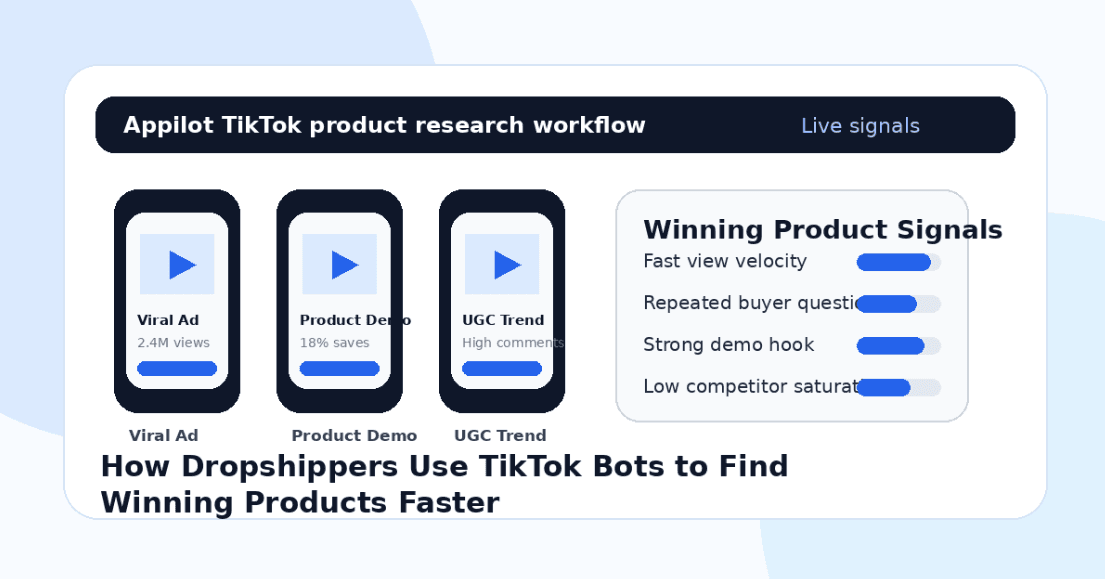
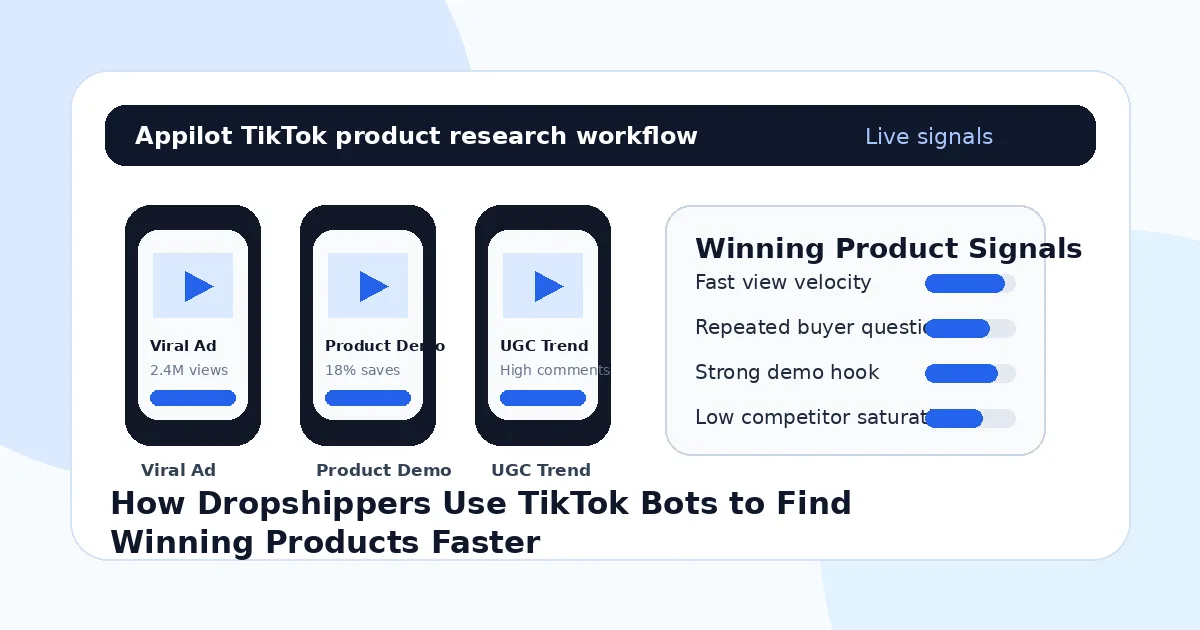
Next, choose the signals you want to monitor. For dropshipping, the most useful signals are repeated product appearances, fast view growth, buyer-style comments, creator duplication, strong demo hooks, and signs of low saturation.
Then set up your Android device or emulator environment. Real-device automation is often more stable for social app behavior, especially when you are running repeated actions over time.
This is where Appilot can make the setup easier. Its dashboard lets you manage mobile automation without needing ADB, terminal commands, or a laptop running all day. For a dropshipper who wants to move quickly from research to testing, that saves time.
After setup, keep your limits conservative. You are researching, not trying to spam TikTok. The bot should help you observe, collect, and organize signals. It should not behave like a reckless engagement machine.
Finally, review results daily. A bot can collect more data, but you still need judgment. The best dropshippers combine automation with taste, pattern recognition, and fast testing.
Common Mistakes Dropshippers Make With TikTok Bots
Chasing Viral Views Without Buyer Intent
A million views does not automatically mean a winning product. If the comments are mostly jokes, arguments, or reactions, the product may not convert. Look for practical purchase questions instead.
Copying Saturated Products Too Late
By the time every dropshipping page is posting the same product, the easy window may already be gone. Automation should help you find early patterns, not just confirm what everyone else has already seen.
Ignoring the Creative Angle
The same product can fail or win depending on the hook. A cleaning tool might work as a satisfying demo, a problem-solution video, or a messy-before-clean-after clip. Product research and creative research should happen together.
Running Bots Too Aggressively
Too much activity too quickly can make accounts look unnatural. Slow, consistent research behavior is better than trying to scan the entire platform overnight.
Skipping Supplier Validation
TikTok can show demand, but it does not confirm shipping time, product quality, refund risk, or margin. A product is not a winner until the numbers and fulfillment make sense.
Is TikTok Bot Research Right for Dropshippers?
TikTok bot research is a good fit if you already understand basic dropshipping validation and want to speed up the discovery process. It helps most when you have clear niches, know what buyer intent looks like, and can test products quickly.
It may not be useful if you expect automation to find guaranteed winners without human review. No bot can tell you with certainty that a product will sell. It can only help you see patterns faster.
The best use of TikTok bots is simple: let automation widen your research net, then use your own judgment to decide what deserves testing.
Final Thoughts
Dropshipping product research is a timing game. The faster you find real demand signals, the faster you can test products before the market gets crowded.
TikTok bots help by turning manual scrolling into a more repeatable research system. They can monitor niches, track competitor activity, collect engagement signals, and help you shortlist products with more confidence.
If you want to build this kind of workflow without coding or managing Android automation manually, Appilot has ready-to-use bots for TikTok, Instagram, and other platforms through a web dashboard. You can check it out at appilot.app.
FAQs
Q1: Can TikTok bots find winning dropshipping products automatically?
They can help find product signals faster, but they cannot guarantee winners. You still need to validate demand, margin, shipping, and creative quality.
Q2: What TikTok signals matter most for dropshipping?
Buyer-style comments, repeated creator posts, fast view growth, strong demo hooks, and low saturation matter more than views alone.
Q3: Are TikTok bots safe for product research?
They can be safer when run through real-device automation with conservative limits. Aggressive activity or low-quality setups can still create account risk.
Q4: Do dropshippers need coding skills to use TikTok bots?
Not always. Tools like Appilot let users run TikTok automation from a web dashboard without writing scripts or setting up ADB manually.
Q5: How fast can a dropshipper find products with TikTok automation?
Automation can surface signals daily instead of after hours of manual scrolling. The actual testing timeline depends on supplier checks, creatives, and store setup.